A copyright protection service, not a one-off takedown
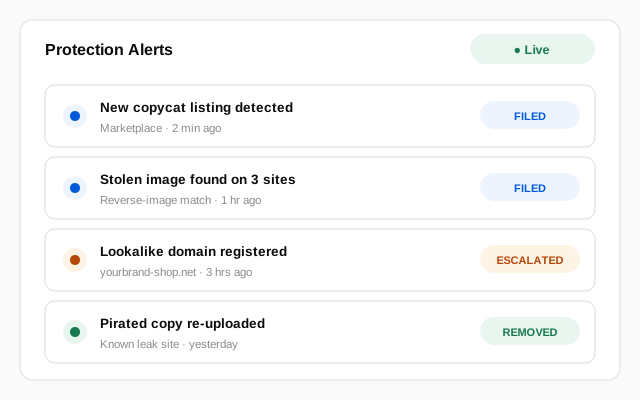
A single DMCA notice fixes a single URL, once. A copyright protection service watches everything you own, files at scale the moment copies appear, and escalates the infringers who keep coming back.
What we remove
- Continuous monitoring across web, marketplaces and platforms
- DMCA filing at scale, tracked to resolution
- Search de-indexing of infringing pages
- Repeat-infringer identification and escalation
- Host, registrar and payment-processor pressure
- Monthly reporting on every filing and outcome
How it works
What clients say

Luke Betts
Neutonic · Brand Protection
"Highly recommend Frankie and his team. Having tried various avenues to get pirated content taken down online all with little to no success."

Laurence Thomas
Hey Ewe · Brand Protection
"We had content copied and put online. A couple of other removal companies tried and were unsuccessful, Content Removal got it taken down very, very quickly. Can't recommend them enough;"

Alan Graves
DoNotAge.org · Brand Protection
"We were dealing with fake websites, ads & social media pages that copied our brand and were duping customers, costing us revenue. It was damaging our reputation."
Why one-off DMCA takedowns stop working
The first time your work is stolen, a single takedown notice feels like the answer, and for a single infringement, it is. But ownership of anything valuable makes infringement a recurring event, and the one-off model collapses under recurrence. You only file against copies you happen to find, weeks or months after they start costing you. Each notice is its own project: identify the host, locate the agent, draft, file, chase, and the infringer's cost is nearly zero. They re-upload under a new URL and you start over, later and more tired.
The infringers understand this asymmetry perfectly. Serial operations count on rights holders burning out. The answer isn't filing harder; it's changing the structure, from reactive notices to a standing program built to outlast the infringers' patience.
Protection as a program: monitor, file, escalate
Monitoring comes first. We fingerprint your catalogue (text, imagery, video, audio, product files) and sweep continuously across the open web, marketplaces, video platforms, file hosts and search results. New copies get caught in days, when removal means one filing instead of a cleanup campaign. Every detection passes through human verification, filtering out licensed uses, fair-use commentary and false matches before anything is filed.
Filing then runs at scale with craft intact: notices to hosts and platforms simultaneously, de-indexing requests to Google for pages that won't die at the source, and locker-level removals that kill files rather than links. Every notice is tracked to an outcome (honored, ignored or rejected) and ignored is a status we act on, not a dead end.
Escalation is the layer that changes infringer behavior. Our tracking links infringements across URLs, aliases and hosts to reveal repeat operators, and repeaters get treated structurally: repeat-infringer policy complaints that threaten their platform accounts, registrar and hosting escalation, and pressure on the ad networks and payment processors monetising the theft. When a case warrants legal action, the evidence file we've built hands your counsel a running start. We're removal specialists, not a law firm, and the handoff is designed for that.
De-indexing deserves particular emphasis because it's the great equaliser: a pirate host in a non-cooperative jurisdiction can ignore your notices forever, but it cannot make Google keep sending it traffic. For sites beyond the reach of process, removal from search is functionally removal.
What it costs you to wait
The service fits any rights holder whose catalogue has outgrown manual enforcement: course creators and education businesses, photographers and stock libraries, publishers and newsletters, software and game studios, video and music producers, and brands whose product imagery feeds counterfeit listings. The common thread is volume: enough works, and enough infringement, that protection has to be systematic to be real. Plans are scoped to catalogue size and infringement pressure, and every plan includes the same monthly accounting: works monitored, detections verified, notices filed, outcomes achieved, repeat offenders under escalation.
Infringement compounds quietly: copies get mirrored, scraped copies rank, and buyers who found the free version never tell you. Rights holders who move from reactive filing to continuous protection consistently find more infringement than they expected, because they'd only ever seen the copies that got lucky enough to be noticed. Book a free Exposure Scan and we'll sweep for your work across the surfaces that matter, show you what's actually out there, and scope the Protection Plan that fits your catalogue.
Frequently asked questions
How is this different from your DMCA takedown service? +
What volume of filings can you actually handle? +
Do repeat infringers actually stop? +
Start with a free, confidential Exposure Scan
We'll scan your digital footprint, show you exactly what's exposed, and recommend the fastest path to remove it, or tell you honestly if you don't need us.
Book Your Assessment