A trading educator, two scam-review pages, and the attack blog that followed
A UK trading educator with a paid programme was named on two long-form "scam" review pages, then a complaint board, then Reddit, then a purpose-built WordPress blog, then an affiliate review site. Over four years the same lesson repeated: the route that works is rarely the obvious one.
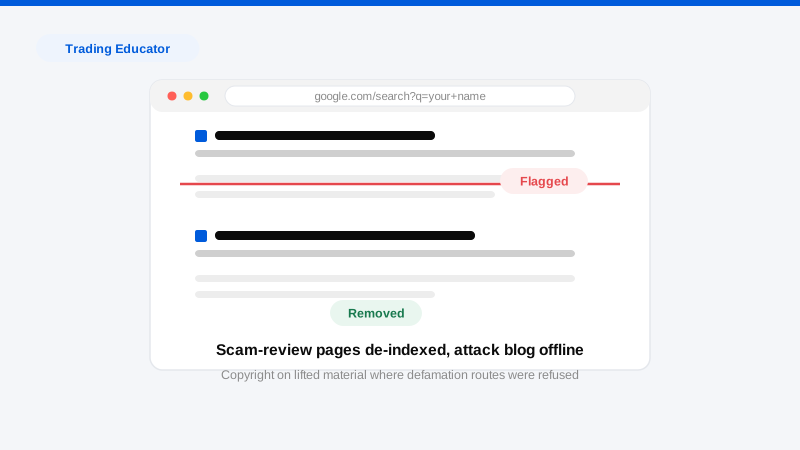
scam-review pages de-indexed from Google worldwide
the attack blog after platform refusals on every other ground
The situation
The educator first wrote to us in late 2022 about a single page. It was a long "review" on a site that publishes near-identical pages about trading educators, framing his programme and him personally as a scam. A second site carried a similar page. We told him honestly that it was a fifty-fifty case and scoped it under our success-based structure.
Over the following years the stack grew the way it does for educators in this market: a listing on a forex complaint board, Reddit threads in trading subreddits, a dedicated X handle, an affiliate review blog running a write-up of his newer course with lifted imagery, more than ten Facebook photo albums reproducing his course artwork with links to pirated full copies, two piracy sites hosting the course, and in 2025 a single-page WordPress blog combining fraud and regulator allegations with claims about his property, movements and personal history.
That progression is worth sitting with, because it is the ordinary life cycle rather than an unusually bad case. One page ranks. Other operators in the same niche see that the name has search demand and write their own version. Communities pick the story up. Somebody with a grievance builds a site of their own. Each layer is easier to create than the last, because the earlier layers supply the material.
Why scam-review pages rank so well for an educator's name
Pages of this kind are built to rank, not to inform. The title carries the educator's name next to the word scam, which is close to the exact phrase a prospective student types when they are checking somebody out. The body is long, the page is updated, and the site publishing it has dozens of similar pages about similar people, so the whole domain accumulates authority on the topic of trading education.
They also sit in a category search engines are reluctant to touch. Criticism and consumer opinion are exactly the material that removal policies are written to protect, and a reviewer reading a long article full of hedged language will usually classify it as opinion rather than as anything actionable. That is why complaints framed around unfairness are refused far more often than they succeed.
The demand side makes it worse. Anyone selling a paid programme is searched by every serious prospect, and the searcher is specifically looking for the negative result. A single page in the first few results is read by a large share of the people who were about to buy. That is the harm, and it is why educators keep coming back to the problem years after the page was written.
What was refused
Google declined to de-index the forex complaint board on criticism grounds and later declined a 2026 Reddit post. Reddit's trust and safety team did not respond substantively to three harassment reports. The WordPress host refused twice, stating that it does not adjudicate defamation and pointing to a court order. Meta repeatedly challenged our authority to act until the client executed a signed authorisation, which Google later required as well.
None of those refusals were unreasonable from the recipient's point of view, and understanding why is the difference between a wasted year and a working strategy. A host is not a court. It has no way to decide whether an allegation is true, and it is not going to try. When it says it will move on a court order, it is describing the only evidence it considers conclusive. Pressing the same argument again against the same policy does not improve the odds.
What worked
Not the argument he expected. The review pages, the affiliate blog and the attack blog were all built out of the client's own photographs, course artwork, slides and screenshots, and that ownership gave us a ground the recipients could not refuse. Both primary review pages were de-indexed globally in July 2023, after months of casework over jurisdiction. When the WordPress host refused in late 2025, we found a different ground and the attack blog URLs returned 404 by mid December. The affiliate review page was de-indexed globally in May 2026. Some Facebook albums were removed by Meta, and eight remaining album URLs were substantiated in September 2026.
The practical consequence is that attack material built out of the target's own assets is far more vulnerable than it looks. Whoever wrote the attack blog needed pictures of the educator, and the only pictures available were his.
Why the obvious argument was not the one that worked
Defamation and platform-harassment arguments ask a recipient to decide whether an allegation is true, or whether hostile commentary about a business crosses a line written for targeted abuse of an individual. Hosts and platforms will not decide either question, which is why those arguments are refused far more often than they succeed against this kind of content.
What finally moved the stack was a question the recipient could answer from documents rather than from opinion. That is the whole difference, and it is why the unglamorous ground is repeatedly the one that works while the obvious one is repeatedly refused.
How the client worked with us
Short, direct emails: a link, one line on the harm, everything else delegated. He forwarded platform correspondence as it arrived and signed authorisations on request. Each engagement was scoped per link under our success-based structure, growing from a single link in 2023 to a substantial engagement in 2026. Unresolved items were named as unresolved in every update.
Common mistakes that make it harder
Paying the operator is the expensive one. Payment marks you as a target who pays, and the page typically returns, sometimes on a second domain. Arguing in the comments, or having your students argue there, is the next, because engagement is what keeps the page alive and ranking.
Losing your own record of the page is quieter and just as costly. Operators edit pages the moment they sense interest, and a matter built on material you can no longer produce is much weaker than one built on material you can.
Firing off do-it-yourself reports first is the one almost nobody expects. A refused report is recorded against the URL and makes the properly built application that follows harder to get reviewed on its merits. If you have already done it, say so at the start rather than letting it surface later.
Who makes first contact and what the 15-minute call covers
Educators in this market usually make contact themselves, often late at night, with one link and a short line about what it is costing them. Sometimes it is a business partner, a marketing lead or a lawyer. Either way the call is the same and it is short.
On the 15-minute call we ask what is on the page, what of it is yours, who else has been contacted, whether anything has been reported already, and what has been said publicly. Then we say what we think the odds are before any money is discussed. This client was told at the outset that his first matter was fifty-fifty, and he was told it in writing.
You leave with a free Exposure Scan: a written, link-by-link picture of what is visible for your name, which for educators is usually wider than the one or two pages that prompted the call. It is yours to keep either way. Confidentiality and an NDA are standard, and we work alongside your lawyer, your PR adviser and your compliance team rather than around them.
What this shows trading and financial educators
Defamation and platform-harassment arguments are refused far more often than they succeed against this content. The material the client owned took a whole attack blog offline and de-indexed two review pages worldwide. The other half of the lesson is scoping: a firm that tells you a case is fifty-fifty before you pay, and names what is still live afterwards, is the one worth keeping for four years.
The second lesson is about time horizon. This was not one job. It was repeat engagements from March 2023 to July 2026, because in this market the stack keeps growing while the business does. Treating it as a standing programme is what made each later matter faster than the one before it.
The third is honesty about what is still there. The forex complaint board listing, one 2026 Reddit post and some Facebook albums were open at the end of this period, and they were reported as open every time rather than buried in a summary.
If your name is attached to a "scam" page, read our page for trading educators or book the free Exposure Scan.
Facing something similar?
This case was handled through our Scam-review and attack site removal service.
Start with a free, confidential Exposure Scan
We'll scan your digital footprint, show you exactly what's exposed, and recommend the fastest path to remove it, or tell you honestly if you don't need us.
Book Your Assessment