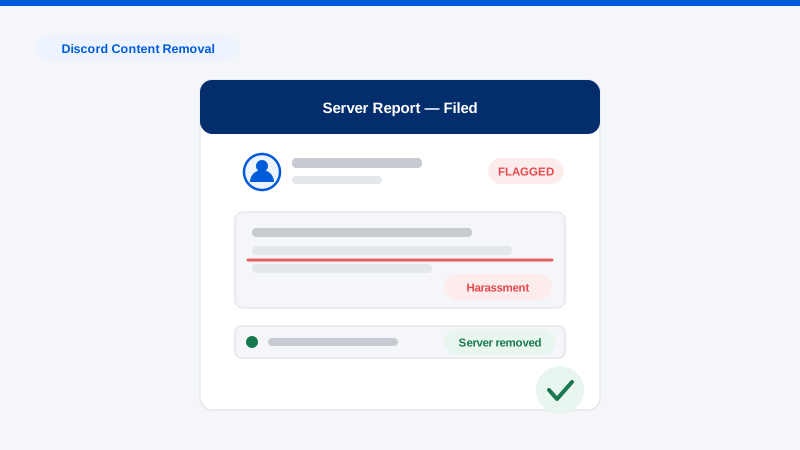
Discord removes harassing content, leaked private messages, doxxing, and entire servers through its Trust & Safety reporting system, and unlike most platforms, Discord genuinely does take down whole servers when a pattern of violation is documented. The difficulty is different: Discord’s harm happens inside semi-private communities you often cannot see, spreads by screenshot and re-invite, and regenerates when a banned server’s members migrate to a new one within hours. Effective removal on Discord is therefore about evidence quality and pattern documentation more than persistence with the report button. This page covers what qualifies, how to report so Trust & Safety can actually act, and how our content removal team escalates when reports stall, with our companion guides on what to do if your private Discord messages are leaked and what to do if your private Discord server messages are leaked covering the leak scenario in depth.
What qualifies for removal on Discord?
Harassment servers and channels. Communities organized around targeting a person (mocking, stalking, coordinating pile-ons) violate Discord’s Community Guidelines at the server level. Documented properly, these are removable in their entirety, not message by message.
Doxxing. Posting your address, phone number, workplace, family details, or documents is a bright-line violation Discord enforces quickly. If the same material is spreading beyond Discord, our doxxing removal practice runs the cross-platform sweep.
Leaked DMs and private server messages. Screenshots of your private conversations shared to shame, defame, or extort you can violate harassment policy, context decides. The report succeeds when it shows the sharing is targeted harm rather than commentary; our two Discord leak guides linked above walk through that framing in detail.
Non-consensual intimate imagery and sextortion. NCII is a priority category with fast enforcement, and threats to publish are reportable as extortion in addition to being crimes. Parallel steps (StopNCII hashing, sextortion help protocols) apply exactly as they do elsewhere.
Impersonation. Accounts and servers posing as you, your brand, or your community, common in crypto and creator scams, violate policy and come down with identity evidence.
What has no removal path: criticism in servers you dislike, arguments you lost, and lawful content in communities you simply find hostile. Discord will not referee disputes, and neither route improves by pretending otherwise.
How to report content on Discord, step by step
- Capture evidence like an investigator. Discord enforcement runs on specifics: copy message links (right-click → Copy Message Link), record user IDs and server IDs (enable Developer Mode to copy them), and screenshot messages with usernames and timestamps visible. Deleted messages are gone for reporting purposes, capture before you confront anyone.
- Report in-app first. Right-click a message → Report Message routes it to Trust & Safety with its metadata attached. Report multiple messages to establish pattern; a single rude message reads as a dispute, twelve coordinated ones read as a campaign.
- File a full report through Discord’s support form for server-level problems: submit the server ID, the responsible user IDs, message links, and a tight narrative mapping the evidence to specific Community Guidelines. This is the filing that takes down servers, quality here decides the outcome.
- Report the users, not only the content. Server owners and moderators who run or knowingly host the targeting are separately reportable; account-level enforcement is what prevents instant regeneration.
- Open the parallel fronts. Doxxing and NCII spreading to other platforms need their own filings, Telegram and Reddit each have separate processes, and indexed pages carrying the leaked material can be de-indexed from Google searches for your name.
- Watch for migration. Banned communities re-form. Note the successor server’s invite links as they appear, and report the regeneration with the prior ban referenced, repeat enforcement gets faster each round.
Get a Free, Confidential Exposure Scan
Honest timelines and success expectations
Discord Trust & Safety typically responds to well-documented reports within days; NCII and doxxing move fastest, server-level removals take longer, one to three weeks is realistic, because pattern review is manual. The honest limits: no one controls Discord’s decisions; poorly documented reports fail almost regardless of merit; content inside servers you cannot access requires either a member’s evidence or professional monitoring to document; and screenshots that have left Discord are beyond any Discord report. They need the cross-platform sweep. What professional handling changes is the evidence package and the sequencing: reports built to Trust & Safety’s actual standards, filed at account and server level simultaneously, with the off-platform spread handled in the same motion rather than discovered a month later.
When reports fail: our escalation
A rejected or ignored report usually means an evidence problem, not a merit problem, and that is fixable. Our sequence: rebuild the report with pattern documentation and precise policy mapping, then refile through Trust & Safety’s escalation paths; pursue the operators, not just the content, repeat-offender documentation drives account terminations that end regeneration cycles; run the off-platform campaign for everything that escaped, takedowns on the destination platforms, DMCA where your own images or writings are being redistributed, host escalation for paste sites and forums, and search de-indexing so the material stops surfacing under your name; and put monitoring in place, because Discord harassment campaigns are social organisms that need to be watched into extinction, not swatted once. For sustained targeting (common for creators, executives, and anyone with a determined ex-community) Protection Plans keep detection and takedown running continuously, and our reputation monitoring covers the wider perimeter.
Frequently asked questions
Can an entire Discord server really be taken down?
Yes. Discord removes servers whose purpose or pattern violates its guidelines: harassment communities, doxxing hubs, NCII trading. It requires server-level evidence: IDs, message links, and a documented pattern, which is exactly what a professionally built report supplies.
Will the server or user know who reported them?
No. Discord does not disclose reporter identity. In leak and extortion situations, avoid signaling you have reported, quiet documentation followed by enforcement is safer than confrontation.
My private messages were screenshotted and shared. Can I get them removed?
Often, yes, on Discord via harassment policy when the sharing targets you, and off Discord via the destination platforms’ own processes, copyright where applicable, and de-indexing. Our Discord leak guides cover the full response protocol step by step.
The server that was banned just re-formed under a new name. Now what?
Report the successor with the prior ban referenced, regenerated servers with migrated membership and the same conduct get removed faster each cycle, and operator-level bans eventually end the game. Monitoring catches each regeneration while it is small.
Someone on Discord posted my address. How fast can it come down?
Doxxing is one of Discord’s fastest enforcement categories, properly reported, removal within days is common. Move in parallel on anywhere else it spread, and treat any credible safety threat as a matter for police as well as platforms.
If a Discord server, leak, or harassment campaign is targeting you, start with a free, confidential Exposure Scan. We will map the exposure on and off Discord and tell you honestly what can be removed. Our full methodology is on the process page.