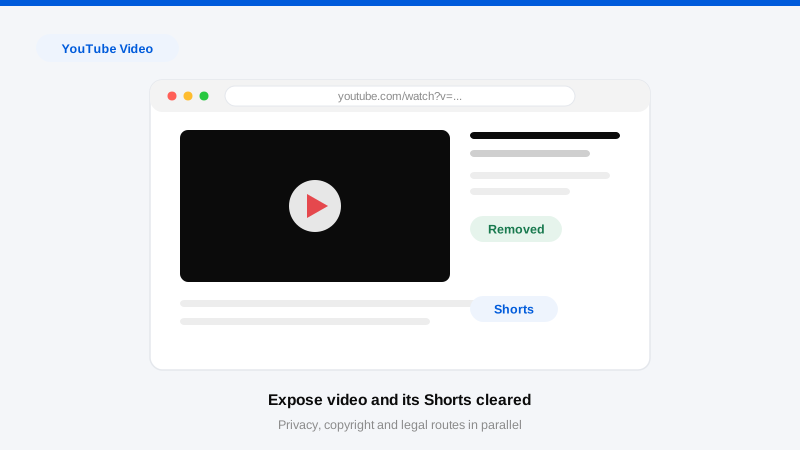
Removing a YouTube video about you means acting through the platform’s own systems rather than arguing in the comments. YouTube does remove videos, on privacy, defamation, copyright and harassment grounds, and Google can take the watch URL out of search results even when the video itself stays live.
Key facts
- YouTube treats privacy as a distinct category and will act where a person is uniquely identifiable in a video and did not consent.
- YouTube normally gives an uploader a window to edit or remove a video before it acts itself, which is one reason these matters take longer than clients expect.
- Defamation is assessed under the law of a named country rather than under the Community Guidelines, so the same video can be removable in one market and not in another.
- In England and Wales the Defamation Act 2013 requires serious harm to reputation, and a trading company must show serious financial loss.
- Copyright under DMCA 512 protects footage you own, but commentary and criticism are often defensible, so an overreaching claim gets reinstated and damages the wider matter.
- YouTube’s impersonation policy covers channels that use your name, logo or likeness to look official or authorised.
- Google can de-index the watch URL from search results even when the video stays live on YouTube.
Why an exposé video does more damage than an article
A video is longer, more persuasive, and stays in front of a viewer for twenty minutes rather than ninety seconds. It also ranks twice: once inside YouTube, which is the second largest search engine people use to check whether a program or a founder is legitimate, and again in Google, where video results are given their own block near the top of the page.
Then it multiplies. The creator cuts the same content into Shorts, other channels react to the reaction, and the transcript becomes the source material for blog posts and AI answers about you. By the time you find it, the video is rarely the only asset. Handling only the original is how people lose these cases.
What are YouTube’s actual removal routes?
More than one, and they are separate systems with separate teams and separate standards. That is the single most important thing to understand about YouTube: a complaint that would succeed in one queue is dismissed without a trace in another, and a video that cannot be touched on one ground is often removable on a different one entirely.
In practice the grounds that matter are privacy, where you are uniquely identifiable and did not consent, and false statements of fact, which are assessed under the law of a named country rather than under the Community Guidelines. Ownership of the footage, the thumbnails and the branding in the video matters too, as does whether the channel is presenting itself as you. Which of those is genuinely available in your matter is a judgment call, not a checklist, and getting it wrong is expensive.
Timelines depend on the route and the platform, and are set out in writing after the free Exposure Scan.
Get a Free, Confidential Exposure Scan
Should you contact the creator?
Sometimes, and rarely first. There are three kinds of creator behind these videos, and they respond differently.
The opportunist made the video because your name gets views. They will often take it down quietly if approached properly, because a single video is not worth a legal file to them. The believer thinks they are protecting people, and an aggressive letter confirms their thesis and produces a follow-up video about being threatened. The extortionist has a Patreon link, a settlement demand, or an offer to remove it for money, and should never be paid.
Reading which one you have is most of the skill, and it is why we look at the channel, its history, its monetisation and its previous targets before anyone sends anything. Approaches come from us or from counsel, never from the client in the moment they find it.
How we run a YouTube matter
We archive the whole footprint before we touch anything, because videos get edited, retitled and set to private the moment a creator senses pressure. Then we work every ground that genuinely applies at the same time, and we treat the video and the search result as two separate problems, because a watch URL can often be taken out of results for your name whatever YouTube decides about the video itself.
We also handle the spread rather than just the original. Shorts, re-uploads on other channels, the comment section and the mirrors on other platforms are separate assets that survive the removal of the video they came from. The work is verified, evidenced to you, and monitored afterwards, because these come back.
Related reading: our YouTube removal service, video removal generally, and what we do for trading educators and for talent managers acting on behalf of a client. There is also an anonymised trading educator case study.
What YouTube’s rules and the law actually say
YouTube runs two systems that people constantly confuse. The Community Guidelines are policy, covering things like harassment, impersonation and privacy, and they are applied against the written policy and nothing else. The legal process is a separate system that applies the law of a specific country to a specific statement. Sending a legal argument into the policy queue is the most common reason a serious complaint disappears without a trace, and it is one of several reasons these matters are lost before they start.
On defamation, the country decides almost everything. In England and Wales the Defamation Act 2013 requires serious harm to reputation, and a company must show serious financial loss. Australia introduced a comparable serious harm element in 2021. In the United States, Section 230 means Google is not liable for what the creator said, so removal there generally follows a court finding rather than a letter, and public figures face the additional actual malice standard. The practical consequence is that the same video can be removable for one client and not for another, and that is a question the Exposure Scan answers before you spend anything.
Opinion is not removable anywhere. Criticism, review and commentary are protected in every jurisdiction that matters here, and any firm that tells you otherwise is selling you a fight you cannot win. What is removable is narrower and more specific than most clients expect, and usually still enough.
What we need from you to start
- The watch URL, plus the channel, and any Shorts, clips or re-uploads you have already seen.
- Whatever you have already sent or received: emails from the creator, a settlement demand, comments they have made about you elsewhere.
- Proof of ownership for any footage, images or thumbnails of yours that appear: original files, upload dates, or the licence you bought.
- A short list of the specific claims you say are false, each with the evidence that contradicts it. Contracts, bank records, regulator or court outcomes, refund logs.
- Your country, and the countries whose audience matters to you, because the legal route is chosen by jurisdiction.
- Written authorisation for us to file, and identity confirmation for a privacy complaint, which has to come from the person in the video.
Timelines and what usually happens first
The first thing that happens is archiving, not filing. A complaint about a video nobody preserved is unwinnable, and creators edit and re-title as soon as they sense pressure.
After that, some routes move in days and others run on a legal timetable measured in weeks or months. You get the realistic range for your matter in writing after the scan. Nobody honest gives you a date.
Common mistakes that make it harder
- Commenting on the video, or making a response video. Both feed the recommendation system and give the creator a second episode.
- Paying a creator who has offered to take it down. It is a demand rather than a settlement, and it is usually followed by another one.
- Mass reporting through friends and staff. Coordinated flags are detectable, they are discounted, and they can be treated as abuse of the reporting system.
- Filing a copyright claim on commentary. The counter notice restores the video and damages the credibility of every other filing in the matter.
- Sending a legal letter the creator can publish. Assume any letter becomes a thumbnail. Correspondence should be drafted knowing that.
- Ignoring the Shorts and the re-uploads. They are separate URLs and they survive the removal of the original.
How this works alongside your lawyer, PR team or security team
Your counsel owns the legal complaint, any pre action correspondence, and any application for disclosure of the uploader’s identity. We prepare the timestamped table of factual claims, the falsity evidence and the archive that the complaint is built on, which is the part that takes the time.
Your PR team owns whether you say anything at all. In most of these matters the answer is nothing, or a quiet correction on a channel you control, timed after the removal work rather than before it. We tell them what is realistically coming down and when, so nothing is published that revives the story.
Your security team matters when the video publishes an address, a school, a vehicle or a travel pattern, or when the comment section turns into organised harassment. We pass that straight across rather than treating it as a content problem.
Who usually makes first contact and what the 15 minute call covers
Managers, agencies, chiefs of staff and lawyers make first contact at least as often as the person in the video does. That is normal and it is easier for everyone: the principal is rarely the best person to make dispassionate decisions about a video accusing them of something in the hour they find it.
Before the call we watch the video, read the transcript and the comments, look at the channel’s history and monetisation, and check what is already ranking on your name. On the call, which is fifteen minutes, we tell you which routes exist, which do not, whether the creator is worth approaching, and what order everything runs in. NDA and confidentiality are standard, nothing is filed without your approval, and the written assessment is yours to keep whether you engage us or not.
Frequently asked questions
Can YouTube really remove a video for defamation?
Yes. The outcome is often country level blocking rather than deletion, which in practice means the audience that matters to you stops seeing it. It turns on the law of the right country and it is slower than the policy routes. We tell you after the scan whether your matter is one of the ones that works.
Will filing a copyright claim backfire?
It will if the footage is genuinely being used for commentary, which is the most common mistake people make here. The video comes back, the creator makes a second one about the attempt, and everything else in the matter loses credibility. This is a judgment call worth getting right before anything is sent.
The video is mostly opinion. Is anything possible?
Often yes, though not on the basis you would expect. Opinion is not removable anywhere, so the work shifts to the parts of the video that are, and to the search results themselves. We will tell you plainly if the honest answer for your matter is suppression rather than removal.
What about the comments and the Shorts?
Both are handled as part of the same matter. Shorts and re-uploads are separate assets that survive the removal of the original, and an abusive comment section is its own problem. Clients who deal only with the video they first saw usually end up dealing with us six months later.
My manager found it, not me. Can they deal with you directly?
Yes. Most of our video work comes through managers, agencies, chiefs of staff and lawyers acting for the person in the video. We work under NDA as standard and alongside your existing counsel, PR and security teams.
How is this priced?
Quoted in writing after the free Exposure Scan, once we have seen the video and know which routes are real. Nothing is charged before you have that in writing, and the assessment report is yours to keep either way. See success based pricing.
Can you get it out of Google search even if YouTube keeps the video up?
Sometimes, and it is often the outcome that matters most. Search and the platform are two different systems with two different decision makers, so the video can stay live while the people typing your name stop finding it. Whether that is available to you depends on your jurisdiction and the content.
The creator has a large audience. Does that change the approach?
It changes the handling more than the outcome. A large channel is more likely to make content about being contacted, so nothing goes out from you directly and nothing goes out loudly. It also means the clips and reaction videos matter more than the original, so the work is wider than a single URL.
If there is a video about you live right now, send us the link. Start with a free, confidential Exposure Scan or read how we work. The 15 minute call is with someone who has run these, not a salesperson, and you will leave it knowing what is removable and what is not.