
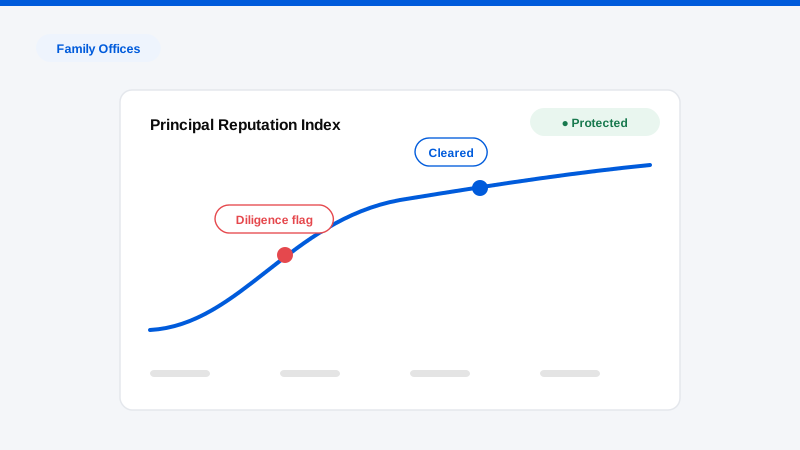
Reputation management for family offices addresses a paradox at the heart of the institution: the family office is designed to be invisible, yet it is constantly being researched. Every counterparty the office touches (fund managers weighing an allocation, banks onboarding accounts, co-investors sizing up a syndicate, journalists mapping private capital, candidates considering a role, and adversaries assessing a target) searches the office, its executives, and its principals before engaging. The office has a reputation whether or not it has a website, and that reputation is being assembled right now from whatever the internet happens to hold: regulatory filings, staff LinkedIn profiles, leaked databases, deal press, litigation records, and the accumulated public history of the family it serves.
This makes the family office something unusual: a brand whose ideal state is not prominence but composure. The office does not want to rank, trend, or be profiled. It wants the small amount of information available about it to be accurate, controlled, and unremarkable, and it wants the sensitive material that inevitably accumulates around private capital to stay out of reach. That outcome does not happen by default. It is produced, deliberately, by treating the office’s public footprint as a managed asset.
This guide defines the family office’s actual exposure surface, explains how reputational and informational leakage translates into concrete institutional risk (failed diligence impressions, fraud targeting, deal-flow damage, principal spillover) and describes what professional reputation and exposure management looks like when it is built for an institution whose brand is discretion itself.
The family office as a quiet brand: what counterparties actually find
When a sophisticated counterparty researches a family office, the search takes a predictable path, and each stop either reassures or raises questions.
The office’s own thin presence. Many offices maintain a minimal site or none at all. Minimal is fine; incoherent is not. A dormant domain, an abandoned LinkedIn page with outdated staff, or inconsistent naming across registries reads as disorganization to a diligence analyst, and creates a vacuum that third-party content fills.
Regulatory and corporate records. Depending on structure, an office may appear in investment-adviser registries, corporate filings, beneficial-ownership records, and property documents. These are legitimate and often unavoidable, but they anchor the office’s name to addresses, executives, and the family, and aggregator sites republish them in searchable, permanently indexed form far beyond their original context.
Staff footprints. The office’s people are its most talkative surface. An investment director’s profile that names the family, a controller’s résumé listing assets under management, a former employee’s bio describing the portfolio, an executive assistant’s public connection graph mapping the office’s bankers and lawyers, each is a page of the office’s dossier that the office never wrote. In diligence, counterparties read staff profiles as primary sources; so do social engineers.
Deal and press residue. Direct investments leave traces: funding announcements naming the office, cap-table references, board seats, conference appearances. A single quoted comment from a principal at a private-capital summit can become the office’s top search result for years.
The family’s gravity. Above all, the office inherits the search picture of the family it serves. Coverage of the principals (the wealth rankings, the old controversy, the divorce, the heir’s social history) attaches to the office’s name in every search that includes both. An office cannot be more composed online than its family is, which is why serious office-level work always connects to family-level work of the kind described in our family office practice.
The gray and dark layers. Beyond the visible web: leaked-database entries exposing office email patterns and credentials, paste-site mentions, forum chatter among service providers, and data-broker records tying office executives’ homes to the family’s. Counterparties rarely see this layer. Fraud crews always do.
Key takeaway: A family office’s reputation is assembled by its searchers, from fragments the office mostly did not publish. Managing it means knowing exactly what those fragments are, removing the dangerous ones, and making the remainder read as competence.
How exposure becomes institutional risk
The case for treating this professionally rests on specific, mechanical connections between what is findable and what can go wrong.
Counterparty diligence outcomes. Allocations, club deals, credit relationships, and prime-brokerage terms all pass through reputational review. Diligence teams are not looking for glamour; they are looking for red flags and coherence. Stale litigation surfacing above the office’s own materials, a former employee’s grievance post, confusion between the office and a similarly named entity, or an unexplained regulatory footnote can quietly cost the office access and pricing, and the office may never learn why the reception cooled. The first professional task is simply to see the office as diligence sees it.
Fraud and social-engineering targeting. Family offices are prime targets for wire fraud, invoice manipulation, and impersonation precisely because they combine large balances with small teams. These attacks are built from open-source research: staff names and roles from LinkedIn, email formats from leaks, executives’ personal details from data-broker profiles, travel and event signals from social media. Every element of the office’s footprint that is removed or hardened raises the cost of the attack; offices that have never audited this layer are, operationally, pre-packaged for the attacker.
Physical-security spillover. Office records expose addresses; staff exposure maps who has access to the principals; broker sites link executives’ homes to the family’s. An office’s informational leakage is part of the family’s physical attack surface, the concern at the center of digital executive protection work.
Deal-flow and relationship damage. Private capital runs on the presumption of discretion. An office that appears in coverage it did not sanction, whose positions leak into trade press, or whose name shows up in a counterparty’s dispute becomes a less attractive partner, not because of wrongdoing, but because its information perimeter looks porous.
Principal spillover in both directions. A principal’s personal controversy becomes the office’s diligence problem; an office-level dispute (an employment claim, a soured deal) becomes the family’s search result. Because the two reputations are inseparable in practice, managing them separately guarantees gaps.
Know exactly what's exposed, before someone else finds it.Free confidential Exposure Scan, live results on a 15-minute call, covered by strict confidentiality.
Book Your Confidential ScanStaff discretion: the human perimeter of the office’s reputation
Family offices devote real attention to confidentiality in contracts: NDAs, employment terms, vendor agreements. Far less attention goes to the public layer those contracts do not reach: what staff, former staff, and vendors lawfully publish about themselves, which cumulatively publishes the office.
The exposure is rarely malicious. A portfolio manager lists accomplishments because careers require it. A recruiter’s job posting describes the office’s size and mandate in detail. A vendor’s case study, an accountant’s client list, a conference’s attendee roster, each is ordinary professional behavior that, aggregated, gives a researcher the office’s org chart, mandate, service providers, and family connection.
Professional management of this layer has a distinct character: it is collaborative, not coercive. It typically includes a staff-exposure audit (what each key employee’s public presence reveals about the office and family), discreet guidance that lets staff maintain credible professional profiles without carrying the office’s details, personal-exposure protection for senior executives as a benefit (their own personal data removal and monitoring, which staff value and which closes the office’s flank) and vendor-facing publication standards handled through relationships rather than confrontation. Former employees require particular tact: their profiles and interviews are beyond the office’s authority, and managing that residue well is a matter of relationship, timing, and, where necessary, search-layer response rather than demands.
Key takeaway: An office’s confidentiality agreements govern what people may disclose; its reputation program must govern what is actually findable. The gap between those two, the lawfully published aggregate, is where most office exposure lives.
What professional reputation management for family offices looks like
An engagement built for a family office does not resemble corporate PR, and offices should be wary of providers who bring a publicity playbook to an institution whose objective is quiet. The professional standard has a different architecture.
A full institutional exposure audit. The engagement begins by assembling the office’s complete findable picture: the entity layer (registrations, filings, aggregator republications), the people layer (executives, staff, former staff), the deal layer (press, announcements, records), the family linkage, the broker and leak layer, and how the whole reads in sequence to a diligence analyst, a journalist, and an attacker. Most offices have never seen this document about themselves; it typically resets the risk conversation immediately.
Removal of the removable. Broker profiles on executives and principals, republished records beyond their required context, leaked personal data, residual staff exposure, and policy-violating content are worked through the appropriate mechanisms: persistent, source-by-source effort of the kind that defines our online privacy service, applied at institutional scale.
Composure at the search layer. For what cannot be removed (regulatory records, legitimate press, historical coverage) the professional objective is proportion: ensuring the office’s accurate, intended materials lead its results, that confusable entities are disambiguated, and that dated or misleading items do not function as the office’s introduction. Where an office’s or executive’s results are dominated by material that misrepresents them, our search-result suppression practice addresses visibility directly, without overpromising what third-party platforms allow.
Continuous monitoring, institution-wide. The office’s names (entity, executives, principals, properties) go under standing watch: new press, new filings republished, broker repopulation, impersonation attempts, leak appearances, and emerging chatter. Reputation monitoring at the office level is the difference between learning of a problem from your own report and learning of it from a counterparty.
Incident readiness. When something acute occurs (a doxxing of a principal, a leak, a hostile story in motion, a dispute going public) an office with a standing program responds from an established baseline with a firm that already knows its terrain. Offices on our protection plans treat this the way they treat cyber incident response: a retained capability, priced against the cost of improvising during the event.
Reporting built for the office. Quarterly, concise, and written for a COO or principal: what changed, what was removed, what is being watched, where the risks sit. The program should make the risk register shorter, not longer.
Know exactly what's exposed, before someone else finds it.Free confidential Exposure Scan, live results on a 15-minute call, covered by strict confidentiality.
Book Your Confidential ScanWhy offices retain a specialist rather than absorbing this internally
Family offices are built to internalize sensitive functions, and the instinct to handle reputational matters in-house is understandable. In practice, offices that try discover three structural problems. The work demands current, niche mechanism knowledge (which platforms, brokers, registries, and publishers respond to what, this quarter) that no generalist staff member maintains. The work is unrelenting rather than episodic: brokers repopulate, filings republish, and monitoring is a standing function, not a project an office manager completes, and the work is safest at arm’s length: removal and de-indexing requests, publisher contacts, and platform escalations made in the office’s own name create precisely the paper trail and attention the office exists to avoid, whereas a specialist firm conducts them without the family’s fingerprints and under strict confidentiality, including confidentiality about the engagement itself.
A reputable specialist will be equally plain about limits: no firm controls search engines, guarantees removals from independent platforms, or promises outcomes, and a family office, of all institutions, should distrust anyone who claims otherwise. What the right firm delivers is the complete picture, everything removable removed, everything else managed for proportion, the human perimeter quietly hardened, and a permanent watch, accountable to the office in the same professional manner as its auditors and counsel. Our case studies describe, in suitably anonymized form, what that partnership looks like in practice.
Key takeaway: The family office professionalizes every function that touches the family’s capital. Its information perimeter (the thing every counterparty, journalist, and adversary examines first) deserves the same standard: a named specialist, a standing program, and a baseline someone is accountable for defending.
Frequently asked questions
Our family office has almost no online presence. What is there to manage?
Absence of a website is not absence of a footprint. Offices with no public presence still appear in corporate and regulatory records, aggregator republications, staff profiles, deal announcements, leaked databases, and the family’s own coverage, and the lack of any authoritative material from the office means those third-party fragments are the entire picture. A minimal presence is a legitimate strategy, but it only works when someone has audited what fills the vacuum and manages it deliberately.
How do you handle exposure created by our employees’ LinkedIn profiles and résumés?
Through consent and collaboration, never coercion. The typical sequence is an audit showing precisely what the staff layer reveals in aggregate, followed by discreet, individually tailored guidance that preserves each employee’s professional credibility while removing the office’s sensitive details, often paired with personal exposure protection for senior staff as a benefit. Former employees and vendors are handled through relationships and, where needed, search-layer work, since they sit outside the office’s authority. Most staff cooperate readily once they see what an attacker could do with the aggregate.
Does an engagement cover the principals and family, or just the office entity?
Any serious engagement covers both, because searchers, journalists, and attackers treat them as one subject. The typical structure runs office-entity work (records, staff, deal residue, monitoring) alongside family-side coverage (principals, spouses, next generation, residences) under a single confidential relationship with consolidated reporting. Scoping them separately leaves each side exposed through the other, the most common gap we find in offices that have previously bought point solutions.
Can you guarantee that a negative article or record about our office is removed?
No, and you should decline to work with any firm that says yes. Legitimate press and mandatory public records are generally not removable, and outcomes on third-party platforms are never in any vendor’s control. What a professional engagement delivers is honest categorization (what can be removed at the source, what can be de-indexed or corrected, what can only be outweighed) followed by disciplined execution of each path and transparent reporting on results. Offices find that this candor, applied persistently, produces materially quieter outcomes than any guarantee ever would.
Every counterparty your office meets this quarter will search it first. A confidential Exposure Scan shows you (live, on a 15-minute call) exactly what they will find: the records, the staff leakage, the broker profiles, the family spillover, and where the risks concentrate. It is free, covered by strict confidentiality, and conducted by a firm built for institutions whose brand is discretion. Book the scan, and see your office the way diligence does.