
A brand reputation recovery service restores control when an external actor has published false allegations, cloned an executive’s identity, leaked private files or posted pirated material under your brand. Unlike PR built for self-inflicted scandals, it runs source removal and search suppression in parallel: preserve evidence, classify the threat, pursue takedowns or de-indexing, build authoritative assets, and monitor for reposts.
Key facts
- Cited data: 41 percent of businesses lose brand value and revenue within a year of a reputation crisis.
- Brands responding to negative press within 48 hours are cited as 2.5 times more likely to recover trust.
- A typical program runs a two-week audit, two to four weeks of damage control and one to three months rebuilding.
- Suppression work cited by LSEO takes 4 to 6 months to push harmful content past Google’s top 30 results.
Where ContentRemoval.com comes in. ContentRemoval.com is built for the victim-side cases this article describes: the fabricated article before a financing, the harassment campaign against a family office principal, the leaked intimate material, the pirate storefront using a brand’s imagery. General counsel, a family office manager or the individual’s agent usually makes the first contact, and the work stays confidential and matter-based. A free 15-minute Exposure Scan maps what is removable, and the report is yours to keep. Get a Free, Confidential Exposure Scan or read how our reputation management work is done.
You find the problem the same way most high-profile clients do. A board member forwards a link. A client asks an odd question. Search results suddenly look wrong. A false article is ranking for your company name. Private material has leaked. A pirate site is using your brand assets. A cluster of fake reviews appears across platforms at once.
At that point, generic advice becomes dangerous.
If the attack is coming from an external actor, you don’t need a brand workshop or a carefully phrased apology drafted over two weeks. You need a brand reputation recovery service that can identify the source, choose the right takedown path, suppress what can’t be removed immediately, and monitor for reposts before the problem hardens into the public record.
Most published advice about reputation recovery is written for companies that caused their own crisis. That advice has its place. It does not fit falsehoods, impersonation, leaks, piracy, or coordinated abuse. In those matters, the first objective is control. The second is containment. Public messaging comes later, if at all.
When Reputation Is Under Direct Attack
At 7:30 a.m., your general counsel sees a fabricated allegation indexed on Google. By 9:00 a.m., investors have seen it. Before lunch, a trade journalist has asked for comment. By the afternoon, screenshots are circulating on LinkedIn, two review platforms show language that looks coordinated, and your name is now attached to a story you didn’t create and can’t ignore.
That is the modern crisis pattern. It compresses exposure, confusion, and reputational damage into hours.
The financial impact is not abstract. Companies that experience a reputation crisis face severe financial consequences, with 41% of businesses seeing a direct loss of brand value and revenue within the first year. Brands that respond to negative press within the first 48 hours are 2.5x more likely to recover public trust according to New Media’s reputation management statistics.
The first error clients make
They treat an attack as a communications issue.
It often isn’t. A malicious article, leaked file, impersonation account, or copied media asset is first a removal and containment issue. If the material stays live, searchable, and shareable, every statement you make risks amplifying it.
Practical rule: When the content is false, stolen, impersonating, or unlawfully published, your first move should be technical intervention, not public explanation.
Discerning clients already grasp this intuitively. They know reputation isn’t a soft concept. It’s tied to financing, partnerships, recruitment, litigation posture, and personal safety. If you want a concise legal framing of why this matters, Lighthouse Consultants has a useful note on understanding that reputation matters.
What a proper response looks like
A serious response starts with triage:
- Map the exposure: What is ranking, where it’s hosted, and which platforms are replicating it.
- Classify the threat: Defamation, copyright infringement, impersonation, privacy breach, non-consensual dissemination, or review fraud.
- Choose the lane: Takedown, de-indexing, suppression, or a combination.
- Lock down spread: Monitor search, social, forums, and repost channels immediately.
A brand reputation recovery service exists for precisely this moment. Not to improve sentiment in the abstract, but to regain control when control has already been lost.
Defining the Modern Recovery Service
Most of the market still defines reputation recovery incorrectly. It treats every problem as if the client did something wrong and now needs to apologize better.
That model is incomplete.
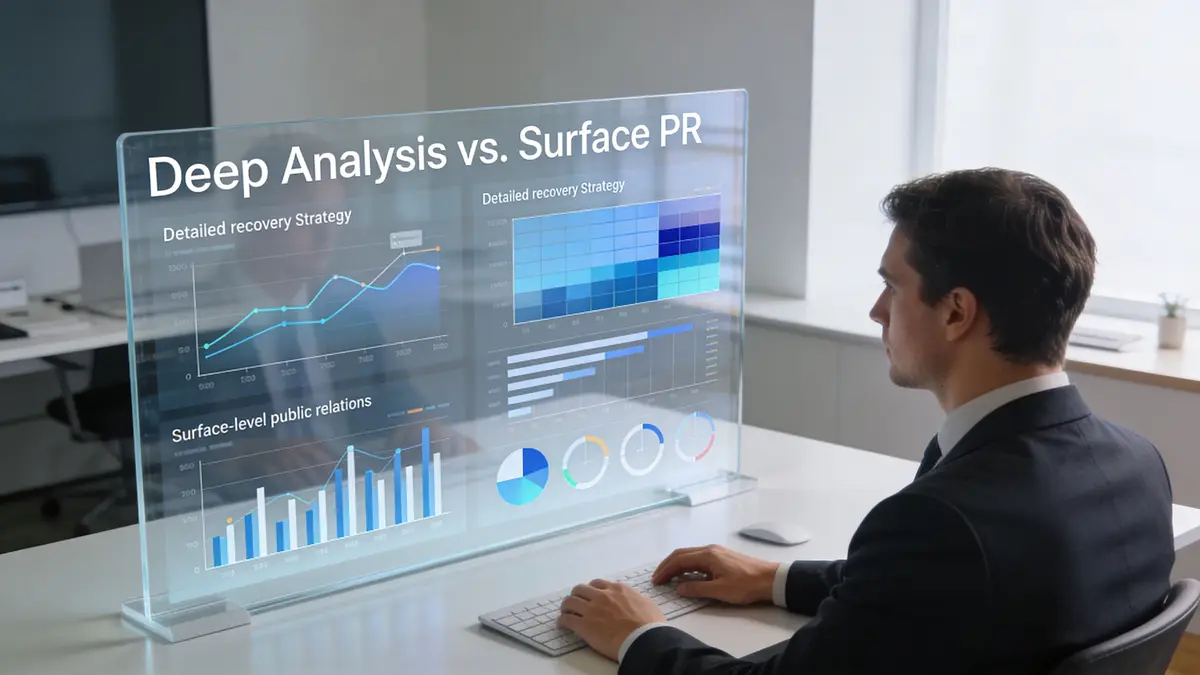
A modern brand reputation recovery service is often less like a PR agency and more like a coordinated technical and legal unit. It deals with hostile content ecosystems, platform rules, search visibility, evidence preservation, rights enforcement, and digital trace analysis. That’s what matters when the client is the victim.
The market’s blind spot
Most reputation recovery commentary centers on scandals, operational failures, and executive misconduct. That leaves a major gap. Existing reputation recovery content focuses almost exclusively on organizational scandals, leaving a major blind spot for harm caused by external actors like pirated content, fake reviews, or leaked materials. This gap ignores that the effective first response for such passive harm is often de-indexing and source removal, not traditional PR, as discussed by PR Daily.
That distinction is decisive.
If your company shipped a dangerous product, the solution starts with accountability and correction. If someone published false allegations, cloned your executive’s identity, leaked private files, or posted pirated material under your brand, accountability theater is irrelevant. You need to remove the material, cut distribution, and prevent recurrence.
What the service covers
In practice, the work falls into a few categories:
- Falsehood and defamation response: Identifying provably false statements, preserving evidence, and pursuing removal or de-indexing.
- Impersonation and identity abuse: Removing fake profiles, cloned websites, or fraudulent accounts designed to confuse customers or discredit principals.
- Piracy and stolen content: Enforcing copyright and platform rights where media, reports, training materials, or branded assets have been republished without authorization.
- Leaks and privacy breaches: Addressing unlawfully disclosed private documents, intimate material, internal memos, or confidential recordings.
- Search result remediation: Suppressing harmful visibility when immediate source removal isn’t available.
Why PR-first advice fails in these cases
A public response can be necessary. It should not be automatic.
When the threat comes from an external actor, a statement can do three harmful things at once. It can validate the story’s importance, create a new citation trail for search engines, and give bad actors confirmation that their tactic worked. That’s why senior advisors don’t start by asking, “What should we say?” They start by asking, “What can we remove, what can we de-index, and what can we push down?”
A victim of impersonation does not need a redemption arc. The victim needs the impersonation disabled.
That is the operational difference between classic reputation management and modern recovery. One manages perception around conduct. The other restores control over a digital environment that has been compromised.
The Takedown and Suppression Process Explained
Clients usually want the same answer first. How does this work?
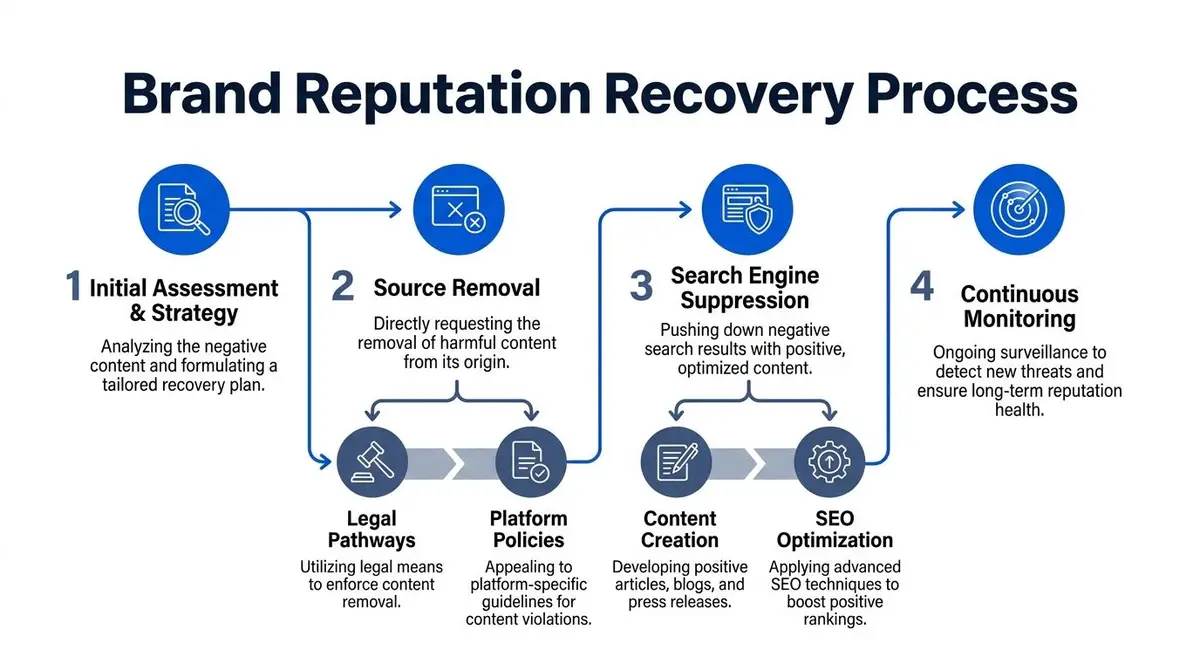
The process is disciplined. It is not magic, and it is not guesswork. A competent brand reputation recovery service runs two campaigns in parallel: source removal and search suppression. One attacks the problem at origin. The other reduces visibility while origin issues are being resolved.
Step one begins with evidence, not outrage
The first step is preservation. Before anyone contacts a platform or publisher, the team captures the material, its URLs, its timestamps, the search queries that surface it, and any connected accounts. That record matters because content often changes once a host knows it’s under challenge.
Then the material is classified. Not everything harmful is removable for the same reason.
A working matrix often looks like this:
| Threat type | Primary path | Secondary path |
|---|---|---|
| Defamatory falsehood | Legal review, platform complaint, de-indexing request | Search suppression |
| Stolen copyrighted media | DMCA or equivalent rights notice | Monitoring for reposts |
| Fake profile or impersonation | Platform identity abuse report | Search suppression |
| Leaked private material | Privacy complaint, host escalation, legal intervention | Monitoring and repeat takedowns |
| Fake reviews | Platform fraud reporting and pattern analysis | Positive content reinforcement |
Source removal is the cleanest win
If content can be removed at source, that is usually the preferred outcome. It cuts off future indexing, sharing, and screenshot circulation more effectively than any press response.
The available routes depend on the content and jurisdiction:
- Platform policy enforcement: Many hosts prohibit impersonation, harassment, privacy breaches, manipulated media, and coordinated review fraud.
- Copyright enforcement: Stolen videos, photos, written materials, presentations, and other protected assets can often be challenged through rights-based notices.
- Defamation and legal de-indexing: Where the facts support it, legal pathways become available.
- Direct host escalation: Some cases are resolved through targeted escalation to hosting providers, registrars, administrators, or legal points of contact.
The performance benchmark here is clear. Legal de-indexing for defamation achieves a 90% success rate under frameworks like GDPR and DMCA, with takedown actions often initiated within 24-48 hours, according to LSEO’s reputation recovery analysis.
That doesn’t mean every matter disappears in two days. It means a capable team starts moving in that window, which is exactly what pressure situations require.
Suppression is not cosmetic
Some material won’t come down quickly. News archives, repost networks, offshore domains, and adversarial publishers can be stubborn. In those cases, suppression becomes essential.
Here, many cheap vendors expose themselves. They flood the web with weak filler and hope for movement. That approach rarely lasts.
Real suppression means building high-authority positive assets that can outrank or displace harmful results. That may include executive profiles, corporate pages, thought leadership pieces, verified social properties, trusted third-party mentions, and carefully structured content ecosystems. The goal is to occupy search real estate with assets you control or can reliably influence.
For a detailed look at the mechanics, this guide on strategic methods to suppress negative content and restore digital authority is a useful companion.
LSEO reports 80% efficacy in pushing harmful content beyond Google’s top 30 results within 4-6 months through high-authority positive asset creation and ranking work in the same analysis linked above.
Suppression works when it is built like an asset portfolio, not a pile of blog posts.
Parallel execution matters
The best results come from sequencing the work correctly:
- Assess the legal and platform angles immediately.
- Initiate removal requests fast where the facts support them.
- Build suppression assets before the search environment calcifies.
- Track reposts, mirrors, and derivative content.
One factual note about the market matters here. ContentRemoval.com offers source removal, de-indexing, false review and impersonation takedowns, leaked image removal, and dark web monitoring as part of its published service set. That combination reflects what complex matters require. Not one tactic, but a controlled campaign.
Project Timelines and Continuous Monitoring
Clients under pressure ask two sensible questions. How fast can anything change, and how long will this stay under control?
The answer depends on the threat type. An obvious impersonation account or a clean copyright violation can move quickly. A resilient news result, a coordinated review attack, or a repost network takes longer. The mistake is expecting one timeline for every problem.
The three operational phases
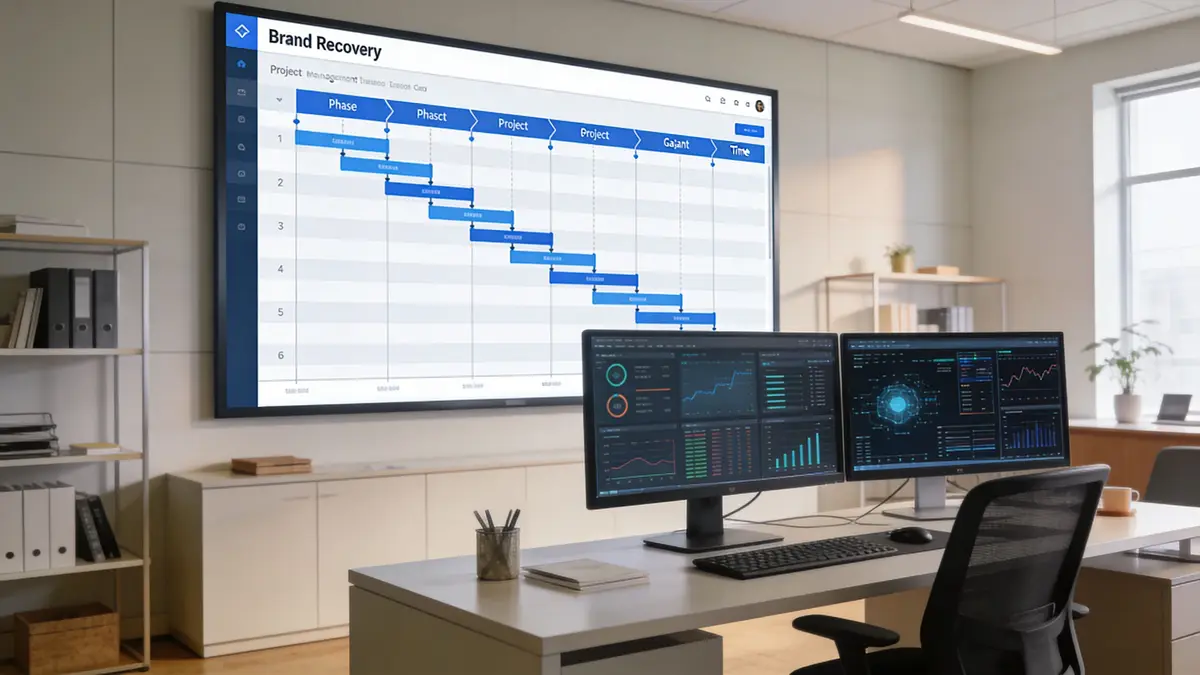
A realistic recovery program usually runs in phases. According to YouScan’s online reputation repair analysis, a typical timeline includes a 1-2 week audit, a 2-4 week damage control phase that reduces negative visibility by 70%, and a 1-3 month rebuilding phase to support long-term suppression. The same analysis notes that AI-powered monitoring tools scan millions of online mentions in real time, reducing crisis escalation by up to 40%.
Those phases map well to how serious engagements work.
Audit and diagnosis
The team identifies every harmful asset, traces amplification, reviews legal posture, and determines which content drives risk. Clients often over-focus on the most offensive item rather than the most visible one. Those are not always the same.
Damage control
This is the intervention phase. Notices go out. Platforms are engaged. search results are mapped. Suppression assets begin publishing. Internal stakeholders receive a practical playbook rather than a stream of updates.
Rebuilding and maintenance
Once the immediate fire is controlled, the work shifts to durability. Search results need reinforcement. Positive assets need support. Reuploads and derivative mentions have to be caught early.
Monitoring is not optional
Too many firms treat monitoring as a nice add-on. It’s a core control function.
If harmful content comes down and then reappears under a variant URL, on a mirror domain, or through a clipped repost on social, you need to know quickly. Otherwise you end up paying twice for the same crisis.
A mature monitoring program watches for:
- Search resurfacing: A removed or buried result re-enters meaningful visibility.
- Reuploads and mirrors: The same content appears on another site or account.
- Narrative migration: The issue jumps from one platform type to another, such as from a forum to a journalist’s article.
- Sentiment spikes: Negative language clusters around the brand or principal after an apparently quiet period.
For ongoing brand defense, reputation monitoring should sit alongside takedown work, not behind it.
The engagement is not over when the first URL disappears. It’s over when the issue stops resurfacing.
What clients should expect
A proper advisor won’t promise instant erasure. They will tell you which items can be attacked immediately, which require patience, and which need a longer visibility strategy. That candor matters. It keeps decisions strategic, and it prevents panic-driven missteps such as issuing an unnecessary public statement or contacting a hostile publisher directly.
How to Evaluate a Recovery Service Provider
This market is crowded with firms that sound convincing until you ask technical questions. Then the language gets vague. They talk about visibility, trust, and storytelling. They can’t explain chain of action, evidentiary standards, or jurisdictional constraints. That’s your warning.
The gap between competent and amateur providers is wide. Organizations face pressure to respond within hours, yet only specialized firms can initiate takedowns in a 24-48 hour window, addressing the speed-trust paradox that traditional PR firms are unequipped to handle, as noted by 5WPR.
What to test before you hire anyone
Don’t evaluate on branding. Evaluate on operational credibility.
Ask direct questions:
- How do you classify removal candidates? A real firm will distinguish among defamation, privacy violations, copyright claims, impersonation, and review fraud.
- Who handles legal analysis? If the answer is vague, the process is likely weak.
- What happens in the first 48 hours? You want a defined action sequence, not a promise to “assess the situation.”
- How do you avoid amplification? A poor provider can turn a manageable issue into a larger one.
- What is your suppression methodology? If the answer sounds like mass publishing, walk away.
- How do you monitor reuploads and recurrence? If there is no recurrence model, the service is incomplete.
- What are your confidentiality controls? Such controls are essential for executives, principals, and family offices.
A useful executive checklist appears in this guide to evaluating professional content removal services for executives.
Provider Evaluation Matrix
| Criterion | Premier Recovery Service (e.g., ContentRemoval.com) | Standard Reputation Agency |
|---|---|---|
| Core orientation | Removal, de-indexing, suppression, monitoring | Messaging and general brand positioning |
| First-response capability | Structured triage and action in the early crisis window | Slower intake, often messaging-first |
| Legal fluency | Works across rights, privacy, impersonation, and defamation issues | Often relies on outside counsel after intake |
| Search strategy | Authority-based suppression tied to risk exposure | Generic content publishing |
| Platform enforcement | Knows policy pathways and escalation logic | Often limited to public-facing requests |
| Confidentiality posture | Matter-based discretion, restricted access, low-visibility workflow | Broader team exposure and marketing-oriented process |
| Recurrence handling | Ongoing monitoring for reposts and mirrors | Limited or absent |
| Risk of collateral damage | Lower when escalation is disciplined | Higher if outreach is clumsy or public |
Red flags you should take seriously
Some firms should be ruled out immediately.
- Guaranteed removal language: No serious advisor guarantees every outcome.
- No discussion of jurisdiction: Cross-border content disputes are common. A provider that ignores jurisdiction is guessing.
- No evidentiary intake: If they don’t preserve evidence at the start, they aren’t thinking properly.
- Cheap retainers tied to volume publishing: That usually means thin content, weak suppression, and little legal substance.
- Public case bragging: High-profile clients should not tolerate a provider that markets confidential matters loosely.
Hire the firm that can explain what it will do before it explains why it’s impressive.
The right provider should sound measured, specific, and slightly hard to impress. That’s what competence sounds like in this field.
Use Cases and the Mandate for Confidentiality
The pressure points vary, but the operating principle doesn’t. When the threat is external, the response must be precise and discreet.

Four situations that demand specialist handling
An executive preparing for a financing event discovers a false article alleging misconduct. The issue isn’t abstract reputation management. It’s transaction risk. The response has to focus on evidence capture, publisher analysis, search containment, and a decision on whether any statement would worsen discoverability.
A family office sees sustained harassment aimed at a principal and their relatives. The threat is broader than one link. It may involve doxxing, impersonation, copied photographs, and forum threads designed to invite further abuse. The recovery service has to coordinate privacy complaints, removal paths, and ongoing surveillance without exposing the family to more attention.
A public figure faces leaked intimate material or manipulated media. In that situation, delay is punishing. The workflow must prioritize source disruption, platform escalation, search reduction, and anti-reupload monitoring. Public commentary is often unnecessary and sometimes harmful.
A consumer brand finds pirate storefronts and counterfeit channels using its name, media, and product imagery. This is both a revenue issue and a trust issue. The task is enforcement, marketplace escalation, and search cleanup, paired with protection of legitimate brand assets.
Why confidentiality is part of the service
Discretion is not a soft virtue in these matters. It is an operational requirement.
A careless provider can create a second crisis by contacting the wrong party, over-sharing the matter internally, or using junior staff with no experience handling sensitive material. High-profile clients need a workflow that behaves more like a legal matter than a marketing project.
That means:
- Restricted matter access: Only the people working the case should see the case.
- Controlled communications: No unnecessary outreach. No speculative emails. No grandstanding.
- Evidence discipline: Preserve first, then act.
- Need-to-know reporting: Senior stakeholders get decisions and outcomes, not noise.
In reputation recovery, privacy isn’t a courtesy. It’s part of the remedy.
The best outcomes often remain invisible to the public. Harmful results disappear, search visibility improves, impersonation accounts go dark, and the client’s name stops attracting the wrong narrative. That is exactly how it should be.
Your Next Step Toward Digital Control
If you’re dealing with criticism that comes from your own conduct, you may need communications strategy, operational fixes, and visible accountability. That’s one category of problem.
If you’re dealing with falsehoods, piracy, leaks, impersonation, or coordinated external abuse, that category does not apply. You need technical intervention. Fast.
A brand reputation recovery service is not a cosmetic layer added after the fact. In the right circumstances, it is the primary mechanism for regaining control. The work is practical. Remove what can be removed. De-index what can be de-indexed. Suppress what cannot yet be removed. Monitor what is likely to return.
Under pressure, clients tend to lose time deciding whether the issue is “serious enough” for specialist help. That hesitation is costly. Search results settle. Screenshots spread. Bad actors test whether anyone is paying attention. If the answer appears to be no, they keep going.
The right move is early assessment by people who understand takedowns, platform rules, search suppression, and confidentiality. Not a brainstorming call. Not a generic PR intake. A disciplined review that produces a clear action plan.
If your name, brand, or principal is under direct digital attack, act before the problem becomes part of the permanent record.
ContentRemoval.com handles confidential assessments for executives, public figures, family offices, brands, and legal professionals facing false content, leaks, impersonation, piracy, and related digital threats. If you need a clear action plan grounded in takedowns, suppression, and monitoring, start with a private review through ContentRemoval.com.
Frequently asked questions
How is a reputation recovery service different from a PR agency?
PR manages perception around conduct. A recovery service restores control over a compromised digital environment through takedowns, de-indexing, authority-based suppression, platform enforcement and recurrence monitoring. The article’s comparison table sets the two orientations side by side.
How long does brand reputation recovery take?
It depends on the threat. An obvious impersonation account or clean copyright violation can move quickly, while resilient news results, coordinated review attacks and repost networks take longer. Cited phases run from a short audit through damage control to one to three months of rebuilding, with monitoring continuing afterward.
What questions should I ask before hiring a reputation recovery provider?
Ask how they classify removal candidates, who handles legal analysis, what happens in the first 48 hours, how they avoid amplifying the issue, what their suppression method is, how they monitor reuploads, and what confidentiality controls apply. Promises of certain removal, no discussion of jurisdiction and public case bragging are red flags.