
A brand statement example for executives, family offices and public figures is a strategic declaration that defines perception and preempts attack, not a marketing slogan. Eight frameworks serve different protective functions: mission-driven, authority-based, solution-oriented, trust and confidentiality, speed and efficiency, multi-service integrated, founder-led, and outcome-assurance. Choose the one that matches your greatest vulnerability.
Key facts
- A mission-driven statement works only when rooted in a verifiable domain and not contradicted by operations.
- Solution-oriented statements lead with action verbs such as remove, suppress and monitor to answer the client’s urgent question.
- Trust-based positioning means forgoing client logos and testimonials in favor of anonymized scenarios and NDAs.
- Pressure-test a chosen framework by drafting responses to likely crisis scenarios before adopting it.
Where ContentRemoval.com comes in. A brand statement sets the narrative, and ContentRemoval.com removes the false, misleading or stolen content that contradicts it: the impersonation profile that undermines a founder-led position, the leaked material that breaks a confidentiality promise, the defamatory article that outranks the official bio. Communications advisers and family office managers usually engage the firm once the statement is in place. A free 15-minute Exposure Scan maps what is removable, and the report is yours to keep. Get a Free, Confidential Exposure Scan or read how our content removal work is done.
For executives, family offices, and public figures under pressure, a brand statement is not a marketing slogan; it is a strategic declaration that defines perception, manages risk, and asserts control over a public narrative. A vague or poorly constructed statement invites misinterpretation, misattribution, and attack. Conversely, a precise, authoritative statement functions as a shield, preemptively neutralizing threats and reinforcing the exact identity you wish to project. It dictates how you are to be seen, leaving no room for hostile interpretation or damaging speculation.
A powerful brand statement often takes the form of a clear and compelling value proposition, acting as a crucial instrument of control over your brand’s core message. Learning to craft a winning value proposition is a foundational step in building this defensive architecture.
This analysis dissects distinct frameworks for crafting such statements. We move beyond generic advice to provide the strategic architecture required for high-stakes reputation management. A specific brand statement example can serve a precise protective function, from projecting unassailable authority to guaranteeing absolute discretion. The objective is not creative inspiration, but tactical implementation for individuals and entities whose reputations are non-negotiable assets. We will examine mission-driven, authority-based, and solution-oriented statements, among others, providing the templates and strategic breakdowns needed to build a statement that protects and controls your public identity.
1. The Mission-Driven Statement: Projecting Purpose to Preempt Scrutiny
A mission-driven statement anchors your identity to a purpose beyond profit. It is a calculated positioning tool designed to preempt scrutiny by establishing a clear, defensible “why” behind your actions. For high-profile entities, this statement provides a resilient framework for public perception, inoculating the brand against accusations of pure self-interest.
This approach aligns your brand with a broader, more noble goal. It is not a vague commitment to corporate social responsibility; it is a strategic shield. By defining your core mission, you create a narrative that is difficult to attack without the critic appearing cynical or misguided.
Strategic Analysis: The Preemptive Defense
Consider a family office dedicated to “funding innovation in decentralized identity technologies to restore individual data sovereignty.” This mission-driven brand statement example reframes their investment activities. They are not merely seeking returns; they are championing a cause.
Strategic Takeaway: When a negative story emerges, this pre-established mission acts as an immediate counter-narrative. An accusation of aggressive investment tactics is immediately contextualized by the stated goal of fighting big-tech data exploitation. The mission becomes the topic of conversation, not the specific transaction.
When to Use This Statement
This statement is most effective for entities whose actions could be misconstrued as purely profit-motivated or self-serving. It is a critical tool for:
- Family Offices & Investment Firms: To frame capital allocation as a tool for societal progress.
- Technology Founders: To position their work as a solution to a large-scale problem, such as protecting intellectual property or securing digital privacy.
- Public Figures & Activists: To create a clear, non-negotiable platform that justifies their public actions and commentary.
Application & Customization
The power of this statement lies in its specificity and authenticity. A vague mission is easily dismissed. The mission must be rooted in a tangible, verifiable domain. “Advancing medical research in pediatric oncology” is strong. “Making the world a better place” is not. Furthermore, do not choose a mission that is contradicted by your business operations. A commitment to environmental protection is ineffective if your portfolio is heavy with polluters. This statement is a long-term reputation asset. It provides a consistent, authoritative answer to the question, “What do you stand for?” In a crisis, having that answer already established in the public record is a decisive advantage.
2. Authority-Based Brand Statement: Industry Expertise & Credibility
An authority-based brand statement positions an entity as the definitive expert within a specific domain. It is built on a foundation of proven methodologies, proprietary processes, and demonstrable results. This approach shifts the brand narrative from a service provider to a trusted authority, making its claims and capabilities inherently credible.
This statement is not an empty boast; it is an assertion of leadership backed by evidence. For firms like ContentRemoval.com, which operates as a “global authority in online content removal,” this positioning is critical. It communicates a mastery over complex processes involving legal tactics, AI monitoring, and high-stakes negotiation, differentiating the firm from less specialized competitors.
Strategic Analysis: The Credibility Moat
Consider a consulting firm like McKinsey or a financial institution like Goldman Sachs. Their brand statements are built on an implied foundation of unparalleled expertise. They are not just participants in their industries; they are the advisors to global leaders, the arbiters of financial markets. Their authority is a strategic asset that attracts high-value clients and commands premium fees.
Strategic Takeaway: An authority-based statement creates a “credibility moat.” When a competitor makes a similar claim, it is measured against your established expertise. Your white papers, high-profile client roster, and proprietary data become barriers to entry that others cannot easily replicate. This is a powerful brand statement example for building a defensible market position.
When to Use This Statement
This statement is most effective for organizations where deep expertise is the primary differentiator and a key factor in the client’s decision-making process. It is essential for:
- Consulting & Professional Services Firms: To justify premium pricing and establish themselves as the go-to experts for complex problems.
- Specialized Technology Companies: To highlight proprietary algorithms, data sets, or processes that provide a distinct competitive advantage.
- Reputation Management & Legal Firms: To build trust in high-stakes situations where outcomes depend entirely on specialized knowledge and proven track records.
Application & Customization
Authentic authority cannot be fabricated; it must be cultivated and demonstrated. Establishing this expertise often involves demonstrating your credibility through various channels, including learning how to increase website authority in a competitive environment. Publish original research, detailed case studies with measurable outcomes, and expert commentary on industry trends. Feature key experts and founders prominently. Avoid making claims of expertise without providing concrete proof. Generic statements like “leading expert” without backing it up with specific credentials, awards, or client successes are ineffective. This statement transforms your brand from one of many options into the definitive solution. It answers the question, “Why should we trust you?” with a clear, evidence-based assertion of superior knowledge and capability.
3. Solution-Oriented Brand Statement: Problem-Solving Focus
A solution-oriented statement bypasses abstract benefits and targets the specific, urgent problems your audience faces. It is engineered for impact, directly addressing pain points like defamation, piracy, leaks, or impersonation with a promise of tangible outcomes. This approach positions the brand as a direct, effective tool for resolution.
Instead of focusing on identity or mission, this statement acts as a functional promise. It is a clear declaration of competence, designed to resonate with an audience actively seeking a fix for a high-stakes issue. For services in crisis management or reputation repair, this precision is a non-negotiable component of credibility.
Strategic Analysis: The Functional Promise
Consider a firm specializing in online content removal. A statement like “We remove defamatory content, suppress negative search results, and restore your digital privacy” communicates capability and purpose in a single stroke. It speaks not to who they are, but to what they do for a client under duress.
Strategic Takeaway: This brand statement example is built on action verbs. When facing a threat like a deepfake video or a targeted smear campaign, a client is not looking for a mission; they are looking for a result. Leading with verbs like “remove,” “suppress,” and “monitor” answers their immediate question: “Can you solve my problem?”
When to Use This Statement
This statement is most powerful for brands whose value is defined by their ability to deliver a specific, measurable result. It is the preferred tool for:
- Crisis & Reputation Management Firms: To immediately establish authority and competence in handling threats like content removal or mugshot suppression.
- SaaS & Technology Companies: To articulate exactly how their software solves a workflow problem, such as ZipRecruiter’s “Hire faster” or Slack’s “Where work happens.”
- Legal & Compliance Services: To communicate precise outcomes, such as securing intellectual property or achieving regulatory compliance.
Application & Customization
The effectiveness of this statement depends on its directness and alignment with the client’s language. Use action verbs and quantify outcomes where possible. “We remove unauthorized content within 24-48 hours” is superior to “We help with content issues.” Do not obscure the solution with jargon or corporate-speak. The goal is clarity and immediate recognition of value, not demonstrating vocabulary. This statement is a tool for immediate qualification. It tells a prospective client that you understand their specific dilemma and possess the precise mechanism to resolve it, building trust before the first conversation even begins.
4. Trust & Confidentiality-Based Brand Statement: Privacy-First Positioning
A trust and confidentiality-based brand statement establishes discretion as your primary value proposition. It is a strategic declaration that your operations are built around the absolute protection of client privacy. This positioning is not merely about security protocols; it is a foundational commitment designed to attract and reassure clients dealing with highly sensitive matters, from executive scandals to family office privacy breaches.
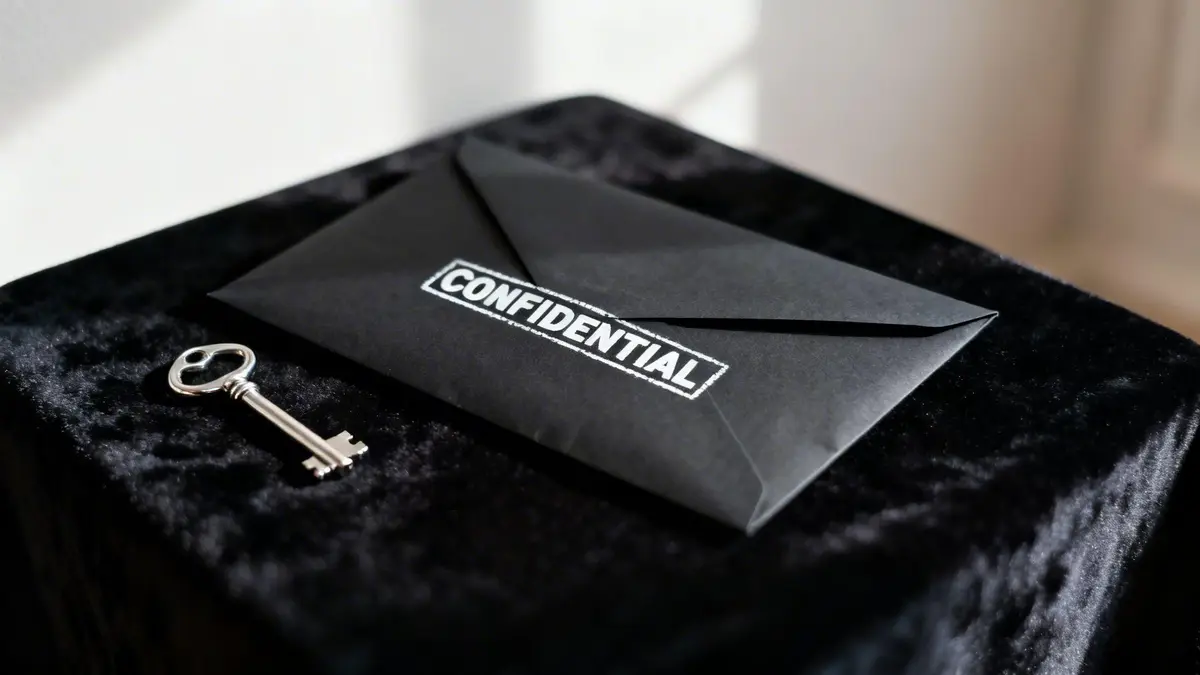
This statement functions as a binding promise. For clients whose reputation or security is at risk, the assurance of confidentiality is non-negotiable. By making it your core brand tenet, you signal that your firm operates under a code of silence, where client engagements are never publicized and sensitive data is sacrosanct. It transforms your service from a commodity into a secure vault.
Strategic Analysis: The Unseen Deliverable
Consider a firm specializing in online content removal whose statement is “We operate with strict confidentiality; our engagements are never made public.” This is a powerful brand statement example that positions their primary deliverable not just as content removal, but as the discreet removal of content. The value is as much in what doesn’t happen (public exposure, case study marketing) as what does.
Strategic Takeaway: This positioning preempts the client’s biggest fear: that hiring a firm to solve a private problem will inadvertently create a public one. It builds trust before the first conversation, assuring prospects that their sensitive issue will be handled with the discretion of attorney-client privilege, even outside a legal context.
When to Use This Statement
This statement is indispensable for any service provider handling information that could be damaging if exposed. It is the gold standard for:
- Private Banking & Wealth Management: To assure high-net-worth individuals that their financial affairs will remain completely private.
- Legal & Advisory Services: To reinforce the sanctity of client privilege and secure client trust in high-stakes litigation or negotiation.
- Reputation Management & Content Removal Firms: To guarantee clients facing public crises that their efforts to secure their online privacy service will not become public knowledge.
- Luxury Concierge & Security Services: To promise high-profile clients that their movements, preferences, and personal details are protected.
Application & Customization
The credibility of this statement rests on operational integrity, not just words. Every client touchpoint must reinforce the message of absolute discretion. Feature your confidentiality agreements, NDAs, and secure communication protocols prominently in your onboarding process. Do not publicize client names or specific case details, even with permission. Use fully anonymized, aggregated data or general scenarios for case studies only. This brand positioning is a deliberate choice to forgo traditional marketing assets like client logos and testimonials in favor of building a reputation for impenetrability. For the right clientele, that silent reputation is the most compelling advertisement you can have.
5. Speed & Efficiency Brand Statement: Action-Oriented Positioning
A brand statement built on speed and efficiency commits your organization to rapid action and measurable results within a compressed timeframe. This positioning is not a mere marketing promise; it is an operational mandate that communicates competence and control, especially in crisis situations where every hour extends reputational damage. It directly addresses the client’s primary anxiety: the loss of control as a negative event unfolds online.

For executives and public figures facing viral leaks, defamatory attacks, or impersonation accounts, a promise of swift action is the most valuable asset. This brand statement example signals that you are not just a service provider but an emergency response unit, equipped to neutralize threats before they metastasize. It transforms an abstract service into a concrete, time-bound solution.
Strategic Analysis: The Crisis Response Guarantee
Consider a reputation management firm like ContentRemoval.com, whose statement centers on a “24-48 hour action” guarantee for content takedown requests. This is not just a service-level agreement; it is the core of their brand identity. They are not selling the possibility of removal; they are selling immediate, decisive intervention.
Strategic Takeaway: When a client is panicking over a defamatory video gaining traction, this statement cuts through the noise. The conversation shifts from “What can you do?” to “When can you start?” It anchors the value proposition to a specific, urgent outcome, making the service feel essential, not discretionary.
When to Use This Statement
This approach is most potent for entities whose value is directly tied to their reaction time and operational effectiveness. It is a critical tool for:
- Crisis Management & PR Firms: To reassure clients that containment of negative press or social media attacks will be immediate.
- Content Removal Services: To establish themselves as a rapid response solution for leaks, piracy, and impersonation.
- Logistics & Delivery Companies: To differentiate on the basis of speed, as seen with Amazon Prime’s delivery model.
- Tech Support & Cybersecurity Firms: To promise quick resolution of system outages or security breaches, minimizing client downtime and risk.
Application & Customization
The credibility of a speed-focused statement hinges on your operational capacity to deliver on it. An unfulfilled promise of speed destroys trust more effectively than no promise at all. Build your internal processes to support the claim. This requires clear escalation protocols, empowered decision-makers, and technology like AI-powered monitoring to enable rapid action. Do not make a universal speed guarantee that ignores external variables. Be clear about factors like jurisdictional complexities or platform response times that can affect the final timeline. Your statement must be both bold and defensible. This brand statement weaponizes time. It projects an image of an organization that is always prepared, systemized for action, and capable of imposing order on a chaotic situation. For a client under pressure, that promise is invaluable.
6. The Multi-Service Integrated Brand Statement: Comprehensive Solutions Positioning
An integrated statement positions your brand not as a provider of a single service, but as an end-to-end solution for a complex problem. This approach bundles multiple capabilities under one unified message, establishing your firm as a single point of contact for clients facing multifaceted crises. It shifts the focus from individual service offerings to the comprehensive outcome you deliver.
For entities in reputation management, this statement signals the capacity to handle intricate scenarios requiring simultaneous interventions. Instead of just offering “de-indexing,” the brand offers a complete system for online threat remediation, from source removal and legal takedowns to dark web monitoring. This positions the firm as a strategic partner, not a tactical vendor.
Strategic Analysis: The One-Stop Mandate
Consider a reputation management firm like ContentRemoval.com, which states it provides “a full suite of services including de-indexing, source removal, defamation takedowns, NCII removal, and dark web monitoring.” This multi-service integrated brand statement example immediately addresses the anxiety of a client facing a coordinated attack. They don’t need to find a separate expert for each issue; they have found the complete solution.
Strategic Takeaway: When a client is under duress, their primary need is to consolidate control. An integrated statement meets this need directly. It prevents decision fatigue and frames your firm as the general contractor for their entire problem, capable of coordinating all necessary specialists.
When to Use This Statement
This statement is essential for organizations whose value lies in managing complexity and offering synergistic solutions. It is a critical positioning tool for:
- Online Reputation & Content Removal Firms: To demonstrate the ability to manage multifaceted crises involving legal, technical, and investigative components.
- Management Consulting & Advisory Firms: To package audit, strategy, and implementation services into a single, high-value offering, similar to McKinsey or Deloitte.
- Full-Service Law Firms: To communicate expertise across litigation, transactional, and regulatory practice areas.
- Technology Companies: To sell a platform ecosystem (e.g., Salesforce) rather than standalone software products.
Application & Customization
The credibility of an integrated statement rests on demonstrating genuine synergy, not just listing services. Frame the services as an interconnected system. Create packages for common scenarios like “Executive Impersonation Response” that combine digital forensics, content removal, and personal brand restoration. Do not simply create a laundry list of capabilities. The value is in the integration, not the individual parts. A statement that feels disjointed will undermine client confidence. This brand statement serves as a powerful qualifier. It signals to sophisticated clients that you understand the full scope of their challenge and have built the operational capacity to resolve it completely.
7. The Founder-Led Statement: Visionary Leadership Positioning
A founder-led brand statement ties the company’s identity directly to the personal reputation, expertise, and vision of its leader. This approach transforms the founder from a corporate figurehead into the primary brand asset, positioning their personal commitment as the ultimate guarantee of quality and integrity. It is especially potent for service-based businesses where trust is the core commodity.
By making the founder the face of the brand, you create a direct, personal connection with your audience. This brand statement example is not merely about telling a founder’s story; it is about making that story the central pillar of the company’s value proposition. Leadership’s expertise becomes the brand’s defensible moat.
Strategic Analysis: The Embodiment of Trust
Consider Frankie Lee’s role at ContentRemoval.com. The brand statement is built around Lee’s documented expertise in digital privacy and rapid, confidential content takedowns. The firm’s value is not an abstract corporate promise; it is a direct extension of Lee’s personal capability and professional track record.
Strategic Takeaway: When a high-stakes client needs to erase sensitive information from search results, they are not buying a generic service. They are retaining Frankie Lee’s specific, proven methodology. This founder-led positioning shortcuts the trust-building process and justifies a premium price point, as clients are paying for access to a recognized expert, not just a company.
When to Use This Statement
This statement is most effective when personal expertise and credibility are critical differentiators in the market. It is a necessary strategy for:
- Premium Service Providers: Firms in sectors like reputation management, legal services, or high-end consulting where the principal’s reputation is the main reason for client selection.
- Tech Companies: To personify complex technology through a visionary leader, as seen with Steve Jobs at Apple or Elon Musk at Tesla.
- Luxury Brands: To infuse the brand with the founder’s unique taste, standards, and personal story.
Application & Customization
The founder’s brand must be authentic and consistently reinforced through action. A manufactured persona will quickly collapse under scrutiny. Systematically build the founder’s thought leadership through media appearances, published articles, and speaking engagements that showcase genuine expertise. For instance, a founder focused on reputation defense might author a guide on strategic Google search removal. Do not allow a disconnect between the founder’s public statements and the company’s operational reality. A founder championing transparency cannot run a company with opaque business practices. This statement anchors the abstract value of a service to a tangible, credible human being. It answers the client’s underlying question: “Who can I trust to solve this problem?” By positioning the founder as the definitive answer, the brand establishes an immediate, powerful advantage.
8. The Outcome-Guarantee Statement: Results-Focused Assurance Positioning
An outcome-guarantee statement shifts the focus from effort and process to concrete, measurable results. It is a powerful positioning tool that signals absolute confidence in your capabilities, assuring clients that you stand behind your work with a specific, guaranteed outcome. This approach is particularly effective for risk-averse clientele who require certainty, not just a promise of “best efforts.”
This brand statement example is not about marketing slogans; it is about building a business model where your success is directly tied to the client’s. It replaces vague assurances with a binding commitment, whether that’s a leak-free roof for 20 years, a defamatory article permanently removed from search results, or a specific performance metric met. This positions the brand as a partner whose interests are perfectly aligned with those of the client.
Strategic Analysis: The Certainty Contract
Consider a content removal firm that guarantees not just the takedown of a harmful article, but also its continued absence through monitoring. Their brand statement isn’t about their methods; it’s about the client’s new reality: “We commit to the complete and permanent removal of damaging online content, with continuous monitoring to prevent its reappearance.”
Strategic Takeaway: This statement transforms a service into a solution. The conversation is no longer about the process, which can be complex and uncertain. Instead, it revolves around the final, guaranteed state of affairs. This is a definitive brand statement example that minimizes perceived risk and justifies a premium price point.
When to Use This Statement
This statement is most potent for services where the outcome is the only thing that matters and the process is secondary to the client. It is a critical tool for:
- Reputation Management & Content Removal Firms: To provide certainty to clients facing high-stakes reputational threats, such as ContentRemoval.com.
- Legal Service Firms: To offer outcome-based arrangements in specific practice areas, assuring clients of results in otherwise uncertain proceedings.
- Performance-Based Agencies: To align their compensation with client success, guaranteeing metrics like lead generation or sales growth.
- High-End Contractors: To justify premium pricing by guaranteeing the longevity and performance of their work, like a “no-break” appliance warranty.
Application & Customization
The credibility of this statement rests entirely on your ability to deliver. A broken guarantee destroys reputation far more effectively than a vague promise ever could. Build operational redundancies and robust monitoring systems to support your guarantee. Your internal processes must be strong enough to make the guarantee a formality, not a risk. Do not make a guarantee you cannot operationally or financially support. The language must be clear, with specific terms and resolutions defined in case the outcome is not met. This statement is a declaration of mastery. It communicates that your organization has such command over its domain that it can absorb the client’s risk entirely, offering them the one thing their situation demands: certainty.
8-Point Brand Statement Comparison
| Brand Statement | Implementation complexity | Resource requirements | Expected outcomes | Ideal use cases | Key advantages |
|---|---|---|---|---|---|
| Mission-Driven Brand Statement: Purpose-First Reputation Protection | Medium: align mission, processes, and messaging organization-wide | Training, consistent marketing, measurable SLAs, culture change | Emotional connection, trusted premium brand, loyal clients | Executives and public figures needing discreet, values-driven protection | Differentiation by purpose; justifies premium pricing; builds trust |
| Authority-Based Brand Statement: Industry Expertise & Credibility | High, sustained thought leadership and verifiable results | Legal experts, proprietary tech, research, case studies, PR | Immediate credibility, barrier to entry, premium client attraction | High-net-worth clients, complex legal/technical cases, enterprise accounts | Strong credibility; defensible positioning; attracts top-tier clients |
| Solution-Oriented Brand Statement: Problem-Solving Focus | Low-Medium, focus messaging and proof on specific outcomes | Clear delivery workflows, monitoring tools, outcome case studies | Fast buyer understanding, higher conversion for acute problems | Clients with defined urgent issues (defamation, leaks, impersonation) | Clear value proposition; easy to sell; measurable results |
| Trust & Confidentiality-Based Brand Statement: Privacy-First Positioning | High: strict processes, legal frameworks and cultural safeguards | Security systems, NDAs, encryption, staff training, legal counsel | Attracts sensitive clients, long-term retention, willingness to pay premium | Family offices, celebrities, executives with sensitive matters | Differentiation on privacy; high client trust and retention |
| Speed & Efficiency Brand Statement: Action-Oriented Positioning | High, operational changes to guarantee rapid response | 24/7 teams, AI monitoring, automated workflows, escalation protocols | Rapid removals, strong appeal in crises, memorable promise | Time-sensitive viral incidents and fast-spreading reputational threats | Clear, memorable promise; competitive edge in urgent situations |
| Multi-Service Integrated Brand Statement: Comprehensive Solutions Positioning | Very high: integrate teams, processes and technology across services | Cross-functional teams, unified platform, broader organizational scale | Holistic protection, higher lifetime value, simplified client experience | Complex, multi-channel reputation problems requiring ongoing management | One-stop solution; upsell/cross-sell opportunities; holistic outcomes |
| Founder-Led Brand Statement: Visionary Leadership Positioning | Medium. Build and maintain founder visibility and credibility | Founder PR, thought leadership, media appearances, direct-access processes | Strong personal trust, emotional connection, niche premium clients | Clients who value direct founder involvement and leadership trust | Personal credibility; strong differentiation; deep client relationships |
| Outcome-Guarantee Brand Statement: Results-Focused Assurance Positioning | Very high: legal review, operational redundancy, clear terms | Robust ops, continuous monitoring, financial reserves, legal safeguards | High buyer confidence, increased conversions, aligned incentives | Risk-averse executives and family offices demanding certainty | Powerful sales differentiator; reduces perceived risk; performance alignment |
From Statement to Strategy: Executing Your Narrative Control
The brand statement frameworks analyzed are not theoretical exercises. They are tactical instruments for asserting and maintaining narrative control. A Mission-Driven Statement anchors a reputation in purpose, an Authority-Based Statement solidifies industry leadership, and a Solution-Oriented Statement positions a brand as the definitive answer to a specific problem. Each brand statement example serves a distinct strategic function, from projecting confidentiality to guaranteeing specific outcomes.
For the executives, public figures, and family offices we serve, a brand statement is the strategic core from which all communications and actions radiate. It is the directive that informs legal strategy, public relations, and internal policy. It establishes the definitive narrative before a crisis can impose one upon you. A well-constructed statement acts as a pre-emptive defense, a clear signal to the market, the media, and malicious actors of who you are and what you stand for.
Synthesizing the Frameworks for Active Defense
The true power of these models is realized when they are not merely adopted but executed with discipline. Consider the Founder-Led Statement; its strength lies in its direct connection to a leader’s vision, making it a powerful tool in countering impersonation or misrepresentation. Similarly, the Trust & Confidentiality-Based Statement is a non-negotiable for family offices and HNWIs, creating a perimeter of discretion that deters unwanted scrutiny.
Your next steps should be a critical self-assessment. First, audit your current narrative. Does your existing public-facing language align with one of these high-stakes models? Is it ambiguous, reactive, or inconsistent across platforms? Second, identify your primary vulnerability. Are you fending off impersonators (requiring an Authority-Based approach) or managing sensitive information leaks (requiring a Trust & Confidentiality focus)? Your greatest risk dictates your strategic choice. Finally, pressure-test the chosen framework. Draft responses to potential crisis scenarios using the statement as your guide. If the language feels weak or inadequate, the framework is wrong.
This is not a branding exercise; it is an essential component of modern risk management. A vague or poorly aligned brand statement leaves your reputation exposed. It creates a vacuum that misinformation, negative content, and adversarial narratives will rush to fill. The difference between a controlled reputation and a compromised one often begins with the clarity and conviction of a single, powerful statement.
Choosing and implementing the right framework is a critical executive function. It demands precision, foresight, and an unsparing assessment of potential threats. The work is not in writing the statement itself, but in embedding it so deeply into your operational DNA that it becomes an automatic, unshakeable defense. For those whose digital legacy is an asset under constant threat, mastering this discipline is not optional. It is the foundation of enduring influence and security.
Your brand statement defines the narrative; our expertise ensures it is the only one that prevails. If your reputation is threatened by negative, false, or misleading online content that contradicts your official position, the team at ContentRemoval.com can help. We specialize in the surgical removal of damaging material, reinforcing the strategic narrative you have worked to build. Contact us for a confidential consultation.
Frequently asked questions
What is a brand statement for an executive or public figure?
It is a precise, authoritative declaration of who you are and what you stand for, built to control the public narrative before a crisis imposes one. The article treats it as a risk management instrument that informs legal strategy, public relations and internal policy.
How do I choose which brand statement framework to use?
Audit your current public language for ambiguity or inconsistency, then identify your primary vulnerability. Impersonation points toward an authority-based approach, sensitive information leaks toward trust and confidentiality positioning, and urgent client problems toward a solution-oriented statement.
What makes a founder-led brand statement credible?
Authenticity reinforced through action: published articles, media appearances and speaking that show genuine expertise, with no gap between the founder’s public statements and how the company operates. The article uses Frankie Lee’s role at ContentRemoval.com as its example.