
A brand protection service is an operating function that detects abuse early across search, social, marketplaces, domains, app stores and messaging, validates what matters with human review, and enforces removal through the route that fits each channel and jurisdiction. The goal is control, measured by time to detection, time to takedown, success ratio and recurrence rate, not takedown volume.
Key facts
- Coverage should span impersonation and phishing, counterfeit and grey-market sales, executive impersonation, asset abuse and unified case management.
- Threats are triaged into immediate harm, commercial interference and reputational contamination categories.
- The first ninety days should establish a verified inventory of marks, domains, executive identities and escalation rights.
- Platform complaints, trademark notices, registrar actions and court remedies each run on different standards of proof and timelines.
Where ContentRemoval.com comes in. ContentRemoval.com is the removal specialist within a brand protection program, taking on executive impersonation accounts, fake statements circulating to journalists, cloned sites and the search results that carry them, discreetly and with recurrence monitoring. Legal, security and communications leads usually engage the firm when three teams are working the same incident from separate queues. A free 15-minute Exposure Scan maps what is removable, and the report is yours to keep. Get a Free, Confidential Exposure Scan or read how our content removal work is done.
A director gets a message before breakfast. Sales has found a cluster of counterfeit listings on a major marketplace. Legal has flagged a new domain using the company name. Communications has spotted an impersonation account pushing a fake statement to journalists and customers. By 9 a.m., three teams are working the same problem from different angles, none of them sharing a common dashboard, and the board wants to know one thing: who is in control?
That situation isn’t unusual. It’s the default condition for a visible brand with revenue, reputation, or executive profile worth exploiting. The threat rarely arrives as a single clean legal issue. It arrives as noise across search, marketplaces, social platforms, messaging channels, rogue websites, and copied content. If your organization is still treating this as a series of isolated takedowns, you’re already behind.
A modern brand protection service exists to impose order on that chaos. Properly run, it’s not a clerical support function. It’s a disciplined operating capability that detects abuse early, validates what matters, escalates the right cases, and removes harmful content through coordinated enforcement.
The Inevitable Digital Threat
The first sign is often small. A customer support lead forwards a screenshot of a fake seller. Then a journalist asks whether an executive really posted a hostile comment from a new social profile. Then paid search performance drops because a fraudulent ad has started siphoning branded traffic. By the time the issue reaches the board, the damage isn’t theoretical. Customers are confused, counterparties are asking questions, and your internal teams are improvising.
That pressure is exactly why executives misdiagnose the problem. They assume they need a few urgent takedowns, a statement from communications, and perhaps a letter from outside counsel. Those responses may be necessary, but they don’t amount to control. They amount to reaction.
Fragmented exposure is the issue. Bad actors don’t care how your org chart works. They move between channels fluidly. A fake account on one platform points users to a spoofed domain. A marketplace listing uses stolen creative from your website. A messaging group amplifies the scam. If your team wants a useful primer on understanding Telegram’s illicit use, that context helps explain why closed or semi-closed channels often become part of the brand abuse chain.
What the board should recognize early
A brand threat becomes an executive issue when any of the following are true:
- Customer trust is at risk. Impersonation, phishing, and counterfeit sales don’t stay confined to one platform.
- Revenue is being diverted. Fake listings, unauthorized sellers, and deceptive ads interfere directly with conversion.
- The response is fragmented. Legal, security, PR, and e-commerce are acting separately and slowing each other down.
You don’t have a monitoring problem. You have a coordination problem.
For many boards, the warning signs show up long before a full incident. If that feels uncomfortably familiar, these signs that your online reputation is at risk usually appear before the abuse reaches mainstream visibility.
A serious brand protection service is the answer because it turns scattered reaction into a managed function. That’s the threshold. Not whether something harmful exists online, but whether your business can detect it, assess it, and shut it down fast enough to matter.
Defining the Modern Brand Protection Service
A board that still treats brand protection as a legal support task is already behind. The current threat is distributed, persistent, and commercial. It hits search, social, marketplaces, messaging apps, app stores, domains, and closed communities at the same time.
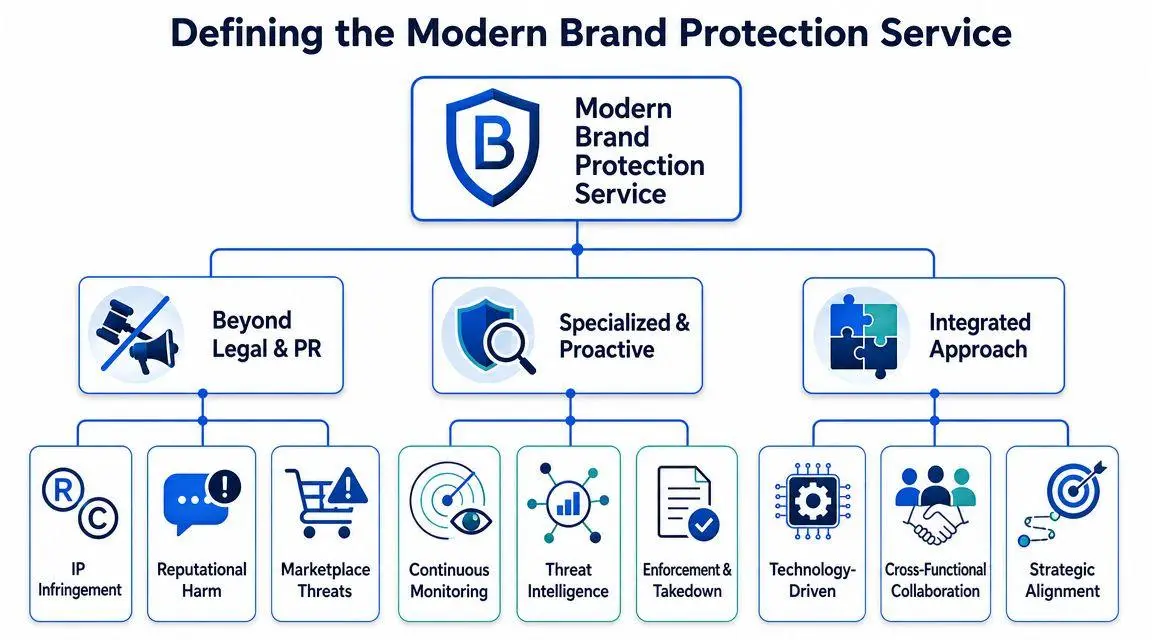
A modern brand protection service is an operating function built to detect abuse early, verify what matters, and enforce action across every channel where your customers and partners can be misled. The objective is not a high volume of takedowns. The objective is control. That means reducing mean time to detect, reducing time to takedown, and limiting revenue loss, fraud exposure, and reputational damage. BlueVoyant’s overview of technically mature brand protection services captures that broader operating model well.
What changed
The field matured because the threat matured. Abuse no longer sits in one obvious place waiting for a legal notice. A scam can start with a spoofed ad, move to a fake domain, convert through a marketplace listing, and spread through a private messaging channel before a brand team has aligned internally.
That is why a serious service has three functions working together. First, continuous monitoring across fragmented digital channels. Second, analyst validation so your team does not waste time on false positives or low-impact noise. Third, enforcement that matches the channel, the abuse type, and the jurisdiction. If a provider cannot explain how those three parts work together, you are buying a takedown vendor, not a risk-control function.
Prevention matters as much as removal. The strongest programs identify repeat actors, abuse patterns, weak points in channel coverage, and enforcement bottlenecks. That is what allows leadership to manage the issue through operational KPIs instead of anecdotes.
What the service must cover
Coverage has to reflect how attacks spread. A modern service should handle:
- Impersonation and phishing threats across domains, social accounts, paid ads, and messaging environments
- Counterfeit and grey-market activity on marketplaces, reseller networks, and affiliate channels
- Executive and employee impersonation that targets customers, suppliers, or internal payment flows
- Abuse of brand assets such as logos, product imagery, copied site content, and fake mobile apps
- Unified case management and enforcement so legal, security, e-commerce, and communications are not working from separate queues
This is the executive test. Can one partner give you a single view of risk across channels, set priorities based on business impact, and drive consistent enforcement? If not, the service is incomplete.
Trademark rights still matter. They are the basis for many enforcement actions. But rights without operational coverage leave the business exposed for too long, especially when threats move faster than legal review cycles.
If your team needs a broader publisher resource on strategy, selection criteria, and service scope, this guide to online brand protection services is a useful companion.
The Core Operational Workflow Explained
A credible provider should be able to explain its operating model without hiding behind jargon. If they can’t, assume the workflow is weak.
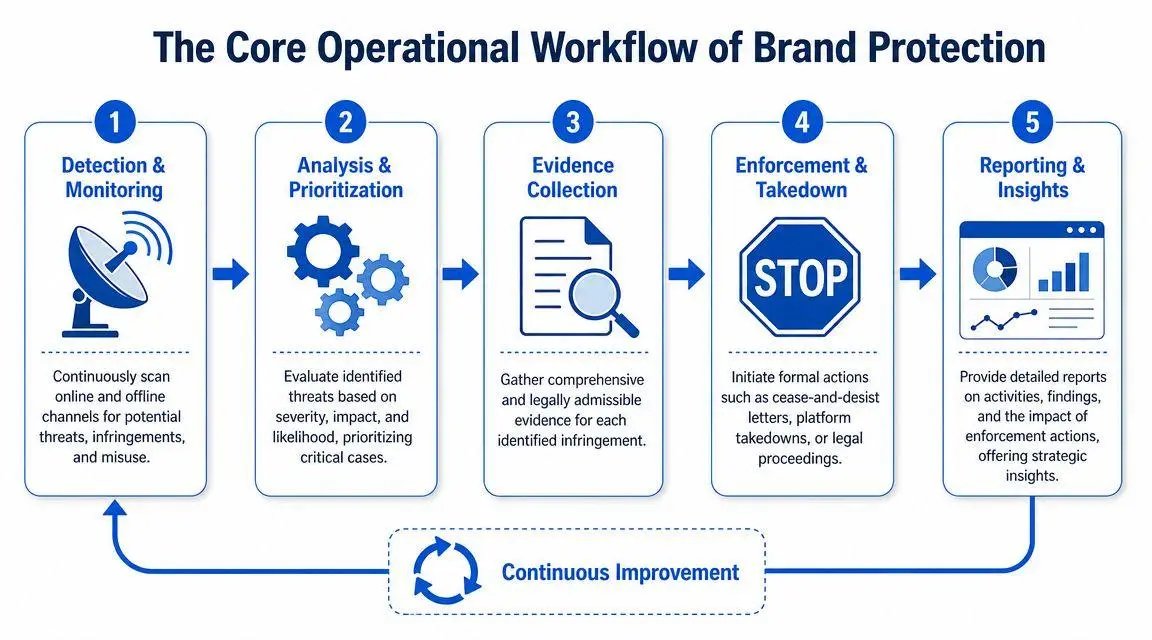
The cycle starts with coverage, not with complaints. Good teams scan continuously because bad actors don’t wait for your quarterly review. They look for impersonation profiles, counterfeit listings, deceptive domains, copied content, fake apps, and abuse patterns that indicate coordinated fraud.
Detection and prioritization
Detection alone has limited value. The key question is whether alerts are triaged intelligently. A fake profile with no reach doesn’t deserve the same urgency as a phishing domain targeting customers or a counterfeit listing attached to a flagship product line.
The best programs use a structured queue. Threats are sorted by likely customer harm, revenue impact, jurisdictional complexity, executive sensitivity, and channel velocity. That’s how a provider avoids wasting time on low-value removals while a live fraud campaign keeps running.
A disciplined review usually separates threats into categories such as:
- Immediate harm cases. Phishing, executive impersonation, payment diversion, and dangerous counterfeit goods.
- Commercial interference cases. Unauthorized sellers, fake ads, affiliate abuse, and search diversion.
- Reputational contamination cases. Fake social accounts, manipulated reviews, copied media, and coordinated disinformation.
Validation and evidence
Automation should find candidates. Humans should decide what to do with them.
Mediocre providers fail by over-removing, misclassifying legitimate resellers, or submitting weak notices that platforms ignore. Strong operators validate ownership, context, and channel rules before acting. They gather screenshots, capture listing details, preserve timestamps, and build evidence packages that can support platform notices, registrar complaints, marketplace escalation, or formal legal action if needed.
A fast but sloppy takedown program creates a second problem. It alienates legitimate partners and weakens your credibility with platforms.
That validation layer matters most in gray areas. An unauthorized seller may not be counterfeit. A fan account may be annoying but lawful. A copied image may support a stronger claim than a copied product description. This is why brand protection sits at the intersection of legal judgment, platform fluency, and operational speed.
To see one external perspective on the workflow, this video gives a useful overview:
Enforcement and recurrence control
Enforcement is multi-channel by necessity. The route for a marketplace listing isn’t the route for a social impersonation account, and neither resembles a registrar or hosting complaint. Providers need channel-specific playbooks, not a generic template library.
A mature workflow ends with re-monitoring. If a listing reappears under a new seller name, if a domain migrates to another host, or if the same actor opens mirror accounts, the system should catch recurrence quickly. Otherwise you’re paying for a revolving door.
That’s the operational core. Detect. Prioritize. Validate. Enforce. Monitor again. Any provider who can’t explain those stages clearly is asking you to buy effort without control.
Measuring Success Business Value and KPIs
A board usually learns the true cost of weak brand protection after a preventable incident. Customer complaints spike. Support queues fill. Sales teams get pulled into channel disputes. Legal is forced into reactive cleanup. At that point, the issue is no longer infringement. It is operational failure.
The metrics that belong on the dashboard
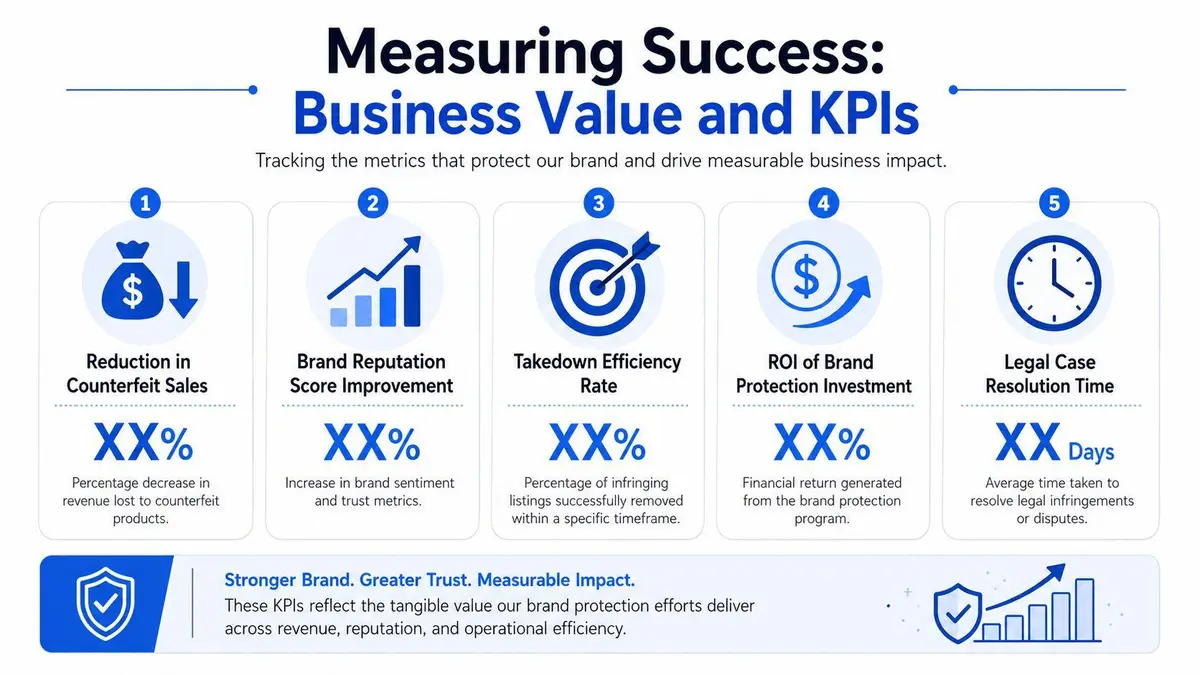
Treat brand protection as an operating function and measure it the same way. The board does not need a long list of removals. It needs evidence that the company can find harmful activity quickly, act on it fast, and reduce business impact across fragmented channels.
As noted earlier, market growth in this category reflects a simple shift in buying behavior. Executives now expect measurable performance, not anecdotal success stories.
A useful dashboard should usually include:
| KPI | What it tells you | Why it matters |
|---|---|---|
| Mean time to detection | How quickly new abuse is identified | Delayed detection gives fraud, impersonation, and counterfeit activity time to spread |
| Time to takedown | How long enforcement takes after validation | Faster action reduces customer exposure, support burden, and reputational fallout |
| Takedown success ratio | How often enforcement results in removal | High activity with weak removal rates is cost without control |
| Fraud loss prevented | Estimated commercial harm avoided | This ties the program to direct financial protection |
| Recurrence rate | How often the same threat actor or asset returns | A low recurrence rate shows the provider is disrupting abuse, not just clearing symptoms |
Two KPIs deserve special attention. MTTD shows whether your provider can see across domains, marketplaces, social platforms, and other channels fast enough to matter. TTTD shows whether they can convert detection into enforcement without delay. Those are executive metrics because they measure exposure window.
What business value actually looks like
Return on investment should not be framed as direct recovery alone. That is too narrow and usually misleading. Value sits in avoided losses, fewer customer harm events, lower support volume, less channel conflict, reduced legal escalation, and less executive time wasted on incidents that should have been contained earlier.
One serious impersonation case can trigger investor questions, staff confusion, media risk, and downstream fraud attempts. One counterfeit seller can create refunds, chargebacks, safety complaints, and retailer friction. Count outcomes, not activity.
Report activity to management. Report exposure reduction to the board.
That distinction matters. Fifty low-value removals can look productive and still leave the company exposed if a high-risk domain, app listing, or executive impersonation account stayed live for days. Good reporting makes priorities visible. Bad reporting hides them behind volume.
If your team is building the financial case, this strategic framework for justifying the cost of online monitoring services is a practical starting point.
Questions to ask when KPIs look strong
Strong numbers can mask weak coverage or loose definitions. Press the provider on the mechanics behind the scorecard.
- What qualifies as a detection? A provider should count newly identified, relevant threats, not recycled cases or obvious abuse that sat unaddressed.
- What qualifies as a takedown? Temporary suppression, partial deindexing, and durable removal are different outcomes and should be reported separately.
- How is prevented loss estimated? You need a defensible method tied to incident type, channel, and likely business impact.
- What is the recurrence rate by channel? Repeat abuse on marketplaces, domains, and social platforms shows whether enforcement is sticking.
- Which functions benefit? Legal, security, e-commerce, communications, and customer support should all see measurable value.
The right provider should also help your team streamline operations with AI agents where triage, escalation, and reporting can be standardized without losing judgment. That matters because fragmented threats cannot be managed well through disconnected workflows and manual spreadsheets alone.
Selecting a Strategic Brand Protection Partner
A board usually discovers the weakness in its provider model during a live incident. A fake executive account appears on social media, counterfeit listings surface on a marketplace, a typo domain starts collecting credentials, and customer support sees the fallout before legal gets a clear picture. If your provider can only process isolated takedowns, you do not have brand protection. You have fragmented vendor activity.
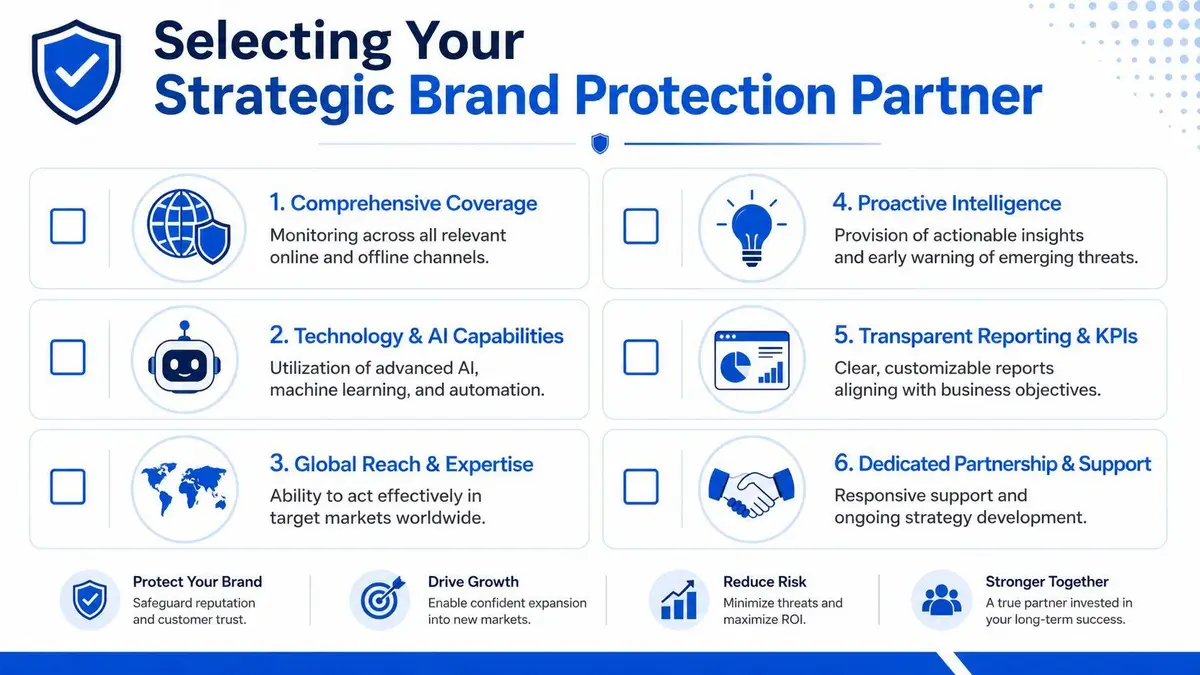
That is the selection problem. The right partner operates as a unified enforcement function across channels, with clear ownership of detection, validation, escalation, and removal. The wrong partner excels in one environment and leaves gaps everywhere else. Fragmented threats require coordinated action across domains, social platforms, marketplaces, app stores, messaging apps, and other abuse points, as discussed in Doppel’s analysis of brand protection concepts and channel fragmentation.
The criteria that actually matter
Start with operating capability, not sales coverage maps. A strategic partner should show that it can reduce time to detect and time to disrupt across your highest-risk channels, then report that performance in a way the board can use.
Use this screening framework:
- Unified cross-channel enforcement. One team should be able to connect impersonation, counterfeit sales, rogue domains, paid search abuse, and copied content into a single incident picture.
- Clear prioritization logic. The provider must separate revenue risk, fraud risk, and reputation risk, then act in that order. If every alert is urgent, nothing is.
- Evidence quality and validation discipline. Weak evidence slows platform action and creates false positives. Ask who validates cases, what proof is gathered, and how edge cases are reviewed.
- Operational KPIs. Require reporting on MTTD, TTTD, closure rates, recurrence by channel, and backlog by severity. Screenshot-heavy reports are not management information.
- Jurisdiction and platform fluency. Enforcement depends on knowing how different platforms and markets respond, who can escalate, and what documentation gets results.
- Executive ownership. You need a partner that can brief legal, security, e-commerce, and communications in one language. That language is business risk.
What to reject quickly
Reject providers that sell volume instead of outcomes. High alert counts, generic AI claims, and activity reports with no proof of durable removal usually signal a weak operating model.
The same applies to structural gaps:
- Siloed channel teams. Separate groups for social, marketplaces, and domains create delay, duplication, and missed patterns.
- No incident command model. If nobody owns the full case from detection through enforcement, response quality will break under pressure.
- No board-ready reporting. Your internal team should not have to translate vendor output into business terms after the fact.
- No view on recurrence. If the provider cannot show whether abuse returns after action, it cannot show whether enforcement is working.
Buy a partner that can run an operating system for brand risk.
Automation has a place inside that system. It can speed triage, routing, evidence collection, and case management. If your operations team is assessing how to streamline operations with AI agents, use that to improve workflow discipline and response speed. Do not confuse automation with strategy or judgment.
In practice, many organizations also need a specialist that can remove harmful material discreetly across search, websites, and social platforms. ContentRemoval.com is one example of a provider focused on takedowns, impersonation, and digital reputation remediation. Treat that kind of capability as one component of the decision. Select the partner whose operating model matches your threat profile, reporting needs, and executive risk priorities.
Understanding Timelines Costs and Legal Nuances
A board approves a brand protection budget after a public incident. Three weeks later, directors ask why the fake domains are still live, why marketplace abuse keeps resurfacing, and why legal says some actions will take months. That tension is predictable. It comes from treating brand protection as a one-speed takedown service instead of an operating function with different response paths, legal thresholds, and cost drivers.
The right question is not, “How fast can you remove content?” It is, “How quickly can you detect, validate, and drive the right enforcement action across channels, and what does that operating model cost us by risk tier?”
A brand protection service should be budgeted like a risk program. Price follows scope, volume, and complexity. The biggest drivers are brand and product breadth, executive exposure, channel coverage, geographic spread, evidentiary requirements, and the share of cases that need legal escalation instead of standard platform enforcement.
What the first ninety days should look like
Expect a staged build.
In the first month, the provider should establish the baseline. That means a verified inventory of marks, domains, executive identities, priority products, official accounts, top marketplaces, known bad actors, and existing escalation rights. If that foundation is weak, every later KPI will be distorted, including MTTD and time to takedown.
The next phase should prove operational control. Detection should be tuned against your highest-cost threats. Validation rules should separate harmful impersonation from noise. Enforcement routes should be tested across the channels that matter most to revenue and trust. You are checking whether the provider can run a disciplined response cycle, not whether it can generate a large queue of alerts.
By the end of the ninety-day period, you should have stable workflows, consistent reporting, and a clear picture of where delays sit. Some delays will be internal approval bottlenecks. Some will sit with platforms. Some will sit with legal process. A serious partner makes those constraints visible and manages them, rather than hiding behind activity metrics.
Why costs vary more than buyers expect
Cost rises sharply when the threat is fragmented.
A single-brand business selling in one market may need limited marketplace and social coverage with periodic legal support. A multinational business facing counterfeit risk, executive impersonation, affiliate abuse, rogue apps, domain fraud, and repeat offenders needs continuous monitoring, cross-channel case management, and repeat-enforcement discipline. Those are different operating models.
As noted earlier, large-scale programs often shift from ad hoc removals to prevention, recurrence tracking, and systemized enforcement. That change increases cost, but it also reduces waste. Boards should prefer a partner that can show where spend reduces repeat abuse, compresses detection time, and lowers exposure in the channels that matter most.
Cheap coverage usually means one of three things. Narrow channel visibility, weak validation, or poor follow-through after the first takedown.
The legal reality boards need to hear
Legal nuance affects speed, cost, and outcome.
Platform complaints, trademark notices, copyright claims, registrar actions, customs support, and court-backed remedies all run on different standards of proof and different service levels. Some cases can move in hours. Others need a stronger evidentiary file, local counsel, or repeated escalation before anything happens. Jurisdiction matters. So does the quality of the rights documentation behind the case.
Privacy rules matter too, especially when a case involves personal data, impersonation, doxxing, or account compromise. Teams handling those matters should understand the important GDPR information for users and know when evidence collection, data sharing, or notice procedures need tighter control.
The board-level instruction is simple. Demand clear service levels by case type, channel, and jurisdiction. Ask what can be removed quickly, what typically stalls, what requires legal escalation, and what success rate the provider achieves on first action versus repeated action. If a vendor cannot answer at that level, it is selling labor, not risk reduction.
Executive FAQ on Brand Protection Services
Is this a legal function or a security function
It’s both, and neither team should own it alone. Legal provides rights and escalation pathways. Security understands adversary behavior and digital exposure. Communications manages external fallout. E-commerce sees commercial leakage. A serious program coordinates all of them under one operating model.
Can our internal team handle this without a specialist
Internal teams should own policy, priorities, and sign-off. They usually shouldn’t own full-time cross-channel monitoring and enforcement unless the threat level is unusually low. Most in-house teams are too siloed and too capacity-constrained to maintain continuous detection, validation, evidence handling, and platform enforcement at speed.
What should we prioritize first
Start where harm compounds fastest. Executive impersonation, phishing, dangerous counterfeits, and high-visibility marketplace abuse usually deserve immediate attention. Low-impact misuse can wait. The mistake is trying to clean the entire internet at once.
The right first move is rarely “remove everything.” It’s “stop the things most likely to injure customers, revenue, or trust.”
How do we avoid over-enforcement
Use validation rules before action. Distinguish counterfeit from unauthorized resale. Distinguish harmful impersonation from commentary or parody. Distinguish copied content from nominative use. Overreach creates commercial and legal friction you don’t need.
How should the board govern this function
Set risk appetite, approve core KPIs, define escalation thresholds, and require periodic reporting that links operational results to business outcomes. If reporting can’t show speed, effectiveness, and recurrence patterns, governance is weak.
Does privacy regulation affect brand protection work
Yes, especially when a program handles personal data, executive profiles, customer complaints, and cross-border evidence. Counsel and providers need to align on lawful processing, retention, and disclosure practices. If your team needs a straightforward reference point on privacy obligations, this guide to important GDPR information for users is a useful starting document.
A brand protection service is worth the investment when it gives leadership control over a risk category that would otherwise remain fragmented, reactive, and expensive. If it doesn’t produce that control, it isn’t mature enough.
If your company is dealing with impersonation, counterfeits, leaks, malicious content, or coordinated online abuse, ContentRemoval.com can assess the threat discreetly and build an action plan around removal, enforcement, and ongoing monitoring. For boards, executives, and legal teams under pressure, the value is clarity: what can be removed, how fast action can begin, and what it will take to keep the issue from resurfacing.
Frequently asked questions
Should legal or security own brand protection?
Both, and neither alone. Legal supplies rights and escalation pathways, security understands adversary behavior, communications manages external fallout and e-commerce sees the commercial leakage. The article recommends one operating model coordinating all four.
What should a company prioritize first in brand protection?
Start where harm compounds fastest: executive impersonation, phishing, dangerous counterfeits and high-visibility marketplace abuse. Low-impact misuse can wait, and trying to clean the whole internet at once is the common mistake.
How do you avoid over-enforcing against legitimate sellers or fan accounts?
Apply validation rules before any action. Distinguish counterfeit from unauthorized resale, harmful impersonation from commentary or parody, and copied content from nominative use. Sloppy takedowns alienate legitimate partners and weaken credibility with platforms.