
Online brand protection solutions should be evaluated like a security function, not a media relations one. Modern brand abuse behaves as an adversarial campaign of impersonation, cloned sites, counterfeit listings, and coordinated complaints, so the program needs detection at scale, human validation, enforcement across platforms, hosts, marketplaces, and ad networks, recurrence monitoring, and executive reporting.
Key facts
- Threat chain: impersonated executives, lookalike domains, counterfeit marketplace listings, fake reviews, and synthetic video
- Workflow runs detection and enrichment, human validation, enforcement, then monitoring after removal
- Netcraft notes malicious assets such as phishing domains can disappear within 24 hours, so speed is operational
- KPIs: mean time to detection, time to takedown, takedown success ratio, and threat recurrence rate
Where ContentRemoval.com comes in. ContentRemoval.com operates in the removal and digital crisis segment of this market: impersonation takedowns, de-indexing, harmful content removal, and monitoring where abuse spans search, websites, and social platforms. The head of security, the general counsel, or a family office principal usually makes contact once a fake profile or cloned site has started reaching investors or clients. A free 15-minute Exposure Scan maps what is removable, and the report is yours to keep. Get a Free, Confidential Exposure Scan or read how our content removal work is done.
A client calls after midnight. Someone has built a convincing social profile in his name, copied his biography, lifted family photos, and started messaging investors. By morning, there’s a cloned website, a fake interview clip, and a support inbox filling with confused replies from people who think they’ve been speaking to him directly.
That isn’t a publicity issue. It’s an active threat.
Most executives still approach this category with the wrong instincts. They ask whether a PR team should respond, whether legal should send a letter, whether the platform will cooperate, whether the false content will “blow over.” Serious attackers rely on that hesitation. They know reputation harm now travels through fraud channels, not just search results. They exploit your name, your company, your likeness, your products, and your authority as attack infrastructure.
If you’re reading this because your company, your family office, or your personal profile has already been targeted, the right response isn’t cosmetic cleanup. It’s controlled, continuous threat suppression. That means detection, evidence preservation, takedown, recurrence monitoring, and executive reporting that tells you whether the threat is being contained.
Online brand protection solutions should be evaluated the same way you’d evaluate a security function. Not by how polished the dashboard looks, and not by how many alerts it generates. By whether it reduces exposure, shortens the life of malicious assets, and prevents the same actor from returning under a new identity two hours later.
When Your Name Becomes a Weapon
A high-profile client usually notices the attack late. Not because the abuse was subtle, but because it was fragmented. One fake account appears on a social platform. A lookalike site follows. Then paid ads begin directing traffic to the clone. Someone uploads a synthetic video or a fabricated endorsement. Separate incidents on paper. One coordinated operation in reality.
That distinction matters. If your team treats each asset as an isolated complaint, the attacker keeps initiative. They rotate domains, rebuild profiles, relaunch ads, and test new hooks while internal teams debate ownership. Marketing sees a brand problem. Legal sees infringement. Security sees phishing. None of them, on their own, runs the whole play.
The executive exposure is personal
For founders, chairpersons, investors, public figures, and family offices, the attack surface is unusually broad. Your public credibility is the asset being converted into money, access, or influence. A fake product listing damages revenue. A synthetic executive message can trigger wire fraud, investor confusion, or regulatory scrutiny. A cloned family-related account introduces a different category of risk altogether.
Your name carries trust. Attackers convert trust faster than most organizations can revoke it.
A lot of damage happens before a journalist calls or a customer files a complaint. By that point, the actor has already tested the brand, found weak reporting paths, and measured platform response times.
The right frame is control, not optics
Online brand protection solutions only work when they’re treated as a standing operational capability. You need one team or one external partner accountable for the whole chain: identification, validation, enforcement, evidence, and recurrence tracking. Anything less leaves gaps an attacker will exploit.
If you’re under pressure now, the objective isn’t to win an abstract argument about online narratives. It’s to regain control of the environment in which your name is being weaponized.
The Shift from Reputation Management to Threat Neutralization
Traditional reputation management was built for criticism, negative press, and search visibility. Modern brand abuse is different. It behaves like an adversarial campaign. It impersonates, redirects, scams, counterfeits, and reappears. That’s why online brand protection solutions belong closer to cybersecurity than to media relations.
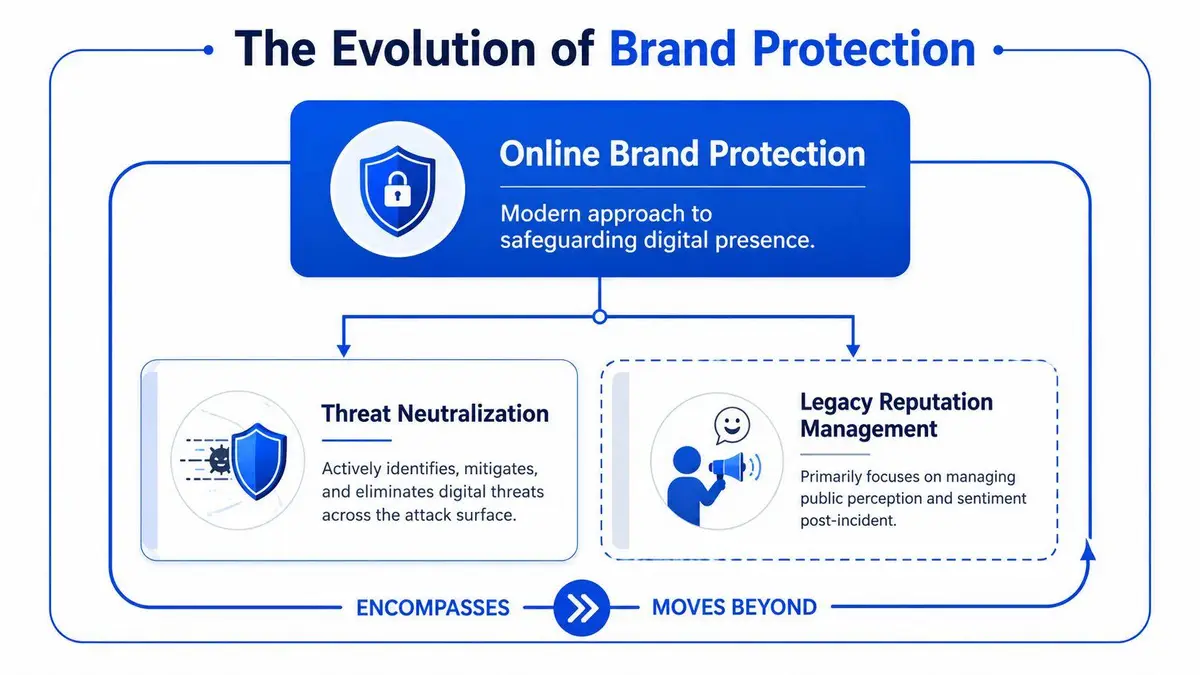
Reputation management reacts. Threat neutralization hunts.
PR teams shape message. They don’t shut down spoofed domains. Communications advisors can calm stakeholders. They can’t preserve technical evidence, trace repeat abuse patterns, or coordinate removals across marketplaces, ad platforms, social networks, and hosting providers.
That’s the shift executives need to internalize. Brand protection now functions as a continuous defense program. Independent market research projects the brand protection tools market at USD 3.40 billion in 2025 and USD 7.96 billion by 2035, reflecting a category that has moved into continuous enterprise infrastructure rather than a narrow legal or IT niche, according to Future Market Insights.
If your operations team still treats this as an occasional clean-up exercise, your posture is already behind.
What a solution actually includes
A proper program combines technology and specialist judgment. The technology scans at scale. The human layer decides what matters, what is lawful, what is fraudulent, and what should be removed first. That combination is what turns noise into response.
A useful way to separate legacy work from modern protection is this:
| Function | Legacy reputation management | Modern brand protection |
|---|---|---|
| Primary goal | Shape perception | Suppress active abuse |
| Trigger | Public criticism or negative content | Fraud, impersonation, counterfeit activity, domain abuse |
| Tempo | Campaign-based | Continuous |
| Main operators | PR, communications, SEO | Security, investigators, legal, takedown specialists |
| Success measure | Sentiment and visibility | Detection speed, takedown speed, recurrence control |
Internal teams often need outside operational guidance for the channels they manage directly. A practical reference is this guide for social media operations teams, especially where brand voice, platform escalation, and incident workflows intersect.
The investment question is already settled
The market’s direction tells you how discerning buyers now frame the issue. They’re no longer buying a dashboard to “monitor mentions.” They’re building a control function with monitoring, evidence, takedown pathways, and reporting suitable for executive review.
Practical rule: If a provider speaks mainly about visibility and barely mentions enforcement, they’re selling observation, not protection.
That difference becomes obvious the first time a fake asset starts collecting money, credentials, or sensitive inquiries in your name.
Mapping the Digital Attack Surface
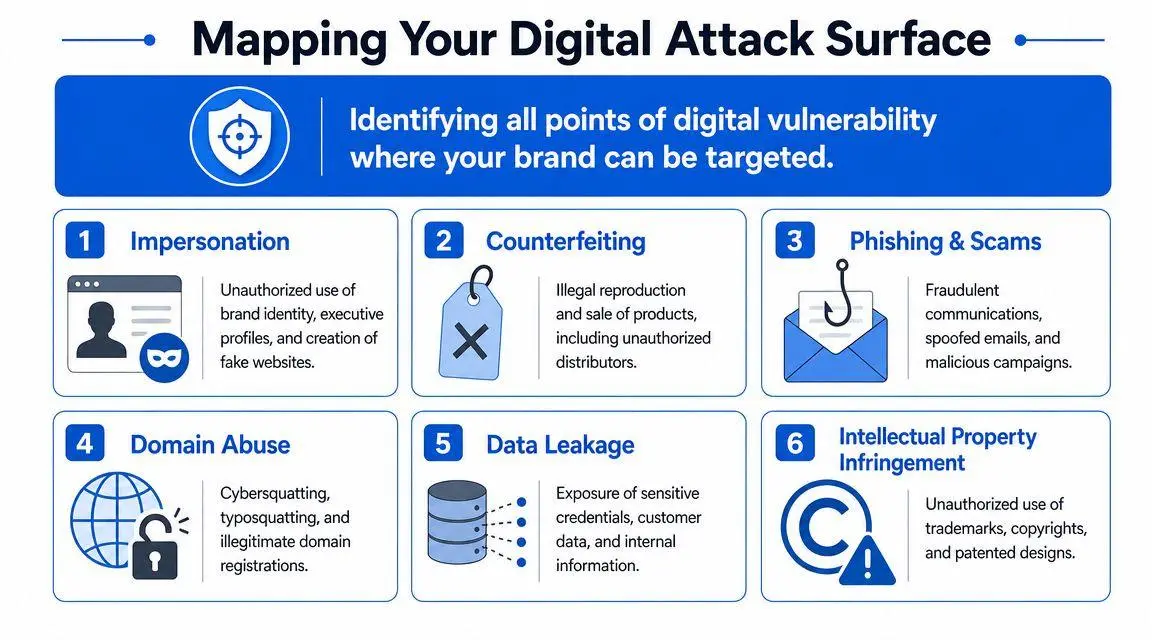
Most boards underestimate the breadth of modern abuse. They picture a fake Instagram account or a phishing email. The complete attack surface is larger, more distributed, and often personal.
Netcraft’s guidance is blunt on why speed matters. The global economy stands to lose as much as USD 4.2 trillion to counterfeiting and piracy by 2025, and malicious assets such as phishing domains can disappear within 24 hours, which is why real-time detection and rapid takedown are now operational requirements, as outlined in Netcraft’s brand protection guide.
The threats that matter most
Some threats are obvious. Others look minor until they connect into something expensive.
- Impersonation of executives and family principals
Attackers copy biographies, headshots, prior media appearances, and public speaking clips. They then use those assets to create fake social accounts, synthetic videos, or outreach messages that look credible enough to deceive counterparties. - Cloned websites and domain abuse
A lookalike site doesn’t need to be perfect. It only needs to be convincing for a few minutes. That’s long enough to collect credentials, payments, or inbound leads. If your business relies on investor trust, booking deposits, or sensitive client communication, a cloned site can create immediate legal and commercial fallout. - Counterfeit and unauthorized marketplace activity
For product-led businesses, fraudulent listings dilute margin and damage trust. For premium brands, the reputational harm often outlasts the listing itself because customers blame the brand, not the seller. - Fake reviews and coordinated complaint campaigns
These aren’t always random disgruntled posts. In serious disputes, hostile actors use review platforms, forums, and copied complaint narratives to create a false pattern of misconduct.
The threats executives miss
The harder problems usually sit outside conventional marketing oversight.
A leak of personal contact data can support impersonation. Stolen credentials can feed account takeover attempts. Mugshot, arrest record, or extortion-style posting sites can rank for a principal’s name and then trigger copycat republishes. Dark web chatter may reveal that a fraud campaign is being packaged and sold before it reaches the open web.
That’s why continuous reputation monitoring matters only if it maps to a broader threat model. Monitoring by itself isn’t enough. It has to tell you where abuse originates, how it spreads, and which assets need immediate suppression.
A practical attack-surface review
When I assess a new client, I want answers to five questions fast:
- Which names are monetizable
The company, the founder, family members, investor relations contacts, or all of them. - Which channels are vulnerable
Search, social, ad networks, marketplaces, app stores, messaging platforms, and niche forums. - Which assets are easiest to clone
Logos, headshots, investor materials, product photography, bios, and domain variations. - Which incidents create legal exposure
Investment solicitation, fake endorsements, product safety confusion, and impersonation of regulated roles. - Which threats recur after removal
That pattern tells you whether you’re facing opportunistic abuse or a persistent actor.
The attack surface isn’t just where your brand appears. It’s where someone else can make your brand believable.
If you don’t map that surface properly, you’ll keep winning isolated removals while losing the campaign.
The Arsenal for Digital Dominance
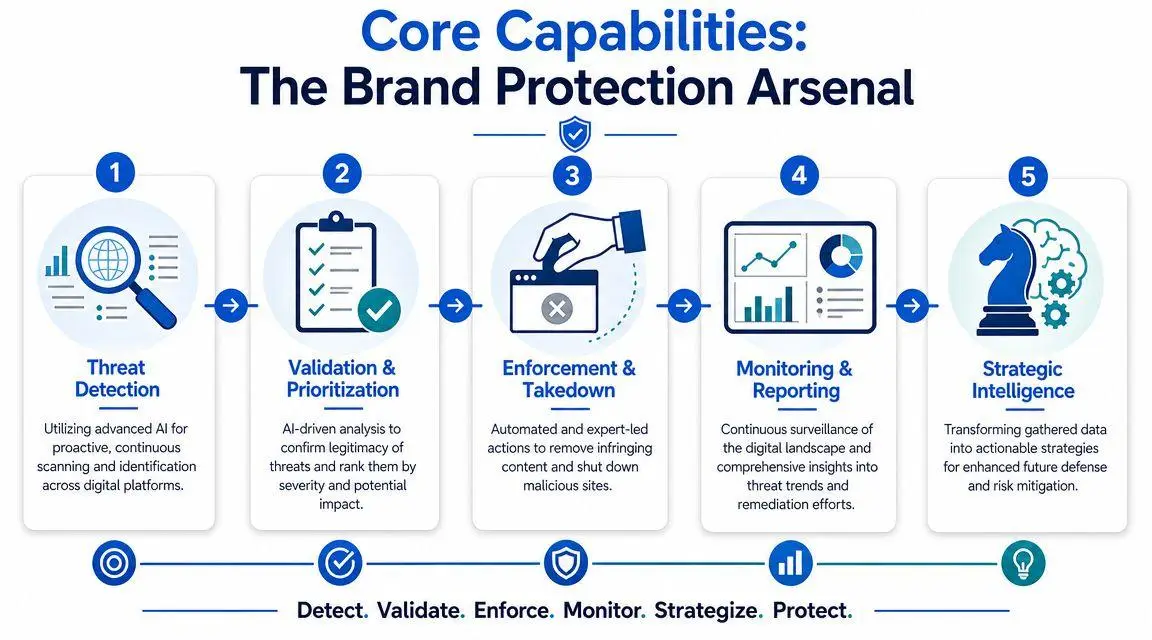
Effective online brand protection solutions run on a simple principle. Machines find at scale. Humans decide with judgment. Both are necessary.
Detection is not the hard part
Most vendors can generate alerts. The quality question is whether detection extends beyond keyword matching into images, logos, listings, metadata, domains, and account patterns across multiple platforms. A mature operating model also preserves evidence from the start, because screenshots alone rarely tell the full story once an asset disappears.
ZeroFox describes the mature function clearly: detection, validation, enforcement, and reporting. It also stresses that validation is critical because human experts must review automated alerts, avoid false positives, and make sure takedown actions are justified in high-volume environments like marketplaces and social platforms, as explained in ZeroFox’s five-step guide.
That point gets overlooked constantly. Over-automation creates two problems. It misses context, and it creates unnecessary takedown attempts against legitimate resellers, commentary, or authorized uses. Both waste time.
The workflow that actually works
A serious response chain usually looks like this:
- Detection and enrichment
The system finds the asset, captures supporting data, and identifies related infrastructure or duplicate abuse patterns. - Human validation
Analysts check whether the asset is abusive, whether it creates fraud or legal exposure, and whether there’s a priority route for removal. - Enforcement
The team files platform complaints, registrar or host notices, marketplace reports, ad network escalations, or legal demands, depending on the asset. - Monitoring after removal
The actor often returns under a variation. If nobody watches for recurrence, the earlier takedown becomes a short pause, not a resolution.
For executives who want a deeper operational overview, this comprehensive guide to online brand protection services lays out how detection, takedown, and monitoring fit together in practice.
A few providers and specialist firms combine these workflows in different ways. Some focus on phishing and fraudulent infrastructure. Others are stronger on marketplace abuse, impersonation, or content removal. ContentRemoval.com operates in the removal and digital crisis management segment, including de-indexing, impersonation takedowns, and ongoing monitoring where harmful content spans search, websites, and social platforms.
Human judgment is the control point
Clients usually underestimate the complexity. Enforcement depends on platform rules, jurisdiction, evidence quality, identity rights, trademark position, and speed. You can’t resolve all of that with one software subscription.
A short visual explanation helps:
> Fast removal without validation creates mistakes. Validation without enforcement creates delay. You need both at once.The strongest operators don’t just remove what’s visible. They document patterns, connect related assets, and make the next wave easier to identify and stop.
Selecting Your Digital Crisis Response Team
Choosing a provider by feature checklist is how executives end up with elegant reports and unresolved abuse. The right question isn’t “What does your platform detect?” It’s “What happens after detection, who owns the decision, and how will you prove that exposure is shrinking?”
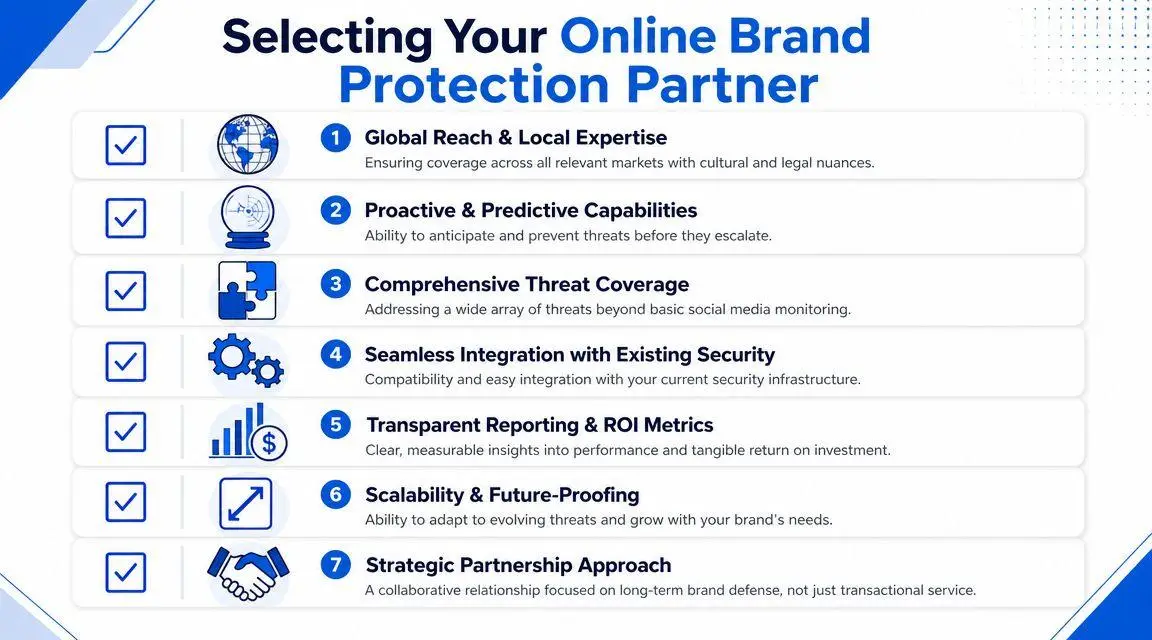
Netcraft’s buyer guidance makes the central point well. Executives should focus on ROI, not raw alerts, and the distinguishing factor is whether a provider can measure and report outcomes such as remediation scope and business impact, including fraud loss avoided or conversion recovery, as discussed in Netcraft’s platform evaluation article.
What to look for
The providers worth considering tend to share a few traits:
| Evaluation criterion | What good looks like | What weak looks like |
|---|---|---|
| Speed to action | Clear triage and immediate next steps | Long onboarding before any enforcement |
| Human oversight | Analysts validate and prioritize abuse | Software-only workflow |
| Cross-channel capability | Domains, social, marketplaces, search, content | One narrow channel |
| Evidence discipline | Preserved records and case documentation | Ad hoc screenshots |
| Executive reporting | Clear KPIs and recurrence tracking | Alert volume presented as success |
The partner should also understand discretion. High-profile matters often involve family members, investor communications, employment sensitivities, or pending litigation. If a provider talks like a marketing agency during intake, they’re probably the wrong fit for a sensitive case.
Questions worth asking in the first meeting
Ask these directly. The answers tell you a great deal.
- How do you define success
If the answer starts with alert count, move on. - Who validates threats before enforcement
You want named analysts, investigators, or counsel. Not “the system handles most of that.” - How do you manage recurrence
Removal is one event. Repeat suppression is the true test. - What evidence do you preserve before takedown
If the asset disappears, you may still need records for legal, regulatory, or internal review. - How do you report to executives
Boards need concise exposure reporting, not platform screenshots.
For leaders weighing specialist support, this guide for executives evaluating professional content removal services is a useful screening framework.
The red flags are obvious if you know where to look
Guaranteed removals are a warning sign. So is a provider that treats every threat the same way, regardless of platform or jurisdiction. Another bad sign is a team that can monitor broadly but has no practical enforcement muscle.
Buy a response capability, not a stream of notifications.
That’s the standard. Anything less shifts the burden back onto your internal team at the exact moment you hired outside help to remove it.
Measuring the Return on Protection
Executives don’t need another dashboard full of noise. They need proof that the environment is becoming harder for attackers to exploit.
The rise of AI-scale cloning has changed the standard. Corsearch’s description of the market captures the core issue: the question is no longer how to remove one fake site, but what operating model stops a persistent actor using realistic fake ads, synthetic executive personas, and chatbot-driven scams. That’s why continuous monitoring and recurrence prevention now sit at the center of any modern solution, as outlined by Corsearch.
The KPIs that matter
A sound program reports a small set of operational indicators tied to exposure and response:
- Mean time to detection
How quickly the team identifies abusive assets after they appear. - Time to takedown
How quickly validated threats are removed or suppressed. - Takedown success ratio
Whether enforcement efforts are producing removals, not just submissions. - Threat recurrence rate
Whether the same actor, asset pattern, or abuse theme returns after action. - Business-impact reporting
This should connect remediation to practical outcomes such as reduced fraud pressure, fewer confused customer contacts, lower support burden, or restored conversion confidence.
These are the metrics that let a board, principal, or general counsel evaluate whether the function is working. They also force discipline on the provider. If recurrence stays high or takedown time stays slow, the operating model needs to change.
What a serious engagement looks like
The right engagement starts with confidential threat mapping. Then it establishes escalation paths, evidence standards, enforcement routes, and executive reporting cadence. After that, the work becomes continuous. Detection feeds validation. Validation drives enforcement. Enforcement feeds recurrence monitoring. Reporting informs the next round of defenses.
That loop is what separates a one-time clean-up from a protection function.
If your name, business, or family interests are exposed online, the issue won’t be solved by hoping platforms act quickly or by treating each incident as a separate nuisance. It requires a discreet system run by people who understand removal, evidence, pressure points, and persistence.
If you need that system now, ContentRemoval.com provides confidential assessments for executives, public figures, family offices, and brands facing impersonation, harmful content, leaks, and coordinated online abuse. The first step is straightforward: define the attack surface, identify the fastest enforcement routes, and put a measurable protection program in place before the next asset goes live.
Frequently asked questions
What is the difference between reputation management and brand protection?
Reputation management was built for criticism, negative press, and search visibility, and it works in campaigns. Brand protection suppresses active abuse such as fraud, impersonation, counterfeits, and domain misuse, runs continuously, and is staffed by security, investigators, legal, and takedown specialists. Success is measured by detection speed, takedown speed, and recurrence control.
Why does a fake executive profile keep coming back after it is removed?
Because the actor treats each removal as a pause. They rotate domains, rebuild profiles, relaunch ads, and test new hooks while internal teams debate ownership. A program without post-removal monitoring and pattern documentation wins isolated takedowns and loses the campaign.
What should I ask a brand protection vendor before hiring them?
Ask how they define success, who validates threats before enforcement, how they manage recurrence, what evidence they preserve before takedown, and how they report to executives. If the answer starts with alert counts, if the system handles validation on its own, or if removals are promised outright, move on.