
Brand crisis reputation management starts as a command problem, not a communications problem. In the first hour, freeze external comment, form a three-person war room for legal, communications and evidence, and verify the source. Within twelve hours build a single source of truth. Within 48 hours attack the spread with takedowns, de-indexing and platform reports, then speak with controlled transparency.
Key facts
- Verify four things fast: what exists at the source, who controls it, the threat category, how fast it moves.
- DMCA notices are often the fastest lane for leaked internal files that contain protected creative material.
- Impersonation accounts move faster under platform Terms of Service reports than through formal defamation routes.
- Use three communication assets: a holding statement, a full statement after fact review, and cadence-based updates.
Where ContentRemoval.com comes in. ContentRemoval.com runs the second track of a crisis: the source removals, de-indexing and platform takedowns that stop leaked files, false articles and impersonation accounts from hardening in search while communications teams handle the message. General counsel, a chief of staff or the PR agency usually brings the firm in during the first day. A free 15-minute Exposure Scan maps what is removable, and the report is yours to keep. Get a Free, Confidential Exposure Scan or read how our reputation management work is done.
At 2:07 a.m., your phone starts vibrating hard enough to wake your spouse. A board member has forwarded a screenshot. Your head of legal has three missed calls. Someone has posted leaked material, a hostile account is impersonating your brand, a journalist is asking for comment, and your internal Slack is already filling with theories. This is the moment most companies lose control.
They lose it because they treat a crisis as a communications problem first. It isn’t. Brand crisis reputation management starts as a command problem. You need facts, authority, and containment before you need polished language. If you get that order wrong, every later move becomes defensive.
The playbook below is built for executives, founders, public figures, and counsel operating under real pressure. It combines strategic communications with the legal and technical interventions that stop digital damage from spreading. PR without removal is incomplete. Removal without messaging is reckless. You need both.
The First Hour Protocol When Crisis Strikes
The first hour decides whether you spend the next week leading the response or chasing it.
At 2 a.m., you do not convene a committee. You form a war room triad. One person owns legal risk. One person owns external communications. One person owns digital intelligence and evidence capture. If you are the principal, you stay above the noise and make approval decisions only. Don’t become the person screenshotting tweets.

Lock the system before you craft the message
Your first move is a communication freeze. No employee comments publicly. No executive texts “off the record.” No one replies to press, posts on LinkedIn, or sends reassuring side messages to clients. Internal speculation becomes external evidence faster than most leaders appreciate.
Issue one instruction across the company: all inbound media, investor, partner, and customer questions route to a single command channel. Then secure the affected accounts, preserve logs, and start collecting source material.
Use active monitoring immediately. A proper reputation monitoring workflow should capture search movement, social mentions, repost velocity, copycat accounts, and any mirrored or syndicated versions of the content. You need a record of what exists now, before platforms change labels, delete posts, or let bad actors edit them.
Verify the threat vector
Most bad responses start with a false assumption. Leaders see one screenshot and declare the crisis to be defamation. Two hours later, it proves to be an internal leak. Or they assume a journalist is hostile when the actual problem is a coordinated impersonation network amplifying the story.
Confirm four things fast:
- What exactly exists
Find the original URL, account, file, post, or article. Not the forwarded screenshot. The source. - Who controls it
A publisher, anonymous account, former employee, forum moderator, host, platform, data broker, or syndication partner. Different owners require different tactics. - What category of threat it is
Leak, defamation, impersonation, product issue, misconduct allegation, data exposure, or operational failure. - How fast it’s moving
A hostile blog post indexed in search behaves differently from a trending social clip or an investor rumor moving through private channels.
Practical rule: In the first hour, collect evidence and narrow facts. Don’t debate motives. Motive analysis wastes precious time.
There is a reason the Tylenol case remains the benchmark. In 1982, Johnson & Johnson faced one of the most severe brand crises in history when seven people died after consuming Tylenol capsules laced with cyanide. The company recalled 31 million bottles at a cost exceeding $100 million, and CEO James Burke assumed responsibility publicly. Johnson & Johnson regained 70% of its market share within three months, a result still cited as the gold standard for decisive crisis action in PRNEWS’ review of crisis preparedness and the Tylenol response.
That lesson still holds. Speed signals control. Ownership buys time. Delay tells the market, the media, and your critics that you are improvising.
The one sentence you can send immediately
You may need an immediate internal instruction before full facts are in. Keep it simple:
We are aware of the issue, the response team is active, and no one is authorized to comment externally until further notice.
That sentence does two things. It stops freelance damage, and it tells your organization that someone is in charge. In a crisis, authority is calming. Ambiguity is combustible.
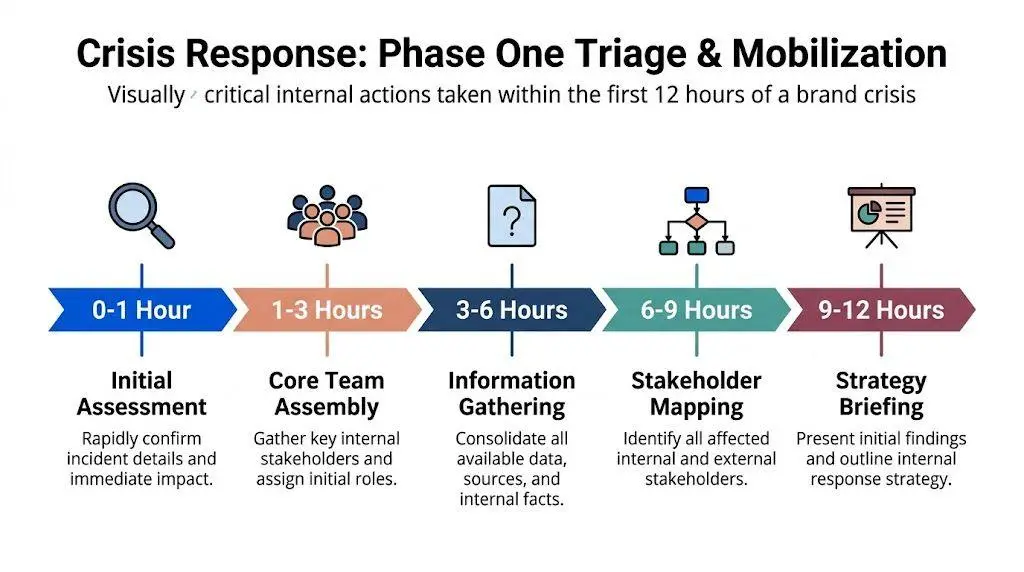
Phase One Triage and Internal Mobilization
The first hour stops chaos. The next twelve hours build the machine that will carry the response.
Most organizations fail here because they gather senior people, not useful functions. Status is irrelevant. You need operators. A proper crisis cell includes legal, communications, digital forensics, IT or security, operations, HR if employees are implicated, and one executive with authority to approve action without delay.
Build a single source of truth
Your response breaks the moment different teams start working from different facts.
Create one live document that records what is known, what is unverified, what has been preserved, who owns each workstream, and what has been said externally. This document should include screenshots, timestamps, platform URLs, journalist inquiries, stakeholder concerns, and draft positions approved by legal.
Do not let people maintain side narratives in email threads. That’s how conflicting statements get sent to investors, staff, and media within the same morning.
A strong source-of-truth file should answer these questions at any moment:
| Question | What must be recorded |
|---|---|
| What happened | Verifiable event summary, with timestamps |
| Where it appeared | Original URLs, accounts, platforms, publications |
| What is exposed | Content type, affected stakeholders, legal risk |
| What has been done | Takedown submissions, platform reports, counsel actions |
| What can be said | Approved language for each audience |
Classify the crisis correctly
Not every crisis deserves the same response footprint. Overreaction creates its own headlines. Underreaction lets the problem metastasize.
Use a simple triage model.
Level one contained threat
A limited issue with modest visibility, a known source, and low replication. This might be a false review cluster, a niche forum allegation, or a single impersonation account with minimal traction.
Assign a tight team. Preserve evidence. Start removal. Hold public comment unless stakeholders require notice.
Level two expanding threat
An issue crossing channels, attracting media interest, triggering partner concern, or involving potentially sensitive facts characterizes most executive crises in the first day.
You need legal review, stakeholder mapping, a holding statement, and active suppression or removal work running in parallel.
Level three existential threat
This is the category for events that threaten leadership continuity, regulatory exposure, safety, core revenue, or brand legitimacy. Examples include major leaks, criminal allegations, consumer harm, or severe data exposure.
At this level, the organization shifts into command structure. Board involvement is immediate. Approval pathways shorten. Every outbound communication is deliberate.
If your team is still asking whether this is “really a crisis,” you are already behind. The issue isn’t the label. The issue is whether stakeholders are changing behavior because of it.
Assign roles with precision
Ambiguity creates duplication in some areas and neglect in others. Assign owners by output, not department.
- Legal lead
Owns preservation, exposure analysis, demand letters, platform escalation language, and approval boundaries for public statements. - Communications lead
Owns message discipline, press handling, stakeholder drafts, spokesperson prep, and internal guidance. - Digital intelligence lead
Tracks spread, captures evidence, maps duplicates, identifies hosts and syndication paths, and reports search and social movement. - Operations lead
Handles business continuity. Customers, vendors, service disruptions, internal procedures. - Executive approver
Decides. Fast. No committee drift.
Map stakeholders in order of consequence
Do not communicate to everyone at once. Prioritize the audiences whose actions can deepen the crisis.
A practical order often looks like this:
- Board and principal investors if the issue affects governance, valuation, or disclosure risk
- Key internal leadership so they don’t create contradictory narratives
- Critical customers and partners who may take protective action if they hear rumors first
- Employees at large once management guidance is stable
- Media and public channels after legal and containment work is underway
This sequencing matters. A generic public statement released too early can box you in legally and force explanations you weren’t ready to make.
What internal mobilization should feel like
It should feel boring. Calm. Repetitive. Controlled.
No brainstorming sessions. No rhetorical debates about brand tone. No late-night executive monologues in group chat. The right internal posture is disciplined fact handling, tightly managed approvals, and visible chain of command.
That is what serious brand crisis reputation management looks like in the first half-day. It is operational, not theatrical.
Phase Two Strategic Takedown and Content Neutralization
Most crisis guides stop at sentiment, messaging, and apology language. That is why most crisis guides are incomplete.
If damaging material is still live, searchable, mirrored, quoted, reposted, indexed, and recommended by platform algorithms, you do not control the crisis. You are narrating around it. That is not a strategy. It is a concession.

Removal is not cleanup work
Brand crisis reputation management in 2026 requires a dual-track response. One track speaks to stakeholders. The other track attacks the digital infrastructure carrying the harm.
That second track is where many companies hesitate. They worry removal efforts will “look aggressive.” They overestimate how much a statement can neutralize a searchable lie, leaked file, impersonation account, or manipulated clip.
The gap in conventional crisis literature is clear. It focuses heavily on post-crisis communication and lacks substantive treatment of preventive and active content removal. For high-profile clients, a single viral defamatory post or leak can trigger a full-scale crisis, which is why Brandlife’s discussion of brand reputation crisis management highlights the need to integrate de-indexing, source removal, and suppression into the response instead of relying on messaging alone.
Use the correct weapon for the correct target
Different content types require different interventions. Leaders waste time when they ask counsel for one broad “takedown” instead of matching the tactic to the platform and violation.
Copyrighted leaks and stolen internal materials
If leaked material includes owned creative assets, confidential presentations with protected elements, videos, photos, marketing copy, or other original works, a DMCA notice may be the fastest route on many platforms and hosts. It is often more effective than arguing reputational harm because it ties the request to a familiar removal framework.
That does not solve every leak. But it gives you a rapid procedural lane where moral arguments won’t.
Defamatory posts and false allegations
Defamation disputes require precision. You need to isolate verifiably false statements, preserve evidence, and direct demands to the publisher, host, or platform based on their complaint process and jurisdiction. Sloppy threats fail. Specificity works.
A demand should identify the false statement, why it is false, how it harms the subject, and what action is required. If the content also violates platform rules on harassment, impersonation, privacy, or manipulated media, use that route as well. Legal merit and platform policy are separate doors. Open both.
Impersonation accounts and fake profiles
These often move faster than formal defamation pathways. Attack them under platform Terms of Service. Focus on impersonation markers, misuse of name or likeness, fraudulent affiliation claims, and coordinated abuse patterns.
This is one reason rapid documentation matters. Impersonation accounts change handles, profile photos, and bios once they realize they are being reported.
Search result contamination
A publisher takedown is ideal. It isn’t always available. In those cases, begin de-indexing analysis immediately. Search removal and source removal are not the same thing, and executives need to understand the distinction.
If the source remains live but can be de-indexed under a valid policy basis, you reduce discovery even if you haven’t fully eliminated the content. If the source can also be edited, buried, or legally challenged, you combine those tactics. A specialist service, such as ContentRemoval.com’s online content removal process, is valuable alongside outside counsel and internal communications, addressing source removal, de-indexing, and platform takedown workflows in one coordinated stream.
A harmful URL that no longer appears prominently in search is not a complete victory. But it is often the difference between a contained event and a recurring executive problem.
Build a neutralization matrix
Do not chase content one post at a time without structure. Use a matrix that categorizes every asset by impact and removability.
| Content type | Primary tactic | Secondary tactic | Owner |
|---|---|---|---|
| Leaked file | DMCA or host complaint | Search de-indexing review | Legal |
| False article | Publisher demand | Host escalation, suppression | Legal and comms |
| Impersonation profile | Platform report | Identity verification escalation | Digital |
| Viral reposts | Batch platform reporting | Evidence clustering | Digital |
| Search snippets | De-indexing review | Positive content displacement later | SEO and legal |
This turns panic into workflow.
Why speed matters more than elegance
Every hour that harmful content remains live, more people screenshot it, summarize it, quote it, and republish it. Then the crisis is no longer one asset. It becomes an ecosystem.
That is why I advise clients to stop treating content removal as an optional support function. It is a primary offensive move. The fastest route to narrative control is often not a better statement. It is fewer attack surfaces.
Public relations teams are trained to answer. Digital crisis teams must also erase, delist, suppress, and block reappearance where lawful and technically possible. If your current protocol doesn’t do that, your current protocol is outdated.
Phase Three Executing Public Communications
Once containment is active, you can speak. Not before.
The objective here is not catharsis. It is controlled transparency. You need to show command, acknowledge the issue at the right level, avoid factual overreach, and keep legal options intact.

The three-statement model
Most high-pressure situations need three distinct communication assets, not one.
Holding statement
This is the first public acknowledgment. It should confirm awareness, state that action is underway, and signal responsibility without locking you into unsupported facts.
A usable structure is simple:
We are aware of the matter currently circulating online. We are reviewing the facts urgently, taking appropriate action, and will provide further information as soon as we can do so responsibly.
That language works because it does not speculate. It does not fight with screenshots. It does not deny before verification. It buys room.
Full statement
This comes after fact review and initial containment. It should define what happened, what you know, what you are doing, and what stakeholders should expect next. If there are affected parties, center them before defending the institution.
A full statement should include:
- Confirmed facts only
Not internal theory, not staff rumor, not legal aspiration. - Specific actions underway
Investigation, containment, account security, product withdrawal, outreach, or corrective measures. - Clear next update point
If you don’t know when, say updates will follow as material facts are confirmed.
Ongoing updates
Silence after an initial statement is usually interpreted as drift, indifference, or deeper trouble. But constant posting creates volatility. Use an update cadence tied to meaningful developments.
That might mean direct outreach to investors and enterprise customers before any broad social post. It might mean a newsroom update page instead of reactive posting across every channel. It might mean the CEO appears only once, with authority, rather than doing multiple interviews that create additional quotes.
Choose channels by audience, not emotion
A common mistake is choosing the loudest channel because the criticism is loud. That’s amateur thinking. Use the channel that reaches the audience whose decisions matter most.
| Audience | Best channel in many cases | Why |
|---|---|---|
| Investors and board | Direct email or call | Reduces rumor risk and allows nuance |
| Enterprise clients | Account-managed outreach | Preserves trust and continuity |
| Employees | Internal memo and manager script | Prevents leaks and confusion |
| Media | Written statement first | Keeps language precise |
| General public | Website statement or primary social channel | Centralized reference point |
If the crisis is tied to executive conduct, a written statement may not be enough. If the issue involves harm, accountability, or confidence in leadership, a CEO video can stabilize the situation if the executive is credible, disciplined, and visibly in command.
A visual format can help when the public is testing sincerity, but only if the spokesperson can deliver without defensiveness.
Here is a useful example format to study:
What to say and what to avoid
The right tone is firm, factual, and proportionate.
Use language that shows action:
- We are investigating
- We have initiated
- We are cooperating
- We have taken steps to secure
- We will update stakeholders
Avoid language that weakens your position:
- This is being blown out of proportion
- We can’t comment
- No comment
- We deny everything
- We’re sorry if anyone was offended
That last phrase is particularly damaging. It sounds evasive and insincere at the same time.
The public does not require instant perfection. It does require evidence that an adult is in charge.
The apology question
Not every crisis calls for an apology on day one. Some call for acknowledgment, some for explanation, some for defense, and some for silence while legal work proceeds.
If harm is clear and responsibility is established, apologize directly and without ornamental language. If facts are disputed, do not deliver a sprawling emotional apology that creates admissions your lawyers will spend months containing.
A disciplined line often works better:
We take this matter seriously. We are focused on establishing the facts, addressing any harm, and taking appropriate corrective action.
This is not soft. It is controlled.
Message discipline inside the building
Every manager needs a script. Every customer-facing team needs approved language. Every executive needs to know what not to say in text, email, and side conversations.
The market often sees your internal confidence before it sees your press release. Staff panic leaks. Mixed executive signals leak. Side assurances to favored stakeholders leak. Public communications fail when private communications are sloppy.
Phase Four Post-Crisis Recovery and Brand Fortification
The crisis is not over when the headlines slow down. It is over when the damage stops shaping decisions about your company, your leadership, and your name.
Recovery must be measured in observable outcomes. Not vague optimism. Not the communications team saying the tone feels better. You need evidence that the digital and commercial environment has stabilized.
What recovery actually looks like
For executives, the most useful recovery indicators are practical.
Search result cleanup
Review what appears when people search the company, the CEO, and the specific crisis term set. Are harmful results still prominent. Are removed URLs resurfacing through mirrors or reposts. Are neutral and authoritative assets regaining visibility.
This is often the clearest external sign of whether your response was temporary or durable.
Stakeholder confidence
Measure what your highest-consequence audiences are doing. Are investors calmer. Are enterprise customers renewing conversations. Are partners proceeding instead of pausing. Is inbound counsel from outside stakeholders becoming less urgent and less adversarial.
Behavior matters more than applause.
Internal stability
A badly managed crisis leaves residue inside the organization. Leadership drift, talent exits, fear-driven communication, and operational hesitation all linger. Recovery means your teams can operate without treating every post, article, or inquiry as an existential threat.
Recovery is complete when the organization stops reacting to the last crisis and starts enforcing the standards that prevent the next one.
Why post-crisis investment pays
There is hard commercial logic behind doing this properly. In 2025, 73% of brands that invested in crisis management recovered faster after a PR incident, while 46% of companies lacking a crisis plan lost over 20% of customer trust. The same 2025 data says 44% of companies faced a major brand crisis, 41% of unprepared firms lost brand value and revenue, and prepared leaders boosted stakeholder satisfaction by 93%, according to Amra & Elma’s 2025 crisis management marketing statistics.
That should settle the budget argument. Preparedness is not overhead. It is loss prevention and brand protection.
Fortify the brand after the event
A serious recovery program has three layers.
First, build a stronger digital asset base. Publish accurate executive bios, updated leadership pages, controlled interviews, thought leadership, legal clarifications where appropriate, and other high-trust content that deserves to rank. You are building a digital firewall, not vanity media.
Second, formalize monitoring and escalation. If the organization learned anything during the crisis, encode it. Trigger thresholds, approval trees, platform reporting protocols, and legal review pathways should become standing procedure, not institutional folklore. A broader online reputation management strategy for 2026 should include monitoring, response criteria, and authority lines before the next attack arrives.
Third, rehearse. Most companies discover during the crisis that nobody knows who can approve what. Fix that. Run drills. Test statements. Review access control. Simulate leaks, impersonation, false reviews, and executive allegations. The goal is simple. Compress decision time.
The post-mortem must be unsentimental
Ask hard questions.
- Did legal move fast enough, or did it over-lawyer the first response?
- Did communications speak too early, or too vaguely?
- Did IT preserve evidence and secure assets quickly enough?
- Did leadership create clarity, or additional noise?
- Did the company have any meaningful ability to remove harmful content, or was it improvising?
If you don’t answer those truthfully, you will repeat the same mistakes under a new headline.
Conclusion From Reactive Defense to Proactive Dominance
The old model treated brand crisis reputation management as a PR clean-up exercise. That model is obsolete.
A modern crisis response has four decisive moves. In the first hour, establish command and stop uncontrolled communication. In the first twelve hours, build the internal architecture that keeps facts, roles, and approvals aligned. In the first forty-eight hours, attack the digital spread through takedowns, legal demands, de-indexing analysis, and platform enforcement. Then communicate publicly with control, not panic. Afterward, rebuild the digital environment so the crisis does not remain permanently searchable, quotable, and reusable.
That is the central point. You do not control the narrative if you leave the harmful content intact.
Most companies still separate communications from digital intervention. The PR team drafts a statement. Legal drafts a letter. Someone junior reports a fake account. Meanwhile the content spreads, search results harden, and mirror sites copy the original material. That fragmented model fails high-profile leaders because their reputations don’t live in one newspaper article or one social platform. They live across search, syndication, screenshots, commentary, and repost chains.
The better approach is integrated and offensive. Speak clearly. Remove aggressively where lawful grounds exist. De-index strategically. Preserve evidence. Map every stakeholder. Keep one source of truth. Rebuild the search presence after the fire is out.
If you are in the opening hours of a crisis, you need command structure now. If you are not in a crisis yet, this is the moment to audit your exposure while decisions can still be made calmly. The executives who fare best are not the ones who improvise best under pressure. They are the ones who prepared removal pathways, legal triggers, spokesperson protocols, and monitoring systems before anyone needed them.
If you need a discreet assessment of your current exposure, ContentRemoval.com can review harmful content risk, search vulnerabilities, impersonation exposure, and crisis response gaps, then map a confidential action plan for removal, de-indexing, and reputation protection before the next incident forces your hand.
Frequently asked questions
What should a company do in the first hour of a brand crisis?
Issue a communication freeze so no employee or executive comments externally, route all inbound questions to one command channel, secure affected accounts, preserve logs and locate the original source rather than a forwarded screenshot. Motive analysis can wait; evidence and narrow facts cannot.
Should a company apologize immediately during a reputation crisis?
Only if harm is clear and responsibility is established. Where facts are disputed, the article recommends a controlled line that acknowledges seriousness and commits to establishing facts and taking corrective action, rather than a sprawling apology that creates admissions.
How do you know when a brand crisis is over?
When the damage stops shaping decisions. The article’s recovery indicators are search results for the company, CEO and crisis terms, the behavior of investors, customers and partners, and internal stability, followed by a formal post-mortem, monitoring thresholds and rehearsed drills.