
A business reputation management service is a defensive function for preserving enterprise value when false articles, coordinated fake reviews, leaks or impersonation appear online. The removal-first model runs on four pillars: identification across platforms, platform-specific negotiation, jurisdiction-aware legal enforcement, and de-indexing with cache clearing and re-upload prevention. Suppression belongs in phase two, after removal.
Key facts
- Cited data: 84 percent of executives rank reputation risk above cyber or regulatory threats.
- Suppression alone can raise a harmful item’s visibility by 25 percent while leaving the source live, per WSI World.
- A 2025 report cited found only 12 percent of services offered 24 to 48 hour takedown processes.
- Impersonation schemes can require parallel action with registrars, hosts, marketplaces, search engines and social trust teams.
Where ContentRemoval.com comes in. ContentRemoval.com is the specialist removal firm this guide compares against generalist PR and SEO agencies: evidence capture, policy mapping, takedown execution and recurrence prevention for founders, executive teams and public figures. General counsel or a board-level executive usually makes contact within hours of a hostile search result appearing, before any public statement is drafted. A free 15-minute Exposure Scan maps what is removable, and the report is yours to keep. Get a Free, Confidential Exposure Scan or read how our reputation management work is done.
At 6:10 a.m., your general counsel forwards a search result you have never seen before. It is a false article, a copied court filing stripped of context, a fake profile soliciting money, or a leak that should never have left a private device. By 7:00, your board chair has seen it. By 8:00, a journalist is asking for comment. By lunch, investors, clients, recruits, and family members have all formed a view before you have had time to verify the facts.
That is when the phrase business reputation management service stops sounding like a marketing category and starts looking like what it is: a defensive function for preserving enterprise value, enhancing negotiation positions, and personal safety.
Most firms still treat reputation damage as a communications problem. High-stakes clients cannot afford that mistake. If the harm sits online, indexed, copied, cached, reposted, and monetized by others, then the core problem is legal, technical, and operational. You need removal where removal is possible, containment where it is not, and monitoring that starts before the next wave appears.
When a Digital Crisis Becomes a Business Imperative
The first mistake executives make is to call it “bad press.” Bad press is criticism. A digital attack is different. It is structured to spread, rank, and persist.

When harmful material appears under your company name or your own name, the impact runs through several channels at once. Prospects hesitate. Counterparties slow a deal. Internal teams spend time answering questions they should never have received. Search results become an attack surface.
That is why the market for online reputation management software has expanded so quickly. The global ORM software market was valued at approximately $175 million in 2022 and is projected to reach $585 million by 2030, reflecting a 16.28% CAGR, while 70-80% of company market value now derives from intangible assets and 84% of executives rank reputation risk above cyber or regulatory threats, according to ElectroIQ’s reputation management statistics roundup.
What changed for leaders
A decade ago, a company could absorb a damaging post and wait for the news cycle to move on. That is no longer serious strategy. Harmful content now migrates across search engines, review platforms, social feeds, forums, archives, and AI-generated summaries. Even when the original post is weak, repetition gives it artificial authority.
For leaders, the question is no longer whether a crisis is “real enough” to address. The question is whether leaving it live creates unnecessary legal exposure and avoidable commercial drag.
Practical rule: If a harmful result appears for a branded search, assume a lender, recruit, journalist, partner, or hostile litigant will see it before you can explain it.
The right response is not generic PR
Traditional public relations can help shape narrative. It cannot by itself force a platform to act, preserve evidence, coordinate with counsel across jurisdictions, or prevent a removed item from resurfacing under a new URL.
A proper business reputation management service should function more like outside crisis counsel than an agency. It should identify the source, classify the harm, map the publication chain, choose the fastest pressure point, and act without enlarging the story.
That difference matters. High-profile clients do not need broad reassurance. They need an answer to a simple question: Can this be removed, de-indexed, or contained before it causes more damage?
The Anatomy of a Digital Reputation Attack
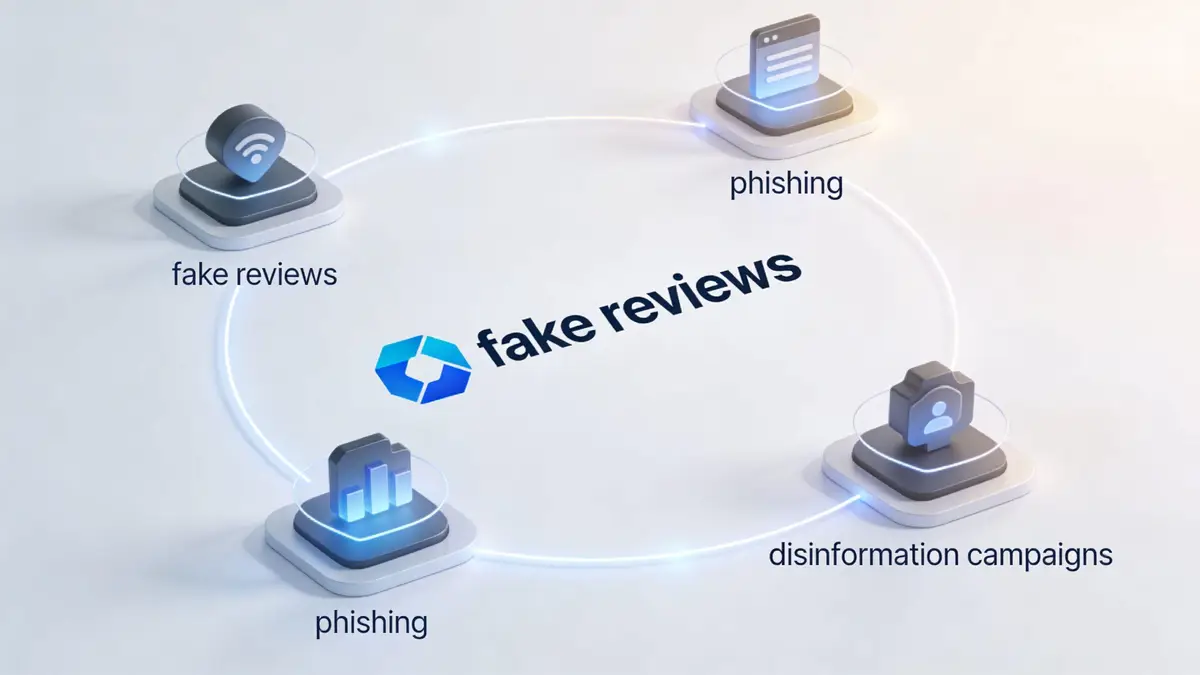
Most attacks follow a recognizable pattern. The surface format changes, but the mechanics repeat. Someone publishes harmful material, amplifies it through channels that reward outrage or confusion, and waits for search engines, aggregators, or users to do the rest.
Defamation and false narrative seeding
Defamation online rarely begins with a polished publication. It often starts with a low-credibility post, a hostile forum thread, or a blog designed to look like a news outlet. The author frames an allegation, strips out context, and uses your name repeatedly so search engines associate the claim with your identity.
The business damage comes from repetition, not elegance. Once a false allegation is indexed, other sites can mirror it, cite it, summarize it, or discuss it. That turns one post into a cluster of related search results.
This category is dangerous because the obvious response is often the wrong one. A public denial can elevate the claim. An aggressive legal threat can alert the publisher that they have found a pressure point. The correct first move is evidence capture, source mapping, and a platform-specific removal route.
Coordinated fake reviews and ratings attacks
A review attack is not just a collection of unfair comments. It is a credibility assault designed to alter buyer behavior at the exact moment of decision.
A well-coordinated campaign spreads across Google Business Profiles, Yelp, Trustpilot, niche directories, app stores, and sector-specific review sites. The wording may vary just enough to evade automated detection while preserving the same allegation. That matters because buyers compare consistency across platforms. If they see similar claims in several places, they assume legitimacy.
Professional monitoring systems now operate across 250+ platforms and use real-time sentiment detection with escalation protocols, as described in ALM Corp’s online reputation management guide. That architecture matters because review attacks rarely stay contained on one platform.
A useful primer on how review campaigns intersect with broader brand positioning appears in this discussion of an international marketing group, especially for companies operating across multiple markets where localized narratives can spread unevenly.
Leaks, stolen material, and private content exposure
This category causes the most panic because it feels personal. It is also where generic ORM firms are weakest.
The leak may involve internal documents, private images, investor memos, employee records, draft agreements, or creative assets. The content may be posted on file-sharing sites, forums, social platforms, pirate domains, or message boards that exist largely to exploit embarrassment and urgency.
Here the objective is not “better search results.” The objective is to stop distribution, cut discoverability, remove cached versions, and reduce the chance of reposting. The workflow is closer to incident response than to brand marketing.
Later in the attack cycle, search engines and social networks become secondary publishers even if they never hosted the original file. If they surface previews, cached text, thumbnails, or autocomplete associations, the damage continues after source removal unless those layers are handled too.
A short explainer on the broader stakes sits below.
Impersonation and counterfeit identity
Impersonation is often underestimated because the first signs look trivial. A fake profile. A cloned executive page. A spoofed seller account. A domain using a minor variation of your name.
Then the consequences arrive. Customers send payments to the wrong place. Journalists quote a fake source. Employees receive fraudulent instructions that appear authentic. Counterfeit products use your brand identity to borrow trust you spent years building.
This type of attack is difficult because platforms review identity abuse differently from defamation, and domain, marketplace, and social procedures rarely align. A single impersonation scheme can require parallel action with registrars, hosts, marketplace operators, search engines, and social trust-and-safety teams.
Key takeaway: Do not classify an attack by how it looks. Classify it by what keeps it alive: indexing, replication, monetization, or identity confusion.
Two Philosophies of Reputation Defense Suppression vs Removal
Most providers sell one of two ideas. The first is suppression. The second is removal. They are not interchangeable.
What suppression does
Suppression tries to outrank harmful material with favorable pages, press placements, owned profiles, branded content, and search-engine optimization. That can work for low-grade issues, especially when the harmful result is weak, old, or buried.
It is not worthless. It is overprescribed.
A suppression campaign leaves the source online. The allegation, leak, fake review set, or impersonation page still exists. It can still be screenshotted, linked, reposted, cited in diligence, or rediscovered by a journalist. For high-stakes clients, that is not resolution. That is cosmetic triage.
Why suppression fails in serious matters
The hard numbers are blunt. 72% of traditional PR and legal avenues take 30+ days and risk unwanted publicity for high-stakes clients. For severe harms such as fake news or impersonation, suppression alone can boost the negative content’s visibility by 25% without removing the source, according to WSI World’s discussion of why reputation management matters.
That is the central flaw. When advisers “fight content with content,” they often increase search activity around the very material they are trying to bury. More branded searches, more public statements, and more linking behavior can feed the result.
Removal is the correct objective
Removal starts from a different premise. If the material is unlawful, non-consensual, impersonating, platform-prohibited, privacy-violating, infringing, manipulated, or procedurally defective, then the first priority is to eliminate it at the source or cut access to it through platform enforcement and de-indexing.
That means evaluating the actual legal and technical basis for action. Not every ugly post is removable. Many are. The key is to stop relying on generic “negative press cleanup” playbooks.
For an executive or family office under pressure, the only sensible sequence is this:
- Preserve evidence first: Capture URLs, timestamps, source code snapshots where relevant, account identifiers, and visible publication pathways before the publisher edits or deletes.
- Choose the fastest point of influence: The right route may be platform policy, privacy law, impersonation policy, copyright procedure, harassment rules, court-backed process, or search de-indexing.
- Work source and visibility in parallel: Remove where possible, de-index where necessary, and clear caches or previews so the content does not survive in secondary form.
If you need to assess whether a page qualifies for direct action, this overview on remove online content lays out the categories that typically support a removal-first strategy.
Adviser’s view: If a provider starts with “we’ll publish positive articles” before asking where the harmful material is hosted, how it spreads, and which policy it violates, you are speaking to a marketer, not a crisis operator.
Use suppression only where it belongs
Suppression has a place. It supports recovery after removal. It helps rebuild branded search results with assets you control. It can reduce the prominence of stale but lawful material that will not come down.
But in serious incidents, suppression is phase two. Never phase one.
The Four Pillars of a Removal-Focused Service
A removal-focused business reputation management service should run as an integrated system. Not a loose collection of tactics. Each stage feeds the next, and a weakness in one stage usually reappears later as relapse.
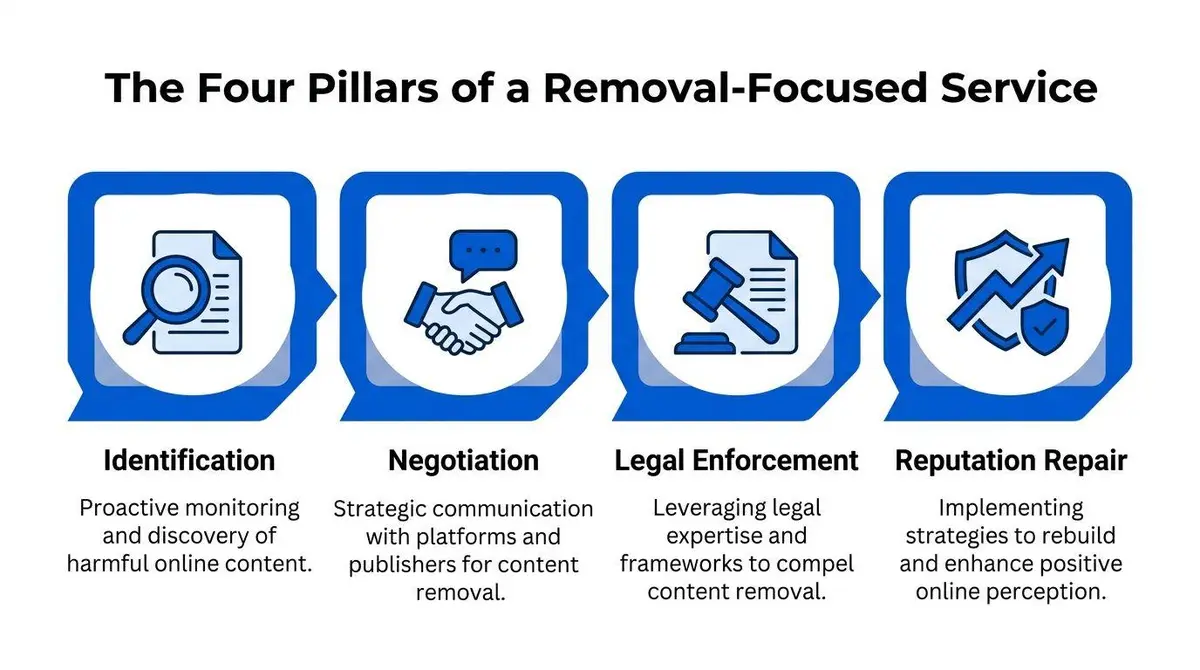
Pillar one: Identification
The first task is not outreach. It is intelligence.
Professional services now monitor 250+ platforms through multichannel aggregation with real-time detection of sentiment shifts and escalation protocols, as outlined by ALM Corp. For a high-risk client, that monitoring set should include search engines, review sites, social platforms, forums, image boards, marketplaces, and dark web references where relevant.
The point is to answer five questions quickly:
- What exactly is live
- Who controls it
- Where else has it spread
- Which policy or legal basis applies
- What will happen if we touch it too early
Good monitoring is not passive listening. It is case preparation.
If your team needs ongoing visibility after an initial incident, a dedicated layer of reputation monitoring gives counsel and leadership a cleaner way to spot recurrence before it becomes public.
Pillar two: Negotiation
Many removals happen before formal escalation. But they do not happen through generic complaint forms and hopeful emails.
This stage requires platform-specific communication, precise categorization, and disciplined sequencing. One publisher responds to privacy framing. Another responds only to impersonation or forged-authority arguments. A review platform may need proof of coordinated inauthentic activity. A host may act on terms-of-service grounds even where a publisher resists.
Negotiation works when the operator understands the receiving system. That means knowing what a platform counts as non-consensual sharing, manipulated media, malicious impersonation, doxxing, or review abuse, and presenting the claim in the language the platform uses.
Pillar three: Legal enforcement
Some targets will not cooperate. That is where many agencies collapse.
Legal enforcement is not chest-beating. It is jurisdictional precision. The issue may involve defamation standards, privacy rights, image rights, intermediary liability, intellectual property, extortion, harassment, or data protection. The remedy may be a takedown demand, sworn evidence package, counsel-to-counsel contact, registrar escalation, or search engine de-indexing request tied to the underlying violation.
Not every matter belongs in court. In fact, many should stay out of court because litigation can extend the life of the story. But legal discipline is still essential because it determines whether a threat is merely offensive or is removable.
Operational point: The strongest action is usually the one that creates the least new attention while giving the platform or publisher a clear reason to act.
Pillar four: De-indexing, cache clearing, and re-upload prevention
Clients often think the job is done once a source page goes dark. It is not.
Search engines may still show cached text, snippets, thumbnails, or stale titles. Third-party sites may have scraped the content. A determined attacker may repost the material under a new account or domain. If you stop after one takedown, you leave the door open.
This final pillar closes the loop. It includes search engine de-indexing where appropriate, cache and preview cleanup, recurrence tracking, and watchlists for variants of the same attack. In practice, it also means adjusting the monitoring rules to detect copies, naming variants, and account recreations.
A serious service treats reappearance as part of the same matter, not a “new project.”
A Confidential Case File Anonymized Examples
The theory matters less once the phone starts ringing. What matters is whether the process holds under pressure.
The founder and the fabricated article
A venture-backed founder discovered a hostile article on a site styled to resemble financial journalism. The piece alleged misconduct, cited no verifiable evidence, and began ranking for his name after coordinated sharing on social platforms.
The first step was not public denial. We preserved the article, the account trail, and the amplification pattern. The publication had weak editorial controls and stronger exposure under platform rules than under direct factual challenge. The removal strategy therefore paired a publisher approach with a parallel visibility strategy in case the site stalled.
The publisher removed the piece after targeted escalation. Search results then had to be cleaned of cached traces and mirrored references. Only after that did the client invest in rebuilding branded search results with controlled assets.
The lesson was simple. If he had led with PR, the article would likely have gained more attention before it came down.
The executive team hit by review sabotage
A multi-location business saw a sudden burst of damaging reviews tied to allegations that did not match actual customer history. The pattern suggested coordination. The wording changed slightly across platforms, but the narrative was identical enough to influence buyer perception.
The team initially wanted to answer every review in public. That would have been a mistake. Public engagement would have validated the attack and consumed internal resources without fixing the source.
Instead, the operation focused on evidence grouping, platform-by-platform reporting, and quiet review-authenticity challenges. Parallel monitoring watched for spillover into forums and local search. Once the false review cluster started to come down, the business shifted to controlled customer outreach and normal review acquisition to stabilize visibility.
The core point is that not every reputation issue is a communications issue. Some are abuse cases disguised as customer feedback.
The public figure facing a private-content leak
A public figure learned that intimate material had been posted across several low-quality sites and then referenced elsewhere. The principal risk was not one page. It was redistribution. The primary challenge was managing ongoing visibility and potential re-publication across new platforms.
The matter required immediate evidence preservation, rapid contact with hosts and platforms, and focused search cleanup so previews and index traces did not perpetuate discovery. Monitoring was then tuned for likely repost patterns, account variants, and file-title mutations.
In that kind of case, speed matters, but discretion matters more. The wrong outreach can trigger retaliation or wider publication. Quiet, coordinated pressure works better than outrage.
What these matters have in common: The fastest visible response is rarely the right first move. Controlled action beats performative action.
The Executive’s Checklist for Selecting a Provider
Most executives choose a provider too late and ask the wrong questions. They ask about search rankings, media outreach, or “brand sentiment.” Those are secondary. Start with removal capability, confidentiality, and jurisdictional competence.
A 2025 report noted that 68% of executives faced unreviewed harms like leaks, while only 12% of services offered the rapid 24-48 hour proprietary takedown processes needed for high-stakes matters, according to Synup’s analysis of profitable reputation management services. That gap explains why so many buyers end up with firms built for review response rather than crisis containment.
Questions that matter in the first call
Ask these directly. If the answers are vague, end the call.
- What percentage of your work involves source removal versus suppression? If they cannot distinguish the two clearly, they are not built for severe incidents.
- Which jurisdictions and platform regimes do you handle in-house? You need a provider that understands the relevant legal pathways, not one that outsources complexity after engagement.
- How do you preserve confidentiality? Ask about NDAs, restricted-access communications, evidence handling, and whether client identity is disclosed to platforms or publishers when avoidable.
- What begins in the first 24 to 48 hours? A serious provider should describe evidence capture, threat classification, publisher mapping, and parallel action tracks.
- How do you handle recurrence? Reuploads, cloned accounts, and mirrored pages are standard. If they treat recurrence as an exception, they lack operational discipline.
Compare the operating model, not the pitch
| Criterion | Specialist Removal Firm (e.g., ContentRemoval.com) | Generalist PR/SEO Agency |
|---|---|---|
| Primary objective | Source removal, de-indexing, containment | Narrative shaping and search suppression |
| Typical workflow | Evidence capture, policy mapping, takedown execution, recurrence prevention | Content production, media outreach, review responses |
| Fit for leaks and impersonation | Stronger, because the method centers on platform and legal action | Weaker, because visibility work does not eliminate the source |
| Confidentiality posture | Usually closer to legal-services discipline | Usually closer to campaign-management process |
| Success definition | Harm removed, de-indexed, and monitored for recurrence | Negative material outranked or diluted |
| Reporting | Matter-based updates tied to action status | Marketing-style reports tied to impressions, content, or rankings |
One option in this category is strategic corporate reputation management services for executives, which reflects the removal-first model more than the standard PR playbook.
Red flags you should treat seriously
Some warning signs appear before the proposal arrives.
First, the firm talks about “flooding the internet with positive content” without asking where the harmful content is hosted. Second, they use generic case claims but refuse to explain the actual takedown path. Third, they promise guaranteed outcomes without defining what counts as success.
A specialist should sound more like outside counsel than an ad agency. Precise. Controlled. Unimpressed by theatrics.
Selection rule: Hire the provider who can explain why a piece of content can come down, not the one who sounds most confident about pushing it lower.
Frequently Asked Questions on Advanced Reputation Defense
How long does removal take
The practical answer depends on the platform, the type of harm, and whether the source is cooperative. Some matters move quickly when the violation is clear and the evidence package is complete. Others require layered action across host, publisher, and search engine.
The wrong expectation is instant disappearance. The right expectation is immediate triage, rapid first action, and a sequence designed to reduce visibility while source removal proceeds.
How do you protect confidentiality during the process
Treat confidentiality as a design requirement, not a courtesy. Limit who knows, what is disclosed, and where it is disclosed. Use restricted communication channels, narrow case summaries, and platform submissions that reveal no more than the rule or right being asserted requires.
For public figures and senior executives, the process should be built to avoid creating a second story about the first one.
What stops the same content from coming back
Nothing stops a determined attacker by default. Systems do.
That means watchlists, variant tracking, account recreation monitoring, and platform memory. Once a matter is classified properly, future copies often become easier to identify and escalate because the pattern is already documented. Providers that treat each repost as unrelated create unnecessary delay.
How do you measure ROI if the goal is protection
You measure it with business indicators, not vanity metrics. Enterprise platforms use proprietary measures such as a Reputation Score benchmarked across 250+ directories, and success can be tracked by correlating removal actions with direct traffic recovery, conversion improvements on important pages, and quarterly audits of branded search positioning, as described by Feedback Robot’s overview of reputation management software.
That matters because executives should not accept “we removed some links” as the whole report. You want to know whether trust signals recovered where buyers, investors, and counterparties make decisions.
Should you ever respond publicly while a takedown is underway
Sometimes. Often not.
If a response is required for legal, regulatory, or stakeholder reasons, it should be narrow, factual, and drafted with the removal strategy in mind. Public overreaction can strengthen the attacker’s distribution. Silence is not weakness when action is already underway behind the scenes.
Is this a marketing function or a legal-risk function
For review management and ordinary brand maintenance, marketing can own part of it. For leaks, impersonation, false allegations, extortionate postings, and private-content exposure, treat it as a legal-risk and crisis-management function with technical execution attached.
That distinction will save you time and prevent expensive missteps.
If harmful content is already live, do not wait for it to “wash out” in search. Start with a confidential assessment at ContentRemoval.com and determine, quickly, what can be removed, de-indexed, and monitored before the damage spreads further.