
Reputation management for entrepreneurs is defensive infrastructure protecting capital access, customer trust and privacy. It starts with a footprint audit that produces a ranked threat register, builds owned and earned assets that hold the first page of search, runs threat intelligence for coordinated patterns, and applies removal, de-indexing or suppression depending on whether content is false, invasive or merely unwelcome.
Key facts
- An audit covers three surfaces: search results, platform profiles, and data exposure on people-search sites.
- Escalate on cross-platform repetition, credentialed amplification, private data specificity, or a low-authority item entering branded search.
- In the first 48 hours, freeze the facts with URLs, screenshots and timestamps before anyone edits or deletes.
- A public apology is often the wrong first move because it concedes framing before the issue is understood.
Where ContentRemoval.com comes in. ContentRemoval.com handles the removal side of a founder’s exposure: false reviews, impersonation accounts, leaked documents, privacy exposure and defamatory posts taken down at source or de-indexed, with duplicates mapped and recurrence monitored. Founders often reach out themselves, though the first call frequently comes from a chief of staff, general counsel or investor relations before a round or acquisition. A free 15-minute Exposure Scan maps what is removable, and the report is yours to keep. Get a Free, Confidential Exposure Scan or read how our reputation management work is done.
A founder closes a financing call, opens X, and sees a clipped video spreading without context. By lunch, a former employee has reposted an old allegation on LinkedIn. By evening, a trade blog has stitched the two together into a narrative that looks coherent enough for investors, partners, recruits, and journalists to repeat.
That is how reputational damage usually starts. Not with a formal accusation. With fragments.
Most founders underestimate the speed of narrative formation. Search results harden quickly. Screenshots travel faster than corrections. Once a claim attaches to your name, people do not wait for a court order or a press statement. They make a decision about your judgment, stability, ethics, or risk profile, then move on.
For a high-growth entrepreneur, reputation management is not brand polish. It is defensive infrastructure. It protects capital access, customer trust, executive mobility, and personal privacy. If you are building something meaningful, someone will eventually test your perimeter. You need systems before that happens.
The Unseen Threat to Your Enterprise
A founder can survive a bad quarter. Many cannot survive a bad search result at the wrong moment.
The usual advice about review responses and social posting is too small for the problem. Serious entrepreneurs face a different category of threat. Anonymous defamation. Leaked documents. Impersonation accounts. Coordinated activist pressure campaigns. Forum threads engineered to rank. Selectively edited clips designed to trigger outrage and force counterparties to distance themselves.
These attacks matter because outsiders use shortcuts. A venture firm associate searches your name before an investment committee. A general counsel reviews your company before approving a partnership. A senior recruit checks whether joining your company will expose their own career. None of them has the time, or incentive, to conduct a fair inquiry.
That is why I tell founders to stop thinking in terms of “online presence” and start thinking in terms of exposure. Your public record is already being assembled by search engines, social platforms, data brokers, bloggers, former employees, competitors, and automated systems. If you do not actively shape it, you are leaving a material asset unsecured.
A basic primer on online reputation management for small business is useful for understanding the mainstream playbook. It is not enough for a founder carrying enterprise value, investor relationships, and personal visibility.
The risk is not criticism. An unchallenged narrative that becomes the default file on you poses a greater threat.
You need a tighter operating model than “monitor mentions and respond politely.” The task is to identify what can hurt you, decide what must be removed, and build enough authority around your name and company that hostile content struggles to dominate.
Conducting a Digital Footprint Audit
The first mistake founders make is searching their name once and calling that an audit. That is vanity checking. An audit is evidence collection.

A useful framework already exists. A step-by-step methodology for entrepreneurs to audit and reclaim online reputation identifies eight phases, including a thorough audit, SMART goals, resource allocation, and proactive content strategy. The same source says businesses actively managing reputation report 93% higher customer satisfaction and 6.9x more leads.
What a real audit includes
Start with your search surface. That means branded searches for your full name, common variations, company name, product names, and key executives. Search in standard web results, news, images, video, and social tabs. Repeat this in private browsing and while logged out of your main accounts.
Then move to your platform surface. Review LinkedIn, X, Instagram, YouTube, Reddit, Trustpilot, Yelp, Glassdoor, GitHub, Medium, industry forums, podcast directories, and marketplace listings if you sell through them. Founders often miss old bios, stale profile photos, abandoned microsites, and unclaimed listings. Those become weaknesses because third parties fill the gaps.
After that, inspect your data exposure surface. Look for people-search sites, cached addresses, family associations, historical employer data, phone numbers, and credential leaks. Executive risk and family risk begin to merge here.
For a practical baseline, founders with meaningful exposure often start with a structured digital footprint cleanup process instead of relying on ad hoc searches.
What most tools miss
Google Alerts is better than nothing. It is not a forensic tool.
An audit also checks for:
- Impersonation risk: Dormant social handles, fake executive accounts, cloned websites, and domains built around your brand or name.
- Narrative seeding: Small blogs, low-credibility “news” sites, forum posts, and syndicated copies that may not rank today but can become source material later.
- Leak indicators: Mentions of internal documents, screenshots, repository references, or employee chatter that suggests future disclosure.
- Sentiment clusters: Repeated themes, not just repeated mentions. If five different channels describe you with the same accusation, someone may be shaping language intentionally.
The audit stops being a list and becomes an intelligence file at this point.
Use a simple classification table.
| Asset or liability | Why it matters | Priority |
|---|---|---|
| Owned assets | Profiles, domains, bios, interviews, company pages | Strengthen and update |
| Negative but removable items | False reviews, impersonation, privacy leaks, policy-violating content | Immediate action |
| Negative but persistent items | News coverage, legal filings, commentary on authoritative domains | Suppress and contextualize |
| Latent risks | Old posts, fringe discussions, stale listings, unclaimed profiles | Preempt before escalation |
A good audit also assigns material risk. Ask blunt questions. Could this affect a funding round? A bank relationship? A board seat? A customer contract? Your spouse or children? If the answer is yes, it belongs at the top of the file.
This walkthrough is worth watching before you begin continuous monitoring.
Set a baseline you can manage
Do not try to fix everything at once. Set a controlled baseline.
Your first audit should produce three outputs:
- A ranked threat register with every harmful or suspicious item.
- A control map showing what you own, what platforms control, and what requires legal or technical intervention.
- A response path for each issue, whether removal, suppression, correction, or observation.
If you cannot tell the difference between an annoyance and a board-level risk, you are not ready to manage your reputation. You are only reacting to noise.
That distinction is the foundation of serious reputation management for entrepreneurs. Everything that follows depends on it.
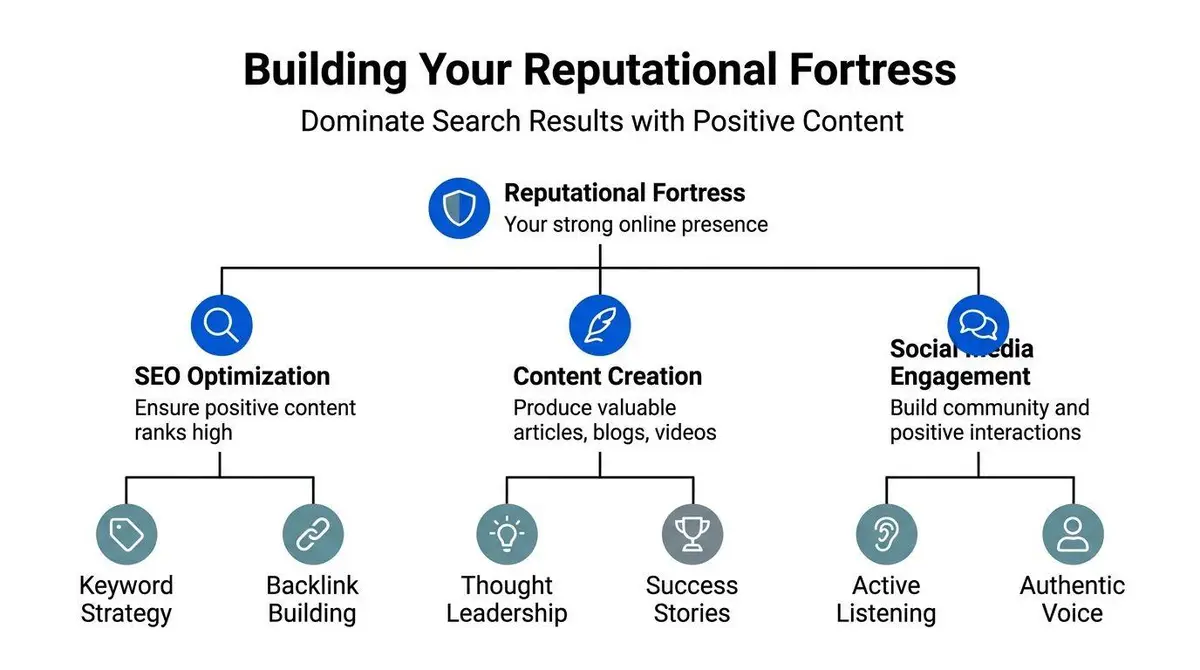
Building Your Proactive Reputational Fortress
Founders wait too long to build positive authority around their name. They assume they can do it after a problem appears. That is backwards.
Reputation defense works best when you already control the first layer of search results, the major professional profiles, and the core factual record about who you are. If you do not, an attacker has empty space to occupy.
The commercial logic is obvious. The online reputation management market is projected to reach $585 million by 2030, and 86% of consumers hesitate to buy from businesses with negative reviews, while a single-star increase can boost revenue by up to 9%, according to reputation management statistics compiled here. Founders who still treat this as a side issue are reading the balance sheet incorrectly.
Own the assets that matter
Start with the assets you can control outright.
Your personal site matters. So does your executive bio page, your company leadership page, your LinkedIn profile, your long-form interviews, and selected bylined articles under your own name. These are not vanity properties. They are ranking targets and source documents.
A proper founder footprint usually includes:
- A primary identity asset: A personal site or executive page with current biography, leadership history, speaking topics, and controlled contact pathways.
- Professional authority pages: LinkedIn and other role-relevant profiles that are complete, current, and consistent.
- Earned media placements: Interviews, op-eds, podcasts, and contributor articles on reputable domains.
- Company-controlled narrative assets: Founder letter, mission page, newsroom, and leadership materials that tell a coherent story.
Do not publish filler. Thin content does not protect anyone. Publish factual, well-structured material that answers the queries serious people search.
Build density, not volume
Most founders hear “create content” and think quantity. That is amateur thinking. You need density around key themes.
If your company is known for AI infrastructure, fintech compliance, biotech manufacturing, or consumer safety, your digital footprint should repeatedly and credibly connect your name to those subjects. That is how you make hostile content less dominant. Search engines and AI systems respond better to consistent, authoritative clusters than random posting.
Legal and cyber planning overlap with reputation work here. A founder facing activist pressure, leaked internal material, or impersonation issues should think through broader digital security and resilience strategies at the same time. Separating “security” from “reputation” is a category error. The same adversary often touches both.
The fortress model
Use this model when deciding what to build first.
| Layer | Function | Founder priority |
|---|---|---|
| Owned media | Controlled facts and rankings | Immediate |
| Earned media | Third-party validation | High |
| Professional profiles | Identity confirmation | Immediate |
| Social channels | Distribution and signal control | Selective |
| Supporting content | Topic reinforcement | Ongoing |
Notice what is not on this list. Constant posting for its own sake.
A quiet founder with excellent owned assets and selective earned media is often in a stronger position than a loud founder with chaotic social output. Visibility without control is exposure.
The right objective is not to be everywhere. It is to make sure the most credible places online say the right things about you first.
A fortress also requires maintenance. Bios drift. Interviews age. Product pivots leave stale metadata across the web. Former ventures remain indexed long after they are relevant. Reputational decay is slow, then sudden.
If you are preparing for fundraising, expansion, M&A, or a public dispute, tighten this layer before the event. Positive authority compounds over time. Crisis messaging rarely does.
Establishing Active Threat Intelligence Systems
Monitoring is passive. Threat intelligence is interpretive.
Google Alerts sends notifications after something is indexed. That can be useful for low-grade awareness. It does not tell you whether a post is coordinated, whether the same operator controls multiple accounts, whether a leak is being staged, or whether a fringe discussion is about to break into mainstream search.
What active monitoring means
An active system tracks your name, company, products, domains, executives, and known adversarial terms across social platforms, forums, news sites, review platforms, and breach-related channels. It does this continuously, not when someone on your team remembers to check.
The point is not to collect mentions. The point is to spot pattern change.
That includes a sudden shift in tone, a repeated phrase appearing across separate accounts, a niche subreddit thread being picked up by industry commentators, or a newly created account posting private details with unusual confidence. Those are indicators. Professionals read them the way security teams read log anomalies.
Founders who want structured surveillance of these signals need a dedicated reputation monitoring workflow rather than a patchwork of free alerts.
The side-hustle problem founders ignore
This is sharper for entrepreneurs who still hold executive roles elsewhere. Some studies indicate over 50% of new ventures are started by people still employed full-time, and that group faces unique spillover risk between personal and professional identities, as noted in this analysis of reputation management strategies for business success.
That matters because a side venture dispute can migrate into an employer’s risk review. A personal social account can be treated as a company issue. A criticism aimed at your startup can affect your board prospects, promotion track, or regulated role.
Signals worth escalating
Not every negative mention deserves oxygen. Some do.
Escalate when you see:
- Cross-platform repetition: The same allegation or phrase appears in multiple places within a short window.
- Credentialed amplification: Journalists, investors, ex-employees, or niche experts start repeating the claim.
- Data specificity: A post includes private details, internal timelines, or material that suggests access.
- Search progression: A low-authority item begins appearing in branded search results, auto-suggest, or platform recommendations.
A compact triage model helps.
| Signal type | Likely meaning | Action |
|---|---|---|
| Isolated complaint | Routine noise | Observe |
| Repeated accusation | Coordinated shaping or contagion | Investigate |
| Private data mention | Leak, doxxing, or insider source | Contain immediately |
| Identity misuse | Impersonation or fraud setup | Takedown and secure accounts |
The earlier you detect hostile coordination, the more options you have. Once the story reaches indexed, repeated, and quoted status, your cost of control rises sharply.
That is the dividing line. Founders who rely on passive alerts usually learn about a problem after outsiders have already formed an opinion.
The Crisis Response Countermeasure Protocol
When a reputational attack lands, founders often make the same error. They speak before they know what happened.
That instinct is understandable and usually destructive. In the first hours, your job is not catharsis. It is containment.

The first moves
Treat the first 48 hours like an incident response exercise.
First, freeze the facts. Capture URLs, screenshots, timestamps, account handles, source code where relevant, and search result positions. Preserve the evidence before anyone edits or deletes it. If the material later becomes part of a legal demand, platform escalation, or investor explanation, you need a clean record.
Third, classify the content. Is it false, misleading, true but invasive, unlawfully disclosed, policy-violating, or hostile opinion? Those categories trigger different responses. Lumping them together wastes time.
Who should be in the room
You need a small team with decision rights.
- Legal counsel: To assess defamation, privacy, confidentiality, copyright, employment, and platform-policy influence.
- Communications lead: To control outgoing language, holding statements, and stakeholder sequencing.
- Technical lead: To secure accounts, preserve logs, identify impersonation, and support takedowns.
- Principal decision-maker: Usually the founder, but only if they can stay disciplined.
Do not let five agencies and twelve executives participate. Large committees produce timid, late decisions.
The response matrix
Use a simple decision framework.
| Situation | Best immediate response |
|---|---|
| False factual allegation on a platform | Preserve evidence, report under platform policy, prepare legal notice |
| Leaked private information | Document, request urgent removal, reduce secondary spread |
| Impersonation account | Secure genuine accounts, submit verification and takedown requests |
| Old truthful but damaging content resurfacing | Avoid emotional rebuttal, prepare context and suppression strategy |
| Coordinated activist campaign | Map operators, identify amplifiers, separate legitimate criticism from targeted abuse |
The public apology is often the wrong first move because it concedes framing before you know the issue. If the allegation is false, you have handed your attacker a quote. If the issue is mixed, you may be apologizing for the wrong conduct. If the content violates policy, you may be increasing its reach while a takedown window is open.
Speed matters. Indiscriminate speed is dangerous. Precision in the first day is worth more than volume in the first hour.
Engagement rules
Not every negative mention deserves oxygen. Some do.
Engage publicly only when one of three conditions is met. The audience that matters is watching and silence will be treated as confirmation. You have verified enough facts to make a narrow statement. Or your statement supports a legal, regulatory, or platform action already in motion.
Ignore bait when the content is low-credibility, low-distribution, and obviously engineered to draw you into a fight. Responding can validate it.
Escalate when there is impersonation, leaked confidential information, fabricated evidence, doxxing, extortion, or a clear campaign to interfere with funding, employment, or contractual relationships.
One more rule. Do not let your first written response become your permanent position. Use a holding line if necessary, then update once the facts are stable.
Founders who rehearse this protocol before a crisis almost always outperform founders who improvise under pressure.
Advanced Remediation and Content Removal Strategies
Some reputational problems can be managed with context and better content. Others need to be removed. Founders should know the difference early.
If a false review, impersonation profile, leaked image, privacy exposure, or defamatory post remains online, it continues to generate harm every time a customer, investor, journalist, or recruit finds it. Suppression can help, but suppression is not the same as elimination.

Removal, de-indexing, suppression
These are separate remedies.
Removal means the source page or account comes down. That is the cleanest result. It may be possible through platform policy, direct negotiation, legal demand, privacy rules, intellectual property claims, or host-level intervention.
De-indexing means the content may remain online but stops appearing prominently in search results. This is useful when source removal is unavailable or delayed.
Suppression means publishing and optimizing stronger assets so harmful content loses visibility over time. This is necessary when authoritative or legally protected material cannot be removed.
Founders should pursue all three where appropriate, not choose one out of habit.
Match the tactic to the content
Different problems require different levers.
A false review may be addressed through platform authenticity and policy complaints. An impersonation profile often turns on trademark, identity misuse, or platform verification processes. A leaked internal document may involve confidentiality, copyright, or privacy theories. Defamatory content may require a fact-specific legal approach combined with technical escalation.
This is why generic PR firms struggle with hard cases. They know messaging. They do not always know how platforms process abuse, how search visibility can be influenced after partial removal, or how to preserve evidence while acting quickly.
If the issue is already causing commercial harm, founders often need a direct remove online content pathway rather than a communications-only approach. Services in this category focus on source takedowns, de-indexing options, and coordinated suppression when removal is incomplete. ContentRemoval.com is one example of that kind of specialist workflow.
What permanent thinking looks like
The amateur approach is to get one URL removed and declare victory. Professionals assume reupload, mirror posting, syndication, screenshot reuse, and reframed reposting.
That changes the remediation plan.
Use this sequence:
- Neutralize the primary source through policy, legal, technical, or negotiated means.
- Map duplicates and derivatives across social posts, scraper sites, archive pages, and search results.
- Harden owned assets so fresh search crawls encounter stronger alternatives.
- Monitor recurrence to catch reappearance before it regains distribution.
A takedown without recurrence control is a temporary improvement, not a solution.
There is also a judgment issue founders need to hear clearly. Not every harmful item should trigger litigation first. Litigation can expose more facts, increase discoverability, and attract coverage if handled badly. Sometimes the correct sequence is quiet technical action, targeted platform escalation, and only then formal legal pressure.
The strongest remediation strategies combine legal influence, platform fluency, and search suppression into a single plan. Used together, they can do what none of them can do reliably on their own.
Selecting Professional Services for Long-Term Defense
DIY tools have a place. They are useful for visibility, light monitoring, and internal hygiene. They are not a serious answer to high-stakes exposure.
Founders should be honest about what they are buying. Software gives dashboards. Specialist firms give judgment, escalation paths, and coordinated action across legal, technical, and narrative fronts. Those are different products.
DIY versus specialist support
This comparison is usually enough to clarify the decision.
| Option | What it does well | Where it fails |
|---|---|---|
| Free alerts and basic tools | Simple awareness, low-cost monitoring | Late detection, no remediation depth |
| Review management software | Centralized review response and reporting | Weak for leaks, defamation, impersonation, privacy exposure |
| PR agency | Messaging and media handling | Limited removal capability, weak technical enforcement |
| Law firm alone | Formal claims and legal pressure | Slow platform execution, limited suppression strategy |
| Specialist reputation firm | Integrates monitoring, removal, suppression, and discretion | Requires careful vetting |
The business case is straightforward. According to this startup statistics guide, 68% of customers will pay a 15%+ premium for a superior reputation, businesses with positive online profiles secure 6.9 times more leads, and 70% of investors avoid companies with unresolved reputational issues. That is not a branding footnote. That is enterprise value.
What to ask before you hire anyone
Ask direct questions.
Can they distinguish source removal from de-indexing and suppression, and explain when each is realistic? Can they handle privacy leaks, impersonation, false reviews, and defamatory content under one operating model? Do they involve legal analysis when needed without turning every matter into litigation? How do they monitor recurrence? Who does the work?
Also ask about discretion. Founders in sensitive situations do not need a loud campaign. They need controlled action, limited visibility, and minimal collateral exposure.
Red flags are easy to spot:
- Guaranteed outcomes: No serious operator promises universal removal.
- Single-channel solutions: If every problem gets the same answer, the firm is not diagnosing properly.
- No evidence protocol: If they do not talk about preserving records, they are not thinking beyond optics.
- Overreliance on content spam: Flooding the web with weak assets is not strategy.
- No recurrence plan: Temporary wins are expensive if the material comes back.
The right threshold for outside help
Bring in specialists earlier than you think.
You should not wait until an investor forwards a hostile article, a customer asks about an allegation, or your family’s information is circulating. The correct time is when you identify material exposure and before the issue hardens into mainstream search, due diligence files, or market gossip.
For most high-growth founders, reputation management for entrepreneurs belongs with legal readiness, security, and board governance. It is a C-suite function because the downside is strategic, not cosmetic.
The best outcomes usually come from quiet work done before the public sees the problem. That means audits before crises, monitoring before leaks, and removal planning before an attacker tests the edge of your defenses.
If you are dealing with defamation, leaked content, impersonation, privacy exposure, or a fast-moving search problem, ContentRemoval.com can start with a confidential assessment and map the practical options for removal, de-indexing, monitoring, and long-term defense.
Frequently asked questions
How do I check my online reputation as a founder?
Search your full name, variations, company and product names across web, news, image, video and social results while logged out. Review LinkedIn, X, Reddit, Glassdoor, Trustpilot and industry forums for stale bios and unclaimed listings, then check people-search sites for cached addresses and family associations. Classify each finding as owned, removable, persistent or latent.
Should a founder respond publicly to a false accusation online?
Only when the audience that matters is watching and silence will read as confirmation, you have verified enough to make a narrow statement, or the statement supports a legal, regulatory or platform action already in motion. Low-credibility bait engineered to draw you into a fight is usually better ignored while evidence is preserved and takedowns proceed.
What is the difference between removal, de-indexing and suppression?
Removal takes the source page or account down through platform policy, legal demand, privacy rules or host intervention, while de-indexing leaves the page online but stops it appearing prominently in search. Suppression publishes stronger assets so non-removable content loses visibility over time, and serious cases usually use all three.