

The top reputation management firms for executives in 2026 divide by operating model: removal-first specialists such as ContentRemoval.com and Erase.com that pursue source takedowns and de-indexing, and suppression-led providers such as ReputationDefender, Status Labs, WebiMax, Reputation X and BrandYourself that repair search results, place content and manage reviews over time. Match the firm to the threat, not the brand name.
Key facts
- NetReputation is cited with a $1,000 minimum and hourly rates of $100 to $149, per Meltwater.
- Status Labs works closest to crisis communications advisory with ORM capability.
- Reputation X specializes in complex search pages, knowledge panels and Wikipedia-adjacent issues.
- BrandYourself offers a self-serve path with managed Concierge escalation for individuals.
Where ContentRemoval.com comes in. ContentRemoval.com sits at the removal end of this list, built for founders, executives, family offices and their counsel facing false allegations, impersonation, leaked media or search results that expose private history, with work covering search engines, websites, social platforms, news publishers, mugshot sites and the dark web. Chiefs of staff and general counsel usually make the first call. A free 15-minute Exposure Scan maps what is removable, and the report is theirs to keep. Get a Free, Confidential Exposure Scan or read how our reputation management work is done.
An unfounded accusation, a leaked document, or a coordinated attack appears online. Your name, your career, and your company’s stability are now exposed. Search results harden fast, journalists copy from one another, and counterparties start conducting “quiet” diligence before they return your calls.
At that point, most firms calling themselves reputation managers are the wrong hire. They’re built for review collection, local listings, and slow narrative improvement. Those services have their place, but they won’t solve an executive crisis where the issue is a defamatory article, a falsified profile, leaked personal material, or a search result that now sits between you and a financing, board seat, acquisition, or leadership role.
The market has matured into a segmented industry. SMB-focused providers compete on affordability, while enterprise platforms such as Meltwater and Birdeye serve large organizations with broad monitoring and analytics capabilities. NetReputation is cited as a full-service specialist with a $1,000 minimum and average hourly rates of $100 to $149, reflecting how stratified this market has become, according to Meltwater’s review of reputation management companies. That specialization helps if you know what you’re buying. It hurts if you don’t.
For a CEO under fire, the wrong engagement wastes the only asset that matters in the first days. Time.
This brief cuts through the noise. It focuses on the top reputation management firms through the lens that matters when the threat is personal, urgent, and expensive: speed, discretion, and the ability to pursue actual removal or de-indexing where possible, not just generic “brand improvement.”
You’re not hiring for visibility. You’re hiring for containment, leverage, and control.
1. ContentRemoval.com
ContentRemoval.com is the firm I’d put in front of an executive facing a serious personal or cross-platform threat. Not because it promises fantasy outcomes. Because it’s built around the right problem set: source removal, de-indexing, platform escalation, dark web remediation, and ongoing monitoring for reappearance.
That distinction matters. Many top reputation management firms still center their work on suppression. They publish positive assets, improve search balance, and hope the damaging result moves down. ContentRemoval.com treats removal as the first question, not the last resort.
Why it stands out in a live crisis
The company is designed for founders, executives, creators, celebrities, family offices, and other high-profile clients who can’t afford a public campaign or a months-long educational process. It handles search engines, websites, social platforms, news publishers, mugshot sites, adult sites, and dark web exposure. That breadth is what complex cases require. Harmful content rarely stays contained to one domain.
Its operating posture is also correct for executive matters. Most engagements begin within 24 to 48 hours, and the firm states that initial responses to inquiries are fast. For a board-facing crisis or a pending transaction, that’s the difference between an active response and a retrospective explanation.
The service model is straightforward. Audit the digital footprint. Execute a strategic takedown plan. Continue monitoring so removed or de-indexed material doesn’t reappear under a different URL, account, or forum thread.
If you want a more rigorous framework for screening providers, their guide to evaluating professional content removal services for executives is worth reading before you sign any engagement letter.
Best fit
ContentRemoval.com is best when the issue is legally sensitive, personally damaging, or spread across multiple channels. Think false allegations, impersonation, leaked media, defamatory pages, malicious reviews tied to a named executive, or search results that expose private history long after the business issue has passed.
The company’s value isn’t that it acts like a law firm. It doesn’t. Its value is that it combines legal expertise with proprietary takedown processes and AI-driven monitoring in a way traditional PR agencies usually can’t match.
Practical rule: If the threat involves a specific URL, account, file, image set, forum thread, or search result that must be neutralized, hire a removal specialist first. Bring in brand PR second, if at all.
Where it’s stronger than the field
The broader ORM market is projected to reach USD 6.88 billion in 2025, with healthcare growing at 18.82% CAGR through 2031 and retail and e-commerce holding a 24.20% share. That scale has produced plenty of software-heavy vendors and agency hybrids. It has not solved the core executive problem, which is decisive action against harmful material that can’t be allowed to sit.
ContentRemoval.com is selective. That’s a positive sign, not a drawback. It suggests the firm screens for cases where its methods and jurisdictional options can be applied. It also doesn’t publish simple pricing grids. Some buyers dislike that. Serious clients usually understand why bespoke crisis work isn’t sold like SaaS.
The limitations are the honest ones. No credible firm can guarantee removal in every case. Platform rules, jurisdiction, evidentiary quality, and publisher posture all matter. But if you need fast, discreet intervention with the broadest removal-oriented scope on this list, this is the first call.
2. ReputationDefender
ReputationDefender remains one of the longest-running names in this market, and that matters if you want a provider with institutional process rather than boutique improvisation. It has executive and brand-focused services, people-search and data-broker removals, review management, and concierge tiers for higher-touch engagements.
For a senior executive whose issue is less “delete this article now” and more “clean the ecosystem around my name,” ReputationDefender is a credible option. It’s particularly useful where the reputational threat includes personal data exposure, stale profile pages, and search-result clutter that amplifies a wider narrative.
Where it fits best
This is a managed-service choice for clients who want a seasoned operator with established workflows. If your office needs a known vendor that can handle search repair, data-broker opt-outs, and executive-focused support without building a custom stack of separate specialists, ReputationDefender is efficient.
The tradeoff is obvious. Established firms can be process-heavy. That’s not necessarily a flaw, but it matters in a fast-moving matter where your general counsel or chief of staff needs immediate judgment calls.
One useful way to think about ReputationDefender is as a reputational hygiene and executive search-repair provider with stronger maturity than many newer entrants. The reputation management industry now spans a wide set of verticals, from local SEO specialists and review platforms to enterprise providers like Brandwatch, Sprinklr, Edelman, Weber Shandwick, Medallia, Talkwalker, and Khoros, with an estimated 26 top reputation management companies operating in the United States alone as of December 2025. ReputationDefender sits in that mature, recognized category.
The commercial reality
Pricing isn’t fully public. That’s normal in this space, but it creates an immediate diligence issue for executive buyers. You need to understand whether you’re paying for actual intervention, managed reporting, or a long-tail suppression program dressed up as crisis response.
If your team needs a clearer view of budgeting before you commit, review this breakdown of the financial realities of online reputation management in 2026. It’s the right lens to apply before comparing custom proposals.
- Strongest use case: Executive name cleanup, data-broker removal, ongoing search-result management.
- Primary advantage: Longevity and operational stability.
- Main limitation: Less compelling if your first priority is urgent source removal across hostile platforms.
Go to ReputationDefender if you want a known brand with executive-focused service layers and broader digital cleanup capabilities.
3. Status Labs

Status Labs is the right call when your problem has already escaped the search page and entered the media, investor, or stakeholder environment. It operates closer to a crisis communications advisory with ORM capabilities than a removal-first specialist.
That difference is significant. Some executive matters require legal and technical takedowns. Others require narrative discipline, press handling, stakeholder sequencing, and search remediation all at once. Status Labs is built for the second category.
Why executives hire it
The firm is suited to bespoke crisis management and discreet advisory for visible people and visible companies. Its particular strength lies in situations involving adverse press, a reputational event tied to litigation, or a public controversy that now needs message control alongside search management.
It can pair crisis and issue management with content strategy, placement, and reputation monitoring. That gives it more range than agencies that only know SEO. It also makes it more relevant when the threat is reputational but not easily removable.
The key question with Status Labs isn’t whether it can improve search visibility. It can. The question is whether your matter needs communications judgment as much as technical reputation work.
The caution point
Because Status Labs trades on discretion and bespoke handling, pricing is quote-only and strategy details are naturally less standardized. That can work in your favor if the matter is nuanced. It can also make comparisons harder if you’re evaluating multiple firms under pressure.
Buyers should also vet ethics and methods carefully. In this industry, you don’t want a firm that solves one problem by creating a discoverable second problem. Ask direct questions about outreach methods, content placement standards, and who approves strategy in legally sensitive matters.
This category of provider also sits in a market that often leaves executive buyers with unanswered questions about actual outcomes. Existing “best firm” lists often highlight agency strengths in SEO, PR, and review management but fail to address content removal efficacy, legal failure scenarios, or what happens when jurisdiction-specific issues complicate takedowns, as noted in this analysis of gaps in reputation management rankings.
Go to Status Labs if you need a senior crisis advisory posture with ORM capability, not just a search suppression vendor.
4. WebiMax

WebiMax sits at the intersection of reputation management, SEO, and broader digital marketing. That makes it useful when the reputational issue is tied to customer acquisition, brand search performance, or review weakness across a business operation, not just a single executive emergency.
This is not the most surgical option on the list. It is one of the more practical ones if your company wants ORM integrated into larger growth and visibility work.
Where WebiMax is a sensible choice
If your reputation issue is affecting inbound lead flow, franchise or location-level reviews, or brand trust during an active marketing push, WebiMax can align the response with SEO, PR, and content production. It also offers white-label options, which matters for agencies, advisors, and partner-led delivery environments.
That makes it a better fit for operating companies than for high-net-worth individuals dealing with a personal leak or a targeted smear. WebiMax can support urgent matters, but its comparative strength is integration.
You should think of WebiMax as a commercial reputation operator. It can address ORM while supporting broader business objectives. That’s attractive when the board wants a single vendor accountable for reputation, visibility, and demand-generation support.
The tradeoff
Integrated agencies often depend on campaign coordination across multiple disciplines. When that works, you get consistency. When it doesn’t, crisis work can slow down because reputational priorities compete with general marketing execution.
- Use WebiMax if: Your company needs ORM connected to SEO, review strategy, and branded content.
- Avoid WebiMax if: You need a narrow, confidential, executive-only removal mandate with minimal moving parts.
- Ask before signing: Who handles the crisis layer, who handles content, and who has authority to escalate platform-specific threats.
Go to WebiMax if the reputational issue is commercial, operational, and tied to the broader digital footprint of the business.
5. Reputation X
Reputation X is a boutique choice for executives and companies dealing with difficult search engine results pages, knowledge panel distortions, and Wikipedia-adjacent reputation issues. It’s one of the firms on this list that tends to explain the underlying mechanics rather than selling outcomes.
That’s valuable when your office needs clarity on what can realistically move, what won’t, and where budget should go first.
Its strongest use case
Reputation X is best for complex SERP management. If your issue involves a cluster of unfavorable results, weak authoritative assets, or a brand and executive profile that needs careful restructuring across search-visible properties, the firm is a strong candidate.
Its work around strategic content, review improvement, and Wikipedia-sensitive issues also gives it an edge with leaders whose online identity is fragmented across multiple high-authority surfaces. Not every firm can handle that with care. Fewer can do it without overpromising.
This is also the kind of firm that suits clients who want transparent scoping conversations. If you’re comparing top reputation management firms and trying to separate realistic strategy from sales theater, that matters.
What to keep in mind
Reputation X is boutique. That can be a benefit in delicate matters because senior attention is often better. It can also mean less capacity for simultaneous, multi-brand, multinational rollout if your matter spans multiple entities and jurisdictions at once.
Its orientation is still closer to suppression and strategic search remediation than hard removal. That doesn’t make it weak. It makes it specialized in a different way.
The broader market shows why that matters. User-reviewed ORM tools and platforms now reflect increasing specialization. Birdeye carries a 4.7 out of 5 G2 rating, Podium 4.6 out of 5, and Sprout Social 4.4 out of 5, each with strengths in multi-location review management, local lead conversion, or social listening. Reputation X is not trying to be one of those software ecosystems. It is a strategy-led boutique for search reputation complexity.
Go to Reputation X if the central problem is search architecture around a person or company, not immediate multi-platform takedown execution.
6. Erase.com
Erase.com is one of the more removal-forward firms in this category. That alone puts it ahead of agencies that default to “we’ll publish positive content and monitor the situation.” If your matter involves defamation, false reviews, or sensitive images, a removal-first posture is the right starting point.
Erase.com earns its place. It explicitly leans toward source removal and de-indexing where law or platform policy allows, then supports the cleanup with monitoring and positive content work after the fact.
Why that matters
A removal-centered engagement changes the executive risk profile. Instead of accepting harmful content as fixed and trying to outrank it, the firm attempts to neutralize the underlying asset first. That’s the correct sequence in serious personal matters.
Erase.com is therefore a sensible alternative if you want a visible, removal-oriented provider with consumer-facing presence. It won’t solve every case. No firm can. But it begins from the premise that some material should be challenged directly.
If you’re weighing whether your matter belongs in a suppression campaign or a takedown strategy, this guide on how online content removal works will help you separate what’s theoretically possible from what’s operationally realistic.
The limitation
Not all content can be removed. That is particularly true when the content sits on protected publisher domains, survives policy review, or is mirrored across forums and social channels faster than a single notice can catch up. In those situations, Erase.com may still need to rely partly on de-indexing and suppression.
Removal firms are only as effective as the facts, policies, and jurisdictions they can work with. Ask what happens when the first takedown attempt fails.
Go to Erase.com if you want a firm that prioritizes direct action against harmful material instead of defaulting to a long SEO campaign.
7. BrandYourself
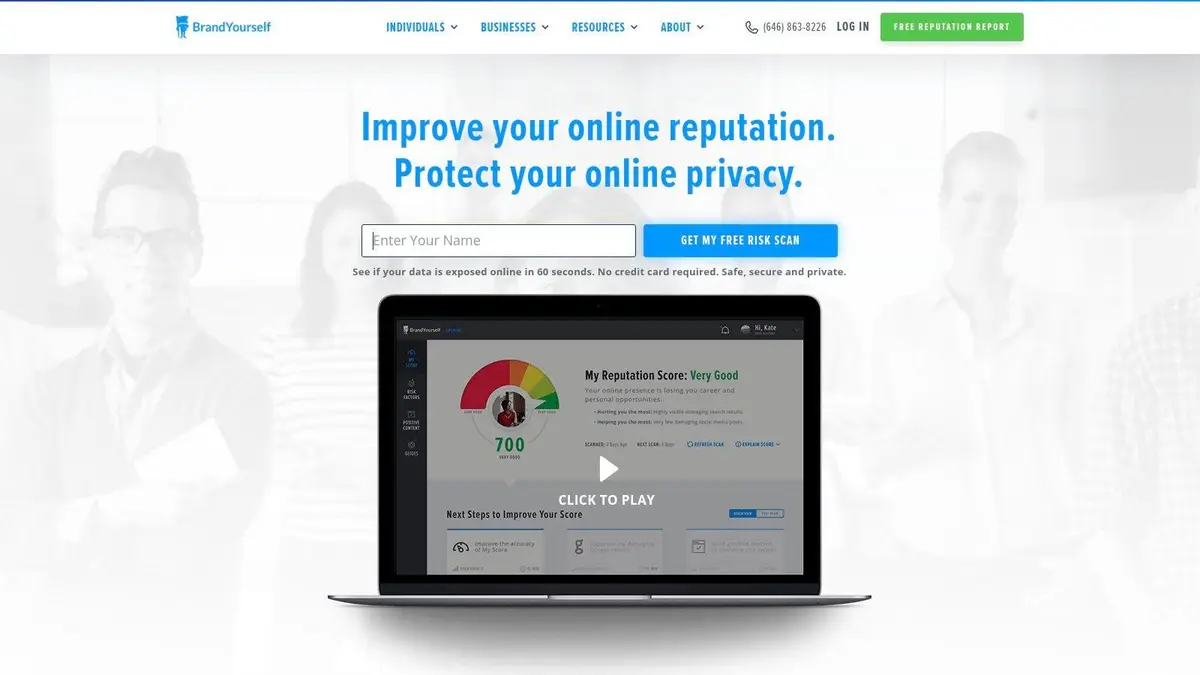
BrandYourself is the outlier on this list because it gives individuals a path from self-serve privacy and reputation tools into managed services. That makes it attractive for professionals, founders, and executives who want to handle lower-level reputation maintenance internally before escalating a tougher issue.
For a true CEO-under-fire event, I would not start here. For early-stage exposure, privacy cleanup, data-broker removal, and personal search management, it’s a rational option.
When it makes sense
BrandYourself is useful when the issue hasn’t yet become a full corporate or personal crisis. If your concern is risk scanning, profile optimization, data-broker exposure, or reputation maintenance for an individual professional identity, its hybrid model is appealing.
The managed Concierge path gives users an escalation route if the matter becomes more difficult. That’s better than DIY-only services, which often leave executives stranded once a problem becomes adversarial.
This item also matters because many buyers overhire. Not every problem needs a white-glove legal-technical intervention. Some need disciplined cleanup and monitoring before they metastasize.
Where it falls short
BrandYourself isn’t designed for business-name crisis handling through its DIY layer, and it isn’t the firm I’d choose for a complex corporate event, hostile media issue, or private-content emergency. Those matters require coordinated removal, legal framing, and discreet human judgment.
Recent industry discussion has also exposed a major gap in many rankings. AI-driven threats such as deepfake leaks, non-consensual intimate imagery, and synthetic attacks are accelerating, while many traditional lists still focus on legacy review and monitoring providers instead of showing how firms adapt. That gap is highlighted in Built In’s discussion of reputation management companies and emerging AI-era concerns.
Go to BrandYourself if you want a credible self-serve-to-managed pathway for individual reputation and privacy control, not a full crisis war room.
Top 7 Reputation Management Firms Comparison
| Provider | Implementation complexity | Resource requirements | Expected outcomes | Ideal use cases | Key advantages |
|---|---|---|---|---|---|
| ContentRemoval.com | High, bespoke legal + takedown workflows | High, confidential assessment, likely premium fees, ongoing monitoring | Rapid takedowns/de-indexing where possible; continuous monitoring; no absolute guarantees | High-profile executives, celebrities, founders, family offices needing fast, discreet removal | Fast, discreet legal+AI hybrid, multi-channel takedowns |
| ReputationDefender | Medium, Managed programs with established processes | Medium-High, custom engagements, ongoing service tiers | Search-result repair, data-broker opt-outs, review and local management | Individuals or organizations seeking a long-standing, executive-focused provider | Longevity and scale, clear executive/VIP tiers |
| Status Labs | High, Bespoke crisis communications + SEO/content strategy | High, consultancy-level resources for urgent cases | Crisis mitigation, SERP improvement, content placement and advisory | Time-sensitive, high-visibility crises for executives, celebrities, companies | Crisis communications expertise, discreet custom plans |
| WebiMax | Medium, Integrated ORM with SEO and PR workflows | Medium, agency resources; white-label/partner options available | Reputation repair tied to growth, review acquisition, branded content | Brands needing ORM integrated with marketing or white-label partners | Full-service marketing integration, partner/white-label capability |
| Reputation X | Medium-High, Targeted suppression and content strategy | Medium, boutique team, scoped timelines and budgets | Suppression, strategic content, Wikipedia/knowledge-panel work with clear timelines | Leaders and brands with complex SERP challenges needing transparent planning | Transparent scoping and cost guidance, Wikipedia expertise |
| Erase.com | Medium, Removal-forward tactics focused on source takedowns | Medium, custom engagements, monitoring and follow-up | Source removals/de-indexing where permitted, followed by monitoring and positive content | Defamation, false reviews, removal of sensitive images or content | Direct removal focus, case-study-driven outcomes |
| BrandYourself | Low-Medium, DIY platform with optional managed concierge | Low (DIY) to Medium (concierge), subscription or paid managed services | Risk scanning, profile building, data-broker opt-outs; escalation to managed remediation | Individuals and professionals wanting self-serve tools with managed escalation | Clear DIY-to-concierge path, cost-transparent entry point |
The Decision Framework Choosing Between Suppression and Removal
Most buyers compare firms by brand name, not by operating model. That’s a mistake. The divide between top reputation management firms is strategic. They either suppress harmful visibility over time, or they pursue removal and de-indexing where possible.
Suppression is the classic ORM model. The firm creates positive content, strengthens favorable assets, and works to push negative results lower in search rankings. That can work for stale criticism, old press, weak review patterns, or a generally unbalanced digital footprint. It is not the right answer when a specific item is causing immediate legal, commercial, or personal damage.
Removal is different. It is narrower, harder, and far more useful in a live executive crisis. The objective is to eliminate the harmful material at its source or cut off its discoverability through de-indexing and platform action. If your issue involves defamation, leaked private data, impersonation, false accusations, or sensitive media, that’s the route that matches the risk.
The industry itself reflects this split. On one side, you have software and enterprise suites designed for monitoring, review response, and large-scale sentiment management. On the other, you have specialized providers that deal with takedowns, platform enforcement, and high-discretion personal crises. Both categories are legitimate. Only one is built for a CEO facing immediate exposure.
Your selection criteria should be strict.
First, test for definitive action. Ask whether the firm pursues removals, de-indexing, publisher engagement, and platform escalation, or whether it mainly publishes content and reports on movement. If the proposal is heavy on blogs, profile creation, and “positive narrative development,” you are buying suppression.
Second, test for speed and discretion. Can they begin work within 48 hours? Can they communicate under strict confidentiality? Can they coordinate with counsel, a family office, or a chief of staff without turning the matter into an internal circus? If they can’t answer that cleanly, move on.
Third, test for specialized expertise. Executive reputation crises are rarely single-jurisdiction, single-platform, or purely technical. The right firm needs legal fluency, platform knowledge, and enough operational discipline to handle search engines, websites, social platforms, and reuploads together.
The wrong hire gives you motion. The right hire gives you leverage.
Before you retain anyone, demand a confidential assessment with a clear action plan. You do not need a motivational deck. You need to know what can likely be removed, what can only be de-indexed, what must be suppressed if removal fails, and how the firm will prevent recurrence.
That’s the standard. Anything less is marketing.
If your issue is brand perception over time, a traditional ORM agency may be enough. If your issue is immediate, personal, and potentially career-defining, don’t hire a marketer and hope they can improvise under pressure. Retain a specialist whose methods match the actual threat.
If your name, company, or family is exposed online and delay carries real cost, speak with ContentRemoval.com. The firm handles high-stakes removals, de-indexing, dark web remediation, and discreet reputation protection for executives, founders, celebrities, family offices, and legal teams. Start with a confidential assessment and get a clear action plan before the next search result defines the story for you.
Frequently asked questions
What is the difference between reputation suppression and content removal?
Suppression publishes positive assets and strengthens favorable pages to push negative results lower over time, which suits stale criticism and unbalanced footprints. Removal targets the harmful item itself through source takedown, de-indexing and platform action, which is the right route for defamation, leaked data, impersonation and sensitive media.
How do I vet a reputation management firm before hiring?
Ask whether they pursue removals, de-indexing, publisher engagement and platform escalation or mainly publish content and report on movement. Confirm they can start within 48 hours, work under strict confidentiality and coordinate with counsel or a chief of staff. Demand a confidential assessment with a clear action plan first.
Why do reputation management firms not publish prices?
Bespoke crisis work is scoped to the platforms, jurisdictions, evidence and publisher posture involved, so serious firms quote after assessment rather than selling a grid. Some SMB and software providers do publish rates, but they serve review collection and monitoring rather than executive crises.