
Removing a bad review starts with triage: a legitimate complaint to resolve offline, a suspected fake, a policy violation, or a defamatory statement of fact. Policy violations such as conflict of interest, harassment, impersonation or private information are reported to the platform with evidence. Provably false claims can be escalated through a cease and desist and a court order.
Key facts
- Capture full-page screenshots with URL, date and time, plus the reviewer’s profile, join date and review history.
- Common removable violations: conflict of interest, impersonation, hate speech, off-topic rants and private information.
- Defamation requires a false statement of fact, publication, fault and damages; opinions such as slow service do not qualify.
- Platforms like Google comply with a valid court order declaring a review defamatory.
Where ContentRemoval.com comes in. ContentRemoval.com takes on reviews that survive flagging and appeal on Google, Yelp, Glassdoor, Trustpilot and the fringe complaint sites that ignore reports, building the policy or legal case that fits and handling coordinated attacks across platforms. Business owners, in-house counsel and their marketing agencies usually get in touch after a second denied flag. A free, confidential 15-minute Exposure Scan maps which reviews are removable and by which route, and the report is yours to keep. Get a Free, Confidential Exposure Scan or read how our review removal work is done.
A single negative review is more than criticism; it is a direct assault on your reputation, capable of inflicting measurable financial harm. This is not a public relations exercise. It is a strategic playbook for leaders who must act decisively when a crisis emerges. We will detail the precise methods for removing bad reviews, from initial forensic analysis and platform disputes to legal takedown orders when circumstances demand.
The Executive Playbook for Removing Negative Reviews
That single defamatory post is not a mere annoyance. It actively erodes trust, deters high-value clients, and impacts revenue. The anxiety you feel when a false or malicious review appears is justified. With significant financial and reputational capital at risk, passivity is not a viable option. You require a structured plan to reassert control.
This playbook is engineered for executives, in-house counsel, and prominent individuals whose reputation is their most valuable asset. It establishes the essential framework for an effective removal strategy, guiding you from the moment of discovery to a decisive resolution. The objective is not simply to respond. It is to neutralize the threat with precision.
The Core Elements of a Removal Strategy
A successful outcome depends on calculated action, not reflexive reaction. Each of these phases is critical, whether you are contending with a genuinely dissatisfied client, a competitor’s unethical tactics, or a defamatory attack.
A forensic assessment is the immediate first step. The review must be analyzed to determine its nature. Is it a legitimate grievance requiring resolution, a clear violation of platform policy, or does it cross the line into illegality, such as libel? This diagnosis dictates all subsequent actions.
Platform-specific action is the next phase. Each review platform (Google, Yelp, Glassdoor, Trustpilot) operates under its own distinct policies and, more importantly, its unwritten enforcement protocols. A successful takedown request is not a generic template; it is a meticulously crafted argument tailored to the specific platform’s Terms of Service.
Legal escalation becomes necessary when a platform fails to act on a defamatory post. This can range from a formal cease and desist letter to securing a court order compelling a search engine to de-index the harmful URL.
Finally, proactive reputation defense is essential. Removing a review is only half the battle. A comprehensive strategy involves building a resilient online footprint that can withstand future attacks. This includes content suppression tactics to demote negative items and continuous monitoring for new threats.
A single bad review lingering online can cost thousands in lost leads, a risk magnified by the volatility of platform moderation. Relying on platforms to self-correct is an inadequate strategy when direct financial and reputational harm is at stake.
The rules governing this landscape are in constant flux. In 2026, for example, Google significantly intensified its review moderation, with deletions increasing by over 600% between January and July alone. Critically, 38% of these were five-star ratings flagged as fraudulent, a clear indication that algorithmic purges can inadvertently increase the visibility of negative content. You can read more about Google’s evolving review policies to understand the environment’s complexity. This guide provides the strategic clarity required to navigate that complexity and protect your most critical asset: your reputation.
When a damaging review appears, the instinct is to counter-attack. An emotional, knee-jerk response can escalate a minor issue into a public relations catastrophe. Before taking any action, you must perform a triage.
This initial assessment is paramount. It is where you diagnose the problem before prescribing a solution. Miscalculation at this stage (for instance, by publicly engaging a fake reviewer or attempting to remove a legitimate customer complaint) exacerbates the damage. It can anchor the negative content higher in search results and provoke the author to intensify their attack.
Sorting Fact From Fiction and Gathering Evidence
First, you must determine the nature of the review. Is this a genuine, aggrieved customer? Or does it bear the hallmarks of a fake: a disgruntled former employee, a competitor, or an anonymous troll? Each scenario requires a distinct playbook. You address a real customer with care and offline resolution; you attack a malicious post with the goal of complete removal.
Simultaneously, you must begin to gather evidence. This is not optional; it is the foundation of any successful takedown attempt. Your evidence collection must be methodical.
Capture full-page screenshots, including the URL, date, and time, to document the publication’s context. Screenshot the reviewer’s entire profile, noting the username, join date, and review history. A new profile with a single, vitriolic review is a significant red flag. Finally, copy and save the direct URL to the review itself for reporting and potential legal action.
The legitimacy of the review dictates your entire strategy. You don’t debate a lie; you get it taken down. You don’t try to get a real complaint deleted; you solve the customer’s problem.
This evidence file is your most valuable asset. It is the proof you will submit to platform moderators to demonstrate a Terms of Service violation, and it is what an attorney will use to construct a defamation case. Without it, your efforts are severely handicapped.
The Decision-Making Framework
To facilitate rapid and logical decision-making for our clients, we employ a structured process. The objective is to classify the review and identify the correct path forward, free from emotional interference.
This flowchart maps the entire process, from the initial discovery of the review to the selection of the appropriate action.
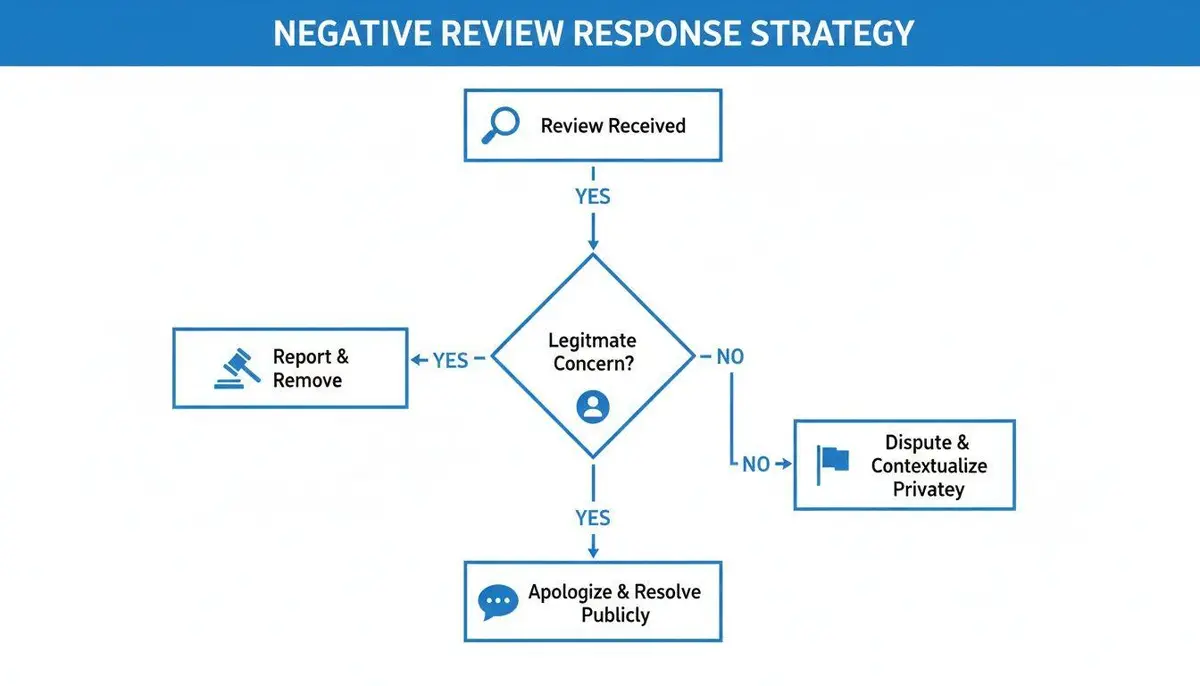
Following a framework like this enforces discipline. It prevents you from replying to a review that should be reported or, equally damaging, reporting a legitimate complaint that requires a human resolution.
To further clarify, we classify all incoming negative reviews using a specific protocol. This determines the immediate next step before emotion can dictate strategy.
Review Triage and Action Protocol
| Review Classification | Key Indicators | Recommended Initial Action |
|---|---|---|
| Legitimate Customer | Mentions specific, verifiable details of an experience. Reviewer has a history of other genuine-looking reviews. Matches customer records. | Do not flag. Draft a public response acknowledging the issue and offer to take the conversation offline to resolve it. |
| Suspected Fake/Competitor | Vague, overly aggressive language. No verifiable details. Sparse or new profile with only 1-2 negative reviews. | Preserve evidence. Cross-reference platform ToS. Do not engage publicly. Begin the platform’s dispute/flagging process. |
| Policy Violation | Contains hate speech, threats, private information, profanity, or is clearly off-topic (e.g., a political rant). | Preserve evidence. Immediately report the review to the platform, citing the specific policy violation (e.g., “Harassment,” “Spam”). |
| Potentially Defamatory | Makes verifiably false claims of a factual nature (e.g., “the owner committed fraud,” “the food has poison”). | Do not engage publicly. Preserve all evidence. Escalate immediately to legal counsel or a specialist removal service like ContentRemoval.com. |
This table serves as your frontline defense, ensuring your first move is always the correct one.
Your analysis begins by comparing the review against the platform’s Terms of Service. Countless reviews have been removed simply because they violated a clear rule unrelated to the customer’s complaint. Identify obvious violations, such as:
- Harassment or hate speech: Personal attacks, threats, or abusive language.
- Impersonation: The reviewer is masquerading as someone else.
- Conflict of interest: The review is from a competitor, ex-employee, or a paid agent.
- Off-topic content: The review is a political commentary or personal grievance rather than a customer experience.
If a clear violation exists, the path is straightforward: file a detailed report with the platform. Do not merely click “flag.” Provide a concise, clear explanation of which rule was broken and attach your evidence. If no obvious violation is present but you are confident the review is fake or defamatory, escalation is required. This is the point where engaging a professional can be decisive.
Getting Platforms to Take Down Bad Reviews
This is the critical juncture. Approaching platforms like Google, Yelp, or Trustpilot directly is your most powerful initial move. However, simply clicking the “report” or “flag” button is an exercise in futility. It is the digital equivalent of shouting into a void.
To secure a review’s removal, you must abandon the mindset of a frustrated business owner and adopt that of a platform’s content moderator. You must construct a case for removal so clear and compelling that they have no alternative but to concur.
Each platform is a distinct ecosystem with its own set of rules. Your task is to become an expert on their specific Terms of Service (ToS) and pinpoint the exact rule the review violates. A takedown request that cites a specific, black-and-white policy violation is infinitely more effective than a vague complaint that a review is “unfair.”
Speaking the Moderator’s Language
A moderator’s function is not to arbitrate truth. They are indifferent to whether a customer exaggerated or if you feel wronged. Their sole purpose is to determine if the content violates a written rule.
Therefore, you must frame your entire argument in their language, the language of policy.
The most common violations that lead to swift review removal include:
- Conflict of Interest: The review originates from a disgruntled ex-employee, a competitor, or a paid agent. This is a major violation on virtually every platform.
- Impersonation: The poster is misrepresenting their identity, whether as a real customer or even you.
- Hate Speech & Harassment: The content includes slurs, threats, or attacks based on protected characteristics.
- Off-Topic Rants: The review is not about a customer experience but is a political tirade or a personal grievance irrelevant to your business.
- Private Information: The post discloses personal phone numbers, home addresses, emails, or other non-public details.
When drafting your removal request, be clinical. Avoid emotional pleas. Adhere to the facts and demonstrate their direct connection to a policy breach.
When you submit a takedown request, you are not asking for a favor. You are reporting a policy violation and providing the platform with the evidence required to enforce its own rules. Your tone should be that of a helpful partner, not an aggrieved victim.
You will operate within the platform’s reporting interface to build your case. Your objective is to make it as simple as possible for the moderator to identify the violation and act.
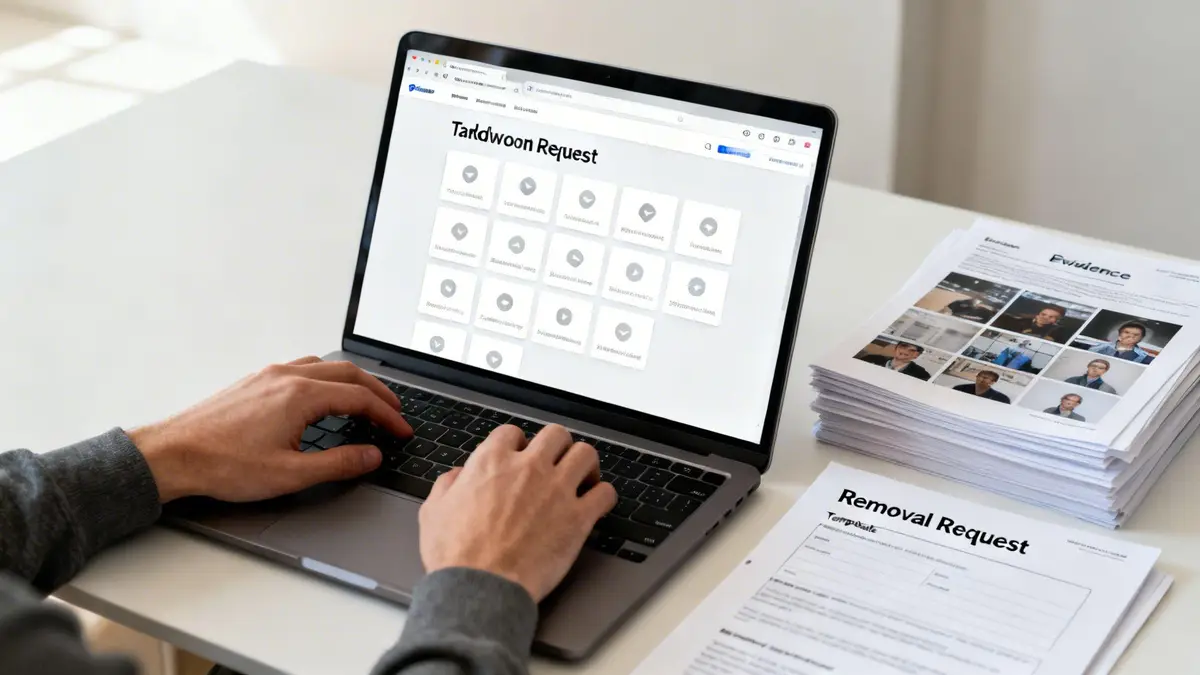
Most platforms have clear policies prohibiting conflicts of interest, harassment, or off-topic content. This is the ammunition for a successful removal case.
How to Build an Airtight Case for Removal
An effective takedown request is concise, precise, and substantiated. It is a report, not a narrative. Forget emotional appeals and focus on a clinical presentation of facts.
Structure your argument for maximum impact. Instead of “This review is fake!”, adopt this approach:
First, identify the specific violation. Begin your request by stating the policy the review breaches. For example: “This review violates your policy against Conflict of Interest.”
Next, present your evidence. Connect the dots for the moderator. Briefly explain how the review violates the rule, referencing the proof you have gathered. For example: “The user ‘JohnD1985’ is a former employee terminated on October 15, 2023. His user profile indicates his previous employer was our company, and this is his only review.”
Finally, attach your proof. This is crucial. Provide screenshots of the user’s profile, past comments, or any other material that substantiates your claim. This makes your report irrefutable.
This methodology transforms the dynamic. You are no longer just another complainant; you are a valuable partner assisting the platform in maintaining its integrity.
Of course, a site like Yelp has its own unique ecosystem and content rules. For a deep dive into that platform, our strategic guide to Yelp review removal for executive reputation management provides a more detailed playbook.
Patience is required. After submission, monitor the review. If your initial request is denied, do not abandon the effort. Many platforms have an appeal process that escalates your case to a more senior moderator. Resubmit your case, refining your argument and perhaps highlighting different evidence. When your case is built on solid policy, persistence often prevails.
When platform support channels fail and a review is not merely negative but maliciously false, it is time to cease negotiation and enforce your rights.
This is the domain of legal counsel. Legal escalation is not for minor grievances or opinions with which you disagree. Initiating litigation over a subjective comment like “service was slow” is a misallocation of resources that will almost certainly backfire. This path is reserved for serious matters: provably false statements of fact inflicting measurable damage to your enterprise.
The Anatomy of a Defamation Case
Defamation is a specific legal tort, not a feeling of being wronged. To prevail, you and your attorney must prove several key elements. This is not about hurt feelings; it is about your reputation being harmed by a lie presented as fact.
The general requirements to establish a legal basis for removal are:
- A False Statement of Fact: This is the core element. The statement must be demonstrably untrue. “I didn’t like the steak” is an opinion. “The restaurant’s kitchen is infested with rats,” when it is not, is a false statement of fact.
- Publication to a Third Party: An online review automatically satisfies this criterion.
- Fault: You must show the reviewer was at least negligent or, in some cases, acted with actual malice (knowledge of falsity with intent to harm). The standard is often higher for public figures.
- Damages: You must demonstrate that the false statement caused real harm, providing evidence of financial loss, such as canceled contracts or a sudden drop in sales attributable to the review.
A court order is the ultimate trump card in any content dispute. It turns your removal request into a legal command. Platforms like Google don’t argue with a valid court order; they comply. This is how you get false, defamatory content taken down for good.
At this stage, you must retain an attorney specializing in online defamation. A general practice lawyer will lack the specific experience required. You need counsel who understands the nuances of Section 230 of the Communications Decency Act and knows how to build a case that compels a platform’s compliance.
The Legal Takedown Process in Action
Your legal strategy will likely begin with the most direct and cost-effective approach. The objective is always to remove the content as quickly as possible.
The first step is typically a Cease and Desist letter. Your attorney drafts this formal notice and sends it to the reviewer. It identifies the false statements, demands their immediate removal, and outlines the legal consequences of refusal. For many individuals, a letter from a law firm threatening litigation is sufficient motivation to delete the post.
If the letter is ignored or the reviewer is anonymous, the next step is to file a lawsuit. If the poster’s identity is unknown, your attorney can file a “John Doe” lawsuit, which permits them to subpoena the platform (e.g., Yelp or Google) for the user’s identifying information.
Securing a Court Order for De-Indexing
Ultimately, the goal of litigation is to obtain a court order declaring the statements defamatory. This order is the master key.
With that legal document, you can compel search engines like Google to de-index the URL where the review is posted. De-indexing removes the page from search results. While the review might technically persist on the original site, it becomes effectively undiscoverable through search.
This legal process requires months, not days, and represents a significant financial commitment. However, when faced with a malicious falsehood that is poisoning your reputation and costing your business, it is the only path to a final, decisive victory.
Building a Proactive Reputation Defense

Removing a harmful review is a significant victory, but the engagement is not over. Content can reappear, and new attacks can surface without warning. A purely reactive approach to reputation management ensures you will always be on the defensive.
True protection requires a shift from reactive crisis management to proactive defense. It entails building a digital fortress around your name, a system that not only resolves current problems but also insulates you from future ones. You must seize control of your own narrative so that a single negative post can no longer destabilize your entire reputation.
This strategy comprises two parts: building a bulwark of positive, authoritative content and maintaining constant vigilance for new threats.
The Strategy of Digital Suppression
While removal eliminates the problem at its source, suppression controls what audiences see. The objective is to populate the first page of Google with high-quality, professional assets that you own or influence. This effectively buries any residual negative content where it will not be found.
A negative review on the third page of search results is effectively non-existent, as over 90% of users never navigate past the first page. Suppression works by signaling to search engines that your owned properties are the most credible and relevant results for your name.
This is achieved through several methods:
- Fortify Your Core Digital Assets: Your company website, personal blog, and key social media profiles must be impeccably optimized with valuable content and relevant keywords to establish them as definitive sources of information.
- Build Out Executive Profiles: Actively manage profiles on authoritative platforms like LinkedIn, Crunchbase, and industry-specific directories to create credible, third-party validation of your expertise.
- Become a Thought Leader: Author articles, publish white papers, or appear on respected podcasts. This not only builds your personal brand but also creates powerful, positive search results that you control.
A crucial component of this defensive strategy is reinforcing your local online presence. Strong local SEO lead generation is often built upon positive customer reviews. By strengthening these assets, you create a buffer that diminishes the impact of any single negative comment.
The Necessity of Continuous Monitoring
A takedown is not always a permanent solution. Determined individuals may re-upload defamatory reviews, sometimes on different websites or under new aliases. A problem you believed was resolved can resurface without your knowledge.
A strong defense is built on two pillars: control and vigilance. You control the narrative with your own content, and you stay vigilant with constant monitoring so no threat goes unanswered.
Continuous monitoring is non-negotiable. This requires more than a daily Google search of your name. It means deploying sophisticated, AI-powered tools that constantly scan the web, acting as your digital sentinels.
Proactive monitoring provides several critical advantages:
- Immediate Alerts: You are notified the moment your name or brand is mentioned online, allowing for immediate assessment and action.
- Catching Re-Uploads: If a removed review reappears, you can immediately restart the takedown process, now armed with a documented history of the violation.
- Spotting Trends: Effective monitoring provides a strategic overview of your reputation, helping you identify potential issues before they escalate into crises.
By combining a strong digital presence with relentless monitoring, you are no longer merely defending against attacks. You are actively managing your reputation with skill and foresight. To better understand this essential process, you can find valuable information on professional reputation monitoring services. This is how you transform your reputation from a potential liability into a protected asset.
When to Engage a Professional Removal Specialist
Attempting to manage a significant reputation attack internally can amplify the negative content and attract more unwanted attention. While flagging reviews and posting public replies are valid first steps, recognizing when to engage experts is a critical leadership decision.
That moment arrives when your own efforts are not only failing but are becoming counterproductive.
The Tipping Point: Red Flags You Can’t Ignore
The indicators that you have reached this point are typically unambiguous. A sudden deluge of negative reviews across multiple platforms is rarely a coincidence. It is the signature of a coordinated attack, demanding a strategic, multi-front response beyond the capacity of an internal marketing manager.
Other clear indicators that professional intervention is required include:
- The Content Is on Obscure Sites: The review appears on a fringe complaint website, an anonymous blog, or a niche forum. These platforms often lack formal reporting processes and ignore takedown requests.
- Your DIY Attempts Have Failed: You have reported the review multiple times, yet it remains live. Continued flagging can be counterproductive, as the platform may begin to treat your reports as spam, diminishing your credibility for future requests.
- The Attack Is Spreading: The same false claims begin to appear in different locations, posted by different accounts. This signifies a deliberate campaign to damage your reputation.
A professional removal firm brings a level of certainty and discretion that internal teams just can’t match. They combine legal expertise, established relationships with platforms, and proprietary processes to turn a defensive scramble into a decisive resolution.
Engaging a specialist is not an admission of defeat; it is a strategic deployment of a more powerful resource. Firms like ContentRemoval.com are structured for these high-stakes situations. They operate with speed and confidentiality, moving beyond simple flagging to employ direct negotiation, legal pressure, and technical methods unavailable to the public. They can often guarantee outcomes that internal efforts cannot achieve.
You can learn more by reading our guide on the strategic approach to online review removal services for executives.
Ultimately, the choice becomes clear when the financial and reputational damage from the content far exceeds the cost of professional intervention. For high-net-worth individuals, executives, and premier brands, the value of a swift, guaranteed removal is far greater than the risk of a protracted, public, and failed DIY attempt. It is about protecting your most valuable asset, your reputation, with the certainty it deserves.
Common Questions About Removing Bad Reviews
When facing a reputation attack, you require clear, direct answers. These are the questions most frequently asked by our executive and high-profile clients.
Can a Bad Review Actually Be Removed Permanently?
Yes, permanent removal is achievable and is always the primary objective. The most direct path is when a review clearly violates a platform’s Terms of Service, such as hate speech, spam, or a conflict of interest. Proper flagging can secure its removal.
If the platform is unresponsive but the review is demonstrably false and causing tangible harm, a court order is a powerful instrument that legally compels a takedown. A specialist’s experience is critical here, combining deep platform knowledge with legal strategies to remove the content at its source, ensuring it is gone for good.
When you’re dealing with a malicious, fake, or defamatory review, our advice is always the same: do not engage publicly. A defensive reply just adds fuel to the fire, telling the platform’s algorithm that the content is important and often provoking the author to post elsewhere.
How Long Does the Removal Process Take?
The timeline is contingent on the specifics of the case. For a straightforward policy violation, we have seen reviews removed in as little as 24-72 hours.
More complex cases, such as those requiring an appeal or negotiation with a platform’s legal department, can take several weeks. If legal action for defamation is necessary, that is the most involved process and can take several months. However, a specialist firm initiates action quickly, typically within 24-48 hours, and many of our removals are completed within days.
Will Responding to a Negative Review Just Make Things Worse?
In most cases, yes. A defensive reply signals to the platform’s algorithm that the post is generating engagement, which can ironically increase its visibility. You also risk a public confrontation that attracts more unwanted attention and may encourage the reviewer to expand their attack to other sites.
The only scenario in which a public response is advisable is for a genuine customer with a legitimate misunderstanding. In such cases, a polite, professional offer to resolve the issue offline can project a positive image. For answers to more general business questions, you can check out our main Frequently Asked Questions.
When facing a complex or coordinated attack, self-representation is a significant risk. ContentRemoval.com specializes in discreet, decisive, and guaranteed removal services for public figures and executives who require certainty. Contact us for a confidential assessment.
Frequently asked questions
How can I tell if a bad review is fake?
Look for vague, aggressive language with no verifiable details of an experience, and a sparse or newly created profile with only one or two negative reviews. Cross-check against your customer records. A genuine complaint usually names specifics and matches a real transaction.
Should I flag a bad review or reply to it?
It depends on the classification. Reply calmly and take it offline if it is a legitimate customer. Do not engage publicly with a suspected fake, policy-violating or defamatory review, since a defensive reply signals engagement to the algorithm and can provoke the author. Preserve evidence and report the specific violation instead.
How long does it take to get a bad review removed?
The article describes straightforward policy violations being removed in as little as 24 to 72 hours, appeals or negotiation with a platform’s legal team taking several weeks, and defamation litigation leading to a court order taking several months.