
Managing online reviews at an executive level means classifying each review before anyone replies. Level 1 is operational feedback for customer success, Level 2 is reputationally damaging content that needs a senior owner, and Level 3 is legally actionable or defamatory material that requires evidence preservation, legal review, and escalation beyond platform reporting.
Key facts
- Level 3 reviews call for screenshots, URLs, timestamps, handles, and internal record checks before any reply
- Google, Yelp, and Trustpilot each review reported content on their own timelines, which vary by case
- A strong escalation model routes reputation-threatening reviews to senior management within 4 hours, per Textedly
- Coordinated attacks show in timing clusters, repeated phrasing, and thin account histories across platforms
Where ContentRemoval.com comes in. When a review alleges fraud, malpractice, or misconduct and platform reporting has stalled, ContentRemoval.com builds the evidence file, assesses the terms of service and legal routes, and pursues removal where the facts support it. The practice owner, the general counsel, or the founder’s chief of staff usually makes contact. A free 15-minute Exposure Scan maps what is removable, and the report is yours to keep. Get a Free, Confidential Exposure Scan or read how our review removal work is done.
At some point, the alert lands in your inbox or on your general counsel’s phone. A one-star review accuses your company of fraud, your clinic of unsafe practices, or your leadership team of deception. It’s public, indexed, and already visible to the people you can’t afford to lose: customers, investors, counterparties, recruiters, journalists.
That’s the moment most organizations discover they never had a review management strategy. They had a patchwork of customer service replies, a junior marketing workflow, and vague faith that platforms would remove anything obviously false. That is not a strategy. It is exposure.
Managing online reviews at an executive level means treating reviews as a live reputational record with legal, commercial, and search consequences. If you’re high-profile, the issue isn’t whether criticism exists. It’s whether your organization can classify it fast, answer it intelligently, and escalate the dangerous material before it defines you.
The Review as a Strategic Threat
A negative review is rarely just a negative review. For a founder, it can affect fundraising diligence. For a physician, it can shape patient trust before the first consultation. For a law firm, private school, luxury brand, or family office service provider, it can become shorthand for your entire operation.

The market consequence is plain. 93% of consumers read online reviews before making a purchase decision. That alone moves review handling out of the marketing department and into the risk portfolio of leadership. If almost every buyer consults reviews before acting, a review profile is no longer commentary. It is part of your commercial infrastructure.
Why executive teams misjudge the risk
Many leaders still frame reviews as customer feedback that can be delegated downward. That works until the review alleges criminal conduct, regulatory misconduct, discrimination, or safety failures. Then every public sentence your team writes can create additional problems.
A rushed reply can do three kinds of damage at once:
- It validates a false narrative by sounding defensive or apologizing for facts that aren’t established.
- It creates discoverable language that plaintiffs, regulators, or reporters may later quote back to you.
- It signals weak control to the silent audience reading the exchange.
Reviews don’t sit in isolation. Search engines, counterparties, and prospective clients often encounter them before they ever speak to you.
What leadership should assume
Assume every serious review is being read by people who will never identify themselves. They won’t call to ask for context. They’ll make a decision in silence and move on.
That means managing online reviews is not about emotional closure with the reviewer. It’s about protecting the decision-making environment around your name, your business, and your principals.
A disciplined review strategy starts with a hard internal rule. Low-friction praise can stay operational. Allegations that attack integrity, safety, legality, or competence belong in a controlled escalation pathway overseen by senior operators and counsel. If your team doesn’t know that distinction on sight, you are one bad review away from improvising under pressure.
The Triage Protocol for Incoming Reviews
Most companies don’t fail because they missed a review. They fail because they misclassified it. They treated a hostile fabrication like routine customer feedback, or they escalated an ordinary service complaint as if it were litigation. Both errors waste time and raise risk.
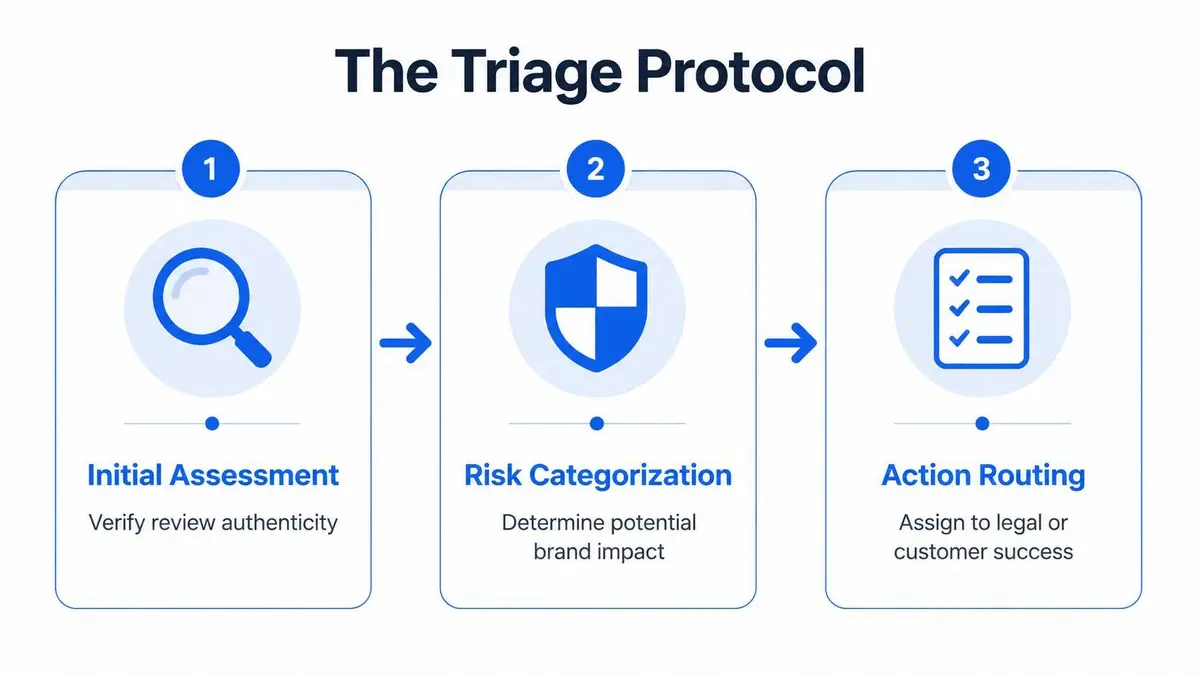
A triage protocol fixes that. It gives your staff a repeatable way to decide what the review is, who owns it, and how quickly it moves. Speed matters. 53% of reviewers demand fast replies to negative feedback, and a strong escalation model routes complex or reputation-threatening reviews to senior management within 4 hours.
Level 1 operational feedback
This category includes genuine complaints about delay, communication, billing friction, staff demeanor, scheduling, shipping, or ordinary dissatisfaction. The reviewer may be upset, but the claim is still within the normal range of service failure.
These reviews belong with customer success, client relations, or operations. They need a response, but not panic.
A Level 1 review usually has these features:
- Specific experience markers such as dates, service details, or identifiable touchpoints.
- No major accusation of illegality, fraud, safety breaches, or discrimination.
- A plausible pathway to resolution through refund review, follow-up call, service correction, or explanation.
Level 2 reputationally damaging content
At this juncture, weak teams lose control. Level 2 reviews may not yet justify legal action, but they can do serious reputational work against you. They often include loaded language, broad attacks on trustworthiness, or claims designed to discourage others from engaging.
Examples include vague allegations that a company “scams people,” claims that an executive is “dishonest,” or emotionally charged narratives that can’t be easily verified but still shape public perception.
These need review by someone with authority over brand voice and risk. Don’t let junior staff freelance the response.
Practical rule: If the review challenges your integrity more than your service quality, it is not routine feedback.
Level 3 legally actionable or defamatory material
This category is narrow, but it carries the highest stakes. A review moves into Level 3 when it contains provably false factual assertions, impersonation indicators, extortion signals, threats, disclosure of private information, or allegations that expose the business or individual to regulatory, legal, or investor harm.
At that point, preservation matters as much as response. Take screenshots. Capture URLs. Preserve timestamps, user handles, account details, and any matching internal records. Don’t edit your own public-facing descriptions in a way that muddies the chronology.
Use a standing monitoring system that alerts the right people immediately. That can be built internally or through a dedicated reputation monitoring workflow with escalation rules tied to platform, reviewer language, and threat type. The point is control, not convenience.
The routing decision
A simple routing model works better than a long policy no one reads.
| Review level | Primary owner | First action | Public reply |
|---|---|---|---|
| Level 1 | Operations or customer success | Verify underlying facts and contact record | Yes, usually |
| Level 2 | Brand lead plus senior operations | Assess credibility, impact, and escalation risk | Yes, but controlled |
| Level 3 | Legal, senior leadership, specialist removal team | Preserve evidence and assess takedown options | Sometimes. Not always |
If your team responds before classifying the review, your process is backward. Triage comes first. Public language comes second.
Response Architecture and De-escalation
A public response is not a private conversation. It is a statement for the record, drafted for everyone who reads the review after the original author has moved on. That audience matters more than the reviewer.
The trust dynamic is unforgiving. 88% of consumers trust online reviews as much as personal recommendations, and 97% of review readers also scrutinize company responses. Your reply has to do three jobs at once: acknowledge the issue, preserve your legal position, and show control.
What a response should accomplish
Most review responses fail because they chase emotional resolution. They apologize too broadly, argue point by point, or sound automated. None of those approaches reassures a serious reader.
A strong response does something narrower and more effective:
- It confirms oversight by showing the matter is being taken seriously.
- It avoids factual concessions that haven’t been verified.
- It invites offline resolution without looking evasive.
- It keeps the tone measured even if the review is inflammatory.
If your team needs a basic primer on how brands respond to negative reviews, use it as a starting point. Then tighten it for legal and executive review. High-stakes organizations can’t rely on generic scripts.
Three response models
Legitimate criticism
When the complaint appears real and specific, acknowledge the experience without accepting unsupported blame.
Example approach: thank the reviewer, state that the experience described does not reflect your standards, say you are reviewing the matter, and provide a direct path for offline contact through a named department or secure channel.
That response shows accountability without turning your public comment into an evidentiary admission.
Vague or emotionally charged complaints
These reviews often say a company is “terrible,” “dishonest,” or “unprofessional” without concrete facts. The mistake here is to fill the gaps for the reviewer by speculating or overexplaining.
Use a narrow reply. State that you take feedback seriously, that you were unable to verify the details from the information provided, and that you invite the individual to contact a designated team to investigate. Short works better.
Don’t argue with an anonymous account in public. You won’t win the thread, and you may strengthen the accusation.
False factual allegations
If the review states something specific and false, your response should avoid litigating every detail in public. Deny the unsupported allegation in restrained language, state that accuracy matters, and note that the matter is under review through appropriate channels.
That wording protects the record without triggering a spectacle. In some situations, silence is better.
When not responding is the stronger move
Not every review deserves oxygen. If the post is clearly bait, part of a coordinated attack, or likely to be the subject of platform or legal escalation, a public reply can increase visibility and complicate removal efforts.
Use a non-response when:
| Platform | Violation type | Typical reporting outcome | Estimated timeline for platform action |
|---|---|---|---|
| Clear policy violation such as impersonation, prohibited content, or private information | Possible removal after report and review | Varies by case | |
| Yelp | Content that appears to violate platform content rules | Possible filtering, non-recommendation, or removal | Varies by case |
| Trustpilot | Suspected fake, harmful, or policy-breaching content | Investigation with possible temporary hold or removal | Varies by case |
| Industry-specific directories | Platform-specific moderation standards | Outcome depends on operator responsiveness | Varies widely |
That uncertainty is why your public response must be coordinated with your remediation plan. If the review is severe enough to require trust recovery after visible criticism, your communications team should align public messaging with a formal guide to rebuilding trust with customers after bad reviews, not ad hoc replies.
Escalation Beyond Platform Reporting
A false review aimed at an executive, a regulated practice, or an enterprise brand can trigger board questions, client hesitation, recruiting fallout, and legal exposure in a single news cycle. If your plan stops at “report and wait,” you have already ceded control.

Platform moderation is only one channel. It is slow, inconsistent, and built around policy enforcement. High-stakes review attacks demand a second track centered on evidence, legal posture, and containment of reputational spread.
The threshold for real escalation
Move beyond ordinary reporting when the review creates material risk, not mere annoyance.
That usually means one or more of these conditions apply:
- The post asserts a specific false fact that your records, communications, security logs, or transaction history can disprove.
- The allegation implies criminality, fraud, safety failures, discrimination, malpractice, or regulatory misconduct with obvious consequences for licensing, contracts, investors, or employment.
- The reviewer appears anonymous but unusually informed, which raises the possibility of an insider, former employee, competitor, or organized harassment effort.
- The post includes coercion or pressure, including demands for money, refunds, concessions, or special treatment in exchange for removal.
- The attack shifts from the company to an individual principal, especially if it drags in family, health, residence, or private conduct.
Once a review crosses that line, stop treating it as customer feedback. Treat it as a reputational incident with legal implications.
Preserve evidence before anyone improvises
The first internal mistake is almost always procedural. Staff start forwarding screenshots, a junior marketer drafts an indignant reply, and someone in leadership wants to call the platform or threaten suit before the facts are pinned down.
Shut that down.
Use a controlled record-building process:
- Capture the full review on desktop and mobile, including profile details, timestamps, star rating, and surrounding context.
- Preserve related evidence such as account URLs, revision history if visible, adjacent reviews, and any signs of coordinated posting behavior.
- Check internal systems immediately to confirm whether the reviewer was ever a customer, patient, guest, client, applicant, or vendor.
- Define the harm clearly. Revenue impact, partner concern, search prominence, media pickup, and personal targeting require different response paths.
- Get legal review before public threats or direct outreach so your position is grounded in facts, not emotion.
A false review is hostile evidence. Handle it with chain-of-custody discipline.
Escalate on parallel tracks
The platform process still matters. Use it where the post plainly breaches written rules, such as impersonation, disclosure of private information, fabricated identity claims, or prohibited content. But do not confuse a policy complaint with a remediation strategy.
Serious matters call for parallel action. That means platform reporting, internal forensic review, legal analysis, and search-risk containment at the same time. It can also mean specialist support built for executive cases, such as strategic online review removal for executives and founders, where the work focuses on evidence preservation, escalation strategy, and legally informed removal planning.
Outside counsel may need to evaluate defamation claims, preservation notices, demands to cease publication, or procedures designed to identify anonymous actors. For enterprise teams, this decision should sit with legal, communications, and the relevant business leader in one room, under one incident owner.
What senior leaders should stop doing
Executives often worsen these cases by treating them as personal insults instead of managed threats.
Cut these habits immediately:
- Calling or emailing the platform repeatedly without a documented file
- Letting assistants, agencies, or junior marketers issue legal-sounding statements
- Threatening litigation before counsel confirms the statement is actionable
- Trying to bury the issue with fake or incentivized positive reviews
- Assuming a single post is isolated when timing, wording, or account behavior suggests a campaign
Speed matters. Discipline matters more.
If the review is false and commercially dangerous, your objective is not to win an argument in public. Your objective is to document the facts, contain the spread, and force resolution through the channels that carry actual weight.
Building a Proactive Reputational Moat
Defensive review management is not enough. If you only engage when there’s a problem, you’re leaving your reputation structurally weak. High-profile brands need a steady body of credible, detailed, recent positive feedback that can absorb shocks.

That doesn’t mean chasing a suspiciously perfect profile. In fact, the opposite is often stronger. 82% of shoppers specifically seek out negative reviews, and a mix of feedback can increase conversion rates by signaling transparency and authenticity. A reputation that looks curated to perfection invites doubt. A reputation that looks real builds trust.
What a moat actually looks like
A reputational moat is not volume for its own sake. It is a pattern of authentic reviews that describe specific experiences in enough detail to be persuasive.
The strongest profiles usually share these traits:
- Recency so readers don’t assume the business has gone stale.
- Specificity with concrete references to service quality, process, outcomes, or staff professionalism.
- Variation in voice so the review set reads like real people, not a campaign.
- Platform breadth across the review environments your audience checks.
If you’re asking everyone for the same generic five-star endorsement, you’re weakening your own record.
Who to ask and how to ask
Don’t solicit reviews indiscriminately. Identify the clients, customers, or patients who had a clean and positive experience, understand your value, and can describe it credibly.
Good candidates usually include long-standing clients, repeat buyers, resolved complainers who ended satisfied, and stakeholders who can speak to professionalism rather than just friendliness. A luxury buyer, investor-facing client, or referring professional often writes more useful copy than a casual purchaser.
Use prompts that encourage substance without scripting the answer. Ask what stood out. Ask what problem was solved. Ask why they chose you over alternatives. Avoid language that pressures for a perfect score or asks them to mention claims you want indexed.
Ask for honest specificity, not praise. Specificity persuades. Praise alone looks manufactured.
Where teams get this wrong
Many companies panic after a negative review and suddenly push for a flood of positive ones. That creates an obvious pattern and can trigger suspicion from both readers and platforms.
A better system is ongoing and deliberate:
- Tie review requests to a natural completion point such as delivery, discharge, closing, renewal, or successful resolution.
- Route requests through the channel your audience answers, whether that is SMS, email, concierge follow-up, or account management.
- Maintain internal review standards so no one offers incentives, writes suggested language, or filters only for favorable feedback in a deceptive way.
- Repurpose strong reviews carefully on owned channels after confirming permissions where needed.
There’s also value in seeing how others explain the basics of review generation and reputation maintenance. This brief video is a useful primer before you adapt the process for a more sensitive client base.
Why realism beats perfection
Executives often fixate on eliminating every negative comment. That instinct is understandable and usually wrong. A profile with thoughtful positives, a few complaints, and measured company responses often reads as more credible than a spotless page full of shallow compliments.
The objective is resilience. When your baseline reputation is strong, one hostile review has less power to redefine you. That is the moat.
Systematic Audits and Sentiment Analysis
Daily monitoring tells you what arrived. Audits tell you what it means. If you’re serious about managing online reviews, you need scheduled review intelligence, not just alerts.
A proper audit looks across platforms, time periods, locations, and reviewer language. It asks different questions from frontline review handling. Which themes recur? Which complaints cluster around one office, one service line, one manager, or one time period? Which reviews look organic, and which look coordinated?
What to look for in an audit
A useful audit tracks language patterns, not just star ratings. Repeated references to billing confusion, dismissive treatment, delayed follow-up, or bait-and-switch expectations point to operational problems. Repeated use of the same unusual phrase across accounts may point to manipulation.
Review teams should examine:
- Theme concentration around pricing, responsiveness, professionalism, product quality, or trust.
- Timing patterns such as bursts of negative reviews after a termination, dispute, media event, or employee departure.
- Platform asymmetry where one site becomes the preferred venue for hostile posts.
- Reviewer overlap indicators including similar wording, review cadence, or account behavior.
Text analysis proves its worth. If you want a practical overview of how language-based review analysis works, Halo AI’s guide to optimizing customer support sentiment analysis is a useful reference for thinking about recurring emotional signals and complaint clustering.
Turning review data into executive intelligence
Most review reports die because they stay at the surface. “Customers are unhappy with service” is not intelligence. “Complaints from one region repeatedly mention delayed callbacks after contract signing” is something an operator can fix.
A tight audit memo should answer three questions:
| Audit question | What leadership needs to know | Likely action |
|---|---|---|
| What is recurring? | The complaint themes or praise themes that appear repeatedly | Operational correction or reinforcement |
| What is abnormal? | Sudden shifts, suspicious clusters, or attacks tied to an event | Escalation and verification |
| What is strategic? | Review language affecting trust, authority, or perceived safety | Messaging, training, or legal review |
The coordinated attack problem
Coordinated review attacks don’t always look dramatic. Sometimes they present as several “plausible” reviews posted across different platforms with similar accusations and just enough factual texture to survive a lazy first read.
That’s why you need humans and systems looking for connective tissue. Review timing, phrase repetition, account creation patterns, and overlap with known disputes often matter more than the star rating itself.
If several reviews appear to come from different people but repeat the same allegation in near-identical language, treat that as a pattern, not coincidence.
An organization that audits regularly can distinguish between a service problem and a hostile narrative campaign. Those are different threats. They require different remedies.
The Permanent Mandate for Reputation Defense
High-stakes review management is not a quarterly initiative. It is a standing executive function. The organizations that understand this early protect margin, trust, and optionality. The ones that don’t end up negotiating with a public record they never controlled.
The strategic shift is straightforward. Stop treating reviews as isolated customer comments. Treat them as searchable, persistent reputation assets or liabilities. Build a triage system. Control response authority. Escalate dangerous falsehoods beyond platform reporting. Develop a credible review base that can withstand pressure. Audit the full review environment for patterns, weaknesses, and campaigns.
What permanence looks like
A serious reputation defense program has institutional features, not just good intentions:
- Named ownership across operations, legal, communications, and leadership
- Written escalation thresholds for integrity, safety, fraud, and defamation claims
- Evidence preservation procedures before any public engagement
- Regular audits that convert review language into business and legal intelligence
If you are high-profile, this is as basic as financial controls. You wouldn’t let random employees improvise earnings guidance. Don’t let them improvise around allegations that affect trust in your name.
The final judgment call
There is still a persistent fantasy that good service alone will solve review risk. Good service helps. It does not neutralize falsehoods, impersonation, extortion, coordinated attacks, or platform inertia.
Professional review management exists because the public record doesn’t manage itself. Platforms won’t protect your interests by default. General PR advice won’t solve a defamatory post, and internal teams under pressure often say too much, too fast, to the wrong audience.
For executives, founders, family offices, and visible professionals, reputation defense is not discretionary overhead. It is part of governance. Treat it with the same seriousness you assign to legal exposure, information security, and investor communications.
If a false, malicious, or reputation-threatening review is already causing damage, a confidential assessment from ContentRemoval.com can help you determine whether the matter calls for platform escalation, evidence preservation, legal analysis, or removal action. The right move depends on the facts, the platform, and the speed required. The wrong move is waiting while the review becomes part of your permanent public record.
Frequently asked questions
Should I reply to a fake review that accuses my business of fraud?
Not before classifying it. If the review is likely bait, part of a coordinated attack, or headed for platform or legal escalation, a public reply can raise its visibility and complicate removal. Where a reply is needed, deny the unsupported allegation in restrained language and note that the matter is under review through appropriate channels.
What evidence do I need before reporting a defamatory review?
Capture the full review on desktop and mobile with profile details, timestamps, and star rating, plus account URLs, adjacent reviews, and any signs of coordinated posting. Check internal systems to confirm whether the reviewer was ever a customer, and get legal review before any public threat or direct outreach.
How do I tell a coordinated review attack from genuine complaints?
Look for connective tissue rather than star ratings: several reviews landing in a narrow window, near-identical accusations from different accounts, thin profile histories, and timing that follows a termination, dispute, or media event. Repeated unusual phrasing across accounts points to manipulation rather than coincidence.