
The best reputation management software depends on the control problem. Review-first platforms such as Birdeye, Podium, Reputation, Chatmeter, SOCi, Yext and ReviewTrackers collect, route and answer customer feedback. Brandwatch and Meltwater track narratives across news and social. None of them can compel a publisher to remove defamatory content, de-index unlawful material or stop reuploads.
Key facts
- The reputation software market is estimated at USD 4.91 billion in 2026, projected to reach USD 9.68 billion by 2031.
- Nearly every platform on the list uses quote-based pricing; Sprout Social is seat-based and Chatmeter prices per location.
- India’s 2021 intermediary rules require NCII removal within 24 hours; the TAKE IT DOWN Act sets 48.
- A valid DMCA notice needs the work identified, contact details, good-faith and perjury statements and a signature.
Where ContentRemoval.com comes in. ContentRemoval.com is the third category the article describes: the removal layer for defamation, impersonation, leaked media, mugshots and persistent reuploads that a dashboard can detect but not resolve. Brand teams, in-house counsel and executives usually reach out once monitoring has found the problem and the question becomes what lawful control exists over the source. A free 15-minute Exposure Scan maps what is removable, and the report is yours to keep. Get a Free, Confidential Exposure Scan or read how our reputation management work is done.
A chief executive discovers that a false allegation has reached page one of search results. A brand team sees a damaging review spreading across locations. A private individual finds leaked material, an impersonation account, or an outdated arrest record attached to their name. In each situation, a dashboard can help identify the problem, but it may not control the source causing it.
That distinction defines this list of the best reputation management software options for 2026. The evaluation considers monitoring depth, sentiment quality, review workflows, social and media coverage, integrations, security, governance, pricing visibility, implementation burden, and fit for different users. Review software can collect feedback, route cases, draft responses, and identify recurring operational issues. It generally cannot compel a publisher to remove defamatory content, stop a reupload, de-index unlawful material, or resolve an impersonation campaign.
The reputation management software market is now a substantial technology category. One 2026 estimate places it at USD 4.91 billion, up from USD 4.42 billion in 2025, with projected growth to USD 9.68 billion by 2031 at a 14.60% CAGR (2026 online review and reputation market data). That growth reflects a practical reality: reputation teams need continuous systems, while high-risk cases still require legal, platform, and operational intervention.
1. Birdeye
Birdeye is the strongest fit for a multi-location business that wants review generation, listings, messaging, surveys, webchat, social publishing, and analytics in one operating environment. Its value isn’t limited to watching reviews. The platform connects customer feedback with customer experience workflows, which makes it useful for franchises, healthcare networks, retail groups, and other brands managing many local profiles.
Best for integrated review and CX operations
The platform supports review monitoring, review requests, routing, display, response assistance, listings synchronization, website and social publishing, webchat, and cross-location analytics. AI-assisted insights can help teams identify recurring themes, while enterprise controls support centralized governance across local operators.
That breadth reduces the need to assemble separate products for listings, reviews, messaging, and social publishing. The tradeoff is commercial rather than functional. Birdeye uses quote-based pricing, and a smaller organization may find that optional modules increase ownership cost beyond what a review-only tool would require.
Practical rule: Birdeye makes sense when a reputation problem is also a customer-experience and local-marketing problem. It’s harder to justify if you only need alerts and manual replies.
Birdeye can help a brand see that complaints are recurring, route them to the right location, and organize responses. It cannot remove a false article, eliminate leaked media from its original host, or guarantee that damaging material won’t return. Executives and private clients facing those issues may need a confidential reputation management assessment alongside software.
Birdeye

2. Podium
Podium treats reputation as a conversation workflow. For local businesses, that emphasis can be more useful than a broad listening suite because the platform connects SMS, webchat, payments, and review requests in a shared operational layer.
Best for SMS-led review generation
Podium’s central inbox brings text messages and webchat into one place, while text-based review invitations help businesses request feedback after customer interactions. Teams can manage Google and Facebook reviews from the same environment, use messaging workflows to support conversions, and accept payments by text. AI helpers assist with repetitive workflows, but the business still controls the customer relationship and response process.
The platform is particularly well suited to restaurants, clinics, home-service companies, dealerships, and other businesses where customers already communicate by phone or text. It can reduce the separation between service recovery and review generation. A dissatisfied customer can be handled in a conversation before the issue becomes a public complaint, provided the business has a legitimate process for receiving and resolving that feedback.
Pricing isn’t publicly listed and is typically quote-based. Location count, messaging volume, and add-ons can change the commercial picture, so buyers should request a complete scope rather than relying on a base-plan assumption.
Podium isn’t a source-removal system. It won’t address a fabricated news story, a stolen private image, an impersonation profile, or content hosted by a third party that refuses to cooperate. Restaurants evaluating it should separate front-line review operations from specialized reputation management for restaurants when the underlying harm extends beyond customer communication.
Podium
3. Reputation, formerly Reputation.com
Reputation is built for organizations that need reputation and customer-experience management across reviews, social channels, listings, surveys, and location-level reporting. Its enterprise orientation is most apparent where multiple departments, regulated workflows, and executive reporting must coexist.
Best for regulated and multi-location enterprises
The platform includes an AI Reputation Manager, sentiment analytics, industry-specific modules, templates, and reporting designed for leadership teams. An automotive group, healthcare organization, financial-services company, or large property network can use those capabilities to standardize how local teams monitor and respond while preserving central oversight.
That structure matters when a response requires approval before publication or when executives need to connect public feedback with broader CX performance. Industry templates can reduce the work required to establish repeatable processes, although they don’t replace legal review for sensitive allegations or regulated disclosures.
The principal limitation is the buying process. Pricing is custom and quote-based, and the platform may be excessive for a small organization with one location and modest review volume. Implementation also deserves scrutiny. Buyers should establish ownership for response approvals, escalation rules, listings changes, and survey follow-up before deployment.
A mature review platform can organize the record of harm. It doesn’t necessarily have authority over the material causing the harm.
That distinction becomes critical when a review contains false assertions, confidential information, or unlawful material. Reputation can support monitoring and response, but it isn’t a substitute for a targeted removal strategy. Businesses dealing with platform-specific review issues may also need assistance removing Glassdoor reviews, subject to the platform’s policies and the facts of the case.
Reputation

4. Chatmeter
Chatmeter is aimed at brands whose reputation is distributed across many locations and whose marketing teams also need local search intelligence. It combines review monitoring and response with listings, social signals, local SEO metrics, competitor insights, and Pulse sentiment analysis.
Best for location-level diagnosis
The useful distinction is between seeing that ratings are declining and understanding why. Chatmeter’s topic-level sentiment analysis is designed to surface shifts in themes, while location reporting helps corporate teams compare patterns across branches. Competitor and local-ranking insights add context for brands that need to understand reputation alongside local visibility.
That combination makes the platform relevant to retail, franchises, financial services, and other distributed operations. A central team can identify a recurring complaint, locate the affected branches, and direct operational attention rather than treating each review as an isolated communications task.
Chatmeter’s pricing model is organized by location and includes unlimited users, according to the product positioning supplied for this comparison. That can simplify internal access as teams expand, but exact per-location rates require a sales conversation. Buyers should ask how listings, social, surveys, analytics, onboarding, and additional locations affect the quote.
The limitation is scope. Chatmeter can help classify and respond to public feedback, but it won’t independently remove a defamatory post, obtain de-indexing, or prevent a stolen video from appearing on replacement domains. Those cases require evidence preservation, jurisdictional analysis, and direct intervention with hosts, search engines, or legal representatives.
Chatmeter
5. SOCi, SOCi Genius Reviews
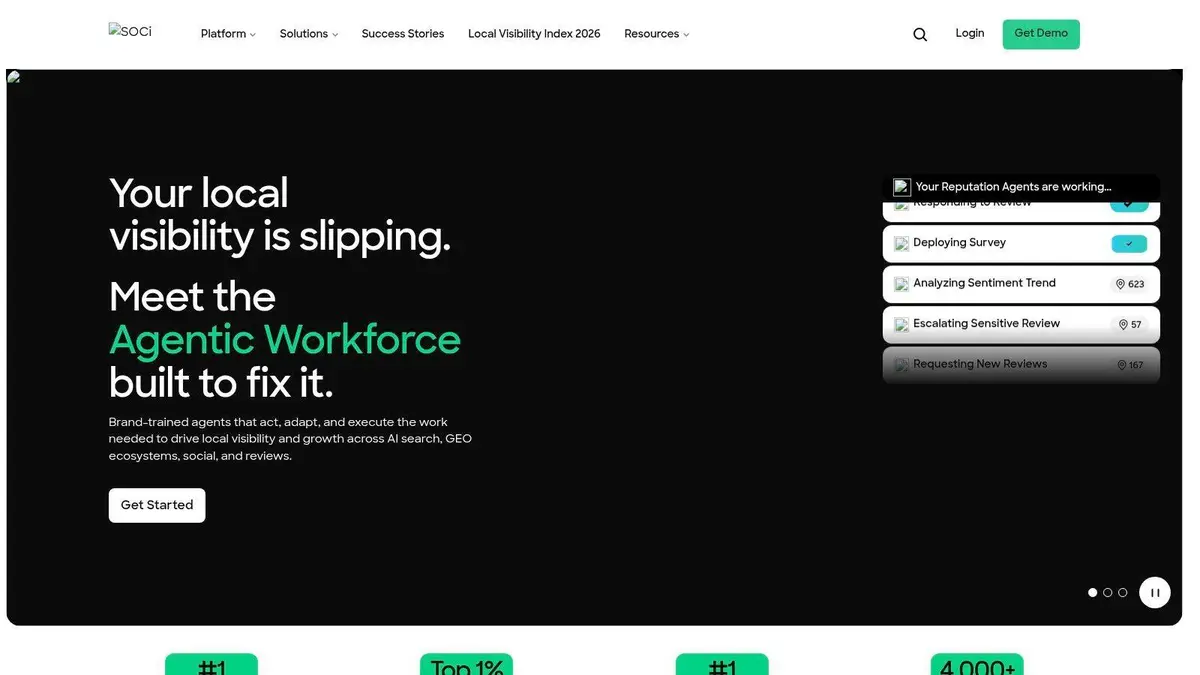
SOCi is designed for distributed brands that need local execution under centralized control. Its reputation module, SOCi Genius Reviews, adds AI-assisted review response and automation to a broader platform covering listings, social media, advertising, and local marketing.
Best for governed franchise response
The platform’s strongest differentiator is governance. Corporate teams can establish approvals, workflows, and brand standards while local operators participate in review response and social activity. The OpenAI integration supports response generation, but approval controls help prevent an automated draft from becoming an unreviewed public statement.
That matters for franchises and regulated organizations where a local manager may know the customer context but shouldn’t publish language that creates legal, compliance, or brand risk. Consolidated dashboards also allow leadership to view reputation, social, and search activity without forcing every location into separate systems.
SOCi’s weakness is pricing and implementation transparency. Detailed package information isn’t publicly listed, so buyers need a sales engagement to understand which modules are included, how governance is configured, and what onboarding requires. The platform may be a strong enterprise fit, but a small team could be paying for capabilities it won’t use.
SOCi can accelerate response operations. It can’t determine whether a harmful allegation is legally defamatory, force a website to surrender content, or address leaked intimate material through a review workflow. Use it for controlled public engagement, not as a replacement for takedown counsel or specialist remediation.
SOCi
6. Yext Reviews
Yext Reviews is most compelling when a company already relies on Yext for listings, location pages, and structured digital presence management. Instead of treating reviews as a separate channel, Yext connects them to the business information that appears across search and directory ecosystems.
Best for listings-led reputation control
The platform aggregates reviews from major publishers including Google, Facebook, Yelp, and TripAdvisor, then supports monitoring, response, generation, and moderation within the Yext environment. Its integration with Listings and location Pages makes it a natural option for multi-location brands that want one source of truth for addresses, opening hours, services, and customer feedback.
That connection can prevent a common operational failure: a team responds to a review while the underlying location information remains inconsistent elsewhere. For a company with many branches, reputation work often includes keeping public facts accurate, not merely answering criticism.
Pricing is typically bundled with the wider Yext platform and quote-based. User feedback indicates that cost can become significant, so buyers should ask for a full breakdown of listings, pages, reviews, seats, support, and renewal terms. The implementation burden also rises when data ownership is fragmented between corporate marketing, local operators, and agencies.
Yext is still monitoring software. It can expose inaccurate information and help teams respond, but it won’t remove a false allegation from its original publisher. If the issue involves unlawful content, impersonation, leaked material, or persistent indexing, the response must move beyond listings administration.
Yext Reviews
7. ReviewTrackers, part of InMoment
ReviewTrackers takes a focused approach. It centralizes multi-site review monitoring, alerts, routing, reporting, and AI-assisted response, while its connection to InMoment creates a path toward broader customer-experience and voice-of-the-customer analysis.
Best for a review-first operating model
Teams that don’t need a large local-marketing suite may prefer a narrower workflow. ReviewTrackers is built around the daily tasks that reputation managers perform, locating new reviews, assigning them, drafting responses, and identifying patterns across sites and locations.
That focus can make adoption easier than deploying a platform that also includes advertising, social publishing, listings, and webchat. The InMoment relationship adds strategic reach for organizations that eventually want to connect public reviews with structured customer feedback and larger CX programs.
The acquisition also creates a diligence question. Pricing isn’t publicly listed and remains quote-based, while enterprise packaging and terms may vary after the product’s integration into InMoment. A buyer should confirm data ownership, export options, support responsibilities, API access, and the exact functionality included in the proposed package.
ReviewTrackers can identify that a customer complaint is spreading or that a location has a recurring service problem. It doesn’t have the authority to remove source content, correct a defamatory article at publication, or stop reuploads of stolen media. That boundary should be written into the risk plan before procurement.
ReviewTrackers
8. Sprout Social Reviews
Sprout Social is a social media management suite, with a Reviews module for teams that want public reviews and social engagement in one workspace. It fits a communications team whose reputation work happens alongside publishing, community management, reporting, and response coordination.
Best for social-connected reputation teams
The platform brings review monitoring and response into social inbox workflows, while mature publishing, analytics, collaboration, and training resources support larger communications operations. A team can coordinate a response to a review with the broader social conversation instead of forcing staff to switch between unrelated systems.
Seat-based plans provide a recognizable commercial structure, but costs can rise as teams add users and modules. Buyers should map the people who need publishing access, approval rights, listening access, and reporting access before accepting a quote. Nonprofit pricing options may also be relevant for eligible organizations.
Sprout Social is useful when the threat is a public conversation moving across social channels and reviews. It is less suitable as the sole system for a business that needs extensive listings control, private feedback triage, or source removal.
A negative post may be visible inside the platform, but visibility doesn’t establish that the claim is true or unlawful. Nor does it create a takedown right. For executives, creators, and public figures, social monitoring should feed an escalation process that distinguishes criticism, policy violations, impersonation, defamation, privacy violations, and leaked media.
9. Brandwatch
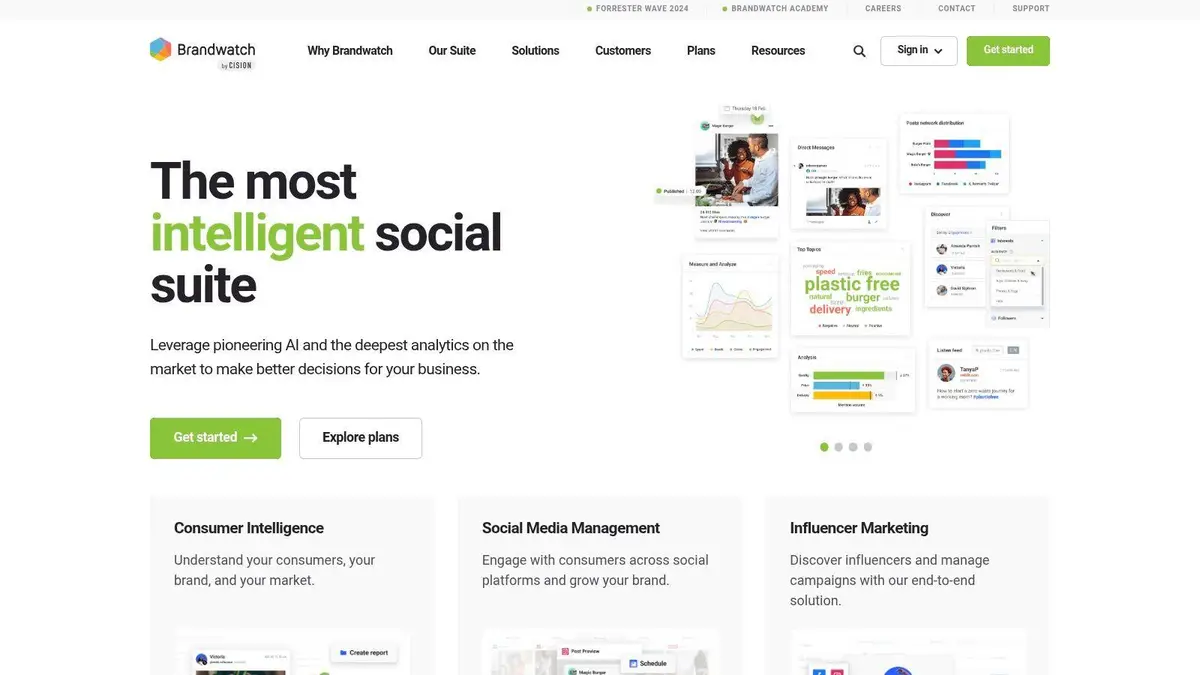
Brandwatch is built for consumer intelligence rather than routine review administration. Its listening capabilities span social media, news, and forums, making it more relevant to executive teams, public-relations departments, and brands monitoring narratives that don’t appear in customer review channels.
Best for crisis and narrative intelligence
Configurable queries, sentiment analysis, alerts, and trend detection help teams identify changes in conversation and investigate what is driving them. Optional social media management allows organizations to connect research with publishing and engagement, while professional services can extend analytical capacity for teams that lack internal monitoring expertise.
That depth is valuable during a media cycle, activist campaign, executive controversy, product issue, or coordinated social narrative. A review platform may show the public reaction at a business location. Brandwatch is designed to help teams examine the wider information environment around the organization.
Enterprise pricing is quote-based and tiered. The product may be overkill for a local business that only wants review alerts, and implementation requires careful query design. Poorly constructed searches can create noise, miss variations of a name, or confuse unrelated conversations with the client’s brand.
Brandwatch detects and analyzes public signals. It doesn’t settle the underlying dispute. If monitoring identifies false or unlawful source material, the organization still needs a response decision, evidence file, legal assessment, platform escalation, or specialist removal effort.
Brandwatch
10. Meltwater
Meltwater is a media intelligence and social listening platform for organizations that need to follow news, web coverage, social signals, journalists, influencers, and developing narratives. It belongs in a reputation stack when the material risk is broader than customer reviews.
Best for brand and executive media monitoring
Meltwater combines media monitoring, social listening, alerts, sentiment analysis, reporting, PR tools, influencer workflows, AI features, onboarding support, and educational resources. Global or multi-brand organizations can use it to track how a story moves across news and social channels, identify relevant journalists, and give leadership a consolidated view of the conversation.
Its broad coverage can be an advantage during a crisis, but it can also create unnecessary complexity for a local business. Pricing is custom and quote-based, with scope affecting the commercial arrangement. The buyer should define monitored entities, languages, media types, alert thresholds, reporting requirements, and support expectations before comparing proposals.
Meltwater can tell a communications team where a narrative is appearing and how it is changing. It can’t remove the source article, compel a platform to delete a fake account, or guarantee that search engines will stop showing lawful content. Those outcomes depend on facts, applicable law, platform rules, publisher cooperation, and sometimes litigation.
Monitoring answers “where is the risk?” Removal work asks “what lawful control exists over the source?”
That distinction is decisive for public figures, founders, family offices, and brands facing leaked images, false allegations, impersonation, or persistent reuploads. Software remains valuable for detection, but the remedy must match the harm.
Meltwater
Top 10 Reputation Management Software Comparison
| Platform | Core features | Best for / Target audience | Unique selling points | Limitations | Pricing (typical) |
|---|---|---|---|---|---|
| Birdeye | Review generation & monitoring, listings sync, webchat, social, analytics, AI responses | Franchises, multi-location brands, CX teams | Broad integrated toolset; enterprise controls; cross-location analytics | Quote-based pricing; add-ons raise TCO for small teams | Quote-based; can be costly with add-ons |
| Podium | SMS & webchat messaging, review invites, centralized inbox, payments, AI helpers | Local & multi-location businesses focused on SMS-driven reviews and conversions | Excellent at driving reviews via SMS; consolidates comms and payments | Quote-based; cost scales with locations and add-ons | Quote-based; varies by location count |
| Reputation (Reputation.com) | Reviews, social, listings, surveys, AI Reputation Manager, CX analytics | Regulated industries and large multi-location enterprises | Mature enterprise workflows; industry-specific modules and reporting | Custom implementations; costly for small teams | Custom quote; enterprise-priced |
| Chatmeter | Real-time review monitoring, local SEO, listings, Pulse sentiment, location analytics | Franchises, retail, financial services with many locations | Location-based pricing with unlimited users; strong local insights | Per-location rates via sales; pricing transparency limited | Location-based pricing; quote required |
| SOCi (Genius Reviews) | AI-assisted review response (OpenAI), governance, approvals, consolidated dashboards | Distributed brands needing compliance and centralized governance | AI-powered response at scale + approval workflows for compliance | Pricing and packages not public; requires sales/implementation | Quote-based enterprise pricing |
| Yext Reviews | Aggregated review monitoring, review generation, tight Listings & Pages integration | Brands already using Yext for listings and local SEO | Source-of-truth for listings + local SEO impact | Typically bundled pricing; can be expensive | Bundled with Yext platform; quote-based |
| ReviewTrackers (InMoment) | Centralized monitoring, alerts, AI responses, InMoment CX integrations | Review-first teams seeking path to broader CX/VoC analytics | Clean review workflows; access to InMoment analytics | Quote-based; enterprise packaging may vary post-acquisition | Quote-based; enterprise |
| Sprout Social (Reviews) | Social management + Reviews module, unified inbox, analytics, training | Teams aligning reputation ops closely with social publishing | Consolidates social and reviews; robust analytics and training | Seat-based pricing can be expensive at scale | Seat-based plans; costs rise with seats/add-ons |
| Brandwatch | Social listening, sentiment, trend detection, optional social management | Enterprise PR, brand and crisis teams monitoring narratives and risk | Deep cross-channel listening for crisis and media intelligence | Enterprise-level product; overkill for basic review ops | Quote-based enterprise pricing |
| Meltwater | Media intelligence, news & social listening, alerts, PR/influencer tools | Brand/executive-level reputation and PR teams tracking news and journalists | Broad channel coverage and PR workflow integration; service-backed onboarding | Custom pricing; may exceed needs for basic review monitoring | Custom quote; scales with scope |
Choose the Control Layer Your Risk Requires
The best reputation management software depends on the control problem, not the product’s feature count. A restaurant group, healthcare network, franchise system, and executive facing a defamatory article may all search for the same category, but they don’t need the same remedy.
Choose a review-first platform when the task is collecting customer feedback, routing issues, responding to public reviews, monitoring ratings, and analyzing recurring service themes. Birdeye, Podium, Reputation, Chatmeter, SOCi, Yext Reviews, and ReviewTrackers all address different versions of that operating model. The right selection depends on whether your organization prioritizes SMS conversations, listings accuracy, location analytics, governance, customer-experience integration, or a focused review inbox.
Consumer behavior makes response discipline a business issue. 97% of consumers read online reviews before buying, and 31% say they’ll only use a business rated 4.5 stars or higher, nearly double the 17% reported the prior year (review behavior data for 2026). The same source reports that 97% of review readers also read business responses, 53% expect a reply within 7 days, and 73% focus mainly on reviews from the past month. Those findings support investment in fast, organized review operations, but they don’t turn every negative review into a removal case.
Choose social listening or media intelligence when the risk travels through news, forums, social platforms, journalists, or executive narratives. Brandwatch and Meltwater are better aligned with that problem than a review-only system. They help teams detect, classify, and escalate conversations beyond local business profiles.
A third category requires different expertise. Defamation, false content, impersonation, leaked images or video, non-consensual intimate imagery, mugshots, arrest records, dark-web exposure, source removal, de-indexing, and reupload prevention can exceed what software can resolve. A valid DMCA notice must identify the copyrighted work and allegedly infringing material, provide contact details, include good-faith and penalty-of-perjury statements, and carry a physical or digital signature (U.S. Copyright Office Section 512 guidance). Google’s legal process asks for exact URLs and a detailed explanation of why material is unlawful through its Legal Help Center (Google’s legal removal process).
Jurisdiction can change the timetable. In India, the 2021 intermediary rules require removal of non-consensual intimate imagery within 24 hours of a complaint by the victim or representative (India NCII takedown guidance). Legal commentary on the TAKE IT DOWN Act describes a 48-hour removal requirement for covered platforms after a valid request, along with reasonable efforts to remove known identical copies (TAKE IT DOWN Act analysis).
ContentRemoval.com is relevant when an entrepreneur, public figure, executive, family office, creator, or brand needs a confidential assessment and case-specific removal strategy rather than another dashboard. The firm handles issues including de-indexing, defamation, false reviews, impersonation, leaked media, NCII, news suppression, mugshot and arrest-record removal, and dark-web monitoring and remediation. Its work should be evaluated on the facts, jurisdiction, source, evidence, and available legal or platform pathway, not on a promise that every result can be erased.
Start by documenting every URL, screenshot, timestamp, account identifier, and relevant communication. Classify the harm, preserve security and access records, assess jurisdictional issues, and decide whether the appropriate control is monitoring, a measured public response, legal escalation, platform reporting, or professional takedown work. That decision prevents a team from buying software to solve a source-control problem, or escalating an ordinary service complaint as though it were a legal crisis.
ContentRemoval.com provides confidential assessments and case-specific strategies for harmful online material, including defamation, impersonation, leaked media, false reviews, de-indexing, and persistent reuploads. If your situation extends beyond review monitoring and response workflows, visit ContentRemoval.com to discuss the evidence, jurisdiction, and appropriate removal path.
Frequently asked questions
Can reputation management software remove negative reviews or articles?
No. Review platforms can monitor, route and draft responses, and listening tools can show where a narrative is spreading, but removal depends on facts, applicable law, platform rules and publisher cooperation. The article recommends writing that boundary into the risk plan before buying.
What is the best reputation software for a multi-location business?
Birdeye suits brands that want reviews, listings, messaging and social in one system, Podium fits SMS-led review generation, and Chatmeter or SOCi help when location-level diagnosis and governed franchise response matter. Yext Reviews makes sense if the company already uses Yext for listings.
How do I decide between review software and social listening tools?
Choose a review-first platform when the task is customer feedback, ratings and responses. Choose Brandwatch or Meltwater when the risk travels through news, forums, journalists or executive narratives. Cited data shows 97 percent of consumers read reviews and 53 percent expect a reply within 7 days, which argues for organized review operations either way.