
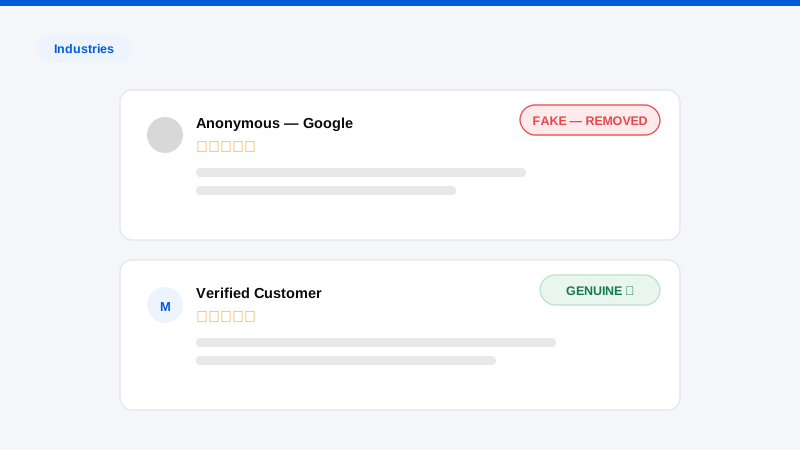
Reputation management for restaurants and restaurant groups is the practice of controlling what diners, delivery apps, and search engines present when someone decides where to eat. For a restaurant, that decision window is brutally short, a diner comparing options on a phone gives each candidate a few seconds of attention, and a star rating, a recent one-star headline, or a viral clip settles the question before your menu is ever seen. Reputation is not adjacent to the business; in the restaurant industry, reputation effectively is distribution.
Restaurants also operate with the thinnest margin for reputational error of any consumer business. The product is consumed on premises, in public, by emotional customers, with staff interactions happening dozens of times an hour, every one of them a potential recording. A single bad night, a single fabricated food-poisoning claim, a single out-of-context clip of a stressed employee can be broadcast to more people in 48 hours than will walk through the door in a year.
This guide defines the threat landscape restaurants and restaurant groups face, what is genuinely at stake when hostile content takes hold, and what professional, removal-first protection looks like, the model Content Removal practices. It is deliberately not a how-to. Removal is specialist work performed against platform bureaucracies that punish amateur attempts, and the operators who recover fastest are the ones who treat it that way.
Why restaurants and restaurant groups are targeted
Restaurants attract adversarial content for structural reasons that have nothing to do with food quality.
Review-bombing is frictionless and consequence-free. Anyone with a phone can rate a restaurant they’ve never entered. Political controversies, staff disputes that spill onto social media, a viral post by an unhappy customer, any of these can trigger hundreds of one-star ratings within hours from people across the country. Because Google and Yelp weight recent activity, a bombing run can crater a rating that took a decade to build.
Refund-leverage reviews. Some diners have learned that a threatened or posted one-star review is a bargaining chip for comps, refunds, and free meals. A subset escalates to serial behavior across multiple restaurants. The reviews read as genuine grievances; the pattern behind them is extraction.
Health-scare rumors. “I got food poisoning here” is among the most damaging sentences that can be attached to a restaurant, and among the easiest to assert without evidence. Foodborne-illness attribution is genuinely difficult even for health departments; a reviewer who ate at four places in 24 hours can sincerely (or cynically) blame yours. Once a poisoning claim appears in reviews or a local Facebook group, it spreads on fear, not facts, and it surfaces in searches and AI answers long after the rumor dies socially.
Viral staff clips. A confrontation over seating, a dispute at the register, a stressed line cook on a bad night: filmed, cropped, captioned, and posted. The platforms’ algorithms reward the outrage; the restaurant’s name rides along in the caption. Restaurant groups face a multiplier: a clip filmed at one location damages search results for every location sharing the name.
Ex-employees and competitors. Hospitality’s high turnover produces a steady stream of departures, some bitter. Former staff posting accusations (about food safety, management, or working conditions) carry an insider’s credibility with readers, whether or not the claims are true. Competitor-sourced fake reviews, while harder to prove, are a persistent background presence in dense dining markets.
Legacy incidents that never expire. A closed health-inspection issue from years ago, a lawsuit long since resolved, coverage of a previous concept in the same space, search engines keep serving it beside your reservation link indefinitely unless it is dealt with.
Key takeaway: A restaurant’s rating can be attacked by people who have never tasted its food, over issues that have nothing to do with the kitchen, and the platforms’ algorithms treat that attack exactly like authentic feedback.
What’s at stake when the attack lands
The mechanism of damage is worth understanding precisely, because it explains why waiting is the most expensive response.
The decision moment is lost silently. Diners filter by rating before they read anything. A restaurant that slips below a diner’s mental threshold doesn’t get rejected. It never gets considered. The lost covers are invisible; operators just see a soft Tuesday become a soft month.
Map and delivery rankings degrade. Google’s local pack and the delivery apps rank partly on rating and review velocity. A damaged score means fewer impressions in “restaurants near me” results and lower placement in delivery search, which cuts the highest-margin discovery channels simultaneously.
Health-scare content has a unique half-life. A false poisoning claim doesn’t just deter the reader; it becomes part of the searchable record and gets ingested by AI assistants that now answer questions like “is [restaurant] clean?” Content that would fade from human memory is preserved and repeated by machines, which is why AI reputation protection now belongs in any serious restaurant engagement.
Staff clips outrun the facts. By the time context emerges (the customer was abusive first, the clip was edited, the employee no longer works there) the video has done its distribution. Corrections never travel as far as accusations.
Group-level contagion. For restaurant groups, damage at one unit bleeds across the brand: shared name, shared search results, shared delivery-app listings. Investors and landlords evaluating the group’s next lease or raise search the brand too, and diligence teams don’t distinguish between locations.
Compounding beats acute damage. The worst outcome is rarely one catastrophic post. It is the slow accretion (a fake review here, an unresolved accusation there) that gradually reshapes what search engines and AI systems “believe” about the restaurant. Each item looks too small to fight; together they move the rating, the ranking, and the narrative.
Key takeaway: Restaurants don’t lose customers to bad content: they lose consideration. The diner who saw the poisoning rumor never calls to tell you why they booked elsewhere.
See what diners find before they choose.Free confidential Exposure Scan: a specialist walks you through live results on a 15-minute call, and the findings are yours either way.
Book Your Free ScanWhat professional reputation management for restaurants looks like
Professional protection is removal-first. The distinction matters because most of the reputation industry sells the opposite: suppression campaigns that bury damaging content under new content while the damaging material remains live, still ranking for long-tail searches, still feeding delivery-app scores, still teaching AI systems the wrong story. For a restaurant, buried is not gone. Removal-first work runs in a defined sequence:
1. Complete exposure mapping. A systematic sweep across Google, Yelp, TripAdvisor, delivery platforms, TikTok, Instagram, Reddit, local Facebook groups, and news indexes. Operators almost always know about two or three items; the sweep typically finds the rest: reposts, scraped duplicates, forum threads, and old press still ranking for the restaurant’s name.
2. Removal at the source. Every platform prohibits fake reviews, extortion, harassment, impersonation, and defamatory factual claims. The work of review removal is converting a policy violation into an enforcement decision: assembling the evidence each platform actually credits, framing it in that platform’s policy language, filing through the channels that reach human reviewers, and escalating when the first answer is wrong. False accusations and health-scare fabrications are pursued through defamation removal pathways built for exactly that content class.
3. Search-layer remediation. Content that can’t be removed at the source (certain news items, forum posts on non-cooperative sites) can often be addressed where it actually hurts: the search results for your restaurant’s name. Search result removal and de-indexing strategies target the queries diners actually run.
4. Suppression where it belongs: last. Once removable content is gone, remaining items are displaced with truthful, well-built positive assets. Suppression layered over a cleaned foundation is durable. Suppression instead of removal is rent.
5. Standing monitoring and protection. Review platforms and social feeds generate new risk daily, and restaurant attacks recur. The refund-leverage reviewer comes back, the viral clip gets reposted. Continuous reputation monitoring catches new items while they’re hours old, and our Protection Plans keep a team on standby that already knows your history, so the next incident is handled as routine rather than crisis.
6. Earned media where it fits. For groups and chef-driven brands, legitimate press placement gives search engines and AI systems authoritative, current material to rank and cite, the strongest possible counterweight to stale negativity.
Key takeaway: Suppression hides the problem; removal ends it. Everything else in a restaurant reputation program (monitoring, press, review growth) works better when it’s built on top of removal, not instead of it.
Why specialists beat DIY for restaurant operators
Operators try the report button first. It fails often enough to feel random, and the reasons are structural. Platform reporting queues are automated triage systems; reports that don’t match the platform’s internal policy taxonomy and evidence expectations are dismissed without human review, and repeated failed reports can make a matter look vexatious before a properly built case is ever filed.
The second failure mode is public engagement. Replying angrily to a fake review, accusing a reviewer of lying, or threatening legal action in a comment thread converts a contained item into a story, the same amplification dynamic that has turned minor disputes into national coverage for restaurants before. Specialists resolve problems quietly precisely because quiet resolution is the outcome that protects revenue.
The third is time. A chef-owner fighting Yelp’s escalation process is a chef-owner not running service. Restaurant margins do not fund a reputation department; engaging a firm whose entire practice is this work is how independent operators get one anyway.
Generalist marketing agencies are not the answer either: “reputation management” from an agency almost always means review-generation widgets and suppression content. Removal, the part that actually eliminates the threat, is a separate discipline, built on platform policy expertise and thousands of matters of escalation experience. Our case studies show what that discipline looks like applied.
One rumor can empty a dining room.Find out what's circulating about your restaurant with a free, confidential Exposure Scan, live results in 15 minutes, no obligation.
Book Your Free ScanWhy restaurants and restaurant groups choose Content Removal
Removal is the core service, not a feature. Content Removal LLC leads with taking damaging content down and keeping it down. Monitoring, protection, and press are built around that foundation, never sold as a substitute for it.
Fluency across every platform restaurants live on. Google, Yelp, TripAdvisor, the delivery apps, TikTok, Reddit, local press: each has distinct policies, intake channels, and escalation behavior. Our specialists work those channels daily, across the full range of restaurant-specific content: review-bombing runs, poisoning rumors, staff clips, and ex-employee accusations.
Speed and discretion. Restaurant reputation damage is front-loaded: the first days decide most of the spread. We move immediately, and we move quietly: no public spectacle, no responses that advertise the problem, no case details disclosed.
Honest, non-legal positioning. We are not a law firm and we do not promise outcomes; final decisions belong to platforms and publishers, and any firm promising otherwise is misleading you. What we provide is professional-grade execution by people who do nothing else, and a straight assessment up front of what’s removable, what’s addressable at the search layer, and what genuinely calls for suppression.
Group-ready structure. For multi-unit operators, we work at brand level: one engagement covering every location’s listings, a single monitoring picture, and coordinated response when one unit’s incident threatens the group’s search results.
Frequently asked questions
Can a false food-poisoning review be removed?
Often, yes. Unsupported or fabricated illness claims frequently violate platform policies on misinformation and defamatory factual assertions, particularly when evidence undercuts the claim, no matching order, contradicted timelines, a pattern of similar claims from the same account. Success depends on building the case in the platform’s own policy terms and escalating past automated triage, which is exactly the work a specialist firm does. No one can promise removal of any specific item, but this content class is among the more winnable when handled professionally.
What can be done about review-bombing after a viral controversy?
Major platforms have specific protections for coordinated, off-platform-motivated rating attacks, Google and Yelp both suspend or clean ratings in recognized bombing events. The professional task is getting the event recognized: documenting the coordination, the timing pattern, and the non-customer origin of the ratings, and putting that evidence in front of the right enforcement channel quickly, while the pattern is still legible in the data.
A video filmed in our restaurant is going viral. Is that removable?
Sometimes at the source, often at the layers that matter most. The clip itself may violate platform policies (harassment, privacy, misleading editing); reposts and duplicates are tracked and reported as they appear; and search-layer work targets the queries where the clip ranks against your restaurant’s name. The honest answer is that virality is fought on multiple fronts simultaneously, and the earlier the response starts, the more of the distribution curve gets cut off.
We’re a group. One location’s problem is polluting the whole brand’s search results. What then?
This is a search-architecture problem as much as a removal problem, and it’s common. The engagement combines removal of the source content where possible, search-layer remediation for brand-level queries, and structured positive assets that teach search engines and AI systems to separate the brand from the incident. Group matters benefit most from ongoing protection, because the brand’s surface area (every location, every platform) is too large to watch manually.
Know what’s out there before it costs you covers
Every restaurant reputation crisis was once a single post that nobody dealt with. The operators who never experience the expensive version are the ones who see threats while they’re small. Start with a free, confidential Exposure Scan: a specialist sweeps what diners, delivery algorithms, and AI assistants currently surface about your restaurant, reviews it with you live on a 15-minute call, and the findings are yours to keep regardless. If your search landscape is clean, you’ll know. If it isn’t, you’ll know exactly what’s there, and what a removal-first plan to fix it looks like.