
Removing fake bad reviews works by proving a specific platform policy violation, not by saying the review is false. Freeze the public response, verify the reviewer against CRM, payment and booking records, preserve screenshots and profile captures, then submit a short policy-coded report citing spam, conflict of interest, impersonation or coordinated behavior. Legal escalation follows when the platform declines.
Key facts
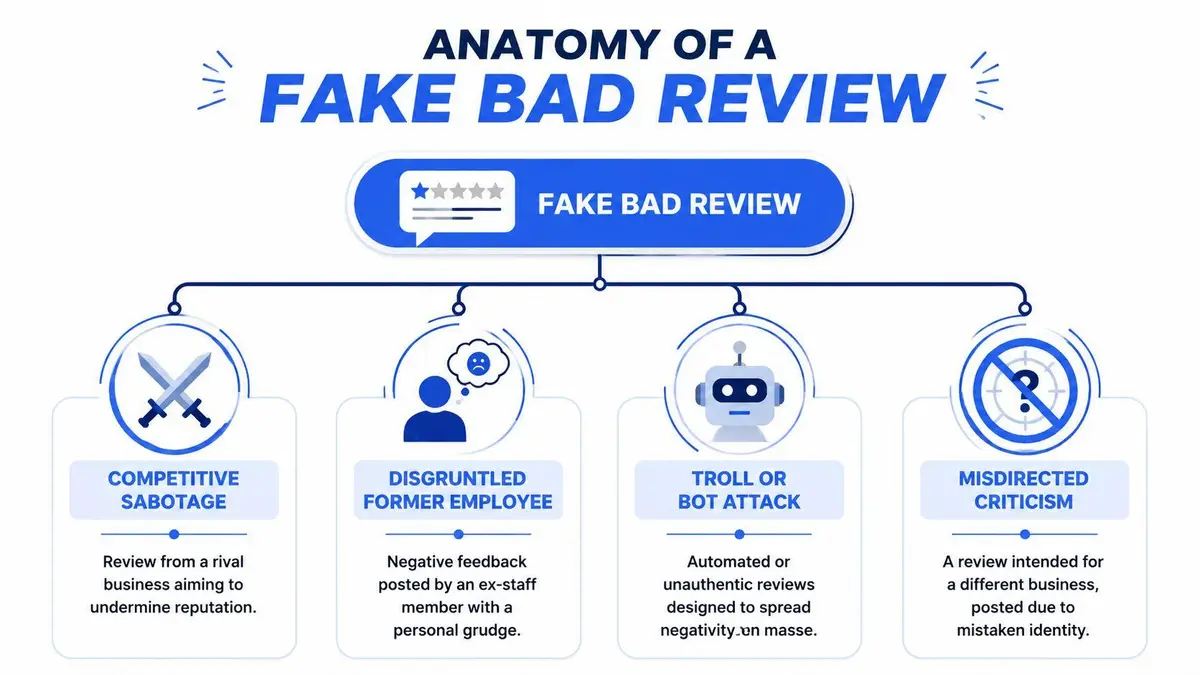
- Four common sources: competitive sabotage, disgruntled former employees, troll or bot campaigns, and misdirected criticism.
- Cluster evidence such as same-day timing and mirrored wording moves moderators more than one suspicious sentence.
- AI-written reviews sound plausible, so timing and account behavior now matter more than tone analysis.
- Anonymous attackers can be pursued through a John Doe action to gain subpoena power.
Where ContentRemoval.com comes in. ContentRemoval.com takes on fake review attacks that a first report did not resolve: assembling the evidentiary packet, matching each review to the right policy category on Google, Yelp or Trustpilot, and coordinating legal escalation when the platform will not act. Business owners, general counsel or a marketing lead usually make contact after a denial. A free 15-minute Exposure Scan maps what is removable and the report is yours to keep. Get a Free, Confidential Exposure Scan or read how our review removal work is done.
A damaging one-star review lands overnight. The reviewer describes an interaction that never happened, names no staff member, and uses details that don’t match your business model, booking flow, or customer records. By morning, your team is debating whether to apologize publicly, argue point by point, or ignore it and hope it disappears.
Treat that impulse as a liability.
A fake bad review isn’t a service issue until proven otherwise. In many cases, it’s a reputation attack. The wrong response gives the attacker exactly what they want: public oxygen, internal confusion, and a weak paper trail. The right response is disciplined, evidence-based, and built for one objective: removal.
Your First Indication of an Attack
Most executives know when criticism is legitimate. Real customers complain in specific ways. They mention dates, locations, order details, or identifiable failures. Fake bad reviews tend to feel off from the start. The facts don’t line up. The tone is theatrical. The accusations are broad enough to sting but thin enough to avoid easy verification.
That first instinct matters, but instinct alone won’t get anything removed.
Freeze the public response
Your first move is restraint. Don’t post a defensive reply. Don’t accuse the reviewer of fraud in public. Don’t let a junior social media manager improvise. Public engagement can harden the dispute, create screenshots the attacker reuses elsewhere, and make a policy team think this is a normal customer disagreement instead of coordinated abuse.
Practical rule: If you can’t prove authenticity or inauthenticity yet, don’t litigate the facts in the review thread.
A fake review campaign should be handled like an incident response matter. Assign one person to coordinate facts. Lock down who can speak externally. Preserve evidence before the platform interface changes or the reviewer edits the text.
Verify before you argue
Start with internal records. Search your CRM, payment systems, support inboxes, appointment logs, shipping records, and HR files if the allegation suggests an insider angle. If the person doesn’t exist in your records, that’s useful. If the alleged incident couldn’t have happened as described, that’s even better.
Create a simple incident file with the following:
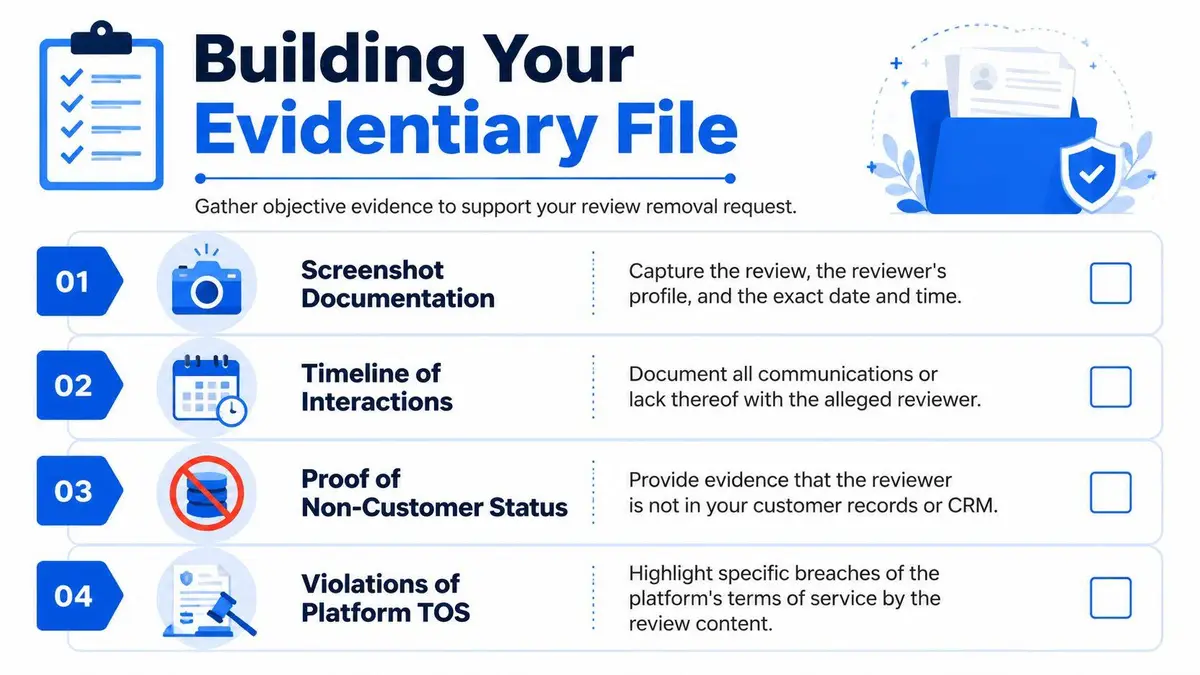
- Review capture: Full screenshot of the review, reviewer name, star rating, timestamp, and the listing URL.
- Profile capture: Screenshot of the reviewer profile and any other visible review activity.
- Internal cross-check: Record whether the reviewer appears in customer, patient, client, employee, or vendor systems.
- Impact notes: Log whether similar reviews appeared on the same day, across multiple locations, or on other platforms.
Platform teams and legal teams respond to documentation, not indignation. If you’re under attack, speed matters. Accuracy matters more.
Anatomy of a Fake Bad Review
Not all fake bad reviews come from the same source, and treating every attack the same way is a mistake. You need to identify the likely operator behind the review because motive shapes tactics. A competitor trying to suppress your ranking behaves differently from a former employee with a grudge. A bot campaign looks different again.
Four common attack patterns
The first category is competitive sabotage. This is the most commercially dangerous because the attacker isn’t venting. They’re trying to move buyers away from you. If you’re dealing with that scenario, this guide on what to do when a competitor is faking reviews addresses the business-response side in more detail.
The second is the disgruntled former employee. These reviews often contain just enough insider language to look credible, but the timeline or subject matter doesn’t match current operations. They may also target leadership personally, not just the business.
Third is the troll or bot attack. Academic and institutional guidance converges on the same signals: bursty timing, repetitive or generic language, and reviewer accounts with thin histories or unusual identity patterns. Those patterns matter because coordinated activity is easier to prove than one isolated post.
The fourth is misdirected criticism. This is less malicious but still harmful. The reviewer describes another company, another branch, or another transaction entirely. These are often removable if you present clean evidence of mismatch.
This is not edge-case noise
The commercial scale is large enough that boards and founders should treat this as a material risk. The World Economic Forum noted in 2021 that $152 billion in global online spending is influenced by fake reviews annually, and roughly 30% of all online reviews are estimated to be fake or inauthentic. A significant portion of that activity involves negative attacks designed to damage competitors and erode trust, not just fabricated praise.
That should end the debate about whether fake bad reviews are a minor annoyance. They aren’t. They’re a weaponized trust problem.
The newer threat is synthetic volume
The older model relied on freelancers, paid review services, and low-cost manual posting. That still exists. The newer problem is AI-assisted abuse. Recent expert coverage points to generated text and a shift away from language-only detection toward behavioral signals, because synthetic reviews can now sound plausible at scale.
When the text looks human, timing and account behavior become more valuable than tone analysis.
If you’re seeing reviews that read differently but arrive in clusters, assume coordination until the evidence says otherwise. The sophistication of the writing no longer tells you much. The structure of the campaign does.
The Triage Protocol and Initial Response
The first day matters. Not because you’ll solve the problem in hours, but because you can either preserve a clean removal record or destroy it with sloppy reactions. The standard business instinct is wrong here. You don’t start with customer service. You start with triage.
What to do in the first 24 to 48 hours
Run a closed internal review. Confirm whether the alleged customer exists, whether the event described could have occurred, and whether any employee recognizes the facts. If your business operates in multiple locations, check each one. Many false reviews exploit internal fragmentation. One office assumes another office handled the matter, and the lie survives because no one owns the verification process.
Then preserve everything. That means screenshots before and after any edit, the public URL, the review ID if visible, the reviewer profile, and the listing page context. Keep file names dated and consistent. If several reviews appear close together, log them in sequence.
Use a working memo that answers three questions:
- Was this person ever a customer, client, patient, guest, or employee?
- Does the narrative match any documented event?
- Are there signs this is part of a broader cluster?
What not to do
Don’t delegate the first response to whoever manages social comments. Don’t offer compensation in public to make the problem disappear. Don’t threaten litigation in the review thread, and don’t assume that a calm, polite public answer is harmless.
There are situations where a measured response to legitimate criticism makes sense. If your team needs a baseline for that side of the equation, Polaris Marketing Solutions has expert advice for handling online feedback that can help distinguish normal review management from attack response. But once you suspect fabrication, your objective changes. You’re no longer trying to win a conversation. You’re building a case.
A fake review should be treated like disputed evidence, not like a service-recovery opportunity.
Establish one command point
Appoint one decision-maker. This can be general counsel, outside counsel, a reputation lead, or a senior operator with authority to gather records fast. Everyone else reports into that channel. Without that discipline, teams create contradictory statements, inconsistent screenshots, and fragmented reporting attempts that weaken later escalation.
If the attack touches personal reputation, regulated services, investor-facing assets, or multiple locations, assume from the outset that you’ll need a file that can survive platform review and legal scrutiny. Build it that way from day one.
Building the Evidentiary File for Removal
Most businesses fail in this way. They tell the platform the review is fake. They explain why it feels unfair. They write an emotional summary. None of that is the standard that matters.
The standard is proof of a policy-relevant pattern.
Peer-reviewed research defines fake reviews as deceptive reviews posted with the intent to mislead consumers, often by reviewers with little or no actual experience, and it notes that negative fake reviews can create unfair competition and may qualify as deceptive advertising under the FTC Act and EU advertising rules. For enforcement teams, the legal status is tied to intent and commercial effect, and high-confidence cases depend on patterns such as reviewer-history anomalies, synchronized posting bursts, and mismatches between the review narrative and verified customer records, as explained in this peer-reviewed analysis of fake review detection and legal significance.
What belongs in the file
Your case file should read like a concise investigator packet, not a complaint letter.
- Exact capture of the review: Save the full text, star rating, date, time, listing URL, and screenshots of the live page.
- Reviewer-account evidence: Document whether the profile appears newly created, has minimal prior activity, or shows odd geographic or identity signals.
- Narrative mismatch evidence: Match the claims against records. If the reviewer says they bought a product, visited a location, or dealt with a named staff member, verify each point.
- Cluster evidence: If multiple reviews appeared in a short period, chart the timing, wording similarities, and affected listings.
A moderator is more likely to act when you show a cluster than when you argue about one suspicious sentence.
How to present patterns
A short table often works better than pages of prose:
| Review reference | Why it is suspicious | Supporting record |
|---|---|---|
| Review A | Reviewer not found in CRM or order system | CRM search log, sales records |
| Review B | Same-day posting pattern with similar phrasing | Timeline log, screenshot comparison |
| Review C | Claims a service your business doesn’t offer | Service menu, booking rules, internal policy |
Keep the language dry. Don’t editorialize. Don’t speculate beyond what you can show.
A useful reference point on evidence gathering appears below.
Match evidence to policy, not emotion
Most platforms don’t remove content because it upsets you or because your staff is convinced it’s malicious. They remove content because the submission shows spam, impersonation, conflict of interest, coordinated inauthentic behavior, or another recognized violation.
The sentence “this review is false” is weak. The sentence “the reviewer cannot be matched to any customer record, posted in a synchronized cluster, and used mirrored language across accounts” is stronger.
Build a packet with attachments, dates, and labels. If your business uses internal systems like Salesforce, HubSpot, Zendesk, Toast, Mindbody, Stripe, or an EHR, export only what’s necessary to prove the mismatch. Redact sensitive data. The objective is credibility, not volume. A smaller file with clean exhibits beats a bloated file full of outrage.
Executing Platform Specific Removal Protocols
Once the evidentiary file exists, you stop thinking like a target and start thinking like a platform reviewer. That means you stop arguing fairness and start mapping facts to policy categories.
Speak the platform’s language
Google is the clearest example. Its reporting flow requires you to select a policy reason, and in some cases use the Reviews Management Tool and appeal path. That design tells you exactly how the platform expects to receive the case. You’re not submitting a moral argument. You’re submitting a categorized policy claim.
The practical implication is simple. Successful review takedowns are often not won by claiming a review is fake, but by proving a specific violation such as spam, conflict of interest, or impersonation, as reflected in Google’s review reporting and appeal workflow. Businesses dealing with clustered one-star attacks on Maps should also review this guide on how to remove review bombing on Google.
What a strong submission looks like
A strong report is short, specific, and attached to evidence. It identifies the review, states the policy category, summarizes the supporting facts, and references the exhibits. It does not ramble. It does not accuse unnamed competitors unless you can prove the connection. It does not ask the moderator to infer what you failed to document.
For example, a useful submission structure looks like this:
- Identify the review and listing.
- Name the suspected policy violation.
- State the factual basis in a few lines.
- Reference attached evidence.
- Request review under the correct tool or appeal channel.
That is how you make the moderator’s job easier. Easy cases move faster.
Why DIY attempts usually stall
Most self-filed reports fail for one of three reasons. First, the business submits no documentary support beyond a sentence of denial. Second, it chooses the wrong policy category. Third, it fragments the evidence across multiple reports, emails, and screenshots with no coherent packet.
Different platforms vary in process, but the underlying logic is the same:
- Google: Prioritizes policy-coded reporting and structured appeals.
- Yelp: Looks closely at authenticity, conflicts, and recommendation logic, which means thin, emotional complaints rarely help.
- Trustpilot and similar platforms: Often focus on whether the reviewer had a genuine experience or whether the content breaches platform rules.
Your task isn’t to educate the platform about the injustice of fake bad reviews in the abstract. Your task is to show, with precision, that this specific content violates this specific rule.
If you can’t do that cleanly, don’t file prematurely. Weak submissions create a bad record and make later escalation harder.
Legal Recourse and Advanced Escalation Pathways
Platform moderation isn’t the final authority. It’s one channel. When the review remains live, the campaign expands, or the harm crosses into defamation or business interference, legal escalation becomes a strategic necessity.
When legal pressure changes the posture
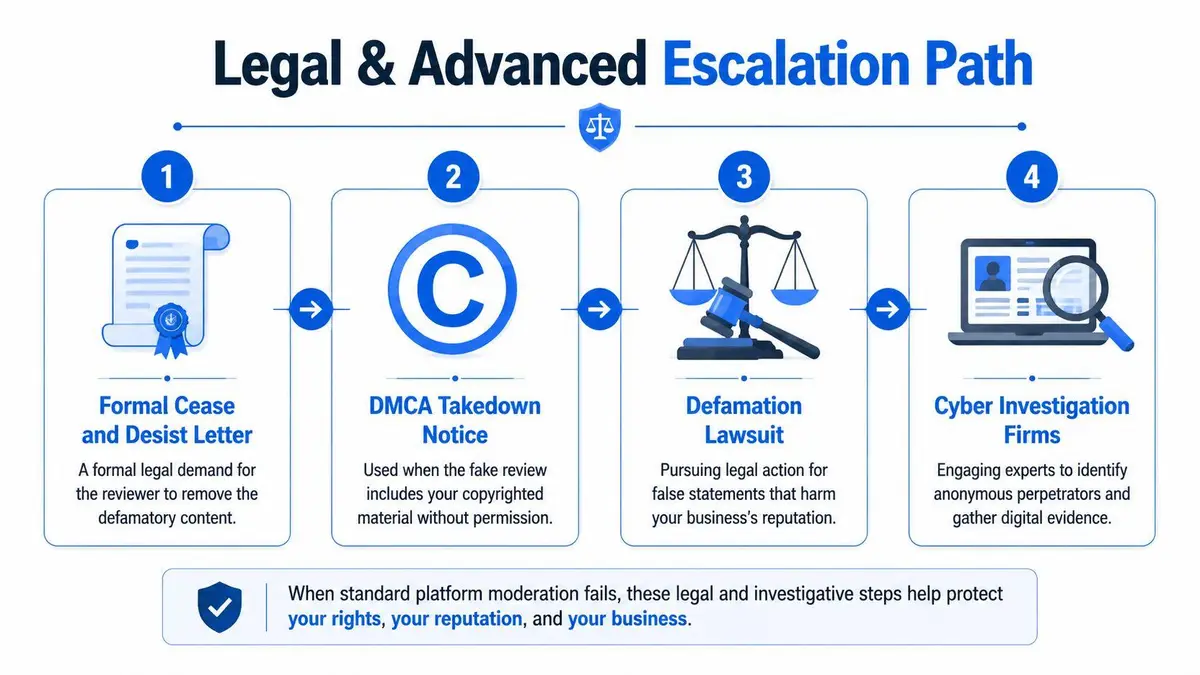
If you know or strongly suspect the source, a formal cease and desist letter can do two jobs at once. It demands preservation of evidence and puts the attacker on notice. That matters later if they delete accounts, alter content, or continue posting after receiving notice. For a former employee, vendor, or identifiable competitor, this is often the first serious pressure point.
If the reviewer is anonymous, the stronger route may be a John Doe action. The point isn’t courtroom theater. The point is subpoena power. In the right case, it can help identify the operator behind an anonymous account, broker, or coordinated campaign.
Match the legal theory to the conduct
Not every ugly review is defamation. Opinion usually isn’t actionable. False factual claims can be. The distinction matters. “Terrible service” is usually protected opinion. “This company billed me fraudulently on a date that never occurred” is different if it’s false and harmful.
Potential claims may include:
- Defamation: False statements of fact that damage reputation.
- Tortious interference: Conduct intended to disrupt business relationships or commercial expectancy.
- Unfair competition or deceptive advertising theories: Especially where review abuse is commercially motivated.
- Impersonation or account misuse claims: Where the attacker poses as a customer, employee, or third party.
Legal action is most effective when it’s built on the same disciplined evidence file used for platform escalation.
Use the right specialists
Some matters require more than counsel. Cyber investigators can help attribute anonymous activity, preserve digital evidence, and identify connections across accounts or platforms. If the review includes your copyrighted images, copied text, or reused proprietary material, copyright-based takedown tools may also become relevant. Those are narrower than defamation claims but sometimes faster.
A specialized provider then becomes practical, not cosmetic. ContentRemoval.com handles false review and content takedown matters alongside broader reputation protection workflows, including removal strategy, monitoring, and escalation support. That makes sense when the attack touches search visibility, executive reputation, or repeated reposting across platforms.
The business mistake is waiting too long because the first report was denied. A denial often means the case was weakly presented. It doesn’t mean the attack is lawful or untouchable.
Proactive Defense and Professional Intervention
A business that only reacts will keep losing time to the same attack pattern. You need a standing defense posture. That doesn’t mean gaming review systems. It means building enough authentic signal, monitoring, and escalation readiness that one false post can’t define your reputation.

Build resilience before the next incident
First, create a lawful process for collecting authentic reviews from real customers. The goal is not to bury legitimate criticism. The goal is to make your public profile reflect reality. A healthy stream of real feedback reduces the damage a single fake hit can do.
Second, monitor review surfaces consistently. Don’t rely on staff spotting problems by chance. Track Google Business Profiles, major industry directories, marketplace listings, and any profile tied to your name or leadership team.
Third, maintain a live incident template. Have a standard capture process, chain of responsibility, and escalation list. If an attack starts on Friday evening, your team shouldn’t be improvising from scratch.
Know when this is no longer a DIY matter
You should bring in specialist help when the pattern shifts from isolated suspicion to organized abuse. That includes review clusters, cross-platform posting, attacks targeting executives personally, repeat denials from platform channels, or signs of AI-assisted volume that your internal team can’t keep up with.
The same applies when the review content touches regulated allegations, investor concerns, licensing issues, or extortion. At that point, the cost of amateur handling exceeds the cost of professional intervention.
A useful benchmark is whether your team can answer three questions clearly:
| Question | If the answer is no |
|---|---|
| Can we prove a specific policy violation? | You need better evidence assembly |
| Can we submit a coherent packet through the right channel? | You need procedural expertise |
| Can we escalate beyond the platform if removal fails? | You need legal and investigative support |
If not, move fast and get help. This broader guide on strategic online review removal for executives and founders is a useful next step if you’re assessing whether the matter requires a formal intervention.
Fake bad reviews don’t become harmless because they’re digital. They become harder to contain when businesses misclassify them as routine feedback. The winning approach is disciplined from the start: preserve evidence, build a policy-based case, escalate intelligently, and treat coordinated abuse as the commercial attack it is.
If you’re dealing with fake bad reviews that threaten revenue, credibility, or personal reputation, ContentRemoval.com can assess the attack confidentially and help you build a structured removal and escalation plan. The right response isn’t louder. It’s better documented, better targeted, and harder for platforms and attackers to ignore.
Frequently asked questions
Should I reply publicly to a review I believe is fake?
No, not while the authenticity question is open. A defensive reply or public fraud accusation can harden the dispute, produce screenshots the attacker reuses and make the platform treat the matter as an ordinary customer disagreement. Preserve evidence, verify internally and build the case before anyone speaks.
Why did Google reject my report of a fake review?
Most self-filed reports fail because they offer a sentence of denial with no documentary support, choose the wrong policy category or scatter evidence across multiple submissions. Google’s reporting flow expects a categorized policy claim with attached exhibits, so a denial usually means the case was weakly presented, not that the review is legitimate.
Can I sue over a fake negative review?
Sometimes. Opinion such as terrible service is usually protected, but false factual claims that cause harm can support defamation, tortious interference or unfair competition theories. A cease-and-desist works where the source is known; a John Doe action can unmask an anonymous account through subpoena power.