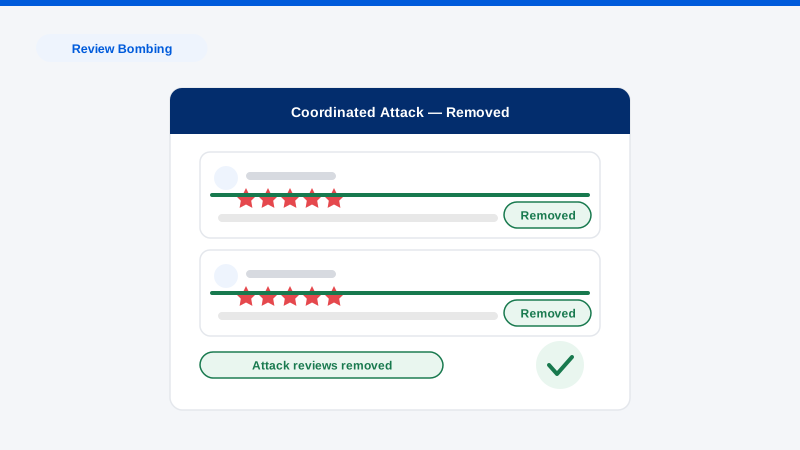
Review bombing (a coordinated wave of one-star reviews triggered by a news story, viral post, or organized campaign) is one of the few situations where Google removes reviews in bulk. Google’s policy prohibits “fake engagement” and content posted “to manipulate ratings,” and its spam systems specifically target coordinated attacks tied to off-platform events. Google has repeatedly deleted thousands of reviews at once after viral incidents and even temporarily disabled reviewing on targeted profiles. The removal path is real, but it is not the three-dot “report” button: it runs through evidence bundling and Google Business Profile support. Here is the playbook.
What qualifies as review bombing Google will remove?
Google distinguishes between many customers having genuine bad experiences (not removable) and coordinated non-customer attacks (removable). The signals that put an attack inside its removal policies:
- A traceable trigger event. A news article, Reddit thread, TikTok, tweet, or activist call-to-action that precedes the review spike. This is your single most important piece of evidence.
- Reviews from non-customers. Accounts with no plausible customer relationship: wrong geography, review histories showing they’ve never been near your business, or profiles created the same week.
- Volume anomaly. Ten times your normal review velocity in days, near-uniform one-star ratings, repeated phrases, or copy-pasted text.
- Off-topic content. Reviews about the controversy, the executive, or a political position rather than any product or service experience, a direct violation of Google’s off-topic policy.
- Harassment of named individuals. Attack waves often name the CEO or an employee; those reviews additionally violate Google’s harassment policy.
What does not qualify: a genuine service failure that many real customers reviewed, or a controversy where actual customers changed their ratings. Google’s systems are calibrated to protect authentic sentiment, and flag campaigns against real reviews fail, and should.
The response protocol, step by step
- Freeze and document immediately. Screenshot the profile’s review count and rating, then capture every incoming review with reviewer name, profile link, timestamp, and text. Export continuously, reviews get edited and deleted during attacks, and your evidence file drives everything.
- Identify and document the trigger. Archive the post, article, or thread that launched the attack, with timestamps proving it preceded the spike. If a call-to-action explicitly tells people to leave reviews, that is coordinated inauthentic behavior in Google’s own terms.
- Do not reply to attack reviews. Responses signal engagement, feed the campaign, and create quotable screenshots. Hold public responses until the wave crests; then respond once, calmly, to the situation, not to individual bombers.
- Report through Google Business Profile support, not one-by-one flags. The three-dot report flow evaluates reviews individually, which is exactly the wrong frame for a coordinated attack. Instead, use the GBP help center’s “Manage reviews” contact flow to open a support case, present the attack as a coordinated incident, and attach the evidence bundle: trigger, timeline, velocity data, and a spreadsheet of offending reviews with policy citations.
- Request profile protections. In active attacks, ask support about temporary protections; Google has paused new reviews on profiles under known attack waves following major news events.
- Escalate on parallel tracks. Individual reviews that dox or harass named people can also be flagged under those policies (fastest-actioned categories). False factual claims support Google’s legal removal process. Our guide to removing Google reviews covers each escalation tier, and the Google Maps-specific flow matters when the attack concentrates there.
- Manage the wider event. Review bombs rarely travel alone: check Glassdoor, Yelp, Trustpilot, and social platforms for the same wave, and treat the trigger content itself as a removal or response target. This is where a coordinated reputation management response outperforms platform-by-platform firefighting.
Get a Free, Confidential Exposure Scan
Timelines and honest expectations
When the coordinated pattern is clear (documented trigger, non-customer accounts, velocity spike) Google support cases typically resolve in one to three weeks, and bulk removals of the attack wave are a realistic outcome. Google’s automated systems sometimes purge obvious waves within days without any report. Messier cases (attacks mixed with genuine customer backlash, slow-drip campaigns without a clean trigger) take longer and come down partially: the fake and off-topic reviews go, the authentic ones stay.
No one can promise total restoration, and any firm guaranteeing removal of every negative review is misrepresenting how Google works. What professional handling changes is the quality of the case file: correct policy mapping, forensic-grade evidence of coordination, and persistence through Google’s support tiers. That difference is frequently what separates “we removed 400 attack reviews” from “we flagged everything and nothing happened.” Ongoing reputation monitoring then catches the second wave, attacks recur around anniversaries and follow-up coverage.
Frequently asked questions
Does Google actually remove review bombs?
Yes. Bulk removal of coordinated attacks is established Google practice, applied after many viral incidents, and its policies explicitly prohibit reviews driven by news events or manipulation campaigns rather than customer experience. The mechanism is pattern-level enforcement through support cases and automated detection, not individual flags.
Should we reply to the attack reviews while it’s happening?
No. Replies amplify the campaign and produce screenshots that extend the story. Document everything, report through the coordinated-attack path, and publish one measured owner response to the situation after the wave peaks. Never respond review-by-review to bombers.
The attack mixes fake reviews with some real unhappy customers. What happens?
Google removes what violates policy and keeps what doesn’t. Expect the non-customer, off-topic, and duplicate reviews to come down while genuine negative reviews remain. Your rating recovers partially through removal and fully through subsequent authentic reviews. Plan for both.
Can we find out who organized the attack?
Sometimes. The trigger post usually identifies the instigator, and patterns across reviewer profiles can support legal action, particularly where the campaign includes false factual claims, which shifts the matter into defamation removal territory with discovery tools attached.
How do we prevent the next wave?
You can’t prevent a viral event, but you can shorten response time to hours instead of weeks: monitoring that alerts on review-velocity anomalies, a pre-built evidence workflow, and established escalation contacts. That’s the core of our Protection Plans for exposed brands and executives.
If your profile is under attack now, speed matters more than anything on this page. Request a free, confidential Exposure Scan and we’ll assess the attack pattern, what’s removable, and how fast, then run the whole escalation through our process.