
A NetReputation alternative for UK clients should be chosen by threat type, not brand name. Specialist removal firms suit urgent attacks where speed, platform process, and reupload control matter; solicitor-led practices such as Adlex suit disputes needing formal legal pressure or court readiness; privacy tools such as DeleteMe and Optery reduce exposure but do not resolve a live threat.
Key facts
- Ten providers reviewed: ContentRemoval.com, Igniyte, ReputationDefender UK, Minc Law, Nullify, Internet Removals, DeleteMe, Optery, Red Points, Adlex Solicitors
- Red Points is built for counterfeits and brand abuse at scale, not personal defamation or editorial removals
- Minc Law is not a UK law firm; pair it with domestic counsel for UK-specific causes of action
- Three tests before signing: reduces visibility at source or in search, works within UK legal realities, keeps intake discreet
Where ContentRemoval.com comes in. ContentRemoval.com sits in the removal-led category of this list, handling source takedowns, de-indexing, impersonation profiles, leaked material, false reviews, and reupload monitoring for UK-based executives, founders, and family offices. Contact usually comes through general counsel, a chief of staff, or the family office itself. A free 15-minute Exposure Scan maps what is removable, and the report is yours to keep. Get a Free, Confidential Exposure Scan or read how our reputation management work is done.
A board member forwards a screenshot at 6:40 a.m. It shows a defamatory post, a burst of fake reviews, an impersonation profile, or an old article now outranking your company site and executive biography. Legal asks which jurisdiction applies. Communications asks how fast it can be contained. The CEO asks for one thing. Remove it discreetly.
That pressure changes the brief. You are not shopping for a generic reputation agency. You are choosing a provider that can assess defamation, privacy, platform policy, search visibility, evidence preservation, and cross-border enforcement in the same matter, without turning a live incident into a longer one.
A common mistake is hiring a firm built for review responses and search suppression when the issue is legal, reputational, and evidential at the same time. NetReputation has a place in broad reputation repair. UK-based clients with serious exposure usually need tighter control over takedowns, intermediary escalation, data rights, injunction readiness, and discretion.
This review is written from that standpoint. It is a strategic brief for executives, legal counsel, founders, family offices, and public figures assessing UK-serving NetReputation alternatives for high-stakes removal work.
I divide the market into three groups. Specialist removal firms handle urgent attacks where speed, platform process, and reupload control matter most. Solicitor-led practices suit disputes that may require formal legal pressure or court readiness. Privacy and monitoring tools help reduce exposure, but they do not resolve a live reputational threat on their own.
The right question is simple. Which provider fits the threat in front of you, the jurisdiction that governs it, and the level of discretion the situation demands?
1. ContentRemoval.com
If you need a serious netreputation alternative uk for a live reputational threat, ContentRemoval.com is the first call I’d make. It is built for removal, not just reputation cosmetics. That distinction matters when the issue involves impersonation, leaked material, false allegations, malicious reviews, mugshot-style listings, search indexing, or reuploads across multiple hosts.
The firm is led by founder Frankie Lee and works at the point where digital law, platform process, and operational discretion meet. That’s the right model for executives and high-net-worth clients because public-facing reputation repair often fails when nobody is controlling the source URLs, the search result layer, and the repost cycle together.
Why it stands above general ORM vendors
Most ORM firms are strongest at suppression. ContentRemoval.com is stronger where the matter requires takedown strategy, de-indexing, escalation, and ongoing prevention. The service profile includes search engines, websites, social platforms, adult sites, impersonation profiles, plagiarised content, and dark-web exposure.
Its process is straightforward. Audit the digital footprint. Execute takedown and de-indexing actions. Continue monitoring to catch reuploads and recurring abuse. The company states that most actions begin within 24 to 48 hours, which is critical when a story, leak, or fake profile is still gathering distribution.
Practical rule: If the content is unlawful, platform-breaching, privacy-invasive, or obviously false, start with a removal-led specialist. Don’t begin with a generic SEO suppression retainer and hope the platform issue resolves itself later.
This is also one of the few options on this list that reads as particularly suitable for family offices, founders of large privately held businesses, creators dealing with piracy, and individuals facing intimate-image or impersonation abuse. The tone is selective and discreet. That’s a strength, not a weakness.
Best use case
Choose ContentRemoval.com when the matter is urgent, reputationally sensitive, and spread across multiple layers of the internet. That includes Google indexing, source-page removal, social media reports, host escalation, repeat-post monitoring, and covert handling.
A few trade-offs are obvious:
- Best for high-stakes matters: It’s designed for executives, celebrities, founders, legal professionals, and private clients where speed and discretion carry more weight than menu pricing.
- Best for cross-platform action: It addresses search, websites, review platforms, social channels, adult platforms, and dark-web exposure in one engagement.
- Less suitable for budget-led buyers: Pricing isn’t published, and the firm is selective. Smaller one-off complaints may find the intake threshold demanding.
If your problem can materially affect capital raising, employment, family privacy, board confidence, or personal safety, this is the strongest option on the list.
2. Igniyte
Igniyte is one of the safer UK choices when you want an established reputation consultancy with domestic familiarity, bespoke handling, and experience spanning removals, reviews, crisis communications, and search result repair. It isn’t the most aggressive specialist on this list, but it is credible and grounded in the UK environment.
That matters because many overseas firms treat the UK as a language market rather than a legal and platform-enforcement jurisdiction. Igniyte doesn’t make that mistake. It has a dedicated UK removal and ORM practice and combines strategy with hands-on implementation.
Where Igniyte fits
Igniyte is strongest for organisations that need both stakeholder management and technical reputation work. If your issue involves public criticism, hostile review patterns, executive profile damage, and a need for measured corporate messaging, it can bridge legal, communications, and search visibility concerns in a way pure software can’t.
The same UK survey referenced earlier found that 71% of companies identified negative social media content as the most damaging to their reputation. That single fact explains why a UK-focused consultancy still matters. Search isn’t the whole battlefield. Social content often drives the first wave of harm.
Negative review disputes and negative social content require different handling. If a provider treats them as the same problem, expect a weak result in at least one channel.
Igniyte’s in-house monitoring and reporting are useful if your legal team needs a running evidential view, not just tactical outreach to platforms. It’s also a sensible fit for companies that need a dedicated account structure rather than a self-serve dashboard.
The trade-off
The trade-off is cost and pace. Bespoke consultancies tend to price higher for complex or prolonged matters, and they may feel more measured than a removal-first specialist. That isn’t necessarily a flaw. It depends on your risk profile.
Use Igniyte when your issue is UK-centric, reputationally serious, and tied to broader communications strategy. If your sole objective is fast removal of a narrow set of URLs, a more concentrated takedown firm may move harder. If the issue touches brand trust, press handling, and search visibility together, Igniyte deserves a place on your shortlist.
3. ReputationDefender (UK)
ReputationDefender UK is a strong alternative if your concern is long-term executive profile protection rather than an immediate takedown fight. It’s more mature as an ongoing reputation management and privacy service than as a specialist emergency-response vehicle.
That distinction should drive your choice. Many executives don’t just need one article or one post handled. They need a standing system for search hygiene, personal information reduction, monitoring, and profile maintenance across months or years. ReputationDefender is built for that posture.
Best for executive protection over time
Its core value sits in suppression, reputation rebuilding, monitoring, and privacy-oriented cleanup such as people-search and data-broker opt-outs. For a public company executive, investment principal, or founder with regular press exposure, that kind of long-view program can be more useful than a one-time takedown campaign.
This makes ReputationDefender suitable where the principal concern is cumulative visibility. You know more negative or intrusive material will appear over time. You want resilience, not just one successful removal request.
A few situations where it works well:
- Executive reputation maintenance: Useful for senior leaders whose names are searched constantly by journalists, investors, counterparties, and recruits.
- Privacy baseline: Helpful where personal data exposure increases the risk of harassment, impersonation, or doxxing.
- Reputation rebuilding: Stronger when the task is to improve what appears around an individual or brand over time.
Where it falls short
It is less compelling if you need immediate, legal-adjacent action against a specific high-harm item. ReputationDefender tends to sit closer to managed reputation and privacy services than to rapid specialist takedown execution. That doesn’t make it weak. It means the service model is different.
If your problem is an unfolding defamation issue, unauthorised imagery, a malicious fake profile, or a source page that has to be challenged directly, you may need a removal-led provider or solicitor first. If your concern is persistent executive vulnerability and long-horizon reputation control, ReputationDefender is one of the more sensible NetReputation alternatives available to UK clients.
4. Minc Law
Minc Law is the right choice when you’re no longer asking for reputation management in the abstract. You need legal strategy. You need letters before action, platform abuse escalation, evidence framing, or litigation readiness. That puts it in a different category from many NetReputation alternatives.
Attorney-led internet defamation firms are often more effective when the content publisher is entrenched, anonymous, or strategically malicious. They’re also more credible when a host, intermediary, or platform takes the complaint more seriously once legal counsel formalises the allegations and evidential basis.
When legal escalation is the real answer
Minc Law is a good fit for online defamation, impersonation, creator piracy, and non-consensual or intimate-image issues where legal pressure may need to sit behind the takedown process. It also helps when the question isn’t just removal, but preserving options if the matter expands into formal proceedings.
If you’re dealing with a false statement campaign, start by reading this strategic guide to online defamation response. It captures the decision point many clients miss. Not every bad result should be litigated, but some absolutely should be prepared as if it might.
If the publisher is anonymous, persistent, or clearly acting with malice, don’t hand the matter to a standard ORM vendor and expect them to solve a legal problem with search tactics.
The trade-off with Minc Law
The legal route is usually slower and more expensive than a pure ORM campaign. It also isn’t the right answer for every unpleasant search result. Some issues are better handled through direct platform reporting, intermediary escalation, data-rights requests, or suppression work.
Minc Law’s advantage is judgement. It tends to distinguish between what can be removed, what can be pressured, and what is better managed through search strategy. That realism is valuable when outcomes are critical and a client can’t afford false confidence.
For UK readers, the limitation is jurisdictional fit. It isn’t a UK law firm. If your issue is closely tied to UK-specific causes of action or court steps, pair this kind of expertise with domestic counsel. But if the issue is online defamation and platform abuse with a serious cross-border dimension, Minc Law deserves attention.
5. Nullify
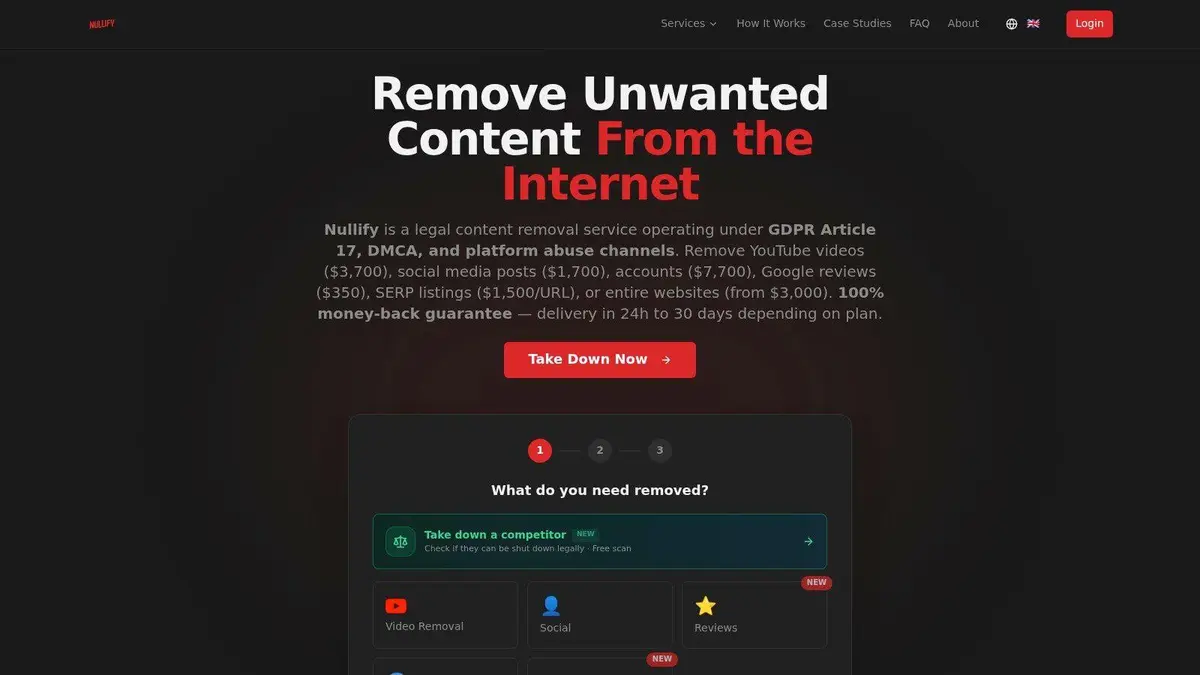
Nullify takes a very different approach from traditional ORM firms. It productises common removal tasks with flat-rate checkout options for specific platforms and rights-based requests. That makes it attractive when you want speed, transparency, and a narrow legal basis for the request.
For UK and EU clients, that can be useful in matters tied to privacy, platform-policy breaches, or data-rights takedowns. You’re not buying a broad reputation strategy. You’re buying a direct route for a defined removal target.
Best for one-off removals with clear grounds
Nullify is sensible when the issue is concentrated and the basis for removal is relatively clean. A Google result, a review platform entry, or social content may be suitable if it falls within the service menu and the facts support action under platform rules or data-protection concepts.
Its published money-back promise and instant-purchase structure make it more commercially straightforward than many agencies. For legal teams and busy executives, that simplicity has value. It reduces the delay and ambiguity that often plague early-stage reputation work.
A few reasons to choose it:
- Transparent buying process: Useful if you want to initiate action without a long sales sequence.
- Focused platform coverage: Better for clearly identified URLs than for sprawling, multi-host harm.
- Rights-based framing: Strong when privacy or policy arguments are central.
Where caution is needed
Nullify isn’t a substitute for a full reputation strategy, crisis response team, or solicitor-led dispute. If your matter touches multiple publishers, repeated reposting, hostile commentary, or board-level sensitivity, a menu-driven service can be too narrow.
This is the option I’d use for a targeted strike, not a campaign. If your issue is one harmful result on one platform and you want a direct path to challenge it, Nullify is practical. If the issue is reputational contagion across search, social, websites, and secondary commentary, move up the chain to a specialist removal firm or solicitor-led team.
6. Internet Removals
Internet Removals is a reasonable option for clients facing a spread of harmful URLs across websites, social profiles, review pages, and search results. Its strength is breadth of removal orientation rather than polished corporate positioning.
That can be useful. Some matters don’t need an expansive strategic narrative. They need an intake system that can absorb multiple URLs, identify the host and platform pathways, and start pushing the relevant channels in an organised way.
Better for multi-URL campaigns than brand positioning
If you’re dealing with a cluster of webpages, profiles, and references rather than one flagship problem, Internet Removals may suit the job. It appears structured around that kind of workflow. Clients who need broad application handling across different hosts may find that more practical than a firm focused mainly on executive branding or review management.
Its dedicated England-facing materials also indicate some awareness of UK client demand, though the broader posture remains global rather than UK-specific.
A provider can be useful without being elegant. In removal work, clean process often matters more than polished messaging.
Strategic limitation
The limitation is depth of UK legal signalling. If your matter depends heavily on UK-specific evidential standards, solicitor-led notices, or nuanced privacy arguments, other options on this list are stronger. Some public materials also feel lighter than you’d want for a highly sensitive engagement.
That said, not every client needs litigation-adjacent sophistication. Many need coordinated, source-level action against harmful content across multiple domains and platforms. Internet Removals can fit that requirement, particularly where the case is operationally messy rather than legally novel.
Choose it when scope is the problem. If the issue is one executive-critical URL with major press sensitivity, use a higher-touch specialist. If the issue is a broad field of harmful content that needs systematic pressure across hosts and search, Internet Removals belongs on the shortlist.
7. DeleteMe (JoinDeleteMe)
DeleteMe is not a direct substitute for NetReputation if your concern is defamation, media coverage, or review attacks. It is, however, one of the best supporting tools for reducing the personal data exposure that often fuels those attacks in the first place.
That distinction matters for executives, family members, and family office staff. Publicly available address data, phone numbers, relative links, and other personal identifiers make harassment, impersonation, and doxxing materially easier. DeleteMe helps reduce that exposure over time.
Use it as a privacy layer, not a crisis tool
DeleteMe handles ongoing removals from data brokers and people-search sites, then continues with repeat removals as the data reappears. That cadence is useful because privacy exposure rarely stays solved after one request cycle.
If you’re trying to lower the probability of future abuse, this is a rational baseline. For a practical framework, see this guide to removing personal information from the internet. It reflects the sequence most high-risk individuals should follow: first reduce exposure, then harden monitoring, then address the visible attack surface.
A few points are clear:
- Best for reducing discoverability: Good for shrinking the publicly searchable personal-data footprint.
- Best used continuously: It works better as a standing privacy service than as a one-time exercise.
- Not suitable for editorial or defamatory content: It won’t solve a hostile article, fake allegations, or a search-result crisis.
Who should buy it
Use DeleteMe if you’re building a defensive perimeter for an executive household, a principal with high visibility, or a company leadership team that has already faced harassment or impersonation. It’s a foundational privacy service, not a reputational rescue service.
That makes it complementary rather than substitutive. In a serious matter, pair it with a takedown specialist or legal team. On its own, it won’t remove the visible narrative attack. It will help stop future attackers from finding so much raw material so easily.
8. Optery
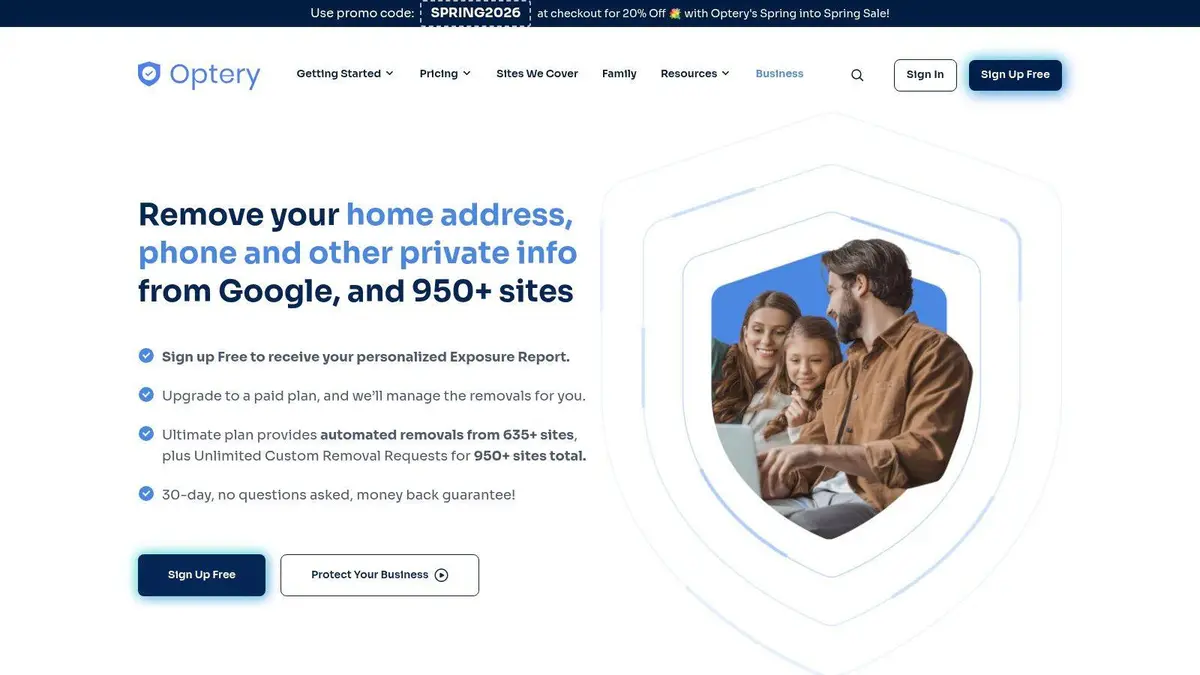
Optery sits in the same defensive privacy category as DeleteMe, but it distinguishes itself through detailed exposure reporting and screenshot-based proof of work. For legal teams, chiefs of staff, and security-conscious principals, that evidence trail is useful.
A surprising amount of privacy tooling remains opaque. Optery does better when a client wants to verify what was found, what was removed, and what remains exposed. That transparency can help when the digital privacy programme needs internal reporting or integration into wider risk management.
Stronger on evidence and visibility
If your office wants records, screenshots, and a clearer dashboard of exposure reduction, Optery is often the better fit than a simpler privacy subscription. It combines automation with human review and offers tiered coverage for varying levels of exposure.
That makes it suitable for clients who need more than casual reassurance. It also helps when the digital-risk discussion involves legal, security, and reputation stakeholders who all want proof rather than verbal updates.
Not a replacement for removal counsel
The limitation is obvious. It won’t remove legitimate editorial coverage or handle defamation disputes. It is a privacy and exposure-reduction service, not a reputation litigation or emergency takedown service.
Use Optery when the problem is discoverability of personal information at scale. Don’t use it as the lead answer to a live reputational attack. In practice, high-stakes clients often need both. A specialist team handles the harmful content. A privacy service like Optery reduces the data exhaust that makes future attacks easier to mount.
9. Red Points
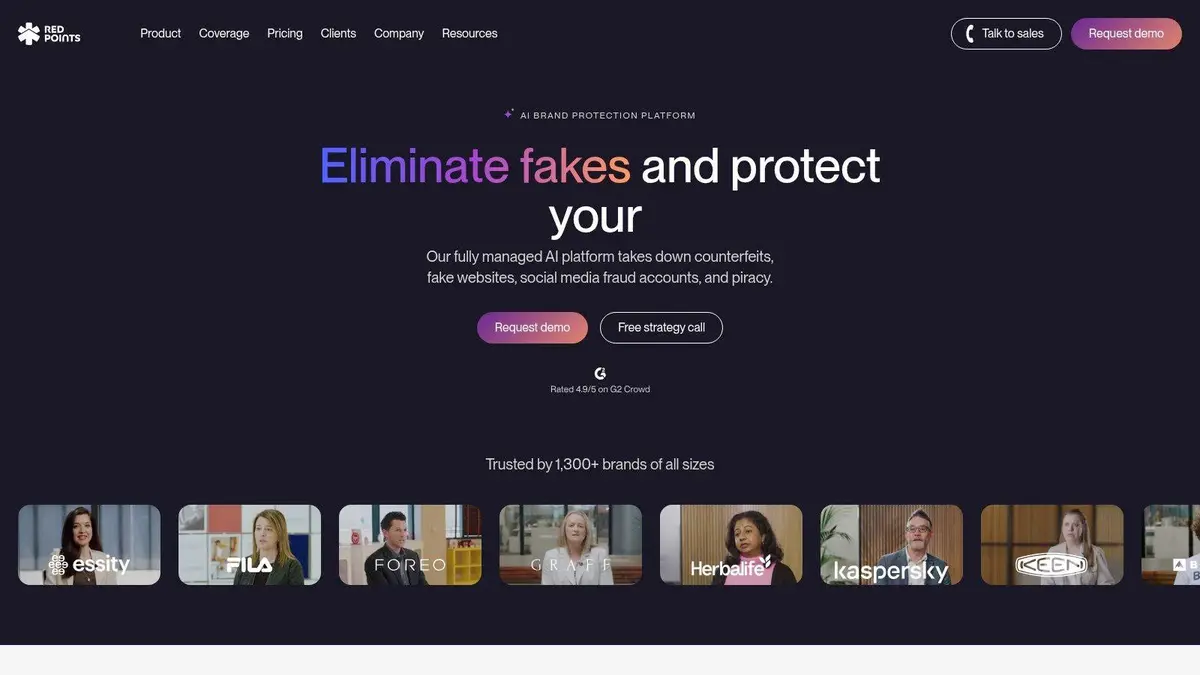
Red Points belongs on this list because some clients searching for a netreputation alternative uk don’t have a reputation problem in the narrow sense. They have a brand abuse problem. Counterfeits, impersonation, marketplace misuse, domain abuse, and IP infringement often sit upstream of the reputational damage.
For those matters, Red Points is more relevant than a classic ORM agency. It is built for detection and enforcement at scale across marketplaces, social platforms, domains, and the web. If your legal and commercial teams are trying to contain recurring infringement rather than clean up one bad page of search results, that’s the right orientation.
Best for brands, not individuals
Red Points is strongest for consumer brands, retailers, licensing-heavy businesses, and companies with repeat impersonation or counterfeit risk. It is not the right choice for a private individual trying to remove a defamatory article or personal post.
That focus is a feature, not a limitation, if you’re handling broad abuse against a trading brand. The platform consolidates detection and enforcement in one place, which can be more effective than stitching together separate monitoring and takedown workflows.
A practical dividing line:
- Use Red Points for infringement ecosystems: Counterfeits, copycats, marketplace abuse, fake storefronts, and recurring impersonation.
- Don’t use it for personal reputation disputes: Editorial removals, personal defamation, and privacy harms need different expertise.
Why legal teams like it
In-house counsel often prefer systems that create one operating view of recurring abuse across channels. Red Points supports that kind of command structure. It also keeps the enforcement task closer to IP and platform governance, where many corporate legal teams are already comfortable.
If your business is suffering from copycat sellers, fake social profiles, or broad misuse of product imagery and marks, Red Points may be a stronger alternative than NetReputation. If the issue is your CEO’s search results, it isn’t.
10. Adlex Solicitors
Adlex Solicitors is the most clearly UK-legal answer on this list. If platforms, hosts, publishers, or registrars need to hear from solicitors rather than a marketing-led ORM provider, Adlex is worth serious consideration.
That difference matters in the UK. Some matters require a proper legal frame from the outset. Jurisdiction, intermediary liability, evidential standards, defamation posture, privacy rights, and possible injunctive routes are not side issues. They are the case.
Best for solicitor-led takedown pressure
Adlex is useful when your objective is to force the legal issue into focus. That includes notice-and-takedown letters, host escalation, domain disputes, privacy and defamation matters, and the kind of platform contact that carries more weight when it is clearly solicitor-led.
The wider market still leaves a gap here. One industry comparison discussing UK agencies points out that legal compliance and success rates for content removal under UK-specific laws remain poorly addressed in many alternative roundups. That is exactly why firms like Adlex matter. The legal path is often underexplained until a client is already in difficulty.
The more a case turns on UK rights and enforceability, the less you should rely on a vendor whose core competence is content marketing.
The cost of choosing a law firm
The trade-off is straightforward. Solicitor-led work can be slower and more expensive than a simpler ORM or self-serve takedown route. It also won’t act as a substitute for brand rebuilding, SEO suppression, or review-management operations.
Choose Adlex when legal remedy is central. If the issue can still be resolved informally through platform channels, a specialist removal firm may move faster. If your opponents are resistant, anonymous, commercial, or legally astute, involving UK solicitors early is often the correct move.
UK NetReputation Alternatives, Top 10 Comparison
| Provider | Core services | Target audience | Speed & guarantees | Pricing model | Key strengths |
|---|---|---|---|---|---|
| ContentRemoval.com (recommended) | Legal takedowns, search de-indexing, social removals, NCII/mugshots, news suppression, dark‑web remediation, AI monitoring | High‑profile founders, executives, celebrities, family offices, enterprises | Rapid action (most starts in 24 to 48h); continuous monitoring; no absolute guarantees | Selective, custom engagements; no public pricing | High‑touch discretion; proprietary/legal workflows; proven success on major platforms |
| Igniyte | UK-focused ORM: Google de-indexing, review disputes, SERP repair, monitoring | UK businesses, brands, executives | Bespoke timelines; consultative delivery | Quote-based bespoke pricing | Deep UK legal ties; integrated stakeholder communications |
| ReputationDefender (UK) | Content suppression, monitoring, data‑broker opt-outs, tailored programs | Executives, public figures, brands needing long‑term protection | Ongoing suppression programs; steady monitoring | Consultation required; enterprise pricing | Global scale; mature processes for executive protection |
| Minc Law | Attorney-led takedowns, pre-action letters, DMCA, litigation and evidence strategy | High‑stakes defamation, legal escalation, press‑sensitive cases | Legal routes (can be slower); strong legal leverage | Law‑firm billing; quote-based | Solicitor authority for injunctions and jurisdictional enforcement |
| Nullify | GDPR Article 17, DMCA, platform policy takedowns; menu pricing | Individuals/organizations in EU/UK needing one‑off removals | Fast checkout for common platforms; 100% removal-or-refund on listed targets | Transparent flat-rate per platform; money‑back promise | Clear pricing; quick path for data‑rights removals |
| Internet Removals | Source‑level removals across websites, social platforms and Google; multi‑URL campaigns | Organizations with multiple URLs/hosts to remove | Structured intake and campaign workflows; variable timelines | Quote-based | Broad host/platform experience; case-study proven |
| DeleteMe (JoinDeleteMe) | Ongoing data‑broker opt-outs, exposure reports, repeat removals | Individuals/families wanting PII reduction and privacy baseline | Continuous subscription with recurring removals | Subscription plans | Extensive broker coverage; reduces doxxing risk |
| Optery | Tiered data‑broker removal (Free→Ultimate), screenshot‑verified reports, human+automation | Individuals needing transparent proof and tiered coverage | Recurring removal cadence; verified before/after evidence | Clear tiered pricing; optional add‑ons | Evidence trails, dashboard, SOC 2 Type II compliance |
| Red Points | AI detection and automated enforcement for counterfeits, IP and brand abuse | Brands, retailers, enterprises with scale infringement | Automated detection and enforcement at scale | Enterprise, quote-based | Scales globally; centralized enforcement workflows |
| Adlex Solicitors | Solicitor‑led notices, domain disputes, UK/EU privacy and defamation litigation | Clients requiring UK/EU legal remedies, injunctions, host escalations | Legal process timelines; effective for platform escalation | Law‑firm fees; engagement quotes | Direct solicitor engagement; UK jurisdiction expertise |
Final Thoughts
A board call at 7:30 a.m. usually means the issue is already public, already indexed, and already costing someone money, influence, or credibility. At that point, choosing a UK NetReputation alternative is not a branding exercise. It is a decision about removal power, legal position, and discretion.
Start with the problem type. If the immediate objective is to get a page, post, review, image, profile, or video taken down, use a removal-led provider. If the matter turns on defamation, privacy rights, harassment, domain control, or cross-border enforcement, instruct solicitors early. If the threat will keep resurfacing because personal data remains exposed, add privacy services to reduce the attack surface.
That division matters because these providers do different jobs. ReputationDefender is better suited to long-term reputation management than urgent source removal. Igniyte is a credible UK-facing option where communications strategy matters alongside reputation support. Red Points is the right choice for counterfeit and brand abuse at scale. DeleteMe and Optery are sensible additions for principals and families who need ongoing personal data suppression, not a one-off crisis response.
Executives and legal teams should apply three tests before signing anything:
- Will this provider reduce visibility at the source or in search, rather than dilute the issue with positive content?
- Can they operate effectively within UK legal realities, including platform escalation and cross-border friction?
- Can they handle the matter, with controlled intake, limited disclosure, and no unnecessary publicity?
Fail one of those tests and remove them from the shortlist.
The UK position is stricter than many overseas ORM vendors admit. Expectations around privacy, defamation, evidence, and platform conduct are different here. So are the consequences of getting it wrong. A careless outreach campaign, a weak legal threat, or a noisy suppression strategy can worsen the record you are trying to contain.
My recommendation is simple. For urgent matters involving search results, false reviews, impersonation, leaked material, social content, or repeat reposting, choose a specialist built for removals first. For matters likely to require formal notices, injunctions, or jurisdiction-specific advice, bring in UK solicitors at the outset, not after the first failed takedown round. For high-risk individuals and executive households, keep privacy tooling in place as a standing defensive layer.
NetReputation may still fit broad ORM mandates. But if you are looking for a netreputation alternative uk, the issue is usually narrower and more serious than that. Match the provider to the legal and operational shape of the threat.
If you need a discreet, high-urgency response rather than a generic ORM retainer, speak with ContentRemoval.com. The firm handles source removals, de-indexing, impersonation takedowns, leaked content, false reviews, and ongoing monitoring for executives, founders, public figures, and family offices, with most actions beginning within 24 to 48 hours and a confidential assessment at the outset.
Frequently asked questions
Which NetReputation alternative is best for a UK defamation case?
If the matter turns on UK causes of action, injunctions, or intermediary liability, a solicitor-led practice such as Adlex Solicitors is the clearest UK legal answer. Minc Law is strong on internet defamation but is not a UK firm, so pair it with domestic counsel. For fast takedown of the content itself, use a removal-led specialist alongside.
Do privacy services like DeleteMe or Optery remove defamatory content?
No. They remove personal data from data brokers and people-search sites on a recurring cycle, which reduces the raw material for harassment, impersonation, and doxxing. They will not touch a hostile article, fake allegations, or a search-result crisis, so treat them as a standing privacy layer paired with a takedown specialist.
When should I choose a removal specialist over a UK ORM agency?
When the content is unlawful, platform-breaching, privacy-invasive, or obviously false, and the objective is to get a page, post, review, image, or profile taken down. Agencies such as Igniyte are stronger where communications strategy and stakeholder handling matter alongside search repair.