
Reputation management for SaaS companies is the practice of auditing, removing, and continuously defending the online content that shapes how buyers evaluate a software product: review-platform profiles, “alternative to” comparison pages, churn-driven review spirals, community threads, and founder-name search results. In SaaS, reputation is not adjacent to the funnel; it is embedded in it. The modern software buyer self-serves most of the evaluation before ever talking to sales, and the surfaces they consult (G2, Capterra, Trustpilot, Reddit, and increasingly AI assistants) are surfaces the vendor does not control and competitors actively work.
That last point separates SaaS from every other professional-services context. In most industries, hostile content comes from aggrieved customers. In SaaS, a meaningful share of it is manufactured by competitors as a growth tactic: fake negative reviews seeded on comparison platforms, “alternative to [product]” pages engineered to rank on your brand and intercept your demand, and community threads nudged by interested parties. The review-platform ecosystem that makes SaaS buying efficient also makes SaaS reputation a contested space where someone else’s pipeline depends on how bad your profile looks.
This guide defines the threat landscape SaaS companies face, traces how review attacks and churn spirals convert into measurable revenue mechanics (conversion, sales-cycle length, valuation diligence) and lays out what professional, removal-first reputation management for SaaS companies involves, including why product-led teams that instinctively self-serve this problem consistently underperform specialists at it.
What reputation management for SaaS companies covers
Reputation management for SaaS companies covers three interlocking surfaces. First, the review layer: G2, Capterra, TrustRadius, Trustpilot, app marketplaces, and Google, the profiles that feed every buyer’s shortlist and every comparison grid. Second, the search layer: what ranks for “[product] reviews,” “[product] alternatives,” “is [product] good,” and the brand query itself, including competitor-authored comparison content and community threads. Third, the founder layer: the personal search results of founders and executives, which investors, enterprise buyers, and journalists check as a proxy for the company. A removal-first program works all three, prioritizing takedown and de-indexing of fraudulent and policy-violating content over publishing-based burial, because in SaaS the damaging items sit on exactly the queries that decide deals, where buried content is still one scroll from every diligent buyer.
This is distinct from the review-ops work most SaaS marketing teams already do. Soliciting happy-customer reviews raises averages; it does nothing about the competitor-seeded one-star cluster, the churned customer’s factually false claims, or the “alternative to” page ranking second on your brand query. Those require review removal, defamation work, and search-result remediation, enforcement disciplines, not marketing motions.
Key takeaway: Review generation and review defense are different functions. SaaS teams almost universally run the first and almost never run the second, which is why fraudulent negative reviews sit unchallenged for years on profiles that sales teams fight over daily.
Why SaaS companies are targeted
The SaaS operating model creates attackers on four fronts, and two of them are unique to the category.
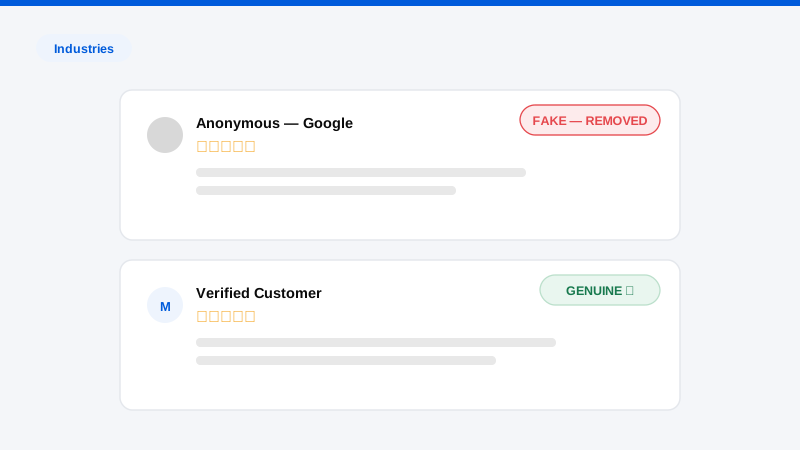
Competitor review warfare. Because comparison platforms mediate so much SaaS buying, review profiles have direct pipeline value, which makes corrupting a rival’s profile a temptingly cheap tactic. Fake negative reviews from accounts with no verifiable product usage, burst patterns timed to a rival’s funding announcement or renewal season, and suspiciously templated criticism appearing across platforms simultaneously are recurring patterns in the category. Review platforms prohibit all of it, but enforcement is complaint-driven: fraud that is never properly challenged simply stands.
“Alternative to X” interception content. Competitors and affiliate publishers build pages targeting “[your product] alternatives,” “[your product] vs,” and “[your product] pricing”, often ranking on your brand query itself. Some of this is legitimate comparison marketing; some is smear content: outdated screenshots, fabricated limitations, misrepresented pricing, and cherry-picked review quotes assembled to redirect your demand. It works precisely because it meets your highest-intent buyers at their moment of evaluation, wearing the costume of neutral advice.
Churn-review spirals. SaaS churn produces reviewers at scale, and the spiral is a distinct mechanism worth naming: a product stumble or price increase churns a cohort; the cohort leaves angry reviews; the reviews lower the profile score; the lower score raises acquisition friction and arms competitor sales decks; renewal conversations get harder, churning more customers, who leave more reviews. Left alone, one bad quarter can echo through the review layer for years, long after the underlying product issue is fixed. The reviews outlive their cause.
Community-thread permanence. Reddit, Hacker News, and niche communities host candid threads about every visible product, and search engines increasingly surface them directly on brand queries. One vivid horror story (an outage, a billing dispute, a support failure, real or embellished) can anchor a thread that ranks for years, accumulating pile-on replies and shaping every subsequent evaluation.
Founder exposure. SaaS companies are unusually founder-identified: investors diligence founders by name, enterprise procurement checks the leadership page, and communities discuss founders directly. A founder’s personal controversy, an old dispute, or fabricated accusations surface on name queries that function as company diligence. Founder and executive protection is company protection, not a personal vanity project.
What’s at stake
In SaaS, reputational damage is not a soft cost. It lands on specific, measured revenue mechanics.
Funnel mathematics. Review scores and comparison-grid placement feed directly into shortlist inclusion. Buyers filter by rating before vendors ever know the evaluation exists; a damaged profile removes the company from consideration sets invisibly and at scale. Damage at the top of the funnel is silent, systematic, and compounding, every marketing dollar spent driving traffic to a damaged surface underperforms, so the reputational problem masquerades as a CAC problem, which is often why it goes undiagnosed.
Sales-cycle drag and competitive weaponization. Every visible negative item becomes a slide in competitors’ objection-handling decks and a question in every later-stage deal. Reps lose hours to rebuttal; deals stretch; win rates against specific rivals sag wherever the hostile content is strongest. Ask any SaaS sales leader which reviews come up in deals. They know the specific items by heart, which is itself evidence of the cost.
Renewal and expansion pressure. Existing customers re-evaluate at renewal, and champions defending a vendor internally are only as strong as the vendor’s public profile. Hostile content arms procurement in renegotiations and weakens the internal case for expansion.
Diligence events. Fundraises, enterprise security reviews, and M&A processes all include reputational diligence on the company and its founders. Unresolved hostile content, especially anything suggesting instability or misconduct, becomes a diligence flag at exactly the moments when the company’s valuation is being set. Cleaning the record before a diligence event is worth strictly more than explaining it during one.
AI-assistant evaluation. Software buyers increasingly ask AI assistants to compare tools and summarize sentiment, and those systems synthesize review profiles, community threads, and comparison content into confident recommendations that happen before any vendor touchpoint. A SaaS company whose index skews hostile gets quietly excluded from AI-generated shortlists it never knew existed. Auditing what AI systems say about your product is now as fundamental as tracking your G2 grid placement.
See what prospects find before they call you.Free confidential Exposure Scan: live results on a 15-minute call, yours to keep either way.
Book Your Free ScanWhat professional protection looks like
Professional protection for a SaaS company is a standing defense function that runs alongside the growth motion: removal-first, evidence-driven, and continuous.
Full-stack exposure audit. The engagement begins by mapping the complete evaluation surface a buyer sees: every review-platform profile (including ones the company never claimed), the full brand-query SERP, “alternatives/vs/reviews” queries, community threads, app-marketplace ratings, founder-name results, autocomplete, and AI-assistant answers. The audit separates content into removable (fraudulent, policy-violating, defamatory), remediable (false comparison claims correctable through publisher or platform channels), and suppressible, because strategy differs entirely by category.
Removal and enforcement at the source. Fraudulent reviews are challenged through each platform’s integrity process with the evidence those processes actually credit: no verifiable usage, burst-pattern documentation, template similarities, conflict-of-interest indicators. Review platforms have real integrity teams and real procedures, but they act on properly built cases, not indignation. Defamatory content (fabricated claims in comparison pages, false accusations in threads, impersonation) is pursued through host-level and platform-level channels, with legal referral where facts warrant. Smear-grade “alternative to” content is addressed through the applicable levers: platform advertising and content policies, publisher correction demands for provably false claims, and de-indexing pathways where they apply. Churn-spiral reviews get triaged honestly: genuine criticism is not removable and shouldn’t be attempted, but spirals always carry a violating layer (non-customer pile-ons, competitor opportunism, terms-violating content) that can be stripped out, and stripping it measurably changes the profile’s trajectory.
Suppression and narrative authority. For the residue, suppression builds durable authority around the queries that decide deals (brand terms, founder names, “[product] reviews”) with earned press coverage supplying assets strong enough to hold rankings against contested queries and credible enough to reassure the diligent enterprise buyer who reads everything.
Standing monitoring and rapid response. Because competitor attacks and churn events arrive without notice, mature SaaS protection runs on continuous monitoring across review platforms, communities, and search, with founder-name coverage, backed by a Protection Plan that keeps removal capacity on standby. Timing is decisive: a fake-review burst challenged within days is a documentable anomaly platforms act on; the same reviews a quarter later have blended into profile history and hardened into every future buyer’s first impression.
Key takeaway: SaaS reputation defense is won at the item level, early. Fraudulent reviews and smear content are most removable in their first days (before they accumulate helpful-votes, backlinks, and index authority) which makes monitoring, not cleanup, the core capability.
Why specialists beat in-house reputation management for SaaS companies
SaaS teams self-serve everything, and reputation is where that instinct reliably misfires, for reasons specific to how enforcement actually works.
Platform integrity processes are an expertise domain. G2, Capterra, Trustpilot, and Google each apply different evidence standards, different definitions of review fraud, and different escalation paths, and their front-line queues auto-reject generic disputes. Specialists who run hundreds of challenges know which arguments each platform credits, how to document a coordinated burst so it reads as the anomaly it is, and when to escalate past the first no. Marketing teams doing this occasionally burn strong cases on badly framed first attempts, and platforms treat repeat challenges of rejected flags with increasing skepticism, so the first attempt is the one that matters.
Founders make it worse in public. The founder who argues in the Reddit thread, replies sharply to a review, or posts the subtweet hands the thread engagement, screenshots, and a second act. Community dynamics reward the pile-on; specialist third-party handling keeps the company out of the frame entirely.
Attention is the scarcest resource in the building. Every hour a growth team spends fighting a moderation queue is an hour off the roadmap and the pipeline, spent learning a discipline that a dedicated reputation partner already runs at volume. Build-versus-buy logic applies: this is a buy.
See what prospects find before they call you.Free confidential Exposure Scan: live results on a 15-minute call, yours to keep either way.
Book Your Free ScanWhy SaaS companies choose Content Removal
Content Removal LLC is a removal-first firm: our core practice is getting fraudulent, defamatory, and policy-violating content taken down, de-indexed, or corrected at the source, the defense function SaaS companies need and almost never have. SaaS teams engage us for reasons that map to their threat model.
We work the review-integrity processes of the platforms that decide SaaS deals, building evidence-grade challenges rather than indignant flags. We treat competitor attacks and churn spirals as events, with the response speed that determines whether they become permanent profile history. We protect founders and executives by name alongside the product, because buyers and investors diligence both. We integrate with how SaaS companies operate: clean handoffs with marketing, sales, and counsel; we are not a law firm and provide no legal advice, and where litigation is the right tool we work alongside your attorneys and execute the platform-layer work courts don’t reach, and we scope with candor: after the audit, you get an item-by-item read on what is strongly removable, what is a long shot, and what calls for suppression, because guaranteed outcomes don’t exist in this field, and a company that lives on honest metrics should demand the same from its vendors. Our case studies show how these engagements run.
Key takeaway: Choose a partner the way you’d choose any critical vendor: proven methodology (removal-first, evidence-driven), speed (standing capacity, not campaign timelines), and honesty about probabilities instead of promised outcomes.
Frequently asked questions
Can fake negative reviews on G2 or Trustpilot actually be removed?
Yes, when they genuinely violate platform policy and the case is built correctly. Reviews from accounts with no verifiable product usage, competitor-linked accounts, coordinated bursts, and terms-violating content are all removable categories on major platforms. The determining factor is evidence quality and framing, platforms act on documented policy violations, not on vendor frustration. No single item can be guaranteed, but fraudulent-review challenges are among the most consistently productive work in SaaS reputation defense.
What can be done about a competitor’s “alternative to us” page that misrepresents our product?
Several levers exist, chosen by the facts: correction demands for provably false claims, platform policy enforcement where the content violates advertising or content rules, de-indexing pathways where applicable, and, where the misrepresentation rises to defamation, legal referral through your counsel. Legitimate comparison content generally can’t be removed and is instead outranked and answered; smear-grade content with fabricated claims is genuinely actionable. The audit distinguishes the two before any effort is spent.
We’re heading into a fundraise. When should we clean up our search and review profile?
Before diligence starts: ideally a quarter or more ahead. Removal and de-indexing work takes weeks to months per item, suppression takes longer to consolidate, and content discovered by an investor mid-process costs more than the same content resolved quietly in advance. Pre-diligence cleanup of the company and founder-name surface is one of the highest-leverage timings for this work.
Our negative reviews are from real churned customers. Is there anything to do?
Genuine criticism can’t be removed and shouldn’t be attempted, but real-churn spirals almost always carry a removable layer (pile-on reviews from non-customers, competitor opportunism riding the moment, terms-violating content), and stripping that layer changes the profile’s trajectory. The remainder is addressed through recovery of the underlying issue, legitimate review generation, and suppression-by-authority. An honest audit tells you the split before you spend anything.
Right now, buyers you will never meet are reading your reviews, your Reddit threads, and an AI assistant’s summary of both, and deciding whether you make the shortlist. See exactly what they see: book a free, confidential Exposure Scan and walk through your product’s and founders’ live results on a 15-minute call. The findings are yours to keep either way.