
Reputation management for fintech companies is the practice of controlling what users, partners, and regulators find when they research a fintech brand, starting with the search that decides everything: “is [company] safe?” Every fintech lives or dies on that query. A legacy bank inherits a century of implied trust from branches, charters, and habit; a fintech asks strangers to connect their bank accounts and move their money through an app they discovered last week. The entire burden of trust is carried by what the internet says, and the internet is where the company’s adversaries publish.
The math of growth makes this exposure vicious. Fintechs spend heavily to acquire users, then route every acquired user past the same checkpoints, the “is it legit” search results, the Trustpilot score, the app-store rating. Damage at any checkpoint is not one lost customer; it is a permanent tax on every dollar of acquisition spend, compounding silently across every campaign. A fintech with a damaged trust surface can outspend its problem for a while, but it is buying users at a markup its competitors don’t pay.
This guide lays out how the threat landscape actually operates against fintech companies (review pile-ons, fraud-adjacent smears, app-store brigading, viral complaint threads) what is at stake across acquisition, partnerships, and fundraising, and what professional, removal-first reputation protection looks like at fintech scale. It is written for founders, CMOs, trust-and-safety leads, and general counsel who already sense that their conversion problem might be a search-results problem.
Why fintech companies are targeted
Fintechs sit at the intersection of money, novelty, and scale, a combination that generates hostile content through several distinct channels at once.
Compliance obligations manufacture furious users. Every fintech must sometimes freeze accounts, hold funds, request documents, and close relationships, often without being able to explain why. The affected user experiences an unexplained lockout of their money, and a predictable fraction goes straight to Trustpilot, Reddit, the app store, and complaint boards with the word every fintech dreads: scam. The company, constrained by regulation and fraud-prevention logic, cannot tell its side. The result is a steady sediment of one-star “they stole my money” content generated by the very controls regulators require.
Review platforms concentrate and rank the anger. Trustpilot pages, app-store listings, and complaint aggregators rank at or near the top for “[company] reviews” and feed the “is it safe” answer directly. These surfaces attract disproportionately negative selection, satisfied users rarely review their payment app, and they are also soft targets for manipulation: competitor-planted reviews, extortion-driven review threats, and coordinated brigades after a policy change. A pile-on week can reset a rating that took years to build.
Fraud-adjacent smears exploit category confusion. When scammers abuse a fintech’s rails, or merely impersonate its brand in phishing campaigns, the resulting victim complaints and warning posts attach to the fintech’s name. The company becomes search-associated with fraud it was itself a target of. Impersonation sites, fake support numbers, and cloned apps generate real victims whose real anger lands on the real brand.
Viral threads outrank the company’s entire content operation. A single Reddit or X thread alleging frozen funds or shady practices can accumulate enough engagement to occupy first-page positions for the brand name indefinitely. Fintech user bases are digitally native and forum-fluent; grievances organize fast, and aggregator blogs republish the drama for the search traffic.
Founders are searched as proxies for the company. Fintech diligence (by users, partners, and journalists alike) extends to founders’ names, histories, and past ventures. A founder’s old lawsuit, misframed exit, or data-broker profile becomes ammunition in the company’s “is it legit” fight. Protecting founders as individuals is a core part of our executive practice and belongs inside any serious fintech program.
What’s at stake
The stakes for a fintech are measurable in the mechanics of its own funnel and its own cap table.
The trust checkpoint taxes all acquisition. Every prospective user who searches the brand before connecting a bank account passes through the same results page. Hostile content there doesn’t just lose the users who see it. It silently raises blended CAC across every channel, because paid, organic, and referral traffic all pass the same checkpoint. Growth teams optimize landing pages relentlessly while the highest-leverage page in the funnel, the search results, goes unmanaged.
Bank partners and processors run reputational diligence. Fintechs depend on sponsor banks, card networks, payment processors, and BaaS providers, all of whom screen partners for reputational and compliance risk, initially and continuously. A brand search-associated with “scam” complaints and fraud reports invites harder questions, slower approvals, and in the worst case, de-risking by a partner the business cannot operate without. The same surface shapes how regulators perceive a complaint pattern.
Investors diligence the search page before the data room. Venture and growth investors google the company and its founders before the first partner meeting, and their diligence firms run adverse-media screens that sweep in complaint boards and pile-on threads. Hostile results rarely kill a deal outright; they shift its posture: more questions, more conditions, more discount.
App-store ratings gate distribution itself. For a consumer fintech, the app-store listing is both storefront and trust signal, and rating collapses suppress conversion and, at the margin, discoverability. Review brigades and fake one-star waves are attacks on distribution, not just image.
AI answers now deliver the verdict directly. Ask an AI assistant “is [fintech] safe?” and it synthesizes an answer from the visible record (the Trustpilot page, the Reddit thread, the complaint aggregator) and hands the user a confident verdict with no appeal process. For a fintech, that answer is a conversion event or a lost user, at scale, invisibly. Auditing and improving what AI systems say is the work of our AI reputation management practice.
Key takeaway: A fintech’s trust surface (search results, review scores, app-store ratings, AI answers) functions as an invisible tax authority over its growth. Damage there is not a PR problem; it is a permanent markup on customer acquisition and a standing question in every partner and investor review.
What does "is [your company] legit" return right now?Find out with a free confidential Exposure Scan, live results on a 15-minute call, yours to keep either way.
Book Your Free ScanWhat professional reputation management for fintech companies looks like
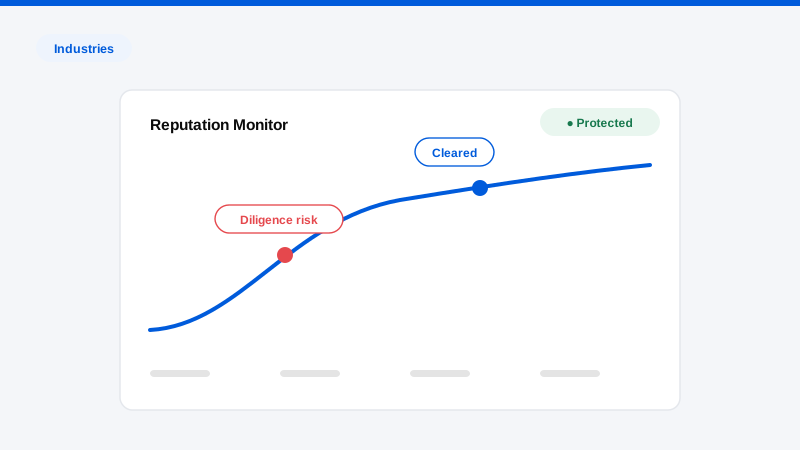
Professional reputation management for fintech companies runs a removal-first sequence (remove at the source, de-index from search, suppress with authoritative press, monitor continuously) executed across every surface that feeds the trust verdict: search results, review platforms, app stores, forums, and AI answers.
Remove at the source. A substantial share of the content damaging fintechs is removable because it violates the hosting platform’s own rules: fake and competitor-planted reviews, reviews from non-customers, brigade content, defamatory posts, impersonation sites and cloned apps, and phishing infrastructure trading on the brand. Each platform (Trustpilot, the app stores, forums, hosting providers) has distinct policies, evidence standards, and escalation paths, and outcomes turn on how precisely the case is built for each one. This is the daily work of our review removal and defamation removal practices. The honest boundary, stated up front: platforms decide removals, so no credible firm guarantees a specific item comes down. Specialists change the hit rate, the speed, and the share of the target set that falls.
De-index from search. Content that survives at the source (a complaint-board page that won’t act, a smear site hosted offshore) can often still be removed from the search results where users actually encounter it, through search engines’ own removal policies and related mechanisms. Our search results removal practice works this layer; for fintechs, taking a smear page out of the “is it safe” results neutralizes most of its commercial damage even when the page technically persists.
Suppress with real press. What remains after removal and de-indexing (legitimate coverage of a genuine incident, aged complaint volume) gets displaced by authority: earned and placed coverage in credible publications via our press placements, structured founder and company profiles, and owned assets built to occupy the queries that matter, including the “is it safe / is it legit” variants. Done in the correct order, suppression is the finishing layer over cleared ground rather than a blanket thrown over live threats.
Monitor continuously. Fintech attack surfaces move fast: reviews arrive daily, threads spike overnight, impersonation campaigns launch in waves, and AI answers shift with their sources. Continuous reputation monitoring across search, review platforms, app stores, forums, and AI systems, for the brand and its founders, catches each new threat at first appearance, when a pile-on is still three reviews and a thread is still one post. Our Protection Plans keep monitoring and standing removal capacity in place year-round, which is how fast-moving companies turn reputation defense from recurring crisis into managed background process.
Key takeaway: Sequence beats spend. Removing a fake-review cluster beats out-marketing it; de-indexing a smear site beats out-ranking it; and monitoring catches the next attack while it is still small enough to remove. Fintechs that invert the order pay for all four and get the benefit of one.
Why fintech companies choose Content Removal for reputation management
Fintech operators evaluate vendors on capability density, and three things consistently drive them to us.
We are removal specialists with brand-scale experience. Content Removal LLC does one thing, removing and neutralizing damaging online content, and has executed it across thousands of engagements, including for global brands such as Danone and Sweat and public figures such as Alex Hormozi; see our case studies. Platform fluency is cumulative: knowing exactly which Trustpilot policy a planted review violates, or how to move a host on an impersonation site, is learned at volume, and volume is what a specialist firm compounds.
We cover the company and the founders as one program. Fintech trust attacks do not respect the line between corporate and personal, so neither do our engagements: brand surfaces, review platforms, app stores, founder search results, and founder data-broker exposure (including data broker removal, which matters doubly for founders facing the harassment that fintech controversies attract) are handled in a single coordinated program.
We are straight about limits, which is why partners take the work seriously. We are not a law firm and do not give legal advice; where a matter needs litigation or regulator engagement, we say so and work alongside your counsel. We do not promise outcomes that platforms, publishers, and search engines control, and we scope every engagement with an item-by-item assessment before we take it. Companies whose own product is trust tend to recognize why we sell ours the same way.
Your CAC is paying for results pages you've never audited.Get the free confidential Exposure Scan: every damaging result on your brand and founders, live on a 15-minute call, yours to keep either way.
Book Your Free ScanFrequently asked questions
Can a Trustpilot pile-on or app-store review brigade actually be unwound?
Substantially, in many cases. Brigade and pile-on events typically contain a high proportion of policy-violating content (reviews from non-customers, duplicate and coordinated submissions, fabricated experiences) and platforms have processes for exactly this, if the violations are documented precisely and pursued through the right channels at the right level. The organic-but-angry residue is then addressed through the platforms’ own engagement mechanisms and displaced over time. No one can promise a specific score; what specialists change is how much of the attack survives.
Scammers are impersonating our brand and the victim complaints are landing on us. What can be done?
Two workstreams in parallel. The impersonation infrastructure itself (cloned sites, fake apps, fraudulent support listings and social accounts) is aggressively removable through hosts, registrars, app stores, and platforms, and taking it down cuts off the supply of new victims. The residue, complaints and warnings naming your brand, is then handled item by item: corrected, removed where policy-violating, de-indexed where eligible, and displaced in the search results that feed the “is it safe” verdict.
We have in-house trust-and-safety and support teams. Why add a specialist firm?
Your teams face inward, protecting users and the platform. This work faces outward, against content published about you across dozens of third-party surfaces, and it is a distinct volume craft: platform-specific removal standards, escalation relationships, de-indexing mechanics, and AI-answer remediation that no in-house team encounters often enough to master. Our fintech clients keep strategy and communications in-house and use us as the execution arm against the content itself, typically under a Protection Plan so capacity exists before the spike.
When should a fintech start, at the first attack, or earlier?
Before the first attack, ideally at the growth stage where the brand search volume starts mattering. An engagement that begins clean is mostly hardening and monitoring: cheap, quiet, fast. An engagement that begins mid-pile-on still works, but it works uphill: content ages into rankings, AI systems absorb it, and partners see it in the meantime. The companies that fare best treat the trust surface like uptime: continuously monitored, instantly responded to, never left to chance.
Somewhere right now, a prospective user is typing your brand name plus the word “legit”, and a partner bank, a journalist, or an investor will run the same search this quarter. Know what they’ll find. Book a free, confidential Exposure Scan: a complete map of the damaging content on your brand and founders, reviewed live on a 15-minute call, yours to keep whether or not we ever work together.