
Online reputation management for small business is an operational risk function, not a branding exercise. It runs on four disciplines: claim and align every listing that shapes buying decisions, build owned content that holds branded search, answer reviews for the next buyer rather than the reviewer, and escalate high-severity attacks to platform enforcement, de-indexing, or source removal.
Key facts
- Claim Google Business Profile, Yelp, Facebook, Apple Maps, Bing Places, and the review sites specific to your vertical
- Legitimate negative review: thank, acknowledge, offer a direct contact path, take it offline, review internally
- High-severity attack: false statements of fact, impersonation, stolen media, doxxing, or coordinated posting
- Cited research: one negative first-page article can cost 22% of customers, three or more reviews up to 59%
Where ContentRemoval.com comes in. When ordinary platform reports fail on a fake review cluster, a defamatory post, an impersonation account, or leaked material, ContentRemoval.com assesses whether de-indexing, source removal, or coordinated protection is the realistic path. The owner or practice manager usually makes contact directly, sometimes through the firm’s outside counsel. A free 15-minute Exposure Scan maps what is removable, and the report is yours to keep. Get a Free, Confidential Exposure Scan or read how our reputation management work is done.
You open your laptop before the day starts. A one-star review sits at the top of your Google profile. Or worse, a blog post with false allegations now ranks for your company name. Your staff hasn’t seen it yet, but your prospects have. The phones feel quieter. The inbox feels slower. You’re not overreacting. You’re seeing the first stage of a revenue problem.
Most advice on online reputation management for small business treats this like a branding exercise. It isn’t. It’s an operational risk function with legal, commercial, and technical dimensions. If you run a small business, your reputation lives in search results, review platforms, social feeds, copied forum posts, and cached pages you don’t control. That means your response has to be structured, fast, and proportionate to the threat.
A bad comment from a real customer is one problem. A false review campaign, defamatory article, impersonation profile, or leaked internal material is a different class of problem entirely. Owners get hurt when they treat both situations the same way.
The Moment Your Reputation Is Attacked
The attack usually starts subtly. A customer sends a screenshot. A spouse googles the company name. A sales lead asks an uncomfortable question on a call. By the time you discover it, the content has already shaped someone else’s decision.

Many owners lose time at this stage. They panic, reply emotionally, ask staff to “clean it up,” or assume the problem will slide down on its own. That delay is expensive. The financial stakes are plain. A single negative article on the first page of Google can cost a business 22% of potential customers, and three or more visible negative reviews can push potential customer loss to 59%, according to research on small business online reputation management and performance.
What to do in the first hour
The first move is evidence preservation, not argument.
- Capture everything: Save screenshots, URLs, timestamps, usernames, business listing IDs, and search results.
- Separate fact from emotion: Ask whether this is unhappy but legitimate feedback, or false and actionable content.
- Lock internal communications down: One person should coordinate the response. Not your receptionist. Not three managers posting different replies.
- Stop improvising publicly: A rushed public response can create admissions, contradictions, and platform problems you’ll regret later.
Practical rule: Don’t answer a serious attack until you’ve classified it. Response comes after assessment.
Panic is normal. Disorder is optional.
A small business owner usually feels attacked on two fronts at once. There’s the visible public hit, and then there’s the private pressure: payroll, active deals, staff morale, and the fear that one search result now defines years of work.
That pressure is real. But this is still manageable if you treat it as a system problem. The right question isn’t “How do I make this disappear right now?” The right question is “What kind of threat is this, what platform controls it, and what remedy applies?”
That distinction determines everything that follows.
Establishing Your Digital Command Center
You can’t defend assets you don’t control. The first discipline in online reputation management for small business is ownership of your digital footprint. If your Google Business Profile is unclaimed, your Yelp page is half-complete, and your industry listings are unmanaged, you’ve handed strangers the microphone.

Claiming profiles isn’t clerical work. It’s control. Businesses that claim their free listings on at least four review sites can see a revenue boost of up to 58%, based on compiled reputation management statistics.
Claim the platforms that shape buying decisions
Start with the platforms buyers rely on. For most local and service businesses, that means Google Business Profile, Yelp, Facebook, Apple Maps, Bing Places, and the industry-specific sites that matter in your vertical. A law firm should care about legal directories. A medical practice should care about healthcare review platforms. A contractor should care about local service marketplaces.
What matters is consistency. Your business name, address, phone number, hours, service descriptions, categories, and imagery should match. Sloppy listings create distrust before anyone reads a single review.
Build one monitoring workflow
Most owners monitor reputation badly because they monitor it casually. They search the company name once in a while, then get blindsided anyway. You need a repeatable system.
A workable command center includes:
- Search monitoring: Google Alerts for your business name, owner name, product names, and common misspellings.
- Review monitoring: Native alerts from Google Business Profile, Yelp, Facebook, and key niche platforms.
- Social listening: Hootsuite or Brandwatch if your business gets discussed beyond review sites.
- Internal routing: One owner or manager receives alerts, tags urgency, and assigns response responsibility.
If your current process depends on someone “remembering to check,” you don’t have a process. You have hope.
For firms that want a dedicated layer of oversight, reputation monitoring services can centralize detection and escalation so issues are caught before they harden into visible search problems.
Your dashboard should answer three questions
Every monitoring setup should make these questions easy to answer:
- What was published?
- Where did it appear?
- Does it require customer service, platform reporting, or legal escalation?
That’s the line between surveillance and management.
Here’s a useful explainer on the operational side of monitoring and profile control before you scale the process across your team:
> If you don’t control the listing, you don’t control the first impression.Building a Digital Moat Through Content and SEO
A business with no owned search presence is fragile. When buyers search your company name, they shouldn’t find only third-party pages. They should find your website, your location pages, your leadership profiles, your media mentions, and content that explains who you are in your own words.
That’s the actual purpose of SEO in reputation work. Not vanity traffic. Protection.
Research on small business performance shows that online reputation management explains 35% of the variance in business performance. That finding matters because it shifts reputation out of the “nice to have” category and into core operations. The point isn’t merely to look polished. The point is to own enough of the search environment that one hostile page doesn’t define you.
Owned content is defensive infrastructure
Most small businesses publish too little, and what they do publish is too thin. A homepage and a contact form won’t protect your branded search results. You need assets with enough substance and authority to rank and hold position.
A practical moat usually includes:
- Service pages with depth: Not generic blurbs. Clear explanations, proof, FAQs, and local relevance.
- Leadership profiles: Founders and senior staff should have credible bios that can rank for name searches.
- Case studies and client stories: Strong social proof without hype.
- Press and speaking pages: A place to consolidate earned media, interviews, and appearances.
- A living blog or insights section: Useful commentary tied to your expertise and location.
Why suppression starts long before a crisis
When negative material appears, suppression works better if the positive infrastructure already exists. Search engines are far more likely to rank mature, relevant, technically sound assets than pages you throw up in a panic.
That means your content strategy should answer branded searches directly. Who owns the company? What does it do? Where is it located? What makes it credible? What does it specialize in? If your site doesn’t answer those questions cleanly, third parties will answer them for you.
Partner-level advice: Build the assets before you need them. Search resilience is earned early, not purchased under pressure.
Use external credibility without outsourcing your identity
A moat gets stronger when your brand appears on reputable third-party properties you don’t own but can influence. That can include guest commentary, local business features, podcast appearances, founder interviews, and niche trade publications. The key is relevance. Random backlinks won’t fix a reputation issue. Credible mentions tied to your expertise can.
If you’re building this layer alongside broader growth work, resources on scaling brands via Digital Marketing Inspector LLC can help frame how SEO, paid search, and social visibility reinforce each other. The reputation point is straightforward: the stronger your legitimate digital footprint, the harder it is for junk content to dominate branded results.
What a digital moat does well
| Asset type | What it protects | Why it matters |
|---|---|---|
| Company website pages | Brand-name searches | Gives Google a primary source to rank |
| Founder and executive bios | Personal name searches | Reduces exposure to third-party narratives |
| Case studies and insights | Trust and authority | Shows substance beyond reviews |
| Earned media mentions | Credibility | Adds independent validation |
| Directory and listing consistency | Local intent searches | Reinforces legitimacy across platforms |
A good moat won’t remove a defamatory page by itself. It will, however, reduce the chance that a single hostile result owns the conversation.
Mastering Review and Community Engagement
Review response is where many businesses reveal their judgment. Not their branding. Their judgment. Buyers read the original review, then they read your reply to decide whether the business is competent, defensive, evasive, or trustworthy.
The gap between customer expectation and business behavior is wide. 53% of customers expect a response to online reviews within one week, yet 63% of companies never reply at all, and businesses that don’t respond earn 9% less revenue on average, according to consumer research on reputation response behavior.
A review response is for the next buyer
Owners often answer the reviewer. That’s the wrong audience. The actual audience is the prospect reading a month later.
A strong response does four things:
- Acknowledges the issue without fighting facts in public
- Shows accountability where appropriate
- Moves resolution into a private channel
- Signals that management is present and competent
That’s why defensive language is so damaging. Even if the reviewer is unfair, a combative reply makes you look unstable. The prospect won’t investigate who’s “right.” They’ll move on.
Different review types need different treatment
A five-star review deserves more than “Thanks.” Mention the service, location, or detail the customer highlighted. That makes the response believable and useful to future readers.
A neutral review is often the most underused opportunity. If someone leaves lukewarm but fair feedback, answer with specificity and show what you improved. That tells future buyers you learn quickly.
Negative reviews require the most discipline. Keep the public reply short. Don’t relitigate. Don’t expose customer data. Don’t imply the reviewer is lying unless you’re prepared to escalate through the platform or counsel.
A public review response isn’t a courtroom. It’s a credibility test.
When a review looks fake
Not every bad review is fake, and many owners hurt themselves by labeling genuine criticism as fraud. But some patterns are obvious: no record of service, copied language across listings, clusters of similar posts, or reviews tied to a competitor campaign.
When that happens, document first and report second. If you need a practical reference on platform reporting mechanics, this business owner’s guide to managing Google reviews is a useful starting point. For a more detailed walkthrough on identifying what can be challenged and how removal requests fit into a broader strategy, see this professional guide to removing a bad business review.
A simple response framework that works
Use this sequence for most legitimate negative reviews:
- Thank them for raising it
- Acknowledge the experience
- Offer a direct contact path
- Take the resolution offline
- Review the complaint internally
That final step matters. Review management isn’t just public relations. If the same complaint keeps appearing, you don’t have a reputation problem. You have an operations problem showing up in public.
The Playbook for High-Severity Content Removal
A harsh review from a disappointed customer is usually manageable in-house. A false accusation of criminal conduct, a fake article, leaked private material, impersonation, or coordinated harassment is not. In these circumstances, common small business advice often fails. It tells you to “respond professionally” when the underlying issue is that the content may be defamatory, unlawful, manipulated, or technically removable.
That gap is not academic. Existing guidance rarely addresses legal removal paths for persistent defamatory articles or fake reviews. Meanwhile, 87% of small businesses reported unremovable negative search results affecting revenue, and only 12% knew about de-indexing or source removal options, according to analysis summarizing this small business ORM gap.
Not every problem belongs in customer service
Business owners waste time when they send legal problems to the marketing team. The question isn’t whether content is unpleasant. The question is whether it triggers a platform rule, a legal claim, or a search engine remedy.
Use this distinction:
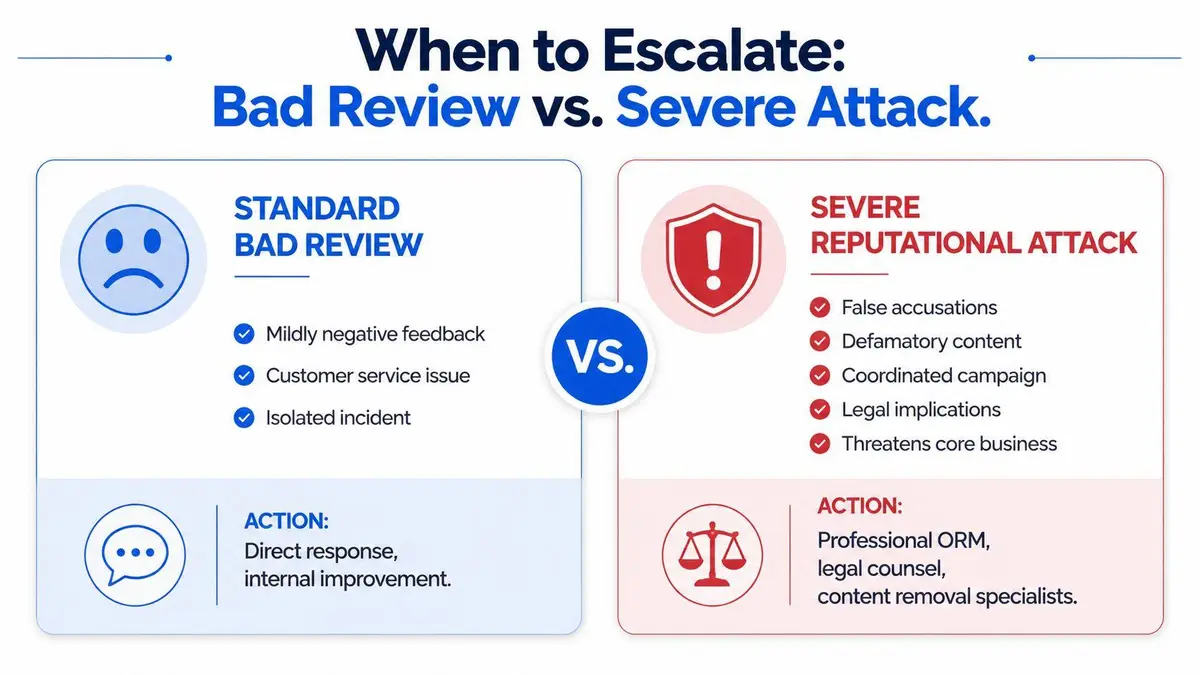
- A standard bad review is negative opinion tied to an actual experience.
- A high-severity attack includes false statements of fact, fabricated allegations, impersonation, stolen media, doxxing, copyright infringement, or coordinated posting designed to damage the business rather than describe a transaction.
Decision Matrix In-House Response vs. Professional Removal
| Threat Type | In-House Action (DIY) | When to Escalate for Professional Removal |
|---|---|---|
| Legitimate negative customer review | Respond calmly, offer resolution, fix the service issue | Escalate if the platform rejects a valid policy-based report and the review contains false factual claims or private information |
| Suspected fake review | Preserve screenshots, compare against customer records, report through platform tools | Escalate if there is a pattern, competitor motive, or repeated reposting across platforms |
| Defamatory article or post | Document the statements, collect evidence showing falsity, avoid public argument | Escalate immediately if the content ranks in search, accuses criminal or unethical conduct, or harms active deals |
| Impersonation account or fake profile | Report through platform impersonation channels, secure your real accounts | Escalate if the profile is soliciting customers, collecting payments, or spreading harmful statements |
| Leaked images, private documents, copied media | Preserve the URL and publication details, request platform removal where available | Escalate immediately for copyright notices, privacy complaints, de-indexing, and source removal strategy |
| Doxxing or exposed personal data | Limit staff engagement, capture evidence, report safety and privacy violations | Escalate immediately where legal and platform remedies must run in parallel |
The remedies most guides ignore
There are several distinct routes, and each serves a different purpose.
Platform enforcement
Review sites, social platforms, and marketplaces all have policy channels. These work best for impersonation, spam, manipulated engagement, policy-violating reviews, and certain privacy issues. They are usually the first move, but they are not the last move.
Search de-indexing
Sometimes the source page stays online, but search visibility can still be challenged through search engine processes if the facts and jurisdiction support that path. That’s often relevant when the page causes the main damage through discoverability rather than direct readership.
Source removal
This targets the website, host, publisher, or platform holding the material. It may involve copyright notices, privacy claims, impersonation complaints, or legal correspondence based on the nature of the content.
Serious reputation attacks usually require two tracks at once: reduce visibility in search and pursue removal at the source.
Specialist intervention
This is the line most owners should respect. If the issue includes false accusations, repeat reposting, synthetic review patterns, leaked media, or cross-platform abuse, a specialist can coordinate platform procedure, legal framing, technical evidence, and monitoring. One available option for that type of work is content removal support for harmful online material, which covers de-indexing and source-removal scenarios where ordinary review replies are irrelevant.
What owners should stop doing
Do not threaten lawsuits in public comments. Do not ask employees to post fake positive reviews to “balance it out.” Do not submit sloppy reports with no evidence, and do not assume a lawyer who handles contracts or employment disputes automatically knows platform takedown mechanics or search removal procedures.
The right escalation framework is simple. Handle honest criticism professionally. Challenge false and harmful content aggressively. When the issue crosses into defamation, impersonation, privacy invasion, or copied content, stop treating it like customer service and start treating it like risk containment.
Preventing Advanced Threats and Future Crises
Most small business reputation advice is far too narrow. It focuses on Google reviews, Facebook comments, and maybe Yelp. That leaves a dangerous blind spot. Some of the worst reputation crises don’t begin on review platforms at all. They begin with breached credentials, leaked documents, pirated content, impersonation, or material circulating in obscure forums before it reaches the surface web.

That risk is no longer theoretical. Coverage of small business reputation gaps notes a 25% rise in small business data breaches in 2025, with 40% of leaked information resurfacing on surface web forums, according to discussion of dark web leaks and reputation exposure. Once leaked material reaches indexed pages, your reputation problem becomes a search problem.
Mature reputation management includes security awareness
If customer lists, invoices, employee information, internal emails, or private media are exposed, no review-response template will save you. You need detection, preservation of evidence, suppression planning, and removal work. That may involve hosts, search engines, platforms, and sometimes legal counsel operating at the same time.
A mature system includes:
- Credential hygiene and account control: Secure admin access to listings, domains, and social accounts.
- Leak awareness: Watch for stolen or reposted brand assets, documents, and media.
- Impersonation checks: Search for fake profiles and cloned sites routinely.
- Crisis ownership: Name one decision-maker before the crisis starts, not after.
The businesses that recover fastest aren’t guessing
They already know who handles review complaints, who handles false content, who preserves evidence, and who can escalate to technical or legal removal when the issue exceeds normal customer service.
That’s the actual endpoint of online reputation management for small business. Monitor continuously. Build owned visibility. Engage reviews with discipline. Escalate serious attacks without hesitation. The companies that survive public hits aren’t luckier than everyone else. They’re better prepared.
If your business is dealing with fake reviews, defamatory articles, impersonation, leaked content, or harmful search results that won’t resolve through ordinary platform reports, ContentRemoval.com can assess the issue confidentially and map the right path, whether that means de-indexing, source removal, or coordinated reputation protection. DIY works for routine feedback. Serious attacks need a tighter process.
Frequently asked questions
How should a small business respond to a negative Google review?
Write for the prospect reading a month later, not the reviewer. Thank them for raising it, acknowledge the experience without fighting facts in public, offer a direct contact path, take the resolution offline, and review the complaint internally. Keep it short and never imply the reviewer is lying unless you are prepared to escalate.
What can I do about a fake review that Google will not remove?
Preserve screenshots, compare the review against customer records, and report through platform tools first. If there is a pattern, a competitor motive, copied language across listings, or repeated reposting, escalate to a specialist who can build the evidence file, frame the policy or legal basis, and pursue removal beyond the standard report.
When does a small business need professional content removal instead of handling it in-house?
When the content crosses from negative opinion into false statements of fact, fabricated allegations, impersonation that solicits customers, stolen media, doxxing, or coordinated posting. Those need platform enforcement, search de-indexing, or source removal running together, which a review reply template cannot deliver.