
A review about a product works in two directions. On offense, a persuasive review establishes reviewer authority, describes observed performance under real conditions and admits honest tradeoffs, which converts better than glossy praise. On defense, a false, manipulative or policy-violating review is a hostile asset that needs triage, evidence preservation and a policy-mapped removal request.
Key facts
- Structure legitimate reviews as context first, observed performance second, decision relevance third.
- Cited research places 4.2 to 4.5 stars as the trust and conversion sweet spot for product ratings.
- Triage negative reviews into low, moderate and high threat; high threat covers impersonation, fabricated purchases and doxxing.
- Cited timelines: defamation cases typically 4 to 12 weeks, DMCA takedowns often 1 to 2 weeks.
Where ContentRemoval.com comes in. ContentRemoval.com handles the defensive half of product review management: fabricated purchase claims, impersonation, coordinated attacks and reviews exposing personal information are documented, mapped to the platform’s policy and escalated through the correct abuse, legal or IP channel rather than generic support. Brand managers, e-commerce directors and in-house counsel usually make contact after a first removal request has been denied. A free 15-minute Exposure Scan maps what is removable, and the report is yours to keep. Get a Free, Confidential Exposure Scan or read how our review removal work is done.
A product launch is hours away. Your team is watching inventory, media placements, retailer commitments, and customer support queues. Then a review appears. It’s not a mild complaint. It accuses your product of defects, dishonesty, or unsafe performance. Sales staff start forwarding screenshots. Investors ask questions. Internal Slack channels turn frantic.
That’s the context for a review about a product, one that carries significant weight. It isn’t a lifestyle blog exercise. It’s a control issue. A single review can influence revenue, trigger platform scrutiny, distort public perception, and expose operational weaknesses you should have fixed earlier.
For executives, founders, and public-facing operators, review management belongs in the same category as legal risk, crisis response, and brand protection. Positive reviews shape conversion. False or malicious reviews create attack surfaces. Both require process, not improvisation.
Introduction The Review as a Business Asset and Liability
The commercial weight of reviews is no longer debatable. 93% of consumers read online reviews before making a purchase decision, 97% say customer reviews directly factor into buying decisions, and 92% hesitate to purchase when no reviews are present, according to SQ Magazine’s review statistics roundup. That same source states that the presence of reviews produces an average 18% uplift in sales.
Executives often treat reviews as downstream marketing debris. That’s a mistake. They operate much closer to due diligence than advertising. Buyers use them to test claims, spot risk, and decide whether your product deserves trust.
A review about a product can therefore function in two directions. It can work as offense, where a credible review validates performance and frames your product in a way the market understands. Or it can work as defense, where a false, manipulative, or policy-violating review becomes a hostile asset that needs containment, escalation, or removal.
Reviews belong on your risk register. If they can alter buyer behavior, they can alter enterprise outcomes.
The leaders who handle this well don’t wait for a crisis. They build a review architecture. They know which products need review velocity first, which platforms matter most, who owns response authority, and when a hostile post crosses from annoyance into legal exposure.
If your current system is “monitor mentions and reply when someone has time,” you don’t have a system. You have drift. Stronger governance starts with the same discipline used in broader online brand protection services, where visibility, escalation, evidence, and removal pathways are mapped before the next incident lands.
Constructing an Authoritative and Persuasive Review
Most brands approach review generation with the wrong objective. They want praise. You want credible influence.
A persuasive review about a product doesn’t read like brand copy. It reads like a competent evaluation from someone whose standards matter. That means the review must establish authority, show balanced evidence, and address the concerns serious buyers already have.

Start with reviewer authority
An anonymous five-star gush doesn’t move a cautious buyer very far. A review from an early adopter, expert user, procurement lead, engineer, or category specialist carries more weight because the reader can infer judgment.
Use a simple structure when you request or commission legitimate product feedback:
- Context first. Who used the product, in what setting, and for what purpose.
- Observed performance. What worked, what didn’t, and under which conditions.
- Decision relevance. Why that experience should matter to the next buyer.
That sequence matters because buyers don’t trust conclusions without operating context. “Great headphones” is weak. “Used Aurora headphones during long editing sessions, found the clamping force manageable and voice isolation reliable on repeated calls” is useful.
Balanced reviews convert better than glossy ones
The strongest reviews include friction. Not fatal flaws. Real tradeoffs.
A review that acknowledges a limitation looks less manipulated and more dependable. If your product excels in battery life but has a learning curve in setup, let the review say that. Precision increases credibility. Credibility increases impact.
Use language that sounds observed, not manufactured:
- Specific over inflated. “The fabric held up after repeated travel use” beats “best product ever.”
- Comparative over vague. “Quieter than the previous model” beats “excellent.”
- Evidence over adjectives. Refer to usage conditions, setup, materials, packaging, support, and repeatability.
Practical rule: If a review could be pasted onto any competing product with only the brand name changed, it’s too generic to matter.
Mine competitor frustration, not your own compliments
Here’s where the typical approach falls short. It involves looking at one’s own positive reviews to extract ad language and stopping there. That misses the market’s most valuable intelligence.
Existing content on product reviews overemphasizes analyzing a brand’s own positive reviews for ad angles, neglecting the critical gap of mining competitor 1 to 3 star reviews where frustrated buyers reveal unmet needs. Data shows neglecting this misses 60% of underserved market insights, as noted in Matthew Gattozzi’s discussion of review mining blind spots.
That means your best review blueprint often starts with a rival’s unhappy customers.
What to extract from competitor reviews
| Signal | What it reveals | How to use it |
|---|---|---|
| Repeated complaints | A stable weakness in the category | Address it directly in product positioning |
| “I wish this had…” language | Missing features or unmet expectations | Prioritize review prompts around that solved pain |
| Service complaints | Fulfillment or support friction | Highlight post-purchase reliability if you outperform |
| Confusion about setup or use | Documentation failures | Make clarity part of the review narrative |
If three competing blender reviews complain about lid leakage, your strongest legitimate reviewer should speak clearly about spill control, seal quality, and cleaning experience. Not because you scripted it, but because that’s what the market is already trying to resolve.
Mastering Review Platform Visibility and Algorithms
A strong review that nobody sees has limited value. Platform visibility decides whether a review influences the buyer or disappears under newer noise.
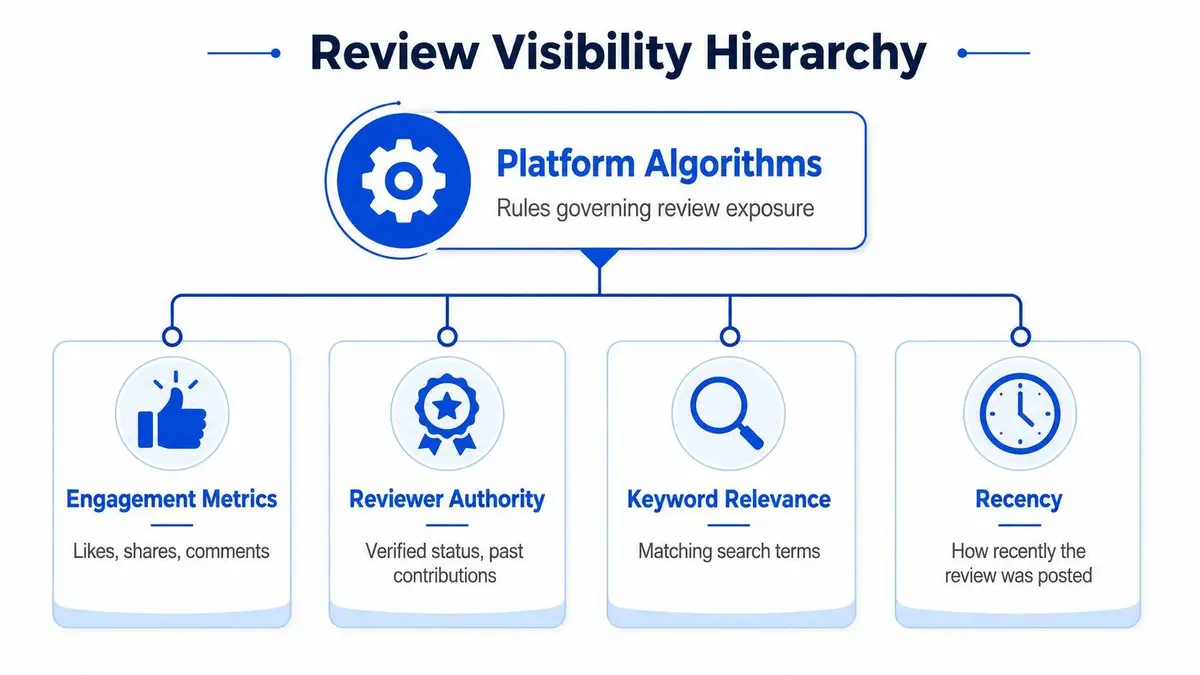
Amazon, Google, and similar platforms don’t treat every review equally. They infer quality from reviewer history, engagement behavior, relevance, and whether the contribution appears useful to other users. If you ignore those mechanics, you surrender visibility to randomness.
What platforms appear to reward
Research on reviewer detection and rating systems shows that weighted methodologies reduce error by filtering out low-quality reviewers and emphasizing those with strong helpfulness patterns, cutting mean squared error by 12.15% to 16.11%. The same research identifies 4.2 to 4.5 stars as the trust and conversion sweet spot in product rating environments, according to the reviewer weighting study in PMC.
The strategic implication is clear. You don’t need a suspiciously perfect profile. You need a believable rating profile supported by substantive reviews from credible contributors.
For teams that manage Amazon presentation alongside review flow, Next Point Digital’s optimization guide is useful because it connects listing quality with buyer interpretation. Reviews don’t operate in isolation. They’re read against images, bullets, titles, and the product page’s overall coherence.
Visibility depends on more than star count
Review ranking usually reflects a mix of signals. Not all are disclosed, but several patterns are obvious in practice.
- Reviewer credibility matters. Verified or established contributors tend to carry more weight.
- Helpfulness reactions act like secondary validation. If users endorse a review, the platform has reason to surface it.
- Relevance language matters. Reviews that describe actual use cases often align better with buyer search intent.
- Freshness influences prominence. A dormant review profile leaves old narratives uncontested.
A good visual summary helps when you’re training teams or vendors on how these inputs interact.
What to do operationally
Don’t try to game the system with thin, repetitive feedback. That approach usually collapses because weak reviews don’t attract engagement and often trigger platform distrust.
Instead, build for durable visibility:
- Seed legitimate expert use with people who can write concrete evaluations.
- Request detail, not praise. Ask reviewers to describe setup, use environment, and comparison points.
- Maintain cadence so your profile doesn’t look abandoned.
- Watch average rating discipline. Extreme volatility creates suspicion and buyer hesitation.
Buyers don’t read reviews as isolated text. They read them as signals of whether the platform itself trusts your product.
Assessing the Threat Level of Negative Reviews
The wrong response starts with emotional categorization. Every harsh review feels unfair when you’re under pressure. That doesn’t mean every harsh review should be removed.
You need triage. Fast. Calm. Documented.
Why negative reviews distort perception so quickly
Consumers don’t process negative and positive reviews equally. Eye-tracking research found that consumers give significantly more cognitive attention to negative comments than positive ones. The same body of evidence notes that 95% of customers report a negative experience while 47% share a positive one, which means criticism spreads with a built-in advantage, as described in the Frontiers in Psychology review research.
That’s why one hostile review can feel larger than ten favorable ones. The audience gives it more attention.
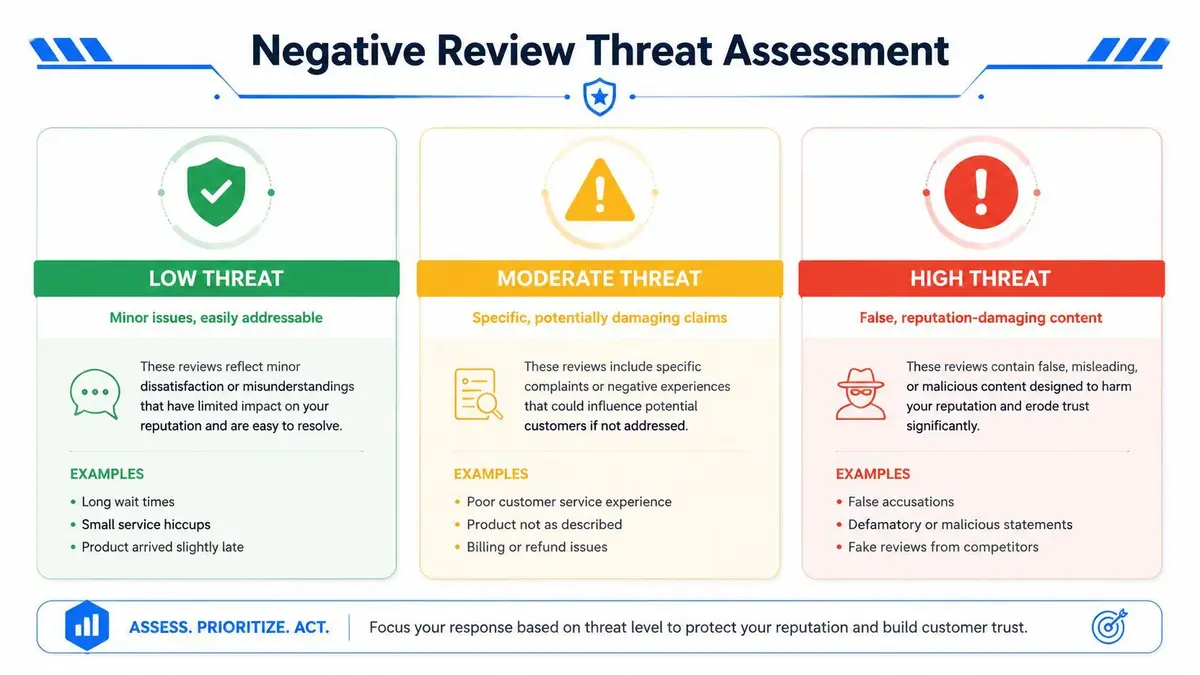
A practical threat model
Use three categories.
Low threat
These reviews describe genuine disappointment, minor defects, delayed shipping, confusing setup, or unmet expectations without false factual claims. They sting, but they’re useful.
Treat them as operational intelligence. Support, product, and fulfillment leaders should examine whether the complaint reflects a repeatable issue. If it does, the review is evidence, not sabotage.
Moderate threat
These reviews contain specific damaging allegations that may be exaggerated, misleading, or unsupported. They might accuse your team of deceptive conduct, claim missing features that were disclosed elsewhere, or misstate events in a way that could influence buyers unfairly.
This category requires fact matching. Pull order history, support transcripts, timestamps, specifications, and listing screenshots. If the claim is wrong, you may have response grounds and potentially platform grounds, depending on wording.
High threat
Legal and platform risk becomes real in scenarios involving false identity claims, impersonation, fabricated purchase experiences, coordinated attacks, threats, doxxing, hate speech, and disclosure of personal information.
These reviews should trigger evidence preservation immediately.
A bad review is not always a reputation crisis. A false factual allegation with visibility is.
A disciplined monitoring stack helps separate pattern from panic. Teams evaluating recurring complaint themes, duplicate narratives, and escalation signals can benefit from reviewing best customer feedback analysis tools, especially when multiple marketplaces or locations are involved.
Questions your team should answer before acting
- Did a real transaction occur
- Does the review contain verifiable factual claims
- Does the wording violate platform policy
- Is the reviewer part of a larger pattern
- Would a public response help or worsen the situation
If you can’t answer those questions within the first review cycle, your internal process is too loose.
Executing a Strategic Content Removal Action Plan
Most removal attempts fail because the party filing them confuses unfairness with removability.
That confusion is expensive. It causes delay, bad submissions, internal frustration, and vulnerability to scam vendors promising impossible outcomes. If the review doesn’t violate platform rules or create a clear legal basis, your chance of removal drops sharply.
The legal reality
The success rate for removing negative product reviews from platforms like Google or Amazon is typically under 10% unless they explicitly violate policies, based on practitioner discussion and platform experience documented in this review removal success rate analysis. Verified process data from ContentRemoval.com’s discussion of removal timelines adds useful timing expectations: defamation cases typically take 4 to 12 weeks, while DMCA takedowns are often resolved in 1 to 2 weeks.
Those numbers should reset executive expectations. Removal is possible. Easy removal is mostly fiction.
What actually makes a removal request credible
Platforms respond to specificity. They ignore indignation.
A proper action file should include:
- The exact review text that creates the issue
- The policy section the content violates
- Supporting evidence such as screenshots, receipts, metadata, account inconsistencies, and archived versions
- A clear legal characterization if the issue involves defamation, impersonation, privacy invasion, or copyright
- A submission log that tracks dates, ticket IDs, and escalations
Weak request versus strong request
| Weak approach | Strong approach |
|---|---|
| “This review is false and hurts our business” | “This review contains no evidence of a transaction and includes personal information, violating platform rules on privacy and authenticity” |
| General complaint to support | Policy-mapped complaint with exhibits |
| One submission, no follow-up | Structured follow-up with preserved records |
| Emotional rebuttal | Evidence-led escalation |
Unsupported removal requests don’t just fail. They educate the platform that you don’t understand its standards.
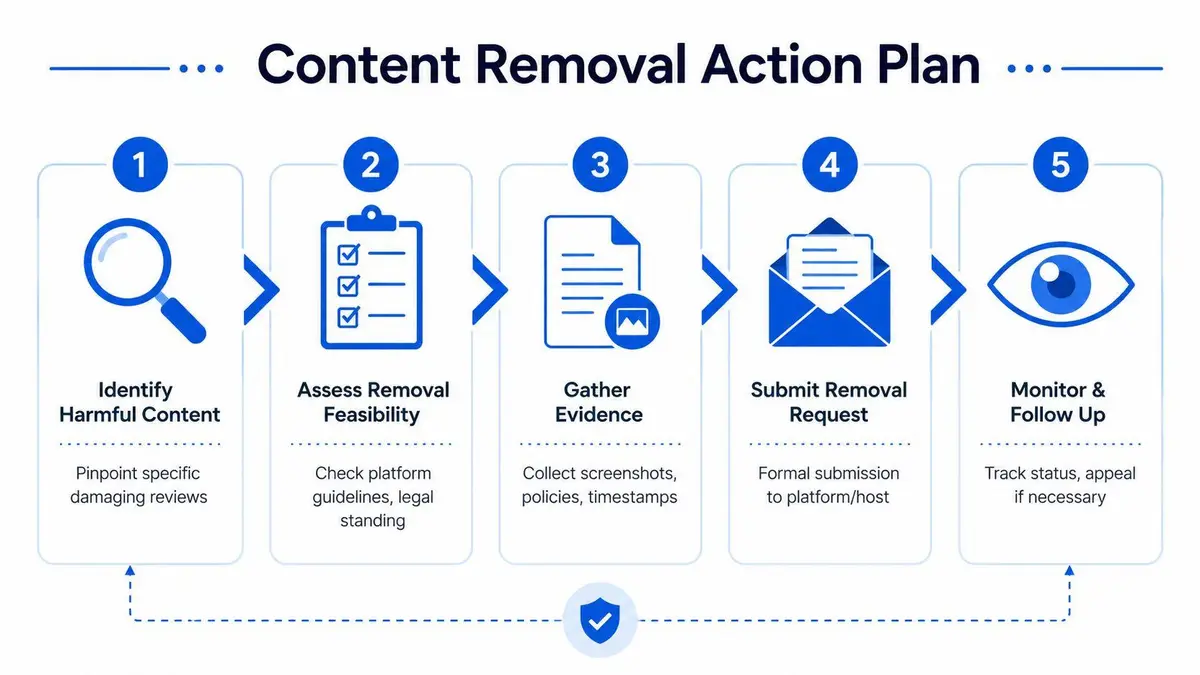
The five-step discipline that works
First, isolate the content precisely. Don’t bundle multiple issues into a messy complaint.
Second, determine whether the target is a policy violation, a legal violation, or both. Hate speech, threats, impersonation, spam, fake accounts, and personal information exposure usually present stronger removal footing than ordinary dissatisfaction.
Third, compile evidence before filing. Once a review is edited or account behavior changes, some advantage disappears.
Fourth, submit through the correct platform path. Not generic help chat. The relevant abuse, legal, IP, or review-policy channel.
Fifth, monitor and escalate. If the platform denies the request, refine the submission. Don’t recycle the same vague argument.
For executives dealing with meaningful exposure, this is why a structured professional guide to strategic online review removal matters. The process rewards precision and punishes improvisation.
Mitigation and Long-Term Reputation Fortification
A damaging review remains live through a board meeting, a sales cycle, and a diligence call. At that point, review management stops being a customer service task and becomes an operational security function.
Your posture changes immediately. Stop trying to erase the incident from public view and start controlling interpretation. The goal is to reduce the review’s persuasive power, contain copycat risk, and build a stronger field of credible evidence around it.
Public replies need discipline. Do not accuse the reviewer. Do not speculate about motive. Do not write a long defense that creates new admissions or gives the complaint more visibility. Publish a short, controlled response that acknowledges concern, directs the matter offline, and preserves legal room to act if the facts are false, defamatory, or manipulated.
The public response is written for the audience, not the critic
Future buyers, partners, journalists, and opposing counsel may read that reply. Write for them.
A strong response does three things:
- Shows control through calm language and clear boundaries
- Invites resolution through a direct contact path or case review
- Avoids unnecessary concessions until your team verifies the facts internally
Then shift to offense. If a harmful review survives removal efforts, build a larger body of authentic, recent, specific reviews that better reflects actual customer experience. One unsupported negative review carries more weight when the surrounding profile is thin, stale, or inconsistent. It loses force when buyers can see a pattern of legitimate satisfaction across products, locations, or service lines.
This is why review generation belongs in operations, not just marketing. You need a repeatable system that requests feedback after verified customer milestones, captures service issues before they become public complaints, and routes reputation signals to the teams that can fix the underlying problem.
Build a standing defense system
Treat review management as two linked functions.
Offense means creating influential reviews that are detailed, credible, and timed to shape buyer decisions.
Defense means detecting hostile, false, exaggerated, or coordinated review activity early enough to contain it before it affects revenue, recruiting, partnerships, or investor confidence.
That system needs a few hard controls:
- Trigger review requests at defined points such as confirmed delivery, successful onboarding, renewal, or repeat purchase.
- Separate review intake from legal escalation so ordinary complaints go to service recovery and higher-risk matters go to counsel or reputation leadership.
- Track concentration risk by platform so one review site or marketplace cannot dominate brand perception.
- Log recurring allegations by theme so operations can fix the complaint categories that keep resurfacing.
- Assign response authority in advance so junior staff do not create legal exposure with improvised public replies.
Some companies also use broader Mr. Green Marketing reputation strategies to align reviews with social proof and visible trust signals. That work helps when it supports a disciplined review command structure. It fails when it substitutes for one.
A durable reputation is built from evidence accumulation, response discipline, and operational correction. Cleanup alone is too reactive.
If your profile already shows visible damage, study a practical framework for rebuilding trust with customers after bad reviews. Recovery works when service remediation, legal judgment, and systematic review generation operate together.
A review about a product affects more than conversion rate. It can shape procurement decisions, trigger internal concern, and define your company before your team ever gets a meeting. Run review operations like a business defense function. That is how you protect the brand on defense and strengthen it on offense.
Frequently asked questions
How do I write a product review that people trust?
Lead with who used the product, where and for what purpose, then describe what worked and what did not under specific conditions, and finish with why that matters to the next buyer. Include a real tradeoff, prefer comparative and evidence-based language over adjectives, and avoid anything that could be pasted onto a competitor’s product unchanged.
Can a negative product review be removed from Amazon or Google?
Only where it clearly violates platform policy or creates a legal basis such as defamation, impersonation, privacy invasion or copyright. Ordinary dissatisfaction is rarely removable, and the article cites a success rate under 10% outside policy violations. A credible request quotes the exact review text, the policy section breached and supporting evidence, then follows up through the correct channel.
Should a brand respond publicly to a false product review?
Keep any reply short and controlled: acknowledge the concern, direct the matter offline and avoid accusing the reviewer, speculating about motive or making admissions before facts are verified. The response is written for future buyers, partners and possibly opposing counsel, not for the critic.