
Brand reputation management, as most of the industry practices it, starts from a quiet assumption: the negative content about your company is permanent, so the job is to out-publish it. Build more pages, earn more placements, push the complaint site or the “scam” headline to page two, and renew the retainer every month to keep it there. It is a real discipline with real uses, but for a company bleeding pipeline to a specific harmful result, it is often the slow, expensive answer to a question that has a faster one: can this content simply be removed?
This guide is written for founders, CMOs, and general counsel who are past the point of abstract concern. Something specific is hurting you (a review cluster, a complaint-site thread, a “scam” autocomplete, an impersonator, an ex-employee campaign) and you are deciding what to do about it and who to trust with it. We work on the removal side of this market: taking harmful content down at the source, then protecting the brand continuously so the cleanup holds. That vantage point shapes everything below, including the honest parts about what removal cannot do.
You will get three things here: a map of the modern brand attack surface, a decision framework for removal versus suppression versus response, and a way to think about measuring the commercial impact of this work without the fabricated ROI numbers this industry loves to invent.
The modern brand attack surface
Companies tend to discover their attack surface one crisis at a time. It is cheaper to map it once. Six zones account for the overwhelming majority of commercial damage we see.
Reviews and ratings platforms
Google Business Profiles, Trustpilot, G2, Capterra, app stores, industry-specific platforms. The commercial mechanics are brutal because reviews sit at the exact moment of purchase decision, and prospects weight negative outliers far more heavily than averages. The removal question here is narrower than vendors imply: legitimate negative reviews from real customers are generally not removable, and firms promising otherwise are either lying or planning to violate platform terms in ways that can get your profile penalized. What is frequently removable: fake reviews, competitor-planted reviews, reviews from people who were never customers, review-bombing waves, and reviews violating platform content policies. Distinguishing the two categories item by item is the actual work.
Complaint sites and ripoff boards
A small ecosystem of complaint sites has built a durable business model on ranking well for “[your brand] + complaints” and being difficult to remove from. Some charge for their own “arbitration,” which tells you what business they are really in. These pages punch far above their traffic weight because they surface for high-intent branded searches during due diligence. Removal pathways exist (defamation claims through counsel, de-indexing on legal grounds, negotiated removals, and policy-based approaches vary by site) but this is specialist terrain where amateur attempts routinely make pages rank better by engaging with them.
Counterfeit and impersonation
Fake domains, cloned checkout pages, impersonator social accounts, fraudulent ads running your brand name, counterfeit product listings. This zone is the most removal-friendly of the six: trademark and copyright claims, platform impersonation policies, and registrar abuse processes all provide established takedown mechanisms, and speed is the differentiator because every day an impersonation stays live, it defrauds your customers under your name. This work sits alongside intellectual property protection and should be running continuously, not case by case.
Ex-employee and insider content
Glassdoor and Indeed reviews, thread-form allegations, leaked internal documents and screenshots, disgruntled-former-employee campaigns. Legally and reputationally delicate: genuine employee opinion is broadly protected, while false statements of fact, confidentiality breaches, and doxxing of executives are actionable. Companies get in trouble here in both directions, overreacting to protected opinion (and triggering amplification), and underreacting to genuinely defamatory or leaked material that had viable removal paths. See our work on defamation removal for how the assessment runs.
Search-layer damage: autocompletes and AI answers
Sometimes the harm is not a page but the search layer itself: “scam,” “lawsuit,” or “complaints” appended to your brand in autocomplete, or an AI assistant confidently summarizing your company using a complaint thread as its source. Autocomplete predictions can sometimes be removed through search engine policy processes when they violate stated rules, and otherwise respond to shifts in the underlying content and query patterns. AI answers are the newer front: assistants inherit the open web, so a removed source is a source no model cites. This is a core reason removal has become more valuable in the AI era, suppression fools a results page but not a crawler. Our AI reputation practice treats assistant answers as a first-class surface.
Press and blog coverage
Negative news coverage, aggregator pickups, and blog posts. Accurate reporting by legitimate outlets is generally not removable, full stop, and be suspicious of anyone who says otherwise. But the damage often lives less in the original article than in its syndication tail: scraper copies, aggregators, and low-quality republishers that keep an old story ranking years later. Those copies frequently have removal pathways the original does not, and editorial mechanisms (updates, corrections, de-indexing of outdated content) apply more often than companies assume.
Key takeaway: Map all six zones before spending anything. Companies routinely fund expensive suppression for a mid-tier problem while an impersonation or complaint-site exposure, cheaper to remove and more damaging, sits untouched.
Removal-first: the strategic argument
Why removal beats burial when it’s available
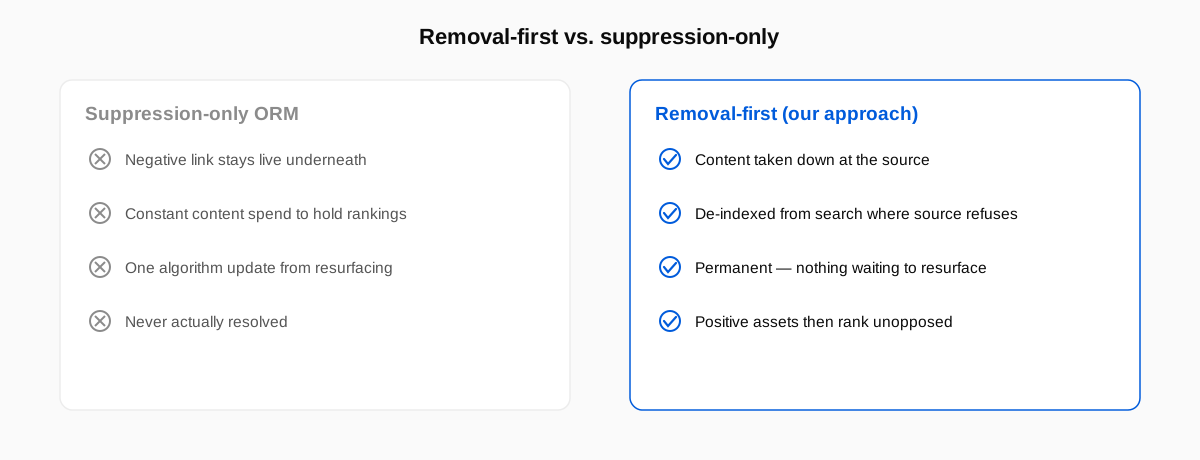
The difference between removed and suppressed content is the difference between solved and managed. Suppressed content still exists, for the journalist doing a story on your funding round, the enterprise procurement team running due diligence, the bank underwriting your credit line, and the AI assistant summarizing your company. All of these readers go past page one, or never see a results page at all. Removed content is gone from every one of those pathways at once.
Removal is also the only approach whose results are durable by default. Suppression is a subscription: stop paying, algorithms shift, or a news event spikes searches on your brand, and the buried item resurfaces. A removed page does not resurface. Over a multi-year horizon, per-incident removal (priced per link, with the exact figure quoted in writing after a free Exposure Scan) is frequently cheaper than indefinite suppression retainers, and it is verifiable in a way suppression never is: the link is dead or it is not.
When suppression and PR are the right tools
A removal-first firm should still tell you plainly when removal is the wrong tool, because sometimes it is. Truthful negative press from credible outlets, accurate regulatory records, and legitimate customer reviews generally cannot and should not be targets. For those, the right play is a combination of genuine remediation (fix the underlying product or service issue, nothing else works for long), owned-content strength so your official properties dominate branded search, earned media that reflects current reality, and direct response where platforms allow it. Suppression is also the correct interim measure while a slow removal pathway (litigation-dependent, for instance) plays out. The failure mode isn’t using suppression; it’s using only suppression because your vendor doesn’t have removal capability and quietly defines every problem as a suppression problem.
Find out what's actually removable before you sign a retainer. Our free Exposure Scan audits your brand across reviews, complaint sites, impersonation, autocomplete, and AI answers, results walked through live in 15 minutes, yours to keep whatever you decide.
Book Your Free ScanA working framework: triage, remove, respond, protect
Here is the operating sequence we recommend, whether you run it internally or with a partner.
Step 1: Baseline the exposure
Audit branded search (including ”+ scam,” ”+ reviews,” ”+ complaints” variants), autocomplete, top review platforms, complaint sites, social impersonation, domain lookalikes, and what the major AI assistants say when asked about your company. Capture screenshots and rankings. You will want the before-state for measurement later.
Step 2: Triage by commercial impact and removability
Score each item on two axes. Commercial impact: does this surface in the buying journey? A complaint-site page ranking third for your brand name outweighs a harsher item nobody sees. Removability: fake/impersonating content and policy-violating material are high; truthful press and genuine reviews are low. Work the high-impact, high-removability quadrant first. It is where a dollar does the most.
Step 3: Execute removals through the right pathway
Each content type has its own mechanism: platform policy and terms-of-service claims, trademark and copyright takedowns, defamation processes through counsel, search engine removal programs, registrar and host abuse channels, and direct negotiation. Sequencing matters, a clumsy first approach can entrench a page or alert a hostile poster, which is why this is a practitioner’s craft rather than a form-filling exercise. Expect honest timelines: days for clear policy violations on responsive platforms, months for entrenched complaint sites, and genuine uncertainty anywhere a third party holds the decision. No credible firm guarantees outcomes on platforms it does not control.
Step 4: Respond and rebuild where removal doesn’t apply
For the non-removable residue: respond professionally on review platforms, fix the operational issues generating genuine complaints, and strengthen owned properties so your official content wins the branded results page. This is where a good PR or content team earns its fee, on the problems that are actually theirs.
Step 5: Protect continuously
New content appears constantly; the question is detection speed. Harmful content is easiest to remove early, before it ranks, gets syndicated, screenshotted, or absorbed into AI training data. A continuous monitoring layer watching search, reviews, social, impersonation, and AI surfaces turns removal from a crisis response into routine hygiene. Managed protection plans handle this as a standing program, priced to the names covered, the monitoring intensity, and the removal capacity included; the wider market spans cheap DIY alert tools (fine for detection, useless for response) up to five-figure enterprise retainers.
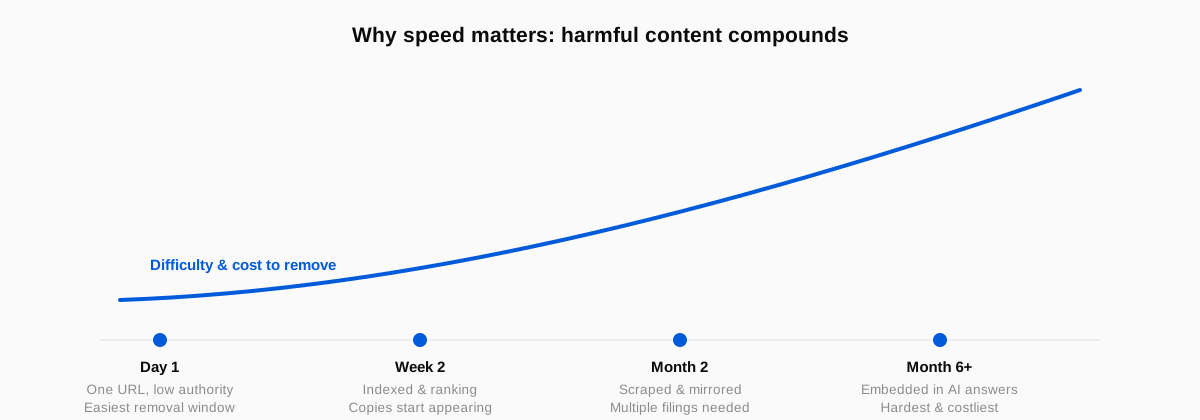
Key takeaway: The cheapest removal is the earliest one. Content that is caught in its first days (before ranking, syndication, and AI ingestion) comes down faster, at lower cost, and with less residue than content that has aged into the index.
Measuring the commercial impact
This industry is notorious for invented ROI figures. We won’t add to them. What we can give you is the honest measurement approach: instrument the mechanisms by which reputation damage costs you money, and observe your own numbers before and after.
The mechanisms that move revenue
Branded-search conversion. Prospects who search your brand name are your highest-intent traffic. Harmful content on that results page is interception at the moment of decision. Measure branded-search click-through to your site and conversion rate from branded traffic before and after a removal; this is the cleanest signal available because the population (people already looking for you) is stable.
CAC via trust friction. Reputation damage doesn’t usually kill deals loudly: it lengthens them quietly. More objection-handling, more security-and-diligence review cycles, more “we saw something online” conversations, lower close rates at constant lead volume. Each raises your effective customer acquisition cost. Sales teams feel this before dashboards show it; ask them which objections disappeared after a cleanup.
Funnel-stage drop-off. Damage concentrates at the diligence stage: demo-to-close in B2B, cart-to-purchase in B2C, offer-acceptance in recruiting. If prospects engage and then evaporate after the stage where they Google you, the results page is a suspect worth testing.
Ad efficiency. Negative results alongside your paid brand ads depress click-through and quality scores, and competitors bid on “[your brand] alternatives” fueled by your negative content. Paid-search teams can quantify this from data you already have.
The honest posture: track your own baseline, execute removals, and measure your own deltas. Any vendor quoting a universal “X% revenue lift” is quoting fiction. Our case studies describe mechanisms and outcomes for real engagements without inventing aggregate statistics.
See your brand the way a due-diligence team does. The free Exposure Scan gives you an itemized, prioritized view of every harmful result touching your funnel, live on a 15-minute call, no retainer required to keep the findings.
Book Your Free ScanChoosing a partner
The brand reputation market is crowded and opaque. A short vetting list separates operators from resellers.
Ask what they remove versus what they bury. Many agencies sell “removal” and deliver suppression. Make them walk you through actual removal mechanisms for your specific items, which pathway, why, and what the realistic probability is. A firm that cannot name the mechanism does not have the capability.
Demand item-level honesty. The strongest credibility signal is a firm telling you which of your problems it cannot solve. Blanket confidence across truthful press, genuine reviews, and court records is a red flag, not reassurance.
Check for pay-for-performance alignment. Removal work supports outcome-based pricing: a link is verifiably down or it is not. Suppression retainers, by contrast, bill monthly regardless of durability. Ask how fees map to verified results.
Look for continuous capability, not just cleanup. A one-time cleanup without monitoring decays. Ask how detection works, what the response time commitment is for new threats, and whether AI-assistant surfaces are covered.
Confirm discretion and escalation fit. For companies, that means clean coordination with your general counsel on anything legally sensitive, with comms on anything press-adjacent, and confidentiality throughout. Firms serving executives and boards will have these protocols as defaults; note that brand damage and executive personal exposure usually travel together, and the strongest programs cover both.
Key takeaway: Vet for capability, not vocabulary. Everyone in this market says “removal.” Only some can name the takedown mechanism for your specific content, quote honest probabilities, and price against verified outcomes.
Frequently asked questions
Can negative reviews really be removed?
Some can, and the distinction is everything. Reviews that are fake, competitor-planted, written by non-customers, part of coordinated review-bombing, or in violation of platform content policies are legitimately removable through platform processes, and this category is larger than most companies assume once someone actually audits it. Genuine negative reviews from real customers generally are not removable, and attempting to strong-arm them tends to backfire. The professional approach is a review-by-review audit that separates the two, removes the first category, and responds well to the second.
How long does content removal take for a company?
It varies by pathway, and honest answers come in ranges. Clear policy violations on responsive platforms (impersonation, counterfeit listings, fake profiles): often days to a few weeks. Complaint-site and defamation matters: typically weeks to months, depending on the site’s posture and whether legal mechanisms are involved. Search de-indexing after a removal: usually days to weeks to propagate. Anyone quoting a fixed universal timeline is guessing on your behalf, because the deciding party is a third platform.
What does professional brand reputation work cost?
Individual removals are priced per link: after the free confidential Exposure Scan, you receive a written quote showing the exact price beside every URL before you commit to anything, complex and litigation-adjacent matters included. Continuous coverage runs through our Protection Plans, scaled to the names covered, monitoring intensity, and removal capacity included. The overall market spans DIY monitoring tools for a few hundred dollars a year (detection only) up to five-figure monthly enterprise retainers. Weigh cost against the revenue mechanism at stake: a single complaint page intercepting branded search for a company with a meaningful sales pipeline usually makes the arithmetic short.
Should we respond publicly to negative content or try to remove it first?
Sequence matters: assess removability before engaging. Public responses, legal threats posted in comment threads, and “arbitration” with complaint sites can entrench content, boost its ranking through engagement, or convert a removable item into a news story. If an item has a viable removal pathway, work it quietly first. If it is genuinely non-removable (a truthful review, accurate press) then respond professionally and invest in fixing the underlying issue. A partner who can run the removability assessment fast keeps you from making the common early mistakes.
Every week a harmful result sits on your branded search page, it compounds: into rankings, syndication copies, screenshots, and now AI answers. The companies that handle this well are simply the ones that get an accurate map early and act on the removable items before they entrench. Start with the map: book a free confidential Exposure Scan and see, in 15 minutes, exactly what is hurting your brand, what can come down, and what it will honestly take.