
Defamation lawyers in New York assess whether a false statement of fact was published to a third party with the required fault and caused real harm. New York applies a one-year limitations period from first publication, a strengthened anti-SLAPP statute that can shift the burden to the plaintiff, and per se rules presuming harm for accusations of crime or misconduct.
Key facts
- New York’s one-year statute of limitations runs from first publication under the single publication rule.
- The 2020 anti-SLAPP amendments require clear and convincing evidence and often actual malice, with mandatory fee-shifting on loss.
- Defamation per se covers serious crime, loathsome disease, unchastity and injury to trade or profession.
- Senior partners at leading New York firms bill roughly 750 to over 1,500 dollars an hour, per the article.
Where ContentRemoval.com comes in. A New York lawsuit can run one to three years while the false article stays live and searchable. ContentRemoval.com handles the other half of the response, working with platforms, hosts and search engines to remove or de-index defamatory content quickly and without a public docket, while counsel preserves claims and pursues damages if warranted. Executives, general counsel and outside attorneys all make contact. A free 15-minute Exposure Scan maps what is removable, and the report is yours to keep. Get a Free, Confidential Exposure Scan or read how our defamation removal work is done.
When your professional reputation is under attack, threatening your career or business, you require a team of expert defamation lawyers in New York capable of swift, decisive action. The right legal counsel understands that speed and precision are paramount when mitigating the damage from false and malicious statements. Their first mandate is to measure the assault against New York’s rigorous legal standards to determine the viability of a legal claim.
Understanding Defamation Claims Under New York Law
When your professional standing is publicly assailed, a methodical approach through the lens of New York’s specific defamation laws is essential. This legal framework is what converts a personal or corporate crisis into a structured, winnable engagement.
Defamation is a false statement of fact that injures a person’s reputation. It is bifurcated into libel (written defamation) and slander (spoken defamation). A private insult is legally distinct from a false accusation published in an industry journal or amplified across social media. For executives and public figures, the line between protected opinion and actionable falsehood is where these legal battles are won and lost.
The Four Elements of a Defamation Claim
To construct a viable cause of action, your legal team must establish four key elements. The failure to prove even one of these pillars will cause the entire claim to collapse. This high standard explains why not every negative online comment constitutes grounds for a lawsuit.
A statement must be provably false. Truth is an absolute defense to defamation. Crucially, the statement must be an assertion of fact, not an expression of opinion. “I believe the CEO is ineffective” is a protected opinion. Conversely, “The CEO falsified Q3 earnings reports” is an assertion of fact that can be proven true or false.
The false statement must have been communicated to at least one third party. A private email sent only to you does not meet the “publication” threshold. However, the moment that email is forwarded to a board member, a client, or posted online, the publication requirement is satisfied.
You must demonstrate that the publisher of the statement was at fault. For private individuals, the standard is typically negligence: the defendant failed to exercise reasonable care in verifying the statement’s truthfulness. For public figures, the standard is significantly higher: actual malice. This requires proving the defendant either knew the statement was false or acted with reckless disregard for the truth.
Finally, you must show the statement caused actual, tangible harm to your reputation. This can be documented through financial loss, a rescinded employment offer, or demonstrable damage to your professional standing within your industry.
These four elements form the bedrock of defamation law in New York. The state’s Court of Appeals has clarified that a successful claim must show the false statement would expose the plaintiff to ‘hatred, contempt, or aversion’ among a substantial part of the community. This is a formidable standard. You can explore this legal terrain further with seasoned New York defamation attorneys.
The Critical Distinction of Defamation Per Se
Certain categories of false statements are considered so inherently damaging that New York law presumes reputational harm has occurred. This legal doctrine is known as defamation per se. In such cases, the plaintiff is not required to provide specific proof of financial loss to have a valid claim.
Defamation per se is a significant tactical advantage. It removes the onerous burden of proving specific pecuniary damages at the outset of a case. When a falsehood is this destructive, the law deems the harm to be self-evident.
Statements that typically qualify as defamation per se include false accusations of:
- Committing a serious crime.
- Carrying a “loathsome disease.”
- Unchastity.
- Injury to a person in their trade, business, or profession.
For any executive or professional, the fourth category is the most consequential. A false claim that you embezzled funds, engaged in professional misconduct, or are incompetent in your role is a direct assault on your livelihood. Such a statement is a prime candidate for a defamation per se action, providing your legal team with a major strategic advantage.
Litigation Versus Strategic Content Takedown Services
When facing an online attack, your initial response is critical. The decision is not if you should act, but how. This decision places you at a strategic crossroads: initiate a formal lawsuit with defamation lawyers in New York, or engage a specialized service for rapid, discreet content removal.
Litigation is the heavy artillery, appropriate when the objective is to secure significant financial damages from a known defendant or to obtain a court order compelling cessation of the defamatory conduct. A lawsuit sends a powerful deterrent message and can establish a legal precedent.
However, the legal process is public, expensive, and protracted. A defamation lawsuit in New York can easily extend for one to three years, during which the defamatory content often remains publicly accessible. This exposure can trigger the “Streisand Effect,” where the attempt to suppress a story inadvertently amplifies its reach.
This decision tree illustrates the foundational questions a defamation lawyer in New York will ask to assess the viability of a claim.
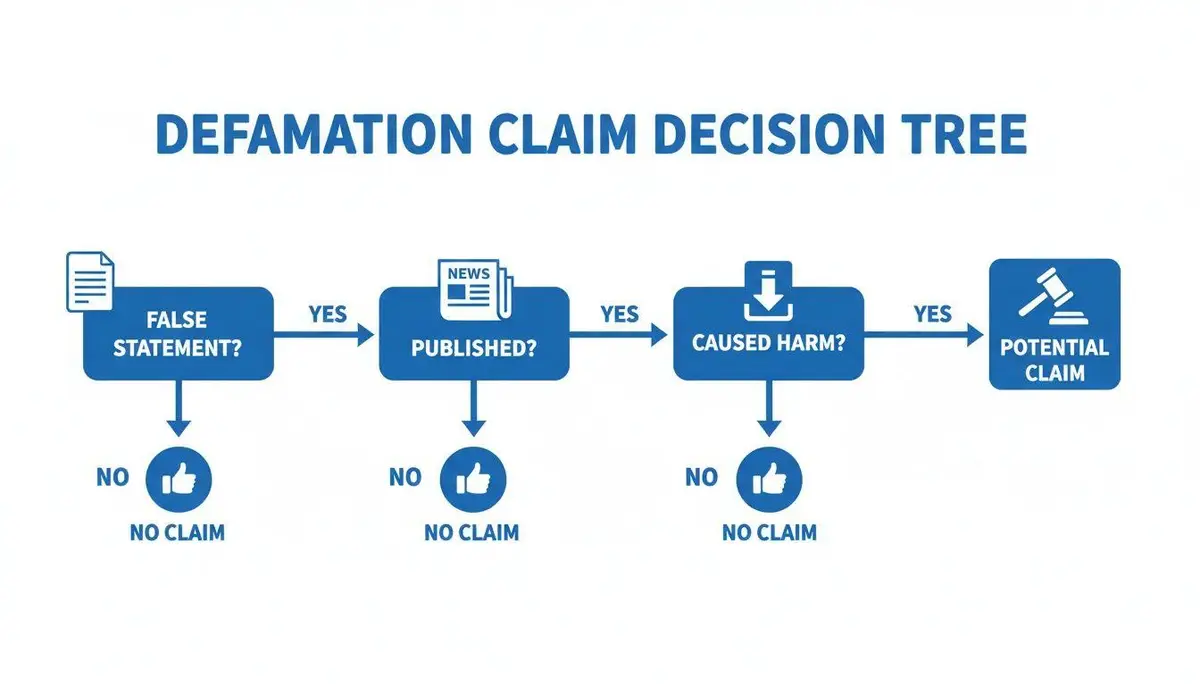
As this illustrates, a viable claim exists only if a false statement was published and caused provable harm. This is a high threshold, which is why many complaints do not proceed to litigation.
The Case for Strategic Content Removal
Strategic content removal services operate on a different paradigm, prioritizing speed, discretion, and certainty. This is the superior course of action when reputational damage is occurring in real-time and immediate cessation is the primary goal.
Consider these scenarios where a takedown service is the more strategic choice:
- Anonymous Perpetrators: When the defamer operates behind a pseudonym and foreign servers, a lawsuit becomes a protracted and costly endeavor simply to identify the defendant. A removal specialist can often bypass the individual and secure removal at the platform or host level.
- Time-Sensitive Crises: Litigation proceeds at a deliberate pace. If a false article is causing immediate loss of clients or derailing transactions, you cannot afford to wait years for a judicial resolution. A removal service can often achieve the objective in days or weeks.
- Foreign-Based Attackers: Suing an individual in another jurisdiction is a logistical and legal quagmire. A content removal strategy does not pursue the perpetrator; it targets the platform or search engine, leveraging their terms of service and internal legal processes.
The core value of a takedown service is its surgical precision. It circumvents the public spectacle and collateral damage of litigation to achieve the singular objective that matters most: making the harmful content disappear.
A Cost-Benefit Framework for Executives
The decision hinges on a dispassionate cost-benefit analysis. Litigation is an investment of capital, time, focus, and energy, resources better allocated to your enterprise. The cost of a lawsuit can easily reach six figures with no guarantee of a successful verdict or collection of a judgment.
A strategic takedown, by contrast, is a targeted operational expense with a defined objective. While it does not yield a financial award, its ROI is measured in the immediate cessation of financial and reputational bleeding. You can learn more about how to remove defamatory content from the internet through these focused methodologies.
While pursuing takedown services, it is also prudent to implement robust online brand monitoring to detect emerging threats. This proactive posture enables a much faster and more decisive response.
Ultimately, these two approaches are not mutually exclusive. An optimal strategy may begin with a rapid takedown to contain immediate harm, followed by targeted legal action if the attacker is identified and the damages warrant pursuit. By consulting with both defamation lawyers and a reputation management firm, you gain a comprehensive view of your options and can deploy the appropriate tool for the specific threat.
How to Evaluate and Select Top-Tier Defamation Counsel
When your reputation is at stake, the selection of legal counsel is the single most critical decision. The attorney you retain as your defamation lawyers in New York will dictate the strategy, tempo, and ultimate success of your case. This requires finding a specialist with a specific skill set for high-stakes digital conflicts.

The ideal counsel possesses a rare combination of trial-tested litigation skills, a sophisticated understanding of technology, and deep institutional knowledge of New York’s court system. A generalist litigator is insufficient. You need an attorney with a demonstrable record of success in internet law, who has unmasked and prevailed against anonymous online assailants.
Vetting for Proven Experience in Digital Defamation
Your initial vetting should immediately disqualify any attorney without direct, substantial experience in online defamation. Counsel whose practice is centered on traditional libel or slander may be ill-equipped to navigate the complexities of digital evidence, ISP subpoenas, and the jurisdictional challenges inherent in internet-based attacks.
A true expert can articulate a clear process for:
- John Doe Lawsuits: This is the primary legal mechanism for unmasking anonymous online posters. A seasoned lawyer will have a battle-tested methodology for leveraging court subpoenas to compel platforms and internet providers to disclose the identity of an attacker.
- Digital Forensics: They must understand the precise methods for preserving and authenticating digital evidence (such as screenshots, server logs, or cached web pages) to meet the exacting evidentiary standards of a New York court.
- Platform-Specific Policies: Top-tier counsel knows the internal legal channels at technology giants like Google, Facebook, and Twitter. This insider knowledge can often achieve content removal far more efficiently than formal litigation.
This specialized expertise is what distinguishes specialists from general practitioners. For example, combating a wave of malicious online reviews requires a nuanced blend of legal threats and savvy platform negotiations. Our analysis on the strategic approach to online review removal services for executives details how these hybrid strategies are executed. An inexperienced attorney might rush to file suit when a more surgical approach could have resolved the issue months earlier.
Use this framework to systematically vet potential counsel, focusing on the criteria most critical for prevailing in digital defamation matters.
Key Vetting Criteria for New York Defamation Lawyers
| Vetting Criterion | Why It Matters | Red Flag to Watch For |
|---|---|---|
| Direct Experience with John Doe Lawsuits | Demonstrates the ability to unmask anonymous attackers, a critical first step. | Vague descriptions of the process or a lack of specific case examples. |
| History of Defeating SLAPP Motions | Proves they can overcome attempts to dismiss your case as an attack on free speech. | Downplaying the significance of anti-SLAPP law or unfamiliarity with its provisions. |
| Knowledge of Digital Evidence Preservation | Essential for ensuring your evidence is admissible in court. | Delegating this responsibility entirely without understanding the legal standards. |
| Familiarity with NY Supreme Court Judges | Local knowledge of judicial tendencies is a significant strategic asset. | Treating a New York case as interchangeable with any other federal or state matter. |
| Network of Forensic & Investigative Experts | A pre-vetted team for tracing attackers and proving damages saves critical time. | Acknowledging a need to “find” an expert after accepting your case. |
This table is a framework for your initial consultations. An attorney who can confidently and specifically address each point is likely a strong candidate.
Assessing New York-Specific Judicial and Investigative Acumen
Litigating a defamation case in New York requires more than just statutory knowledge. It requires an intimate understanding of the courts, the judges, and the local legal culture. A veteran New York defamation attorney understands the procedural nuances and judicial leanings within the New York Supreme Court, where these cases are typically adjudicated. This local knowledge is a quiet but powerful strategic advantage.
An attorney’s network is as important as their legal knowledge. In defamation cases, this means having established relationships with private investigators and digital forensic experts who can quickly trace anonymous attackers and quantify financial damages.
Beyond the courtroom, premier counsel will have a trusted network of professionals on call. This includes digital investigators skilled at penetrating layers of online anonymity and forensic accountants who can build an irrefutable case for the financial harm you have suffered, a prerequisite for securing significant damages.
Interpreting Industry Accolades as Vetting Tools
While a single award does not guarantee success, peer-reviewed honors from respected directories like Chambers & Partners or Super Lawyers are strong indicators of an attorney’s standing. These are not purchased accolades; they are earned through a rigorous vetting process based on peer nominations and independent research.
These rankings signal that an attorney has a history of success in high-stakes litigation and has earned the respect of both peers and adversaries. In the hyper-competitive legal market of New York City, a global hub for reputation management, Super Lawyers recently recognized 43 top-rated defamation attorneys. This number reflects the depth of expertise available for those combatting online attacks in New York.
View these credentials as confirmation that the lawyer has consistently delivered for clients in circumstances analogous to yours. They point to a career built on winning difficult cases and protecting the reputations of individuals with everything to lose.
Critical Deadlines and Defenses: The Statute of Limitations and Anti-SLAPP Law
In New York defamation law, two procedural obstacles can terminate a case before it begins: the statute of limitations and the state’s formidable anti-SLAPP law. A misstep on either is a fatal error from which no amount of evidence can recover.
In New York, you have a strict one-year statute of limitations to file a lawsuit for libel or slander. The clock begins to run the moment the defamatory statement is first published.
For online content, “publication” occurs on the date the material first appeared. Whether it is an article, a blog comment, or a social media post, that is Day One. Waiting even a day beyond the one-year deadline forfeits your right to sue.
The Single Publication Rule
New York law adheres to the single publication rule, a concept of critical importance for online defamation. This rule establishes that an entire online distribution, even one that accrues millions of views over time, is treated as a single act of publication.
The statute of limitations is anchored to the initial date the content was made public. The clock does not restart each time the post is shared or the false article is read. Once that one-year anniversary passes, your option to litigate is extinguished.
A common error is to wait, hoping the problem will resolve itself. It seldom does. By the time the permanence of the damage is clear, the window for legal action has often closed.
Facing New York’s Potent Anti-SLAPP Law
Beyond the tight deadline, a plaintiff must contend with New York’s powerful anti-SLAPP statute. A “SLAPP” (Strategic Lawsuit Against Public Participation) is a lawsuit perceived as an attempt to intimidate or silence a defendant for exercising free speech rights. These laws are designed to facilitate the rapid dismissal of such cases.
New York’s statute was significantly strengthened in 2020 and now applies to a broad range of communications on matters of “public interest.” The courts have interpreted this term expansively, meaning it can encompass everything from online business reviews to news articles and social media commentary.
If a defendant files an anti-SLAPP motion, the procedural posture of the case shifts dramatically. The burden of proof flips to you, the plaintiff, and it is a heavy burden.
You must prove by clear and convincing evidence that your claim has a substantial basis in fact and law. Furthermore, you must demonstrate that the statement was made with actual malice: meaning the defendant knew it was false or acted with reckless disregard for the truth.
This “actual malice” standard is a very high bar, far more difficult to prove than simple negligence. Following the 2020 amendments, this standard often applies even to private-figure plaintiffs. As legal analysis indicates, these changes have dramatically increased early-stage dismissals of defamation claims. Firms are advising businesses on how to navigate this new landscape shaped by the strengthened law.
Losing an anti-SLAPP motion results in more than just the dismissal of your case. The statute mandates that the court order you to pay the defendant’s reasonable attorneys’ fees and litigation costs. This creates the risk of a disastrous outcome where you finance the legal defense of the very person who damaged your reputation.
Preparing for Your Initial Consultation and Understanding Fee Structures
The initial meeting with potential defamation counsel is not a perfunctory introduction; it is the strategic kickoff for your entire case. Your preparation can significantly impact the quality of the legal opinion you receive.
You are asking a specialist to rapidly assess a complex set of facts. The quality of the information you provide dictates the quality of the advice you receive. Arriving with disorganized screenshots and a vague narrative is insufficient for top-tier defamation lawyers in New York. They require a clear chronology of events and evidence of the resulting harm.

Assembling Your Evidence File
Your primary task is to compile all relevant evidence into a single, organized dossier. The objective is to construct a timeline that narrates the attack and its consequences. A well-organized file allows an attorney to immediately begin analyzing the strengths and weaknesses of your potential claim.
Your dossier must include:
- The Defamatory Statements: Provide clear, verbatim copies. This means high-resolution screenshots of social media posts, websites, and online reviews. For video or audio content, secure the original files and, if possible, a transcript.
- Proof of Publication: Document where the statements were published and by whom. Collect all relevant URLs, and consider using services like the Wayback Machine to capture archived versions in case the originals are removed. Note the date of publication and any available metrics on views or shares.
- A Clear Timeline: Create a simple, chronological list of events. Detail when each statement was published, what responsive actions you took, and any subsequent actions by the opposing party. This narrative forms the backbone of your case.
- Initial Evidence of Damages: Begin documenting the harm. This can range from emails evidencing a lost business opportunity to analytics showing a decline in web traffic that correlates directly with the defamatory content.
Presenting this information is essential. This evidence package is the foundation upon which your entire legal strategy will be constructed.
This checklist will help you organize your materials for a productive and substantive consultation.
Consultation Preparation Checklist
| Document/Information | Purpose | Example |
|---|---|---|
| Copies of Defamatory Content | Provides the core evidence of what was said. | A high-resolution screenshot of a Yelp review; a downloaded copy of a YouTube video. |
| Timeline of Events | Establishes a clear, chronological narrative for the attorney. | “May 10: False review posted. May 12: Emailed Yelp support. May 15: Client ‘X’ cancelled contract, citing review.” |
| Publisher/Author Information | Identifies the defendant(s) and where the defamation occurred. | Profile URL of the social media user; name and address of the blog owner. |
| Evidence of Damages | Connects the defamatory statements to tangible harm. | A profit-and-loss statement showing a sales decline; an email from a potential partner backing out of a deal. |
| List of Key Questions | Ensures you get the specific answers you need about strategy, cost, and timeline. | “What is your experience with Section 230?” “What is your firm’s typical retainer for a case like this?” |
| Your Desired Outcome | Helps the lawyer understand your primary goal (e.g., removal, damages, injunction). | “My main priority is getting the article taken down, but I also want to explore recovering financial losses.” |
A well-prepared dossier transforms your first meeting from an introduction into a productive strategy session.
Decoding Legal Fee Structures
Understanding the fee structure is as important as the legal strategy itself. Ambiguity regarding fees can create significant friction. A reputable defamation attorney will be transparent about their billing practices.
Fee structures are not just about cost; they reflect the firm’s strategic approach. An hourly rate indicates a detailed, ongoing engagement. A flat fee suggests a discrete, defined task, such as drafting a cease-and-desist letter.
The vast majority of defamation litigation in New York is handled on an hourly billing basis. You are paying for the attorney’s time and expertise. You will be required to provide a substantial retainer upfront, against which the firm will bill its time. For senior partners at leading NYC firms, hourly rates can range from $750 to over $1,500.
For smaller, well-defined tasks, an attorney may offer a flat fee. This is common for discrete services like drafting a cease-and-desist letter or conducting an initial investigation to identify an anonymous online poster. This provides cost certainty for a specific action.
Exercise extreme caution with any attorney offering to take your case on a contingency fee basis, where they receive a percentage of the final award. Such arrangements are exceptionally rare in defamation law. The high risk of dismissal, the difficulty of collecting a judgment, and New York’s stringent anti-SLAPP law make it an untenable business proposition for most reputable firms. An attorney who readily offers a contingency arrangement may not fully comprehend the complexities and financial risks of this practice area.
Key Questions for Your New York Defamation Lawyer
Executives and public figures facing a reputational attack consistently raise the same urgent questions. Here are direct answers based on extensive experience managing these high-stakes situations.
Can I sue an anonymous online poster?
Yes. You are not without recourse against an anonymous online attacker in New York. The strategy begins with a “John Doe” lawsuit, filed against the unknown defendant. This action provides the legal basis for a court to compel the disclosure of the poster’s identity.
Once the lawsuit is filed, your attorney can issue subpoenas to the website, social media platform, or Internet Service Provider (ISP) hosting the defamatory content. These are legal orders compelling the companies to produce identifying information associated with the user, such as IP addresses, account details, and email addresses. It is a methodical process of peeling back layers of anonymity to identify the responsible party.
How long does a defamation lawsuit take in New York?
A defamation lawsuit that proceeds through a full jury verdict is a protracted process. If the case involves extensive discovery, motion practice, and a trial, the timeline can span one to three years. For an executive whose primary objective is immediate mitigation of harm, this is a significant consideration.
However, a majority of cases do not go to trial. A significant number are resolved much more quickly through other means.
- Strategic Negotiation: Often, a well-crafted cease-and-desist letter from a lawyer specializing in New York defamation is sufficient to secure removal of the content without litigation.
- Early Settlement: The significant costs and public exposure of litigation create powerful incentives for both parties to seek an early resolution.
- Rapid Dismissal: A case may conclude quickly if the defendant has a strong defense, particularly through the use of New York’s anti-SLAPP law to dismiss meritless claims.
The timeline is not fixed; it is a function of legal strategy, the defendant’s response, and your ultimate objectives.
While a full trial can take years, the most effective strategies often center on winning early. That might mean aggressive negotiation before a suit is ever filed or using pre-trial motions to force a resolution. This saves time and money, and most importantly, contains the damage to your reputation.
What damages can be recovered in a New York case?
A successful defamation lawsuit in New York can result in the recovery of several types of damages. The ability to secure a significant award depends almost entirely on the quality of the evidence your team gathers to prove harm.
Actual Damages
This is monetary compensation for direct, measurable financial losses. This requires a documented, causal link between the defamatory statement and the financial injury you suffered, such as a lost contract, a failed business deal, or a direct loss of income.
Presumed Damages
In cases of defamation per se, the law presumes that reputational harm has occurred. As previously discussed, this applies to false accusations of a serious crime or statements that attack one’s professional competence. In these cases, you are not required to prove a specific monetary loss; the damage to your reputation is assumed.
Punitive Damages
Punitive damages are not compensatory; they are intended to punish the defendant for egregious conduct and to deter similar behavior by others. To be awarded punitive damages, you must prove that the defendant acted with “actual malice”: knowledge of the statement’s falsity or a reckless disregard for its truth. This is a high evidentiary standard reserved for the most malicious attacks.
Answering these questions is one component of a successful engagement. Building a strategy around those answers requires a legal partner who understands both the nuances of the law and the practical realities of protecting a high-value reputation.
When your reputation is under assault, you require a team that fuses legal expertise with rapid, decisive action. ContentRemoval.com specializes in protecting high-profile individuals and executives by removing harmful online content quickly and discreetly. If you are facing defamation, do not wait for the damage to spread, contact us for a confidential assessment.
Frequently asked questions
What is the statute of limitations for defamation in New York?
One year from the date the statement was first published. Under the single publication rule, the clock does not restart each time an online post is viewed or shared, so waiting for the problem to fade can quietly extinguish the right to sue.
How does New York’s anti-SLAPP law affect a defamation case?
If the defendant files an anti-SLAPP motion on a matter of public interest, you must show by clear and convincing evidence that the claim has a substantial basis and, in most cases, that the statement was made with actual malice. Losing the motion means the court must order you to pay the defendant’s attorneys’ fees and costs.
Is a lawsuit or a takedown service better for online defamation in New York?
The article recommends litigation when the goal is damages or a court order against a known defendant, and a takedown service when the attacker is anonymous or overseas, the harm is unfolding in real time, or discretion matters. The two are not exclusive: a rapid takedown can contain the harm while counsel evaluates legal action.