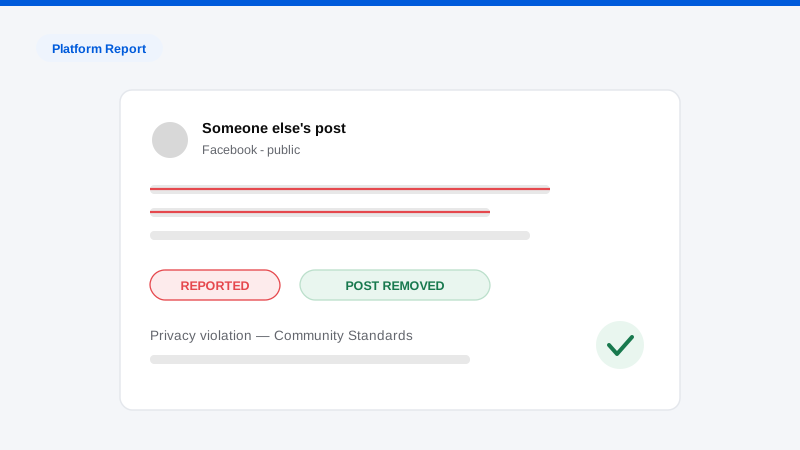
You can get someone else’s Facebook post removed when it violates one of Meta’s Community Standards: harassment or bullying, privacy violations (your personal information or, in many cases, your image), non-consensual intimate imagery, impersonation, threats, or intellectual-property infringement. The route is Facebook’s report flow on the post itself, matched precisely to the violated policy; posts that are merely unflattering, critical, or embarrassing do not qualify, and reporting them as something they are not is the fastest way to a denial. This guide walks through what qualifies, how to file reports that succeed, and the escalation options when Facebook’s first answer is no.
What qualifies for removal from Facebook?
Meta’s Community Standards give you more levers than most people realize, but only if you pull the right one:
- Bullying and harassment. Posts targeting you with degrading content, mockery of protected characteristics, coordinated pile-ons, or unwanted sexualization. Meta’s policy is notably stronger for private individuals than for public figures, who must tolerate more criticism but not sustained abuse.
- Privacy violations. Posts exposing your home address, phone number, financial information, medical information, or identity documents. Facebook also removes images of private individuals in defined circumstances when reported by the person depicted, the exact fact pattern behind most “photo of me I never approved” cases.
- Non-consensual intimate images. A zero-tolerance category with dedicated reporting and hash-matching to block re-uploads. If this is your situation, our intimate image removal practice covers the full cross-platform response.
- Impersonation. Accounts, pages, or posts pretending to be you. Facebook maintains a dedicated impersonation report that does not require you to have an account.
- Threats and incitement. Statements of intent to harm you, which also belong with law enforcement.
- Intellectual property. Your photos or content reposted without authorization, actionable through Meta’s copyright (DMCA) form regardless of any other policy.
- False and defamatory claims. The hardest category, Facebook is not a truth arbiter and generally will not remove “he said something false about me” absent another violation. Defamation runs through legal channels and our defamation removal practice, where the platform work and the legal leverage combine.
How to report a post, step by step
- Preserve first. Screenshot the post, comments, and profile; copy the post URL. Posts get edited or deleted-and-reposted once authors sense reports, and your evidence anchors escalation, legal options, and any doxxing response.
- Report the post itself. Use the three-dot menu on the post, choose “Report post,” and follow the category tree to the specific violation. The category selection is not cosmetic. It routes your report to different review systems with different rules. “I don’t like this post” routes nowhere useful.
- Match the frame to the policy. Reporting a doxxing post as harassment, or an impersonation as fake news, produces denials for the wrong reasons. One report, correctly framed, beats five scattershot ones.
- Report the profile or page too when the pattern is bigger than one post. Serial harassment supports account-level reports, which Meta weighs against the pattern rather than the single item.
- Use the dedicated forms for special categories. Impersonation, NCII, and IP infringement each have standalone reporting channels that work without friending, following, or in some cases even having an account. The IP form in particular, Meta’s copyright report, is the reliable route when your own photo is the content, and the machinery behind our DMCA takedown service.
- Track the outcome in Support Inbox. Decisions arrive there, usually within days. Keep the case numbers; they matter for appeals.
Get a Free, Confidential Exposure Scan
When the report fails: the escalation ladder
A denial is a first answer, not a final one. Options, in order of effort: Appeal through the decision notice, a meaningful share of automated denials reverse on human re-review. Refile with better framing: the most common fix, because most failed reports chose the wrong category or buried the violation in narrative. Ask the poster: in genuinely non-hostile situations (an old friend’s photo, a tagged post), a direct request resolves quietly and is worth one calm attempt; skip this entirely with harassers, where contact feeds the fire. Escalate externally: the Oversight Board exists for a sliver of cases, but the practical external routes are legal ones: demand letters, and in defamation or NCII cases, statutory remedies that convert requests into obligations. De-index and contain: where a post survives on-platform, Google-level removal of eligible personal information and suppression still decides what a search of your name shows. Escalation sequencing is most of what separates professional outcomes from DIY: platforms tell you what failed, rarely why, and each refiling teaches the next one, the working reality of our Facebook removal practice.
Honest timelines and expectations
Clear-cut violations (NCII, doxxing, threats) typically resolve in one to seven days. Harassment and impersonation reports run days to several weeks, longer through appeals, and some posts will not come down: lawful criticism, true statements, unflattering-but-permitted content. Meta enforces its rules inconsistently at billions-of-posts scale, decisions are ultimately Meta’s alone, and no honest professional guarantees a specific removal. What professional handling changes is the probability and the pace, correct framing on the first filing, escalation that actually escalates, parallel legal and search-level tracks, and monitoring for the repost that so often follows a removal.
Frequently asked questions
Can I remove a Facebook post about me if it’s true but embarrassing?
Usually not on truth grounds, Facebook does not remove content for being embarrassing. But check the actual policies before giving up: embarrassing posts frequently also contain your personal information, your copyrighted photo, or targeting that meets the bullying standard, and any of those hooks supports removal. When no hook exists, containment and suppression are the honest strategy.
How do I report a Facebook post if I don’t have an account?
Meta provides standalone reporting forms (impersonation, intimate-image, and intellectual-property reports among them) that work without logging in. For categories that require an account, an authorized representative can report on your behalf, which is routine in our client work.
Someone posted my photo without permission. Can I make them take it down?
Often, yes, by two routes. If you took the photo, Meta’s copyright form gives you a DMCA claim, the strongest tool available. If someone else took it, Facebook’s privacy standards cover images of private individuals in defined circumstances, reported by the person depicted. Intimate images have their own zero-tolerance channel and should be reported there immediately.
How long does Facebook take to act on a report?
Automated review can respond within hours; human review typically takes one to seven days; appeals add days to weeks. Silence beyond two weeks on a well-founded report is a refile signal, not a wait signal, refiled reports with tightened framing regularly succeed where the first attempt stalled.
What if the poster keeps reposting after removal?
Document each round (removal notice, repost, dates) and report the account for the pattern rather than reporting each post in isolation. Repeat violations support account-level enforcement up to permanent removal. Persistent targeted reposting is also the point where the situation has become a harassment campaign with legal dimensions, and where coordinated professional handling pays for itself.
A post you cannot delete, written by someone you cannot control, is exactly the situation professional removal exists for. Start with a free, confidential Exposure Scan. We will assess the post, the poster, and everything else attached to your name, and tell you honestly what comes down, what gets outranked, and what it costs. Our process page walks through the engagement step by step.