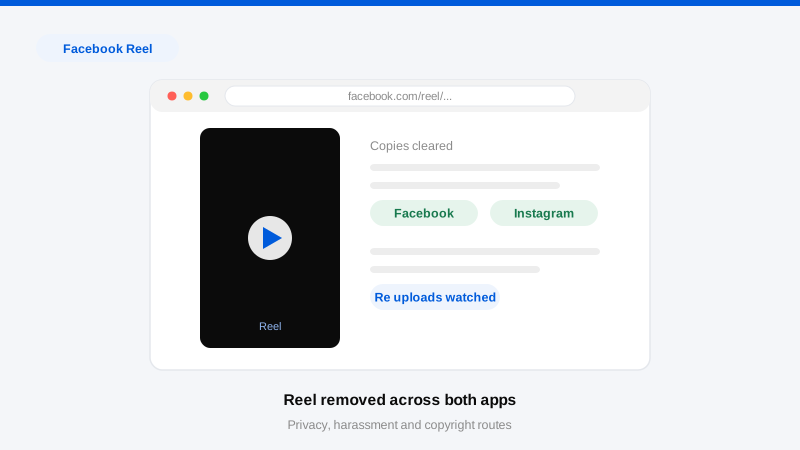
Removing a Facebook reel about you means getting the video taken down by Meta on a ground it already acts on. Harassment, bullying, adult nudity and privacy violations are all removable, and so is footage that belongs to you. Reels cross post to Instagram, so both apps have to be cleared.
Key facts
- A reel is distributed by recommendation rather than by following, so the audience is frequently far larger than the account that posted it.
- Meta’s Community Standards on bullying and harassment protect private individuals more strongly than public figures.
- Meta treats an address, a workplace, a vehicle plate, a child or contact details visible on screen as a privacy matter, whether or not the rest of the reel is accurate.
- Non consensual intimate imagery is handled through dedicated, prioritised channels and should be treated as an emergency rather than an ordinary report.
- Reels cross post to Instagram under a separate URL with a separate moderation queue, so both apps have to be cleared.
- Footage you own is protected under DMCA 512, so it does not depend on anyone agreeing that the reel is unfair.
- Under the EU Digital Services Act, platforms must give reasons for their decisions, so a wrongly declined complaint is no longer the end of the road.
How is a reel different from a post?
A post sits in front of the people who follow the account that made it. A reel is pushed by a recommendation system to people who follow nobody involved, which is why a reel about you can be seen by an audience a hundred times larger than the account’s own following.
Three other differences change how these matters are run.
Reels are remixable and downloadable, so within hours the same footage exists as a stitch, a duet style response, a re-upload with a new caption, and a file on somebody’s phone. Reels cross post: the same video is frequently live on Instagram under a different URL, and removing one does nothing to the other, and reels are short, so the harmful part is rarely a sentence you can quote. It is a caption, an on screen text overlay, a sound, and a face, which means the evidence has to be captured as video, not as a screenshot.
Which routes remove a reel?
More than one, and the strongest matters use several at once. Reels are made fast and carelessly, which is why they so often contain something the maker never thought about: your footage, your address in the background, a child’s face, a claim stated as fact.
The two grounds that carry the most weight here are harassment of a person and personal information visible on screen, and the second is consistently underused. Ownership of the footage matters as well, and false statements of fact sit outside platform policy and are decided by the law of your country. If the reel is sexualised or intimate and was shared without consent, that is an emergency rather than an ordinary matter, and you should contact us today rather than reporting it and waiting.
Timelines depend on the route and the platform, and are set out in writing after the free Exposure Scan.
Get a Free, Confidential Exposure Scan
Why does the same reel keep coming back?
Because removal acts on a video file at a URL, not on the content. When a reel is taken down, the copies already downloaded are untouched, the Instagram cross post has its own URL and its own moderation queue, the remixes made by other accounts are separate videos, and any re-upload is treated as new content that nobody has reported yet.
There is also an incentive problem. A reel that gets attention gets re-uploaded by accounts that had nothing to do with the original, purely because it performs. That is why a matter handled as “report the video” tends to be back within a fortnight, and a matter handled as an inventory of every copy across both apps tends to stay closed.
How we handle a reel matter
We capture the reel properly first, as video rather than as a screenshot, along with every copy we can find across Facebook and Instagram. A screenshot does not preserve the caption, the overlay, the sound or the account, and a reel deleted before it was captured is a matter you cannot act on.
Then we work every ground that genuinely applies, at the same time and across both apps in the same wave, because a reel left live on Instagram is simply recycled back to Facebook. We treat the video and the search result as two separate problems, since one can often be cleared whatever happens to the other. The work is verified across both apps, evidenced to you, and monitored afterwards, because these resurface.
Related: Facebook removal, image and video removal, and removing a TikTok bullying video, where the mechanics are similar but the platform is not.
If a child or a young person is in it
Content involving minors is handled differently by Meta and by us. Meta’s protections for people under 18 are broader than for adults, covering bullying, sexualisation and the publication of personal details, and the reporting routes are prioritised. Parents, schools and family offices contact us about this regularly, and we treat it as urgent from the first message. Nothing about the matter is discussed outside the people you name.
What Meta’s rules and the law say
Meta decides reel complaints against written standards, and which standard a matter falls under determines the outcome more than the facts do. That is the single reason so many honest, obviously justified complaints come back declined.
Bullying and harassment is the main policy route for a reel attacking a person. The protection given to a private individual is broader than the protection given to a public figure, because criticism of public activity is expected. In practice a founder is often treated as a public figure for claims about the business and as a private individual for anything about their family, health, appearance or home. Which side of that line you sit on changes what is possible, and it is rarely obvious.
Privacy is the underused one. Personally identifiable information visible on screen is removable whether or not the surrounding claims are accurate, and that includes a house, a street sign, a plate, a school uniform or a workplace. Intimate imagery shared without consent has its own prioritised channel, and in Australia the eSafety Commissioner runs a statutory image based abuse scheme that can compel removal.
Defamation is decided by national law rather than by policy. In England and Wales the Defamation Act 2013 requires serious harm to reputation, with serious financial loss for a trading company. Australia added a comparable serious harm element in 2021. In the United States, Section 230 means Meta is not liable for what the account posted, so removal there generally follows a court order. The EU Digital Services Act and the UK Online Safety Act 2023 both impose process duties on platforms, which is why a well built complaint is worth more now than it was five years ago.
What we need from you to start
- The reel URL, the account, and the URLs of every copy, stitch, remix or cross post you have already found on Facebook and Instagram.
- A downloaded copy of the video if you have one, because reels are deleted and re-uploaded constantly.
- Proof of ownership for any footage, images or music of yours in it: original files, upload dates, or the licence.
- The exact claims you say are false, each with what contradicts it.
- Anything personal that is visible on screen, flagged with the timestamp: your home, your car, your workplace, your children.
- Whether a person under 18 appears, because that changes both the route and the urgency.
- Written authorisation for us to act, and, where a privacy complaint is filed, confirmation from the person in the video.
Timelines and what usually happens first
Evidence first, and as video rather than screenshots. A reel taken down before it was captured is a matter you cannot act on, and reels are deleted and re-uploaded constantly.
After that, some routes move within days and some run on a legal timetable measured in weeks or months, depending on the country. Re-uploads are normally dealt with faster than the original. You get the realistic range for your matter in writing after the scan.
Common mistakes that make it harder
- Commenting on the reel or duetting it. Engagement is exactly what the recommendation system rewards, and it widens the audience you were trying to shrink.
- Reporting it as false information. Truth is not something a platform reviewer adjudicates in a personal dispute, and this is the most common reason these reports come back declined.
- Asking your followers to report it. Coordinated flagging is detectable, gets discounted, and can be treated as abuse of the reporting tools.
- Clearing Facebook and leaving Instagram. The cross post gets recycled straight back within days.
- Screenshotting instead of archiving. You lose the caption, the sound, the overlay and the account details that the filing depends on.
- Messaging the account holder in the moment you find it. Whatever you send becomes the next reel’s on screen text.
- Deleting the abusive direct messages. They are frequently the strongest evidence of a harassment pattern.
How this works alongside your lawyer, PR team or security team
Your counsel owns the legal reporting form, any pre action correspondence, and any application to identify an anonymous account. We prepare the video archive, the frame by frame breakdown and the falsity evidence, which is the part that takes time and does not need a lawyer to do.
Your PR team owns whether you say anything. With reels the usual answer is nothing, because a response is content and content is what the format rewards. Where a correction is genuinely needed, it goes out on a channel you control and after the removals land, not before.
Your security team is involved as soon as a home, a vehicle, a school or a routine is visible on screen, or where the comments start organising something offline. For family matters we work with the family office or the household security lead directly and keep the circle as small as you want it.
Who usually makes first contact and what the 15 minute call covers
The person in the reel, their manager or agency, or a parent. With younger clients it is almost always a parent or a school, and with talent it is almost always the manager.
Before the call we watch the reel, look for the copies across both apps, and check whether anything is already surfacing in search on your name. The call is fifteen minutes and mostly us listening, then telling you which routes apply, how many copies exist, what is realistically removable and in what order. Everything is under NDA, nothing is filed without your approval, and the written assessment is yours to keep whether you engage us or not.
Frequently asked questions
Can I get a reel removed if it is just someone’s opinion about me?
Not on the basis of the opinion itself. Opinion is not removable anywhere. What is often removable is everything around it, and reels made in a hurry usually contain more of that than the maker realised. We tell you at the assessment stage what actually applies rather than raising your hopes.
The reel is also on Instagram. Is that one filing or two?
Two problems, one matter. They are separate URLs on separate moderation queues even though the same company owns both, and clearing one and leaving the other is how these come back. We always deal with both apps together.
Will reporting it tell the person who complained?
Not in an ordinary policy complaint. A legal route is different, because the platform may pass details of the claim to the account holder. We tell you which approach carries which exposure before anything is done in your name.
Someone downloaded it before it came down. What then?
Assume they did. That is why monitoring for re-uploads is part of the work rather than an extra, and why the second removal is far faster than the first.
How quickly can this move?
Some of these move within days and some run for months, depending on the reel and your jurisdiction. Intimate imagery is treated as urgent. Nobody honest gives you a date, and any range we give you is a range rather than a commitment.
Who do you normally work with on these?
The person in the reel, their manager or agency, or a parent. We work under NDA alongside your counsel, PR and security teams, and the written assessment is yours to keep whether you engage us or not. Fees are quoted in writing after the free scan.
Should I ask the person to take the reel down myself?
Usually not, and never in the hour you find it. A message from you is content the account can post, and it tells them the reel is working. Where an approach is genuinely the best move, it comes from us or from your counsel rather than from you.
What if the reel is being promoted as a paid ad?
Then it is often more exposed rather than less. Advertising is held to a stricter standard than ordinary posts, particularly around impersonation, financial claims and personal attacks, and stopping the spend limits the damage while the rest is dealt with. It is one of the first things we look at.
Send us the link and any copies you have already found. Start with a free, confidential Exposure Scan or read how we work. The 15 minute call is with someone who runs these matters daily, and you will come away knowing exactly what can be removed.