Removing a TikTok video that bullies your child means getting it taken down under the rule it actually breaks, acting as the child’s parent or guardian, and chasing every repost before the clip settles on Instagram Reels and YouTube Shorts. Speed matters more than anything else here. A video removed in hours rarely spreads.
Key facts
- TikTok’s Community Guidelines cover bullying and harassment, youth safety and well-being, privacy violations, and violent or hateful behavior.
- TikTok applies stricter protections to anyone under eighteen, so stating the child’s age and the guardian relationship changes how a report is handled.
- A parent or legal guardian can act on a child’s behalf, and that carries far more weight than anything sent from the child’s own account.
- Where your household filmed the original footage, the DMCA protects it on every platform hosting a copy, which is often a family’s strongest position.
- Google and Bing both act on imagery of minors independently of whatever the platform decides about the video.
- Instagram Reels, YouTube Shorts, Snapchat and Facebook each decide for themselves, because a removal on TikTok does not touch a copy elsewhere.
- Evidence disappears when a video is removed, so a family that reports first and saves nothing is often left with nothing.
Which TikTok policies actually get a video removed
TikTok removes content that breaks one of its own written rules, and the rules that matter to a family are bullying and harassment, youth safety, privacy, and violent or hateful behavior. The single most important fact in any of these matters is the child’s age, because TikTok applies far stricter protections to anyone under eighteen than it does to an adult in the same situation.
Sexual content involving a minor is not a moderation question at all. It is an emergency, it is handled as one by TikTok and by law enforcement, and it should never be dealt with quietly.
What TikTok will not remove is a clip your child finds embarrassing but which breaks no rule. We tell families that plainly rather than raising hopes and spending their money on complaints that will fail.
Reporting as a parent or guardian
TikTok will accept a parent or legal guardian acting on behalf of a child, and that changes how the matter is treated. A complaint from the child’s own account is one more user report in a very large queue. A properly made guardian complaint is a different object entirely, and this is the single biggest reason families who have already reported a video get nowhere and assume nothing can be done.
Families we work for are often not the ones filing. The first call usually comes from a family office, a private office manager or the family’s security lead, sometimes before the parents have seen the video. That is a good sequence, and it is why our family office page exists.
The video will not stay on TikTok
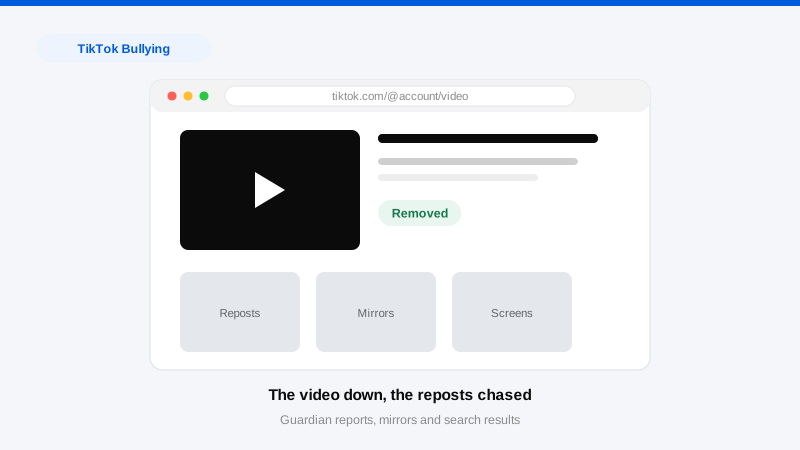
Assume it is already elsewhere. Within a day a clip that gets traction is downloaded, reuploaded by accounts that trade in other people’s content, and cut into Instagram Reels, YouTube Shorts, Snapchat and group chats. Removing the TikTok original while leaving eight copies running gives a family a false sense of resolution, and it is the single most common way these matters go wrong.
Each platform decides for itself, so a removal in one place does nothing to a copy in another. Timelines depend on the platform and the route, and are set out in writing after the free Exposure Scan.
Get a Free, Confidential Exposure Scan
What to preserve before you do anything
Keep everything, and do it before anyone reports anything. Once a video is removed the record of it goes too, and a school investigation or a police report six weeks later will need what nobody thought to save. That includes the messages your child would rather delete.
This is uncomfortable and it is essential. If you have already reported the video and it has gone, tell us, because there is usually still something recoverable.
How we run a family case
We triage in the first hour: what is live, where it has already spread, how fast it is moving, and whether anything in it crosses a line that needs the police today rather than a report. Then we act on the strongest ground available, across every platform the clip has reached rather than only the one you were sent, and we keep going until the copies stop appearing.
Search is handled separately from the platforms, because a child’s name attached to a bullying clip is exactly the kind of result that can be dealt with even where a video survives. Everything is verified and reported to you in writing, so the family has a record for the school and for counsel, and monitoring continues for as long as you want it, because the same accounts try again. See remove images and videos and remove a Facebook Reel.
School, police and counsel
Involving the school is usually right when the accounts belong to pupils, and schools in most countries have a duty to act on bullying that reaches their community even when it happens off site. Involving the police is right when there are threats, when the content is sexual, when there is extortion, or when the same person will not stop. Those thresholds are lower than most parents assume.
We are not lawyers and we do not replace them. We work alongside your counsel, your family office and, where there is one, your security team, and we handle the removal work so the family can deal with the child. Our wider cyber abuse and TikTok pages cover the surrounding cases.
What the platform’s rules and the law say
TikTok’s Community Guidelines are the operative document, and they are enforced as rules rather than as a judgment about who is right. Everything involving a minor is applied more strictly than the equivalent content about an adult, which is the most useful fact a family has.
The law sits behind those rules and varies by country. In the United Kingdom the Online Safety Act 2023 places duties on platforms to protect children, and harassment and malicious communications are criminal matters handled by the police rather than by us. Across the European Union the Digital Services Act obliges platforms to act on unlawful content and to give reasons for their decisions, and GDPR Article 17 supports removal of a child’s personal data from search, with regulators treating children’s data as deserving particular protection. In the United States, Section 230 keeps the platform out of the liability question, so the practical routes are the guidelines, the school and, where conduct crosses a line, the police.
Schools in most countries carry a safeguarding duty that extends to bullying reaching their community even when the filming happened off site. That duty is often the most useful lever a family has, and it does not depend on any platform decision.
What we need from you to start
Nothing is required for the scan. To file properly we need a small, boring evidence pack.
- Links to the video, the account, and any repost you have already found, plus screenshots relatives have sent you.
- The child’s full name and date of birth, and confirmation that you are the parent or legal guardian.
- Your own copy of the original footage where the video came from your household, with proof of who filmed it.
- The names of any accounts you believe belong to pupils, and the school’s name, if the family intends to involve the school.
- Any contact from the poster, including messages demanding money or attention, preserved rather than deleted.
- One named adult who can make decisions quickly, because these cases move in hours.
NDA is standard, and nothing about the child is shared beyond what a report requires.
Timelines and what usually happens first
The first hour is triage and capture. We establish what is live, where it has already spread, and whether anything in it needs immediate escalation to the police rather than a report.
Clear breaches involving a minor are often actioned within hours. Other routes run in days, and school and police processes run on their own timetable measured in weeks. Nobody can promise a time on any of it, and any firm that does is selling you something. What we can do is tell you where each item stands, in writing, as it moves.
Common mistakes that make it harder
- Waiting to see whether it fades. The first day is when a clip is cheapest to remove and least likely to have been downloaded.
- Letting the child reply. A reply is the reaction the accounts wanted and it usually produces a second video.
- Posting a public statement. It introduces the clip to everyone who had not seen it.
- Letting the child report it from their own account. It is treated as one more user report in a very large queue.
- Deleting the evidence. Parents often block the account and clear the screenshots, then need them six weeks later for the school or the police.
- Contacting the other child’s parents first. Sometimes right, often not, and it can prompt a rush of reposts before anything has been filed.
- Reporting it yourself in the first hour. A rejection marks the item as reviewed and makes a better complaint harder to land afterwards.
Working alongside the school, counsel and a security team
We handle removal. We do not replace your lawyer, your school’s safeguarding lead or your security team, and we work openly with all of them.
For families with counsel, we supply the evidence pack in a form a solicitor or attorney can use, and we file nothing that would cut across advice they have given. Where a family office or private office manager runs the household, they usually hold the practical detail that makes a privacy report work: which school, which uniform, which address appears in the frame. Where there is a security team, they take the offline side, including anything that suggests a person is being followed or approached. Our wider cyber abuse work covers cases that escalate past a single video.
Who usually makes first contact and what the 15-minute call covers
First contact is a parent, or a chief of staff, private office manager or security lead acting for the family, sometimes before the parents have seen the video. Either is fine.
Fifteen minutes covers what is live and where, which items are removable and on what ground, what we would need from you today, and whether the school or the police should be involved now rather than later. Nothing is signed on the call, everything is confidential, and if the answer is that one report will fix this, we will tell you that instead of proposing work.
Frequently asked questions
How fast can a TikTok video be taken down?
Clear breaches involving a minor are often actioned within hours. Weaker cases run to days. Nobody can promise a time, and any firm that does is selling you something.
The account is anonymous. Does that stop us?
No. Removal does not require knowing who posted. Identifying the poster matters only if the family wants to pursue them, and that is a decision for counsel after the content is down.
My child recorded the video themselves and it was reposted. Does that help?
Yes, significantly. Where your child or your household owns the original footage, your position is much stronger than most parents realise, and it holds on every platform hosting a copy.
What if TikTok rejects the report?
Rejections are common on a first attempt and are rarely the final answer. There is almost always another way at it, and a declined report is a reason to get help rather than a reason to give up.
Should we respond publicly or post something?
Almost never. A response gives the clip a second life and hands the accounts involved the reaction they wanted. Quiet removal, monitoring and, if needed, school action does more.
Who normally makes first contact?
A parent, or a chief of staff or private office manager acting for the family. Everything is confidential and NDA is standard. The 15-minute call is short and practical, and the report we produce is yours to keep.
Can you stop the video being reposted after it is removed?
Not absolutely, and we do not promise that. What we do is monitor for reuploads across the platforms these clips travel to, so a new copy is caught within days rather than found by a classmate months later. Each new copy is dealt with far faster than the first.
The bullying is in the comments rather than the video. Is that removable?
Yes, and often faster. Comment level harassment aimed at a named minor breaches the bullying and youth safety rules on its own, and a pile-on is treated as a pattern rather than as a list of separate comments.
If a video of your child is up now, do not wait to see whether it fades. Start with a free, confidential exposure scan: we find every copy across every platform, tell you what is removable and on what ground, and show you our process before you commit.