Cybersecurity starts inside. We clean up the exposure outside.
Cybersecurity content removal reduces the public information and impersonating content attackers use to target your business and its people. We remove exposed personal details, phishing and clone sites, fake accounts and leaked files, then address the search footprint an attack leaves behind.
- Executive and employee home addresses, phone numbers and family details
- Phishing sites, clone websites and lookalike domains
- Fake executive profiles and brand support accounts
Free assessment · Covered by NDA · Reply within 8 to 12 hours










How our cybersecurity service works
Map external exposure
Agree the business, leadership and employee information in scope alongside your security lead.
Remove and verify
Assess each source and record content removal separately from search-result removal.
Watch for recurrence
Optional Protection Plans monitor for new copies, impersonators and renewed exposure.
A senior specialist replies within 8 to 12 hours. Source-specific removal estimates follow assessment; this is not a technical incident response service.
Why us?
Removal at the source
We go after the page where it lives, not just its listing, so it stops resurfacing.
One specialist, start to finish
A dedicated specialist runs your case from assessment to final verification and keeps you updated.
Verified results
Each outcome checked across Google, Bing and the source site before we call it done.
Confidential by default
Discretion from the first call. We never disclose client relationships.
- Executive and employee home addresses, phone numbers and family detailsAssess
- Phishing sites, clone websites and lookalike domainsAssess
- Fake executive profiles and brand support accountsAssess
- Leaked credentials, documents and database copiesAssess
- Paste sites, forums and file-host mirrorsAssess
- Telegram and Discord leak channelsAssess
- Dark-web sources, assessed case by caseAssess
- Damaging breach search results and inaccurate AI answersAssess
Gone where it lives, not just hidden
Source removal takes the page down from the site hosting it. De-indexing clears it from search when the host will not act. We assess both for every link and tell you which is realistic before any work starts.
What does cybersecurity content removal cover?
Your security team protects the systems you control. We focus on harmful content outside those systems: the exposed address that makes an executive easier to target, the clone site collecting customer details, or the stolen file still accessible after an incident. The outcome is less accessible exposure, not a claim that your network is secure.
This is external attack-surface clean-up focused on published information and impersonation, not vulnerability scanning or a software platform. We work for businesses, brands, founders, executives, HNW individuals and family offices that need a managed removal engagement with a defined scope. Request a confidential assessment or start with a Free Exposure Scan.
Which public details help attackers target your people?
Home addresses, private phone numbers and family details can make social engineering more convincing and turn a business threat into a personal one. Exposed employee information also gives impersonators material for targeted phishing and whaling, where an attacker pretends to be or targets a senior decision-maker.
We assess exposed personal data, people-search listings and published records for removal where appropriate. Data broker removal addresses broker listings within that footprint. For an individual leader's broader privacy and reputation mandate, see digital executive protection. This cybersecurity service is the coordinated business-facing engagement across people, brand abuse and attack-related content.
The distinction is reflected in the wider security market: ZeroFox describes external threat disruption as including exposed personal information, phishing and impersonation. Our part is the content clean-up, not its wider technical security offering.
Can phishing sites and brand impersonators be removed?
We assess phishing pages, cloned websites and lookalike domains that impersonate your brand, along with fake executive profiles and fake support accounts. A cloned login page and a social profile sending customers to it belong in the same assessment, rather than separate unconnected lists.
Our impersonation removal service handles fake accounts and copied identities. The cybersecurity engagement connects that work to exposed staff information, leaked files and the wider external footprint. Taking a page offline does not reverse transactions, recover an account or secure a compromised mailbox.
What changes after a breach or ransomware attack?
Technical containment does not remove stolen credentials, documents or database copies already published elsewhere. We assess accessible copies across the open web, paste sites, forums, file hosts, Telegram and Discord. Dark-web sources are assessed case by case, together with the mirrors and search results that make leaked material easier to discover.
Start with data breach removal for the overall clean-up. Leaked documents removal covers internal files and databases; dark web takedown assesses leak sources and accessible copies; ransomware leak removal focuses on published extortion-related data. Removal cannot invalidate stolen credentials or confirm deletion of private copies.
Who owns security, legal decisions and the published content?
We work alongside your security team or MSSP, incident response firm, breach counsel and insurer. Your designated lead agrees the removal priorities, evidence handling and updates with us. Those teams retain their own responsibilities; we handle the agreed published exposure under NDA.
We do not provide penetration testing, firewalls, endpoint security, incident response, forensics, malware removal, decryption or ransom negotiation. We do not provide legal advice, breach notification services or insurance. Preserve evidence and involve your incident response provider and counsel. Do not pay or contact attackers without counsel. Your security team should reset exposed credentials.
Do not upload stolen databases, live passwords or sensitive records with an initial enquiry. Begin with a short description and the affected links through our confidential assessment.
What happens to breach search results and AI answers?
A copied file, misleading article or persistent breach result can remain visible after the technical incident is resolved. We assess the underlying content and its search visibility separately. Source removal takes content down where it is hosted; search removal reduces discovery without necessarily deleting the original.
Our data breach reputation management service addresses damaging search exposure and inaccurate or outdated breach content, including material reflected in AI answers. We assess what can be changed without promising control of a search engine or AI system. For public examples of the lasting commercial consequences, read data breach case studies. These are public incidents, not our client results.
How do you keep external exposure under review?
A fake account can return with a different name. A stolen archive can appear on a new file host. Our Protection Plans provide ongoing monitoring and removal support within an agreed scope, so newly discovered exposure has a clear owner.
We distinguish content removed at source, search results removed, sources still under review and exposure outside the engagement. Monitoring does not mean every private copy can be found. Your security team continues to own systems, access and technical defenses.
Frequently asked questions
Is this a managed IT cybersecurity service?
Can you remove executive and employee personal information?
Do you handle phishing sites and lookalike domains?
Can you remove leaked credentials and database copies?
What about stolen information on the dark web?
How is this different from digital executive protection?
Can you monitor for new leaks and impersonators?
Will you work with our response firm, counsel and insurer?
Ready to take it down?
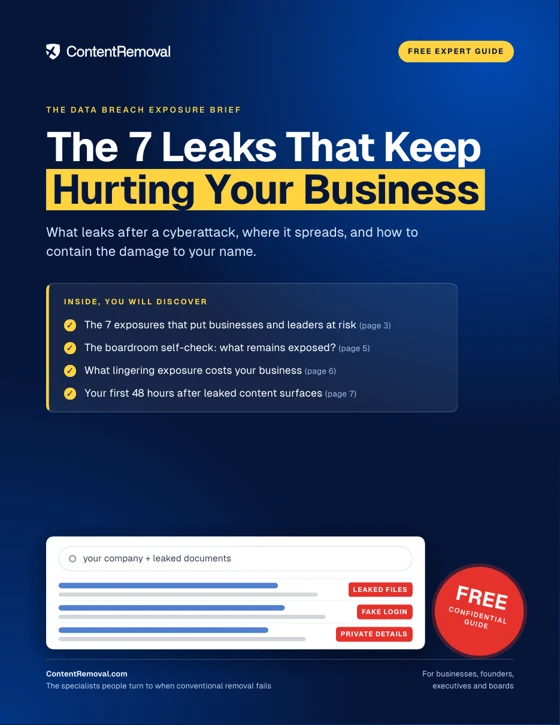
Free brief for businesses and leaders
The 7 Leaks That Keep Hurting Your Business
Inside the free guide:
- The 7 exposures that put businesses and leaders at risk
- The boardroom self-check: what remains exposed?
- Your first 48 hours after leaked content surfaces
Guide on its way
Check your inbox,
We have emailed you the guide. You can also download it right now.
Already dealing with something? A senior specialist will tell you honestly what can be removed.