
Data privacy best practices for high-profile leaders follow a sequence: know what sensitive information exists, restrict and encrypt access to it, control vendors, analytics and retention, handle rights requests properly, monitor access, and prepare legal, technical, communications and content-removal teams to respond together when material is published. Each control needs an owner, a decision rule and an escalation path.
Key facts
- Start classification with the repositories that would cause the greatest harm if exposed, such as tax and identity records.
- Keep encryption keys separate from the data they protect and monitor decryption activity.
- GDPR Article 33 requires regulator notice within 72 hours of awareness where feasible.
- The article sets a 30, 60 and 90 day sequence: risk picture, protect key data, rehearse a leak.
Where ContentRemoval.com comes in. Internal controls reduce what can leak, but once private correspondence, identity documents or family records reach the open web, securing the database does nothing about the copies. ContentRemoval.com handles that outside layer: source removal, de-indexing, data broker cleanup and monitoring for reuploads. General counsel, a family office or a security lead usually make contact. A free 15-minute Exposure Scan maps what is removable, and the report is yours to keep. Get a Free, Confidential Exposure Scan or read how our personal data removal work is done.
A chief executive discovers that private correspondence, family records, or credentials are circulating outside the organization. A family office learns that a vendor retained sensitive files long after the engagement ended. A legal team receives notice that confidential material has reached a search engine, an online forum, or a data broker. At that point, privacy is no longer a policy question. It’s a leadership crisis involving legal exposure, technical containment, stakeholder confidence, and personal safety.
Effective data privacy best practices must connect those functions. They should identify sensitive information before exposure, restrict and protect access, govern vendors and retention, and prepare a coordinated response when controls fail. A useful privacy commitment can also be communicated clearly to stakeholders, as shown by MyHalo’s privacy commitment.
The sequence below follows the point at which each control reduces risk. First, know what exists. Next, limit access and protect the data that must remain. Then control third parties, analytics, retention, and individual rights. Finally, prepare legal, technical, communications, and content-removal teams to act together when sensitive material is published.
1. Data Classification and Inventory Management
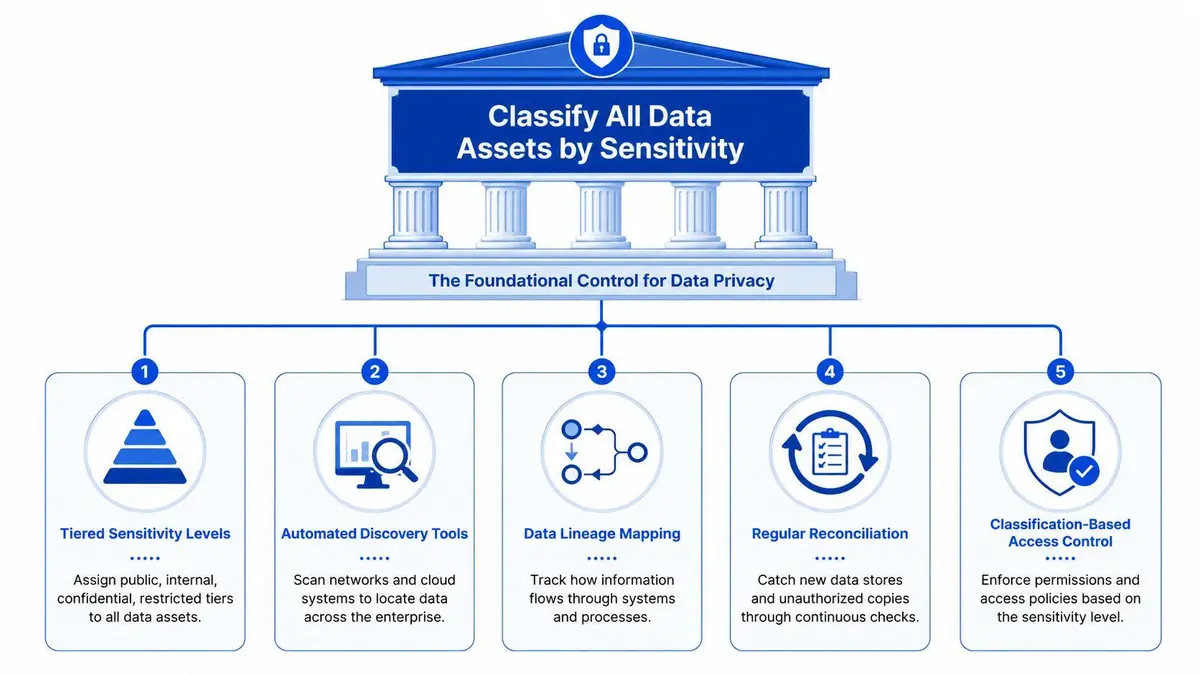
You can’t protect information you can’t locate or distinguish. A high-profile executive’s personal address, a family office’s estate plan, an investment firm’s trading model, and a public marketing brochure shouldn’t sit under one undifferentiated access policy. Classification gives each asset a sensitivity level and connects that level to encryption, permissions, monitoring, retention, and response obligations.
Start with the information that would cause the greatest harm if exposed. For a family office, that may include tax returns, investment account details, travel arrangements, identity documents, and private correspondence. For a technology founder, it may include product roadmaps, financing materials, board communications, and employee records. Create a written decision rule for each category, then require business leaders to validate the context. IT can identify where data sits, but the business owner usually knows why it matters.
A practical inventory should record the system, data owner, purpose, users, storage location, vendors, retention requirement, and applicable legal restrictions. Include email, cloud drives, collaboration tools, laptops, mobile devices, backups, physical files, and personal accounts used for business activity.
Practical rule: Begin with the highest-risk repositories. A focused, accurate inventory is more useful than an organization-wide spreadsheet that nobody maintains.
Use content scanning to classify high-volume email and file stores, but spot-check the results. Classification is living governance, not a one-time technical project. Review it when business priorities, vendors, systems, or family circumstances change.
2. End-to-End Encryption for Data at Rest and in Transit
Encryption should protect sensitive information while it’s stored and while it moves. It doesn’t prevent every incident, but it can stop an unauthorized person from immediately using a stolen contract, photograph, financial file, or private message. That distinction matters when an attacker reaches infrastructure, a device disappears, or a communication channel is intercepted.
Require encryption by default. Stored data should use a managed cryptographic service, and transmitted data should travel through protected connections. AWS KMS, Azure Key Vault, and Google Cloud KMS provide established approaches to key management. Don’t allow individual users to decide whether sensitive files deserve protection. They’ll make inconsistent choices under time pressure.
Keep encryption keys separate from the data they protect. If a compromise exposes both the repository and its keys, encryption provides little practical resistance. Restrict key administration, monitor decryption activity, and investigate unusual patterns. A sudden increase in decryption requests, access from an unfamiliar environment, or repeated failed key operations can indicate compromise.
Recovery deserves equal attention. Your team needs to know how authorized personnel will decrypt information during an incident without weakening controls. Test recovery procedures regularly, document ownership, and preserve emergency access under controlled conditions.

Encryption reduces the usefulness of exposed data. It doesn’t replace classification, access control, retention limits, or a response plan.
3. Zero-Trust Access Control Architecture
A perimeter is not an access policy. Executives, contractors, advisers, assistants, and vendors work across offices, homes, airports, personal devices, and cloud applications. A zero-trust architecture verifies every access request instead of assuming that a person or device is safe because it’s inside a network.
Apply least privilege to the highest-value information first. A family member may need access to correspondence but not tax records. An investment professional may need deal documents but not personal medical information. A departing employee should lose access immediately, including access through shared accounts, tokens, mobile devices, and third-party applications.
Use multifactor authentication, device-health checks, role-based permissions, and contextual risk decisions. A familiar user on a managed device may receive routine access to ordinary work systems. A new device requesting financial records should trigger stronger verification or human review.
Make permissions reflect actual responsibility
Write roles narrowly. “Executive support” is not a sufficient permission definition if it grants access to every repository. Document the specific systems and data each role requires, then automate provisioning and deprovisioning. Manual access administration creates dormant accounts and forgotten permissions.
Review privileged access on a recurring schedule. The review should confirm that the user still needs access, the device remains managed, and the account’s activity matches the role. Segment tax records, investment accounts, household information, and business correspondence rather than relying on one broad family-office login.

For a practical implementation perspective, review Bizbe’s data room best practices, then adapt the controls to your organization’s risk profile.
4. Privacy by Design in Product and System Development
Privacy decisions made after launch are usually expensive and incomplete. Product teams should define what information they need, why they need it, how users provide permission, how long the information remains available, and how deletion will work before development begins.
Add privacy requirements to the same planning system used for functional requirements. A user story should cover consent withdrawal, data export, deletion, access logging, and retention behavior where those functions apply. Threat modeling should examine privacy harms as well as unauthorized access. Ask whether a system could expose a person through inference, excessive visibility, searchable records, or unnecessary data fields.
Real products illustrate different design choices. Apple’s App Tracking Transparency requires applications to request permission before tracking across apps. DuckDuckGo has built its search service around avoiding collection or profiling of user search history. Signal is designed to minimize metadata while supporting private communications. These examples don’t eliminate all privacy risk, but they show how product architecture can limit collection and downstream exposure.
Set privacy as the default state
Audit production behavior against the original design. Scope creep often adds analytics fields, backup copies, integrations, and administrative access that weren’t part of the initial privacy assessment. The system should collect the minimum information necessary for its stated function, with restrictive defaults and clear user controls.
Make deletion as visible as creation. Users shouldn’t need a specialist to locate a privacy setting or understand what happens after a request. The development team should be able to demonstrate which systems receive deletion instructions and how the organization verifies completion.
5. Comprehensive Data Retention and Secure Deletion Policies
Every retained record creates another opportunity for unauthorized access, accidental disclosure, or future publication. A retention policy must therefore answer a specific question for each category: what lawful or operational purpose justifies keeping this information, and when does that purpose end?
Write retention rules with legal counsel, records managers, security personnel, and business owners. Separate regulatory obligations from convenience. A team may want to retain every email forever, but convenience isn’t a defensible privacy rationale. Apply shorter retention to credentials, authentication tokens, payment information, identity documents, and obsolete copies unless a documented legal hold or business requirement applies.
NIST SP 800-122 advises organizations to collect personally identifiable information that’s directly relevant and necessary for a specified purpose, then retain it only as long as needed for that purpose. The NIST Privacy Framework also treats minimization as a way to reduce privacy risk and improve manageability.
Make deletion verifiable
Automate deletion where possible, including backups, replicas, archives, and vendor-held copies. Preserve deletion logs, generate alerts for failures, and investigate exceptions. A deletion policy that removes a visible record while leaving searchable backups intact creates false assurance.
Organizations must also understand how deletion rights intersect with legal holds and public exposure. Once personal information has reached the open web, internal deletion doesn’t remove copies from search results, archives, or reposting networks. For that separate problem, review the right to be forgotten in the USA.
6. Third-Party Data Handler Agreements and Vendor Risk Management
Your privacy posture includes every provider that can view, store, transmit, analyze, or recover your information. Cloud hosts, payroll companies, accountants, law firms, marketing agencies, communications platforms, and household service providers can all become part of an executive’s exposure chain.
Before granting access, define the permitted purpose, data categories, security requirements, subcontractor restrictions, return and deletion duties, audit rights, and incident-notification process. Use appropriate data processing agreements and contractual transfer mechanisms where applicable. Require current evidence of relevant controls, such as SOC 2 or ISO 27001 certification, but don’t treat a certificate as a substitute for reviewing the actual service scope.
Escalate vendor incidents immediately
A vendor shouldn’t notify only an IT contact while attempting to resolve a privacy event. Contract terms should route suspected exposure to legal, security, executive leadership, and the relationship owner. The agreement should preserve investigation rights and require evidence about affected systems, data categories, access paths, and containment.
Review critical vendors periodically. Check whether permissions remain necessary, whether subcontractors changed, whether deletion occurred, and whether the provider still meets the agreed standards. Vendor risk scoring can help prioritize attention, but the score must lead to a decision, not sit in a procurement system.
Executives and family offices should also assess exposure outside formal corporate vendors. A broker listing, people-search record, or doxxing page may reveal information that a carefully drafted contract never addressed. Data broker removal services for executives can address that external layer through removal and suppression work.
7. Privacy-Preserving Analytics and Aggregate Reporting
Analytics teams often ask for individual-level data because it’s convenient, not because the business question requires it. Give them the least detailed dataset that can support the decision. Aggregate reporting, pseudonymization, k-anonymity, and differential privacy can reduce the number of people who handle identifiable records and limit the consequences of an accidental disclosure.
Start by defining the minimum useful resolution. A board report may need regional trends, customer segments, or overall engagement rather than names, exact locations, or individual histories. A healthcare team may need treatment patterns without patient identities. An e-commerce team may need purchase behavior in groups rather than a record tied to one household.
Differential privacy introduces calibrated noise to help prevent a person’s participation from being inferred. K-anonymity groups records so an individual isn’t uniquely distinguishable within the released dataset. Aggregate-only reporting removes the need to distribute raw records for many routine decisions. None of these methods is automatically safe. Small groups, repeated queries, linked datasets, and unusual attributes can still create re-identification risk.
Govern analytical usefulness
Privacy counsel and data scientists should approve the architecture together. Document what information is removed, generalized, or perturbed, and explain the effect on accuracy. Use established libraries such as Google’s Differential Privacy library or OpenDP rather than building an untested implementation.
Test whether the protected output answers the original business question. If it doesn’t, revise the question or the method. Don’t restore unnecessary personal detail because a dashboard was designed around raw records.
8. Data Subject Access Request Management and Response Procedures
A privacy-rights request is an operational event, not an email for customer service to forward casually. The organization must verify the requester, locate relevant information across systems, assess exemptions, redact protected material, and provide an intelligible response within the applicable legal timeframe.
Build the process around a data map created before requests arrive. Identify where account data, interaction histories, analytics records, support tickets, communications, backups, and vendor-held information reside. Assign each system an owner who knows how to search it and how to preserve evidence of the search.
Legal counsel should approve redaction rules. A response may contain another person’s information, privileged material, confidential business information, or security-sensitive details that require separate treatment. Customer-facing teams need a clear escalation route so they don’t debate the request or ask the individual to repeat it.
Automate the workflow, not the judgment
Use DSAR management software to record identity verification, deadlines, assignments, searches, redactions, approvals, and delivery. Spreadsheets make ownership and deadline failures difficult to detect. Set internal service levels that leave counsel time to review the final response.
The request process also exposes weaknesses in the underlying privacy program. If a team can’t find a person’s data, it may lack inventory controls. If deletion is inconsistent, retention enforcement needs attention. If a vendor can’t return records in a usable format, the contract and technical integration are inadequate.
Treat each request as both a rights obligation and a control test. The organization should be able to explain what it holds, why it holds it, who receives it, and how it will remove or correct it.
9. Continuous Monitoring, Logging, and Anomaly Detection for Data Access
Access controls prevent some misuse. Monitoring identifies what happened when prevention failed or when an authorized account behaved abnormally. Logs should record who accessed sensitive data, what they accessed, when, from where, and what action they took.
Prioritize repositories containing personal financial information, identity documents, credentials, executive communications, health information, and proprietary business material. Establish normal activity before tuning alerts. An assistant who routinely accesses a small set of family-office records should not suddenly export an unfamiliar collection of documents without scrutiny. A system administrator’s broad access may be legitimate, but it still requires stronger logging and review.
Detection rules should reflect the business. Off-hours access may be ordinary for a global organization and suspicious for a local office. Large exports, repeated searches for a particular executive, access from an unmanaged device, and unusual download patterns deserve different escalation paths.
Preserve evidence outside the compromised system
Audit logs must be protected from alteration by ordinary system users. Send them to a separate, access-controlled repository with integrity protections and defined retention. Connect alerts to the incident-management system so someone owns investigation and closure.
Monitoring also extends beyond internal systems. Public leaks, credential dumps, impersonation accounts, and exposed personal records can signal that an access incident has already moved into the public domain. A focused dark web monitoring service can support detection and escalation, but it doesn’t replace forensic investigation or legal analysis.
10. Incident Response, Breach Notification, and Governance Reviews
A breach plan should assign responsibility before anyone discovers the incident. The response team needs legal counsel, forensic investigators, security leadership, executive decision-makers, communications personnel, affected business owners, and a specialist capable of addressing public copies of the material.
Under Article 33 of the GDPR, a controller must notify the competent supervisory authority without undue delay and, where feasible, no later than 72 hours after becoming aware of a personal data breach. A late notification requires an explanation. The legal team should maintain a notification decision matrix covering regulators, affected individuals, contractual partners, insurers, and other relevant recipients.
Containment and notification aren’t the only workstreams. Preserve forensic evidence, isolate compromised accounts, secure credentials, identify the data involved, and document every decision. At the same time, communications personnel should prepare accurate statements, while content-removal counsel assesses search engines, websites, social platforms, forums, data brokers, and reposts.
A public leak requires two response plans running together. One addresses the incident inside the organization. The other limits visibility and redistribution outside it.
The CFTC recommends that regulated entities assess privacy and security risks, implement controls, test them regularly, report at least annually to the board, and maintain an incident-response program. Use that governance discipline even where another regulator applies. Audits should produce prioritized remediation, named owners, budget, and a board-level escalation route.
Top 10 Data Privacy Best Practices Comparison
| Control | Implementation complexity | Resource requirements | Expected outcomes | Ideal use cases | Key advantages |
|---|---|---|---|---|---|
| Data Classification and Inventory Management | Medium, process + tooling integration | Discovery tools, data owners, governance processes | Clear map of sensitive assets; prioritized controls | Organizations with mixed data stores; executives tracking personal/financial records | Targeted protection; faster incident scope identification |
| End-to-End Encryption for Data at Rest and in Transit | Medium, crypto and key management | Encryption libraries/HSMs/KMS, network TLS, key ops personnel | Data unreadable if exfiltrated; reduced exploitability | High-risk communications, stored archives, executive messaging | Strong technical protection; regulatory alignment |
| Zero-Trust Access Control Architecture | High, architectural and cultural change | IAM, MFA, device posture, microsegmentation, ongoing ops | Minimizes lateral movement; tighter access control | Remote work, privileged access to executive assets | Limits insider compromise; auditable access trails |
| Privacy by Design in Product and System Development | Medium, process and culture shift | Privacy experts, design reviews, developer training | Reduced data collection; privacy-native products | New products, startups, regulated markets | Lowers breach scope; builds customer trust |
| Comprehensive Data Retention and Secure Deletion Policies | Medium, policy + automation | Retention tooling, legal counsel, deletion automation | Smaller data footprint; less historical exposure | Firms holding long-lived records, executives with legacy data | Limits attack surface; compliance with “right to be forgotten” |
| Third-Party Data Handler Agreements and Vendor Risk Management | Medium, contractual and monitoring effort | Legal templates, vendor assessments, risk scoring | Contractual accountability; faster breach notification | Organizations using many vendors/cloud providers | Reduces vendor risk; creates legal remedies |
| Privacy-Preserving Analytics and Aggregate Reporting | High, specialized techniques | Differential privacy libraries, analytics engineers | Actionable insights without individual-level exposure | Analytics teams needing aggregate insights in regulated sectors | Enables analytics with reduced re-identification risk |
| Data Subject Access Request (DSAR) Management and Response Procedures | Medium, process + system integration | DSAR platform, legal team, system connectors | Timely compliance responses; discovery of data gaps | Consumer-facing services, regulated companies | Regulatory compliance; reveals hidden data copies |
| Continuous Monitoring, Logging, and Anomaly Detection for Data Access | High, scalable telemetry and SOC capability | SIEM/UEBA, logging infrastructure, analysts | Faster detection and containment; forensic evidence | Environments with high-value data access (finance, health) | Detects insider/compromise; supports investigations |
| Incident Response, Breach Notification, and Governance Reviews | Medium-High, planning and external relationships | IR team, legal/forensic partners, comms, audit budget | Rapid containment; compliant notifications; governance improvement | Any org managing sensitive executive or customer data | Minimizes damage; demonstrates due diligence |
Turn Privacy Controls Into Crisis Leverage
Privacy protection works best when the organization reduces exposure before publication and limits damage after publication. Encryption, classification, least privilege, retention limits, vendor controls, and privacy-preserving analytics reduce the amount of usable information available to an unauthorized person. Monitoring, incident response, legal notification, public communications, and source removal address the consequences when prevention fails.
The executive standard should be operational, not ceremonial. A policy that nobody can apply during an urgent disclosure offers little protection. Every control needs an owner, a documented decision rule, a technical enforcement point, a review schedule, and an escalation path.
Use the first 30 days to establish the risk picture. Inventory restricted data across corporate, family-office, and personal environments. Identify the highest-risk repositories, exposed accounts, critical vendors, public records, and systems that cannot reliably support deletion or access requests. Counsel should map the legal duties that apply to the organization, its personnel, and its jurisdictions.
Use the next 60 days to protect the most valuable information. Enforce multifactor authentication, narrow privileged access, separate keys from encrypted data, review vendor agreements, and apply retention rules to the categories that create the greatest harm. Test deletion in production and backup environments. Enable monitoring for sensitive repositories and preserve logs outside the systems they record.
Use 90 days to rehearse the failure scenario. Bring counsel, security, communications, executive leadership, insurers, forensic investigators, and content-removal specialists into the exercise. Walk through discovery of leaked credentials, private communications, financial files, or personal records. Decide who contains the technical incident, who evaluates notification, who communicates with affected people, and who contacts websites, search engines, platforms, and data brokers.
When sensitive material reaches the web, legal notification, technical containment, public communications, and source removal must proceed as one coordinated response. Removing one page won’t resolve an exposed database, and securing the database won’t remove copies already indexed or reposted. The response should distinguish the original source from derivative copies, search visibility, impersonation, defamatory framing, and ongoing reuploads.
Executives, family offices, and organizations facing leaked, defamatory, impersonating, or otherwise harmful content can seek a confidential assessment and a custom takedown strategy from ContentRemoval.com. The firm addresses source removal, de-indexing, personal-data exposure, impersonation, harmful media, and monitoring as part of a broader digital privacy response.
ContentRemoval.com offers confidential online content removal and reputation protection for executives, family offices, public figures, and organizations dealing with exposed personal information, leaks, impersonation, or harmful coverage. Visit ContentRemoval.com to request an assessment and receive a customized strategy for source removal, de-indexing, and ongoing monitoring.
Frequently asked questions
What is the most important data privacy practice for an executive?
The article puts classification and inventory first, because you cannot protect information you cannot locate. Record the system, owner, purpose, users, storage location, vendors and retention rule for the highest-risk data, including personal accounts and devices used for business. Then apply encryption, least privilege and retention limits to that list.
How should a family office handle vendor access to sensitive data?
Define the permitted purpose, data categories, security requirements, subcontractor limits, deletion duties and incident notification path before granting access. Ask for evidence such as SOC 2 or ISO 27001 but review the actual service scope. Contracts should route suspected exposure to legal, security and leadership, not just an IT contact.
What should happen when private data is leaked online?
Two response plans run at once. One contains the incident inside the organization: preserve evidence, isolate accounts, secure credentials and assess notification duties. The other limits visibility outside it, with content-removal specialists assessing search engines, websites, platforms, forums, data brokers and reposts.