
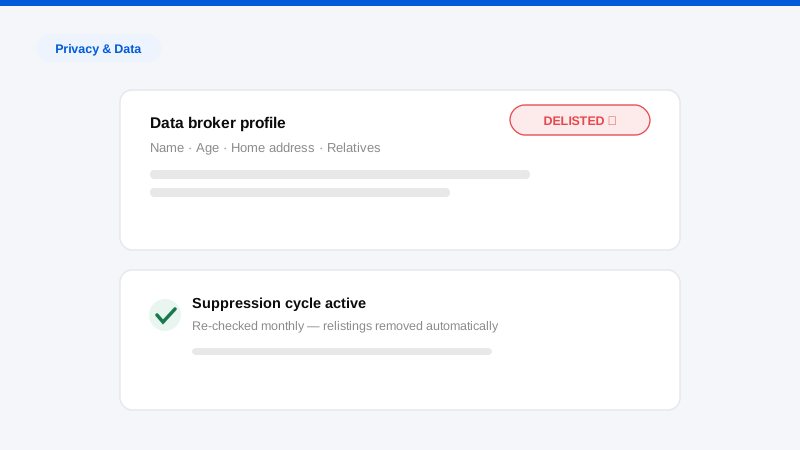
Data broker removal services have gone from a niche privacy product to a standard line item in executive security budgets, and for good reason. The people-search industry publishes searchable profiles on essentially every American adult, and for an executive those profiles function as a pre-built targeting package: home address, cell phone, relatives, past addresses, estimated net worth signals. Anyone with ten dollars and a grudge can pull the file.
We run these removals every day, so this guide is written from the operational side rather than the marketing side. That means we will tell you things vendors often skip: that opt-outs work but listings re-populate, that automated tools cover a fixed list while the risky exposures often sit outside it, and that “removal” is better understood as ongoing suppression than as a one-time purge.
If you are evaluating data broker removal services for yourself, your leadership team, or your family, here is how the ecosystem actually works in 2026 and how to buy intelligently.
What data brokers are and why executives should care
“Data broker” covers a wide industry, but the segment that matters for personal safety is people-search sites: Whitepages, Spokeo, BeenVerified, Intelius, Radaris, TruePeopleSearch, FastPeopleSearch, and hundreds of smaller operations. They ingest public records (property transactions, voter registrations, court indexes, business filings) plus commercial marketing data, then merge everything into profiles keyed to your name.
For most people this is an annoyance. For executives it is an attack surface:
- Social engineering. Business email compromise, SIM-swap attempts, and impersonation scams are dramatically more convincing when the attacker knows your cell number, your home address, and your spouse’s name. Broker profiles supply all three.
- Physical security. Layoffs, litigation, activist campaigns, and plain public visibility all generate hostile attention. A home address one search away converts online anger into a doorstep problem.
- Deal and litigation exposure. Opposing parties run open-source research as a matter of course. Broker profiles are the first stop.
- Family exposure. Profiles cross-link “possible relatives,” so an executive’s cleanup that ignores the household leaks right back. This is why family offices increasingly commission privacy work across the whole family tree.
The uncomfortable structural fact: brokers are largely operating legally, republishing records that are individually public. You generally cannot make the underlying records disappear. What you can do (at scale, persistently) is force the aggregated, searchable profiles offline. That is the entire job of data broker removal.
How data broker removal services actually work
Every legitimate service, ours included, is built on the same mechanical foundation: brokers offer opt-out processes (some voluntarily, some pushed by state privacy laws), and the service files and tracks those opt-outs on your behalf. The differences between services come down to coverage, persistence, and what happens when the easy path fails.
The opt-out layer
Each broker has its own process. Some accept a web form. Some require email confirmation, a phone verification call, or a photo ID. Some have hidden or deliberately cumbersome flows. A removal service maintains current knowledge of each process, they change constantly, and files requests correctly the first time, because malformed requests are silently dropped.
The verification layer
A confirmation email is not a removal. Good services verify that the profile is actually gone, that sister sites operated by the same broker (many run networks of near-identical sites) have also dropped it, and that the dead page falls out of Google. Where a cached result lingers, the fix runs through Google’s own tools, part of the broader work of removing yourself from Google.
The recurrence layer
This is where cheap services quietly fail. Brokers refresh their databases from public-record feeds on rolling cycles, and a profile removed in Q1 frequently reappears by Q3 under a new URL. One-time removal buys you a temporary state. The real product is recurring suppression: scheduled re-scans, re-filed opt-outs, and monitoring for new brokers entering the market. When you compare protection plans, the recurrence layer is the thing you are actually pricing.
Automated tools vs. managed removal programs
The market splits into two models, and the honest answer is that each has a legitimate use case.
Automated subscription tools
These services script opt-outs across a fixed list of brokers, commonly a few hundred sites with machine-submittable processes, and re-run the list periodically. Strengths: low cost, broad coverage of the mainstream broker list, decent recurrence. Limits:
- They only cover sites on their list. New brokers, obscure brokers, and offshore mirror sites are out of scope until the vendor adds them.
- They struggle with brokers that require ID uploads, phone verification, or notarized requests.
- They do not touch non-broker exposure at all: the PDF attendee list, the alumni directory, the scraped copy of your data on a forum. That long tail is where a motivated adversary looks, and cleaning it is manual digital footprint cleanup work.
- They cannot exercise judgment: every listing is treated the same, whether it shows your name and state or your home address and children.
For a private individual with ordinary exposure, an automated tool is a reasonable purchase.
Managed removal programs
A managed program layers human analysts on top of automation. Analysts handle resistant brokers, chase the long tail, verify removals manually, prioritize by actual risk, and cover the household. They can also coordinate with corporate security teams, and, where an exposure crosses into legal territory such as defamation or doxxing with threats, they can flag when it is time to involve counsel. (To be clear about our own lane: we are a removal firm, not a law firm, and nothing in a removal engagement is legal advice.)
For executives, the case for managed work is simple: the exposures that carry real risk are disproportionately the ones automation cannot reach. Our executive program exists because scripts do not escalate, follow up, or notice that a minor site just published your daughter’s college address.
How to evaluate data broker removal services
Whichever direction you go, use the same diligence you would apply to any security vendor:
- Demand a baseline. A serious provider scans and documents your exposure before touching anything, so results are verifiable. If there is no before picture, “we removed 214 listings” is unfalsifiable.
- Interrogate the coverage list. How many brokers, which ones, how often the list is updated, and, most importantly, what happens with exposures that are not on it.
- Ask how removals are verified. Accepting broker confirmation emails at face value is the tell of a low-effort operation.
- Ask about recurrence explicitly. “How often do you re-scan, and what percentage of listings do you see return?” A vendor who claims listings never return is either not measuring or not being straight with you.
- Check household handling. Executives should insist on spouse and family coverage; relatives’ profiles republish your address history.
- Distrust absolute promises. “Complete removal from the internet” and guaranteed permanence are marketing claims no operator can honor. Public records persist at the source; the win is that aggregated profiles stay suppressed.
Two softer signals are worth weighing as well. First, reporting: a provider should be able to show you, on demand, the current state of every listing it is tracking for you (filed, pending, removed, returned) rather than a quarterly PDF of totals. Second, escalation paths: ask what happens when a broker simply ignores requests, because some do. The credible answers involve documented follow-up sequences, state privacy-law leverage where applicable, and search-engine suppression as a fallback when a site will not cooperate. Vendors without an answer to “what if they say no” have never had to handle a hard case, and executives generate hard cases.
A step-by-step broker removal plan (DIY or vendor-managed)
Whether you run this yourself or use it to audit a vendor, the sequence is the same:
- Map your exposure. Search your name alone, with city, with employer; search your cell number and home address in quotes. Log every broker profile and every non-broker page exposing sensitive data. A free exposure scan does this systematically.
- Triage by risk. Rank listings by what they expose, not where they rank. Address-plus-relatives beats a name-only listing every time.
- File opt-outs across the major networks. Start with the high-traffic brokers and their sister sites, removing from one site in a network without the others accomplishes little.
- Handle the resistant brokers. Set aside the sites demanding ID or phone verification and work them methodically; these are the ones most people abandon.
- Sweep the long tail. Use your address and phone searches from step 1 to find the small sites and non-broker pages, and pursue each individually.
- Clean search results. File Google removal requests for pages exposing contact information and outdated-content requests for pages already gone at the source.
- Extend to the household. Repeat for your spouse and adult children.
- Schedule the re-check. Calendar a full re-scan at 90 days and quarterly after. Re-file everything that returned. This step is permanent; treat it like patching servers.
Run honestly, step 1 through 7 is dozens of hours the first time through, and step 8 never ends. That labor, plus the judgment applied to it, is what a managed personal data removal service is actually selling.
What removal services cannot do
Clear expectations prevent bad purchases:
- They cannot delete government records. Your deed, court filings, and corporate registrations remain with their custodians. (Certain protected classes (judges, law enforcement, abuse survivors) have statutory address-confidentiality options in many states; consult counsel about eligibility.)
- They cannot control the news. Press coverage, blogs, and social commentary are outside broker opt-out mechanics entirely and involve different, often legal or editorial, routes.
- They cannot promise permanence. Suppression is a maintained state, not an achievement.
- They cannot stop data collection at the source. Brokers keep ingesting; removal keeps deleting the output. Reducing what you emit going forward, an online privacy service discipline, shrinks the problem over time.
Frequently asked questions
How much do data broker removal services cost?
Automated tools generally run from roughly $100 to $300 per person per year for a fixed broker list. Managed programs with analysts, long-tail work, verification, and household coverage price higher, typically in the four figures annually for an executive household. The right comparison is not tool vs. service on price; it is which exposures each actually covers.
How long until my information comes down?
Major brokers process correct opt-outs on timelines ranging from about 24 hours to a few weeks. Search results lag site removal by days to weeks more. A realistic expectation: substantial improvement within the first month, long-tail and stubborn-site cleanup over the following quarter, monitoring thereafter.
Do state privacy laws mean I can just demand deletion?
Several state laws, California’s most prominently, give residents deletion and opt-out rights that strengthen your hand with brokers, and California’s Delete Act is pushing toward centralized broker deletion mechanics. Coverage varies by state and by broker, and rights still have to be exercised and enforced request by request. The laws improve the tooling; they have not made the work disappear. For how the rules apply to your specific situation, ask a privacy attorney. That is outside what a removal firm should opine on.
Is one clean sweep enough if I keep a low profile?
No. Re-population is driven by brokers’ data pipelines, not by your behavior. Even a person who never posts anything generates fresh public records (a move, a refinance, a vehicle registration) that flow straight back into broker databases. Low profile slows the refill; only recurring suppression stops it from mattering.
Start with evidence, not a subscription
Before you buy anything, from us or anyone else, find out what is actually published about you. Run our free exposure scan and get a documented baseline of your broker listings and exposed personal data. From there, the right service level tends to choose itself.