
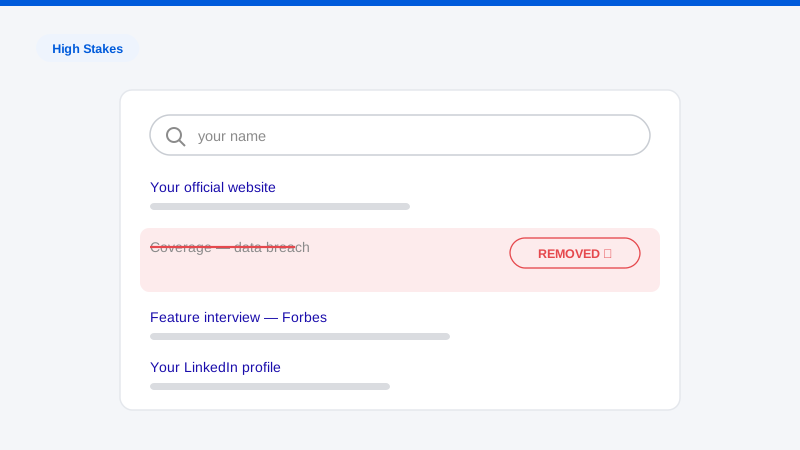
Reputation management after a data breach is the long-horizon repair of what an incident does to a company’s, and its executives’, public search footprint after the technical response is complete. Breaches have two lives. The first is operational: detection, containment, forensics, notification, regulatory filings. It is intense, and it ends. The second life is reputational, and it does not: the coverage, the “company + breach” search results, the leaked data circulating on paste sites and forums, the executive blame stories, and the AI-generated summaries that mention the incident every time anyone asks about the company, for years.
Most organizations resource the first life completely and the second not at all. The incident-response retainer, outside counsel, and crisis communications all stand down within a quarter. Meanwhile, the breach has become a permanent fixture of the company’s search identity: prospective customers researching “is [company] safe” find it; procurement teams running vendor diligence flag it; sales cycles quietly lengthen as security questionnaires cite it; and the CISO, CEO, and board members named in the coverage carry it in their personal search results into every future role.
This guide explains the reputational mechanics of the post-breach period: what a breach does to search and AI answers, why the damage compounds on a different timeline than the incident, and what professional, removal-first protection looks like, for the company and for the individual executives the coverage names. Content Removal LLC is not a law firm or an incident-response provider; we run the reputational workstream alongside counsel, security teams, and communications advisors, and nothing here is legal advice.
What a breach does to your search page, and to AI answers
“Company + breach” becomes a permanent query. Breach coverage is precisely the content search engines rank hardest: authoritative security press, mainstream news, regulator announcements, and class-action firm pages, all densely interlinked. Within days, searches for the company name surface the incident; suggested searches begin advertising it (“[company] breach,” “[company] hacked,” “was [company] data leaked”); and dedicated pages (breach-tracker databases, attorney solicitation sites, notification archives) take up long-term residence in the results. Years later, coverage of a long-remediated incident routinely outranks product pages and current news, because nothing about the company ever again attracts links the way the breach did.
Trust queries inherit the damage. The searches that matter commercially are not the incident’s name. They are the trust questions every prospect, patient, client, or partner types before committing: “is [company] secure,” “[company] reviews,” “[company] safe to use.” Breach coverage colonizes these results too, which means the incident is re-litigated silently in every buying decision, vendor review, and renewal for years. This is where the commercial cost actually accrues: not in the news cycle, but in ten thousand individual searches you never see.
The leaked data has its own life. Beyond coverage sits the exfiltrated material itself: dumps on paste sites and forums, samples posted as proof, credential sets recirculated and repackaged, and, most painfully, customers’ and employees’ personal information moving through the ecosystem. Some of this content is removable through platform and legal mechanisms; all of it is findable by journalists, plaintiffs’ firms, and the affected individuals themselves. Executives face a parallel personal layer: breach-era attention drives traffic to data-broker profiles exposing their homes and families exactly when anger at the company is highest.
Executives get named, and it follows them. Breach coverage personalizes: the CISO who owned security, the CEO who signed the statement, the executives whose testimony or exit becomes its own story. Those articles attach to the individuals’ names permanently, surfacing in every future board consideration, funding process, and executive search, long after they have left the company. Executive blame coverage is a distinct reputational asset class, and it requires its own workstream.
AI answers institutionalize the incident. Ask an assistant “should I use [company]?” or “is [company] trustworthy?” and the synthesized answer reliably includes the breach, often undated, often without the remediation, sometimes with details the follow-up reporting corrected. AI systems compress the corpus; if the corpus is dominated by incident-era coverage, the answer presents a years-old event as a current characteristic. For a company competing on trust, the assistant’s standing paragraph is now part of the sales funnel.
Key takeaway: The breach ends; the query never does. “Company + breach” results, trust-search contamination, circulating leaked data, and AI answers form a standing tax on every future customer, deal, and hire, invisible precisely because it operates one search at a time.
Timeline dynamics: the response ends in weeks; the record compounds for years
The acute phase (days to weeks). Coverage, notification, regulatory attention. Reputational removal work in this window is narrow and careful. The story is live, and outreach to publishers is generally counterproductive. The valuable work is preparatory: full-footprint mapping, monitoring stood up across news, forums, paste sites, and AI answers, and immediate action on the clearly unlawful layer (posted dumps, doxxed individuals, credential sets) through platform mechanisms that operate even mid-story, coordinated with counsel and the IR team.
The subsiding phase (months one to six). Attention moves on; the record sets. Syndication has spread the story to aggregators and scrapers; class-action pages and breach databases have taken their positions; suggested searches have crystallized. This is when the systematic work begins: tracing and pursuing scraped copies and re-posted data, addressing defamatory or materially false commentary that exceeded the facts, and beginning broker-clearance for named executives.
The remediation-complete phase (six months onward). As the company completes remediation, settles or resolves proceedings, and accumulates a post-incident security record, the core coverage’s incompleteness becomes documentable. Publisher outreach under correction and outdated-content standards becomes viable, updating stories that state as current what has long been fixed, pursuing removal where standards support it, and addressing the stale satellite pages. De-indexing avenues open for content meeting their criteria. The affirmative record (security certifications, substantive press assets, current trust documentation) is built to give search engines and AI systems accurate material to weigh.
The long tail (years). Anniversary stories, “biggest breaches” listicles, and research citations periodically refresh the incident’s ranking signals. Re-posted data resurfaces as dumps are repackaged. Without standing monitoring and periodic re-clearance, the record quietly re-degrades; with them, each resurfacing is caught small.
Your incident report is closed. Your search results are not.Free confidential Exposure Scan: live results on a 15-minute call, covered by strict confidentiality.
Book Your Confidential ScanWhat professional protection looks like
Post-breach reputational work is removal-first and runs on two tracks at once, the company’s record and the named executives’, because the two degrade differently and repair differently.
Full-spectrum mapping. Everything the breach put into the findable world: press coverage and its syndication tree, breach-tracker and solicitation pages, forum and paste-site material, re-posted data locations, executives’ personal search footprints, screening-database entries, suggested-search states, and the current AI-assistant answers to the company’s trust queries. Graded for harm, visibility, and tractability, because post-breach footprints always contain a large tractable middle beneath the untouchable top press layer.
Leaked-data cleanup. Systematic pursuit of exfiltrated material at every findable location: platform takedown mechanisms for posted dumps and personal information, host-level requests for paste and mirror sites, and legal-remedy coordination with counsel where stolen-data and privacy frameworks apply. This work is iterative by nature, dumps get reposted, which is why it is run as a standing process with monitoring, not a one-time sweep.
Record repair at the source. Publisher outreach, with documentation, on coverage that has become outdated or was corrected in later reporting; pursuit of the scraped and aggregated copies that reprint early, often-wrong versions of the story; removal of defamatory commentary that asserted more than the facts; and de-indexing where criteria are met. Repair prioritizes the queries that carry commercial weight, the trust searches, over vanity queries.
The executive track. For each named individual: personal search-footprint repair, broker suppression and re-clearance, blame-coverage assessment (what is addressable through corrections and outdatedness as the record evolves), and construction of an accurate professional record that reflects a career rather than an incident. Executives who leave the company carry this work with them; it is frequently arranged by the individuals or their family offices independently of the corporate engagement.
Affirmative assets and AI remediation. Current, substantive, well-sourced material (security posture, certifications, leadership press) published so that trust queries and AI syntheses have accurate, dated content to draw on; plus deliberate monitoring of what assistants answer about the company, since that answer now sits in front of every diligence process and buying decision.
Standing protection. Monitoring and periodic re-clearance as permanent infrastructure: because the long tail is measured in years, and the organizations that recover fully are the ones still watching in year three.
Key takeaway: Professional post-breach work runs company and executive tracks in parallel: leaked-data cleanup as a standing process, source-level repair aimed at trust queries, an executive workstream the individuals carry with them, and monitoring that outlasts the news cycle.
Why specialists beat DIY and PR alone
The post-breach bench (IR firms, privacy counsel, crisis communications) is deep, and every member of it stands down when the incident closes. None of them owns the second life of the breach.
Crisis PR shapes the story while the story is live; it does not remove the paste-site dump, clear the scraped copies, update the two-year-old article that still ranks for “is [company] safe,” or change what an AI assistant synthesizes from an incident-era corpus. Communications is an addition discipline. The post-breach problem is substantially a subtraction problem, and content that still exists keeps resurfacing through every new aggregator, dataset, and model that reads it.
Counsel, likewise, is essential for the proceedings and the notification obligations, but publisher unpublishing standards, platform takedown frameworks, syndication tracing, broker cycles, and AI-answer remediation are a separate trade, practiced URL by URL over years. In-house teams who attempt it themselves discover the failure modes quickly: denied requests that get logged and harden positions, outreach mid-story that generates follow-up coverage, sweeps that catch the original dump but miss forty mirrors. The specialist advantage is equal parts mechanics and sequencing judgment, knowing what is pursuable in month two versus month twelve, and doing all of it without ever becoming a story titled “company tries to scrub breach coverage.”
Find every place the breach still lives: coverage, copies, and leaked data.Book a free, confidential Exposure Scan: 15 minutes, live results, strict confidentiality.
Book Your Confidential ScanWhy clients call Content Removal
Content Removal LLC is the firm companies and their leadership engage for the breach’s second life. The work is removal-first and source-level (leaked-data takedowns, scraped-copy pursuit, publisher corrections and unpublishing, de-indexing, broker suppression, and AI-answer remediation) sequenced by practitioners who understand both the mechanics and the optics, and executed with the discretion the situation demands: quietly, through proper channels, without creating a coda to the story.
We slot in alongside your counsel, security team, and communications advisors rather than duplicating any of them; we are not a law firm and provide no legal advice. We are also honest in the way this situation requires: accurate coverage of a real incident is often not removable, leaked data can be relentlessly pursued but a copy may always exist somewhere, and no outcome is promised, by us or by anyone credible. What we commit to is the complete map, an item-level tractability assessment before you spend anything, disciplined execution on every legitimate avenue, a dedicated track for your named executives, and standing protection sized to a tail that runs years, not quarters.
Frequently asked questions
Can news coverage of our breach be removed?
The accurate, contemporaneous reporting usually cannot, and we will tell you that in the first conversation rather than let you discover it after an invoice. What is realistically addressable is substantial: coverage that has become materially outdated or was corrected in later reporting (through publisher standards, with documentation); the scraped and aggregated copies that reprint early versions; stale solicitation and tracker pages; defamatory commentary that exceeded the record; and the entire leaked-data layer. The engagement begins with an honest sort of your footprint into those categories.
The leaked data keeps reappearing. Is cleanup pointless?
No: but it must be run as a process, not an event, and anyone selling a one-time sweep misunderstands the ecosystem. Dumps get repackaged and reposted; the professional response is monitoring that detects each reappearance early plus a standing takedown practice that pursues it at each location through platform and legal mechanisms. The practical goal is honest: driving the material out of casually findable spaces (the indexed paste sites, forums, and search results where journalists, customers, and opportunists encounter it) and keeping it out, while your security team addresses the underlying exposure.
Our CISO and CEO are named in the coverage. What can be done for them individually?
A dedicated executive track: full personal footprint audits, broker clearance and re-clearance for home addresses and family exposure, pursuit of defamatory and unlawful satellite content, assessment of blame coverage against correction and outdatedness standards as the factual record evolves (settlements conclude, remediation completes, later reporting supersedes early reporting), and construction of an accurate professional record so their names return a career, not an incident. This track is portable, executives who move on retain it, and it is often engaged privately by the individuals or their family offices.
When should this work start, and how long does it run?
Mapping and monitoring should start during the incident response, because early footprint intelligence is cheap and the unlawful layer is actionable immediately. The systematic repair begins as coverage subsides and expands as remediation completes and outdatedness becomes documentable. As for duration: the tail of a covered breach runs years, and the honest engagement model reflects that, an intensive repair phase measured in months, then standing monitoring and periodic re-clearance measured in years. Companies that treat this as a one-quarter project get one quarter of results.
If your organization has been through a breach, last month or three years ago, the essential first step is seeing what it still costs you in the searches that decide deals, renewals, and careers. Book a free, confidential Exposure Scan: a 15-minute call, live results across search, leaked-data locations, and AI answers, under strict confidentiality. The incident is over. Let’s close the record it left open.