
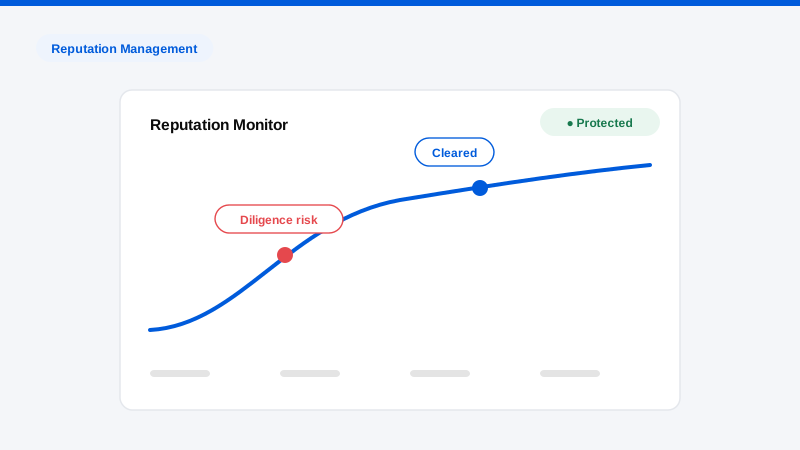
Executive reputation management used to mean a media-trained spokesperson and a good relationship with two or three journalists. That world is gone. Today, an executive’s reputation is whatever Google, LinkedIn, a handful of data brokers, and, increasingly, AI assistants say it is, to anyone who asks, at any hour, without context or right of reply. Before a board seat is offered, a term sheet is signed, or a keynote is confirmed, someone types your name into a search bar. What comes back is the decision-making input.
Most reputation firms respond to this reality with one tool: publish more content and hope the good outranks the bad. That approach has its place, but it treats the symptom. The damaging article, the data-broker profile exposing your home address, the misleading forum thread. All of it is still there, one click or one algorithm change away from page one. Our position, and the premise of this guide, is that serious executive reputation work starts with removal: get the harmful material taken down or de-indexed at the source wherever possible, suppress only what genuinely cannot be removed, and then defend the result continuously.
This guide walks through the full discipline as we practice it for senior leaders: why executive exposure is now an enterprise-level risk, what the modern exposure surface actually looks like, a practical four-step framework, the role of data brokers and AI-generated answers, how to fund the work through your company, and how to evaluate a partner without getting sold a content mill.
Why executive exposure is enterprise risk, not a personal problem
The instinct is to treat a leader’s online reputation as a private matter, awkward to raise, awkward to budget for. That framing is a decade out of date. When a person’s name is the shorthand for a company’s judgment, anything attached to that name in public becomes attached to the enterprise.
The diligence moments where search results decide outcomes
Executive careers and corporate transactions both turn on concentrated moments of scrutiny. Consider how many of these involve a stranger researching a name:
- M&A and investment diligence. Acquirers and LPs run background and adverse-media checks on the leadership team as a matter of course. A page-one result raising questions about an executive can slow a deal, reprice it, or become a negotiating lever for the other side.
- Board appointments and executive searches. Nominating committees and search firms screen candidates online before the first conversation. Most candidates never learn why they were quietly dropped from a list.
- Enterprise sales. Procurement teams and buying committees research the leadership of vendors they are about to depend on. A CFO’s name should not be the reason a seven-figure contract gets a second legal review.
- Lending, insurance, and banking relationships. Know-your-customer and reputational-risk reviews increasingly include open-web and adverse-media screening of principals.
- Recruiting. Senior candidates research the people they would report to. So do their spouses.
In each of these moments, nobody calls to ask for your side. The search result is the interview.
Trust transfers in both directions
Reputation risk flows both ways between an executive and the enterprise. A company crisis attaches to the leaders’ names permanently through news archives, even after the company recovers, and a personal issue (old litigation, a contentious divorce filing, a decade-old arrest that was never prosecuted) bleeds into how the company is perceived, because counterparties reason, fairly or not, from the person to the institution. This is why sophisticated boards now treat leadership digital exposure the way they treat cybersecurity: as a standing risk domain with an owner and a budget, not a one-off embarrassment to be handled quietly. Our executive protection practice exists because that shift is already underway at the companies that take risk seriously.
Key takeaway: An executive’s search results are screened at every high-stakes moment of a career and a company’s life, usually without the executive ever knowing a screen happened. You cannot rebut what you never see being read.
The modern executive exposure surface
Before you can manage exposure you have to map it honestly. Most leaders think of “my online reputation” as their Google page one. That is the visible tip. The full surface looks like this:
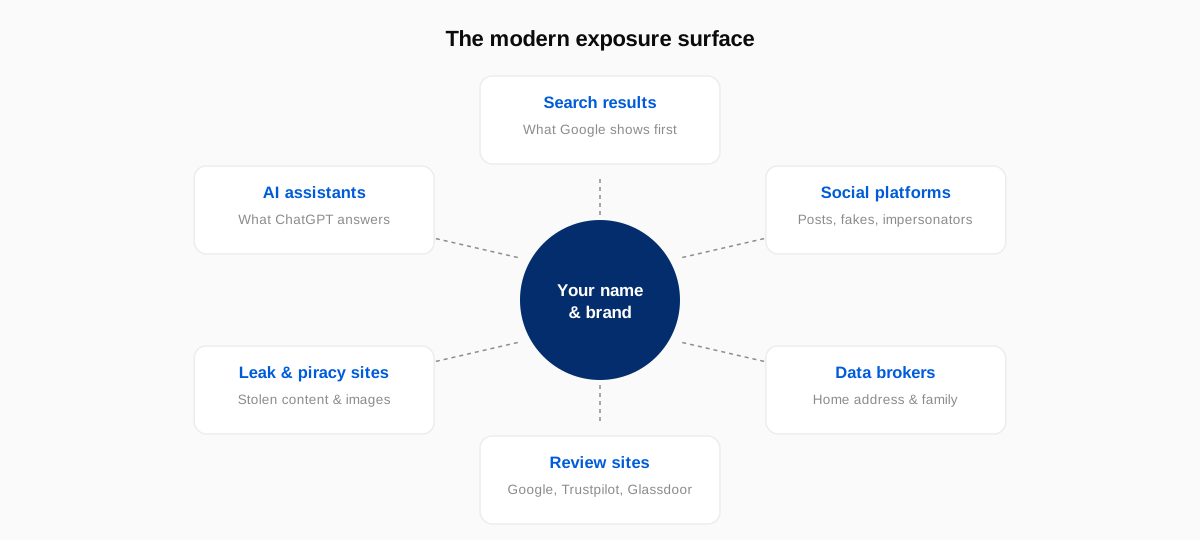
Search results and autocomplete
Page one of Google for your name (and for your name plus your company, plus “lawsuit,” plus your city) is the highest-traffic asset. Autocomplete suggestions matter almost as much: a suggested query like “[name] fraud” frames every search before a single result is read. Suppression-only firms live entirely on this layer. We treat it as one layer of six. When a damaging URL can be removed or de-indexed at the source, the problem is solved on every layer at once.
News archives and “old news” permanence
A story that was accurate in 2016 can be profoundly misleading in 2026 (charges dropped, cases settled, findings reversed) yet it ranks as if it were breaking news, because news domains carry enormous search authority. Options here range from publisher outreach (updates, de-indexing, unpublishing under editorial policies many outlets now maintain) to search-engine remedies, and they require a practitioner who has actually run these processes, not a template letter.
Data brokers and people-search sites
Hundreds of broker sites republish home addresses, family members’ names, phone numbers, and property records. For executives this is not merely a privacy irritation. It is the raw material for doxxing, executive-targeted phishing, and physical-security incidents. Brokers repopulate continuously, which is why one-time opt-outs decay. Ongoing data broker removal is now baseline hygiene for anyone with a public profile.
Social platforms, forums, and complaint sites
Reddit threads, X posts, Glassdoor commentary about a named leader, gripe sites, and complaint boards. These rank surprisingly well, resist suppression because platforms have high domain authority, and are often the first thing an AI assistant quotes.
AI-generated answers
When someone asks ChatGPT, Gemini, or Perplexity “who is [your name]” or “is [your name] trustworthy,” the answer is synthesized from whatever the model ingested, including the defamatory blog post and the outdated article. This layer now sits in front of traditional search for a growing share of professional research, and it requires its own monitoring and remediation discipline.
The paper trail nobody audits
Court-record aggregators, SEC and regulatory mirrors, old press releases, conference bios with stale claims, expired domains that scrapers resurrect. Individually minor; collectively, the corpus that everything above draws from.
Removal first: the strategic difference that changes everything
Here is the fork in the road that defines this industry. When a damaging item surfaces, there are two fundamentally different responses:
Suppression: publish and promote enough positive content that the damaging item slides to page two. The item still exists. It still surfaces in AI answers, in news-tab results, in diligence databases, and it returns to page one whenever an algorithm shifts or a journalist links to it. Suppression is rented ground that requires perpetual payment to hold.
Removal: get the item taken down, retracted, corrected, or de-indexed at its source. This means direct publisher negotiation, platform policy enforcement, terms-of-service and privacy-violation claims, copyright claims where applicable, coordination with independent counsel where a legal remedy exists, and search-engine removal processes. When removal succeeds, the problem is not hidden. It is gone, from search, from AI training refreshes, from the diligence report.
Honesty requires saying clearly: not everything can be removed. Truthful reporting by a major outlet about a matter of public record usually cannot be, and anyone who guarantees otherwise is lying to you. The correct strategy is a triage: pursue removal everywhere it is realistically achievable, use suppression as the fallback for the residue, and never pay suppression prices for problems that could have been eliminated. Most of the industry runs this in reverse, because publishing content is easier to sell and easier to staff than the specialist work of getting things taken down.
Key takeaway: Suppression manages the symptom and bills you forever. Removal cures what is curable, shrinks the problem set, and makes whatever suppression remains dramatically cheaper and more stable.
Find out what a diligence team would find on you.Free confidential Exposure Scan for executives: live results across search, brokers, and AI answers, walked through on a 15-minute call, yours to keep either way.
Book Your Free ScanA four-step framework for executive reputation protection
Whether you run this internally, with counsel, or with a firm like ours, the work follows the same arc. Skipping a step is where programs fail.
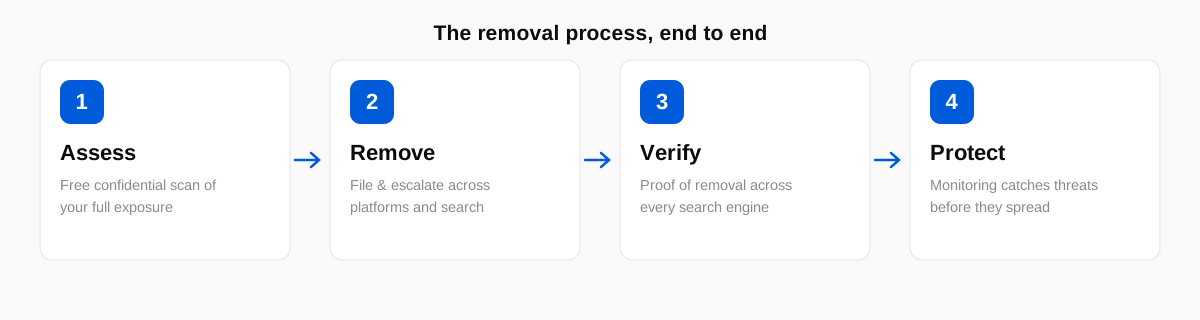
Step 1: Audit, map the full surface, not just page one
Inventory everything: 5+ pages of search results for name variants and damaging query combinations, image and video results, autocomplete, news archives, all major data brokers, social and forum mentions, court and regulatory aggregators, and what each major AI assistant says when asked about you. Score every item for visibility, severity, and audience relevance. The output is a prioritized exposure register, the same artifact a security team would produce for technical vulnerabilities, and something a board can actually read.
Step 2: Remove, eliminate what can be eliminated
Work the register top-down through the removal channels appropriate to each item: publisher and webmaster outreach, platform policy and terms-of-service enforcement, privacy and data-protection mechanisms, de-indexing requests, broker opt-outs at scale, and, where content is genuinely false, defamation-content removal pathways executed with independent legal counsel where needed. Each item gets a realistic probability call before work begins; you should know what you are paying to attempt.
Step 3: Build, establish assets you own, sized to the residue
Only now does content enter the picture: an authoritative personal site, corrected bios, structured profiles, selective earned media. Because Steps 1 to 2 shrank the problem set, this layer is smaller, more credible, and built to hold ground rather than to win an endless volume war against content that should have been removed.
Step 4: Protect, monitor and respond continuously
New content, broker repopulation, AI model refreshes, and algorithm changes mean reputation is a stock that depreciates without maintenance. Continuous reputation monitoring with defined response playbooks (who acts, on what trigger, within what timeframe) converts future incidents from crises into tickets. This is the layer our Protection Plans exist to run.
Data brokers: the exposure executives underestimate most
Ask an executive about reputation and they think about press. Ask their security team and they think about broker data, because that is where the practical harm concentrates. A current home address plus family names plus a phone number, republished across dozens of sites, enables targeted phishing of the executive’s family, credible-looking fraud against the company, and, in the worst cases, physical confrontation at a home. Several recent high-profile incidents involving corporate leaders have pushed boards to fund this category for entire leadership teams at once.
The operational reality: brokers number in the hundreds, many share back-end data, opt-outs are deliberately tedious, and records repopulate within months as new public-records data flows in. Effective programs therefore run continuous enumeration and re-suppression, not an annual cleanup, and extend coverage to spouses and household members, since brokers link family records and attackers pivot through the least-protected person in the household.
AI answers: the new front page you do not control
A growing share of professional research now starts with a question to an AI assistant rather than a search query, and the assistant returns a synthesized verdict, not a list of links. That verdict inherits every flaw of the underlying corpus: it states outdated allegations in the present tense, blends you with same-named strangers, and repeats defamatory content with fluent confidence.
Managing this layer means: regularly querying the major assistants about you and your likely diligence questions; correcting the source material those systems learn from, which is another reason removal beats suppression, since deleted content eventually falls out of refreshed models while suppressed content does not; strengthening the structured, authoritative sources models weight heavily; and using the feedback and correction mechanisms the AI platforms provide. It is early, imperfect, fast-moving work, and it is precisely why we built a dedicated AI reputation practice rather than bolting it onto SEO.
Key takeaway: AI assistants compress your entire online footprint into a three-sentence verdict. The only durable way to change the verdict is to change the record it is drawn from, which is a removal problem, not a publishing problem.
See what ChatGPT and Google say when a board member searches you.Our free confidential Exposure Scan covers search, data brokers, and AI answers, results reviewed live on a 15-minute call, no obligation.
Book Your Free ScanFunding it: making the board and budget case
Executive reputation work stalls more often on budget mechanics than on merit, because it falls between chairs: is it marketing, security, legal, or a personal expense? The companies that handle it well have converged on a few patterns:
- Frame it as risk management, not vanity. Present the exposure register alongside the diligence moments on the corporate calendar: fundraise, exit window, proxy season, executive searches. The question for the board is not “does our CEO deserve better search results” but “what is our exposure at the next moment a counterparty screens our leadership.”
- House it with security or legal, not comms. Physical-security teams already own executive-protection budgets; digital exposure is the same threat surface. Legal ownership fits where litigation-adjacent content dominates.
- Cover the leadership team as a program, not one person as an exception. Per-seat protection for the executive team and board normalizes the spend, removes the stigma of any individual “having a problem,” and closes the gap attackers actually use: the least-protected name on the org chart.
- Be straight about cost. In our practice, removal pricing is set per link and confirmed in writing after the free Exposure Scan, the board sees the exact cost of every item before approving anything, and comprehensive Protection Plans are sized to surface and threat level. The broader market spans cheap DIY monitoring tools to five-figure monthly ORM retainers, the spread reflects real differences in what is actually being done, which is exactly why the next section matters.
What to look for in an executive reputation partner
The industry is unregulated and opaque, which puts the diligence burden on you. The questions below separate specialists from content mills in one call.
Removal capability, demonstrated, not implied
Ask directly: “Of the items in my audit, which will you attempt to remove at the source, through what mechanism, and with what realistic probability?” A suppression shop will pivot to talking about content velocity and domain authority. A removal-first firm will walk the register item by item. Ask to see anonymized case work that involved actual takedowns, not ranking screenshots.
Honesty about what cannot be done
The fastest disqualifier in this industry is a guarantee. No firm controls Google, publishers, or courts. A credible partner gives you probability bands, declines work it cannot deliver, and tells you when an item is simply going to have to be outweighed rather than removed. If everything is “no problem,” everything is a red flag.
Legal fluency with clean boundaries
Much removal work is legal-adjacent: defamation standards, privacy statutes, DMCA, court-record procedures. Your partner should be fluent in all of it, work smoothly with independent counsel when a legal remedy is the right tool, and be clear that they are not your law firm. Beware of firms practicing law without a license and equally of law firms selling SEO.
Discretion engineered in, not promised
Executive work demands strict confidentiality: NDAs by default, minimal internal access to your file, no client logos on the website, no case details recycled as marketing. Ask how many people at the firm will know your name. The right answer is a small number they can state precisely.
Full-surface coverage with continuous protection
Search-only engagements leave brokers and AI answers open. One-time cleanups decay within months. Look for a partner whose standing offering covers the whole surface (search, news, brokers, social, AI) under continuous monitoring with defined response SLAs, and whose pricing model rewards shrinking your problem set rather than perpetually managing it.
Frequently asked questions
How long does executive reputation remediation take?
Expect an audit within the first two weeks, first removals (typically broker records and clear policy violations) inside 30 to 60 days, and harder targets (publisher negotiations, de-indexing of stubborn URLs) over three to nine months. Suppression assets, where needed, take several months to consolidate ranking. Anyone quoting days for hard targets, or refusing to give ranges at all, should concern you equally.
Can truthful news coverage about me actually be removed?
Sometimes: but never on demand, and no honest firm guarantees it. Many outlets now operate “right to be forgotten”-style editorial policies for dated coverage, especially where charges were dropped or matters resolved; others will update, de-index, or anonymize. Where the publisher declines, search-engine remedies or suppression become the fallback. The realistic framing is a probability per item, assessed before you spend.
Should my company pay for this, or should I personally?
For most senior executives it is legitimately a corporate expense: the exposure screens are run by the company’s counterparties, and the harm lands on the enterprise. Structuring it inside a security or legal budget as leadership-team coverage is the pattern we see at well-run companies. Founders pre-institution and executives with purely personal matters often engage personally; a good firm supports both structures with equal confidentiality.
What does this cost, honestly?
At our firm, per link: the free confidential Exposure Scan comes first, and you then receive a written quote with the exact price next to every URL, nothing is owed until you have seen it. Ongoing Protection Plans scale to the size of the surface and the threat profile. Across the market you will see everything from $20-per-month DIY broker tools (useful, narrow) to five-figure monthly ORM retainers that are mostly content production. Price the outcome, items eliminated and surface defended, not the deliverables list.
Your name is being searched this week by someone whose decision matters to you, and you will not be in the room. The rational move is the same one you would make for any other enterprise risk: measure it before it gets tested. Start with a free, confidential Exposure Scan. We map your full surface across search, data brokers, and AI answers, walk you through the results live in 15 minutes, and the findings are yours to keep whether or not we ever work together.