
Invasion of privacy law rests on four claims: intrusion upon seclusion, which covers hacking, spyware or covert cameras even if nothing is published; public disclosure of private facts, for offensive publication of genuinely private, non-newsworthy information; false light, for highly offensive misrepresentation; and appropriation of name or likeness, for unauthorized commercial use of your identity, including deepfakes and voice clones.
Key facts
- Public disclosure claims require private facts, a highly offensive disclosure and no legitimate public concern.
- Public figures must prove actual malice to win a false light claim against a publisher.
- Newsworthiness is the main defense to appropriation; news use is protected, advertising use is not.
- Remedies include temporary restraining orders or injunctions plus actual, general and punitive damages.
Where ContentRemoval.com comes in. ContentRemoval.com is the containment track that runs alongside the legal one: rapid de-indexing, source removal and reupload monitoring for executives, public figures and family offices whose private material, leaked documents or manipulated likeness is already spreading. The instruction usually comes through the person’s attorney or chief of staff while counsel prepares the injunction. A free 15-minute Exposure Scan maps what is removable now, and the report is yours to keep. Get a Free, Confidential Exposure Scan or read how our personal data removal work is done.
When your right to be left alone is violated, you may have a legal claim for invasion of privacy. For high-profile individuals, this is rarely a minor annoyance; it is a strategic assault on personal security and public reputation that demands a swift, expert-led response.
Your Rights Against Digital Intrusion
For an executive, public figure, or family office, a privacy invasion is almost never a random event. It is a calculated attack.
Consider a data breach leaking sensitive business negotiations, a disgruntled former employee publishing private correspondence, or a deepfake video manipulating your likeness to promote a fraudulent product. These are not hypotheticals. They are tangible threats to your security, brand equity, and financial stability.
Your defense begins with a precise understanding of the four core legal claims that anchor modern privacy law. While specific rules vary by jurisdiction, most privacy violations are actionable under one of these categories.
The Four Pillars of Privacy Law
Each type of privacy invasion is designed to address a distinct form of harm, providing a specific legal angle to counter the attack and mitigate the damage. A correct initial diagnosis of the violation is critical to formulating an effective strategy.
| Legal Claim | What It Protects | High-Profile Scenario |
|---|---|---|
| Intrusion Upon Seclusion | Your right to physical and digital solitude. | An adversary hacking your email server, installing spyware on your phone, or placing a covert camera in your private office. |
| Public Disclosure of Private Facts | Your right to keep sensitive, non-newsworthy information private. | The unauthorized publication of your private medical records, intimate photographs, or confidential family communications. |
| False Light | Your right not to be misrepresented in a highly offensive manner. | A publication twisting your statements to imply you hold extremist views you do not support. |
| Appropriation of Name or Likeness | Your right to control the commercial use of your identity. | A company using your photograph or a voice clone in an advertising campaign without your authorization or compensation. |
These four distinct legal claims originate from the fundamental concept of privacy rights, each protecting a unique aspect of your life from a different type of attack.
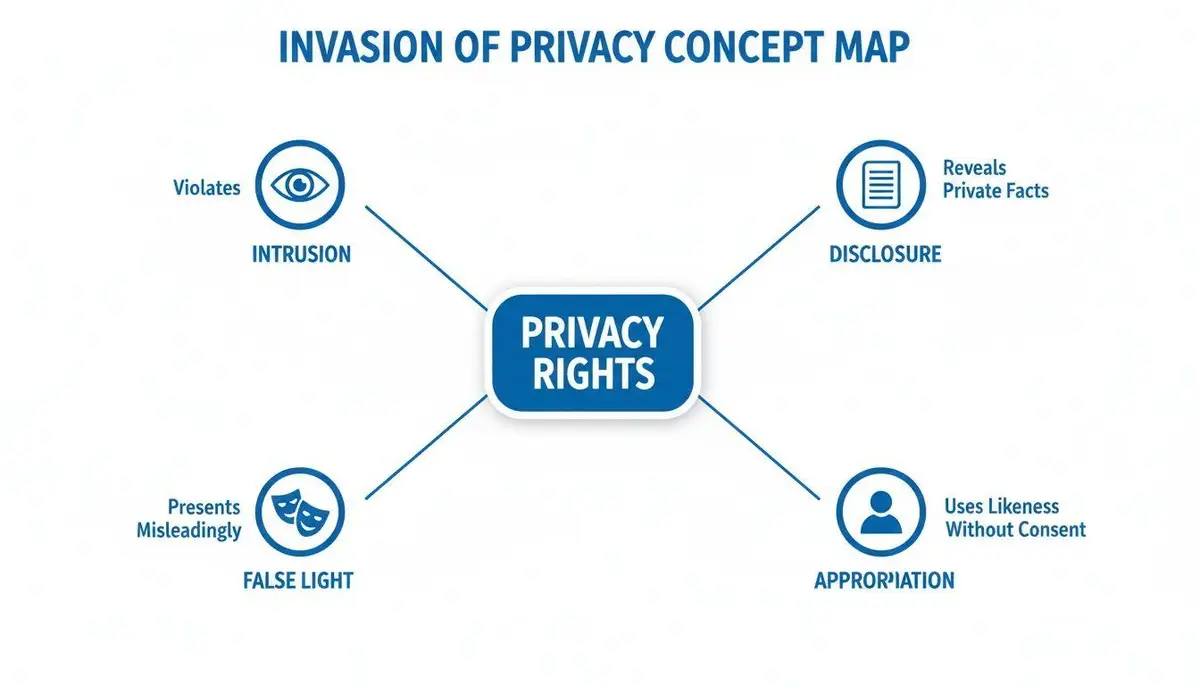
Analyzing these claims in practice reveals their strategic application.
Intrusion Upon Seclusion addresses the act of wrongful observation itself. The harm is realized the moment your private space is breached, whether by hacking cloud storage or bugging a boardroom, even if the gathered information is never published.
Public Disclosure of Private Facts focuses on the damage from broadcasting sensitive information that has no legitimate public interest. The critical element is that the information, while true, is profoundly private and its publication is offensive.
False Light is distinct. It applies to situations where you are portrayed in a misleading and highly offensive way, even if no explicit lies are told. It is an essential tool for correcting reputation-damaging distortions of your character and beliefs.
Appropriation of Name or Likeness protects your identity as a commercial asset. It prevents others from capitalizing on your reputation by using your name, face, or voice for commercial purposes without your consent.
The methods used to gather information can blur legal lines. The legality of web scraping, for instance, is not absolute. Whether it is permissible depends heavily on the specific data being collected and the methods employed. More on this topic can be found in “Is scraping websites illegal?”.
The law protects your right to be left alone. When that line is crossed in a manner a reasonable person would find highly offensive, a legal path exists to hold the perpetrator accountable and contain the fallout.
Effective protection of your privacy and reputation requires first identifying which claim fits your situation. Only then can a response be tailored to the specific violation you face.
When your privacy is violated, the law offers several avenues for recourse. Two of the most powerful are claims for Intrusion Upon Seclusion and Public Disclosure of Private Facts. While they sound similar, they protect against different harms, and understanding this distinction is critical to structuring a successful invasion of privacy legal case.
Intrusion Upon Seclusion centers on the act of spying. The legal injury occurs the moment someone breaches a space, physical or digital, where you have a reasonable expectation of privacy. This could be a hacker penetrating your private server, a corporate rival installing spyware on your laptop, or a covert camera planted in your office.
The key is that the information obtained need not be published or shared. The intrusion itself constitutes the offense. The law recognizes that psychological damage and a breach of security occur at the moment of violation, not merely when private information becomes public.
Distinguishing Intrusion from Public Disclosure
Public Disclosure of Private Facts addresses the other side of this coin. This claim is not about the act of snooping; it concerns the devastating consequences that occur when someone publishes your private information.
For a disclosure to be legally actionable as an invasion of privacy, it must clear several high hurdles:
- The information must be genuinely private. It cannot be information already available in public records or previously shared openly by you.
- The disclosure must be highly offensive to a reasonable person. This is a demanding standard, referring to revelations that are truly damaging, not merely embarrassing.
- The facts revealed must not be of legitimate public concern. This is often the most contentious element, particularly for public figures.
Courts are in a constant state of balancing an individual’s right to be left alone against the public’s right to know.
A classic example is the leak of a public figure’s confidential medical records. While the public may be curious, there is almost never a legitimate, newsworthy justification for broadcasting such sensitive information. The same applies to private financial data, intimate family correspondence, or confidential business strategies that do not affect public welfare.
The central legal battle often reduces to one question: Where does legitimate public interest end and offensive prying begin? For an executive, the financial details of a major corporate merger might be newsworthy. Their private text messages with a spouse are almost certainly not. This distinction is the battleground where these privacy cases are won or lost.
The Challenge of Proving a Case
Successfully proving either of these claims requires a meticulous, evidence-driven approach. For an intrusion claim, the primary challenge is identifying the perpetrator. This often demands sophisticated digital forensics to trace a hack or expert analysis to pinpoint the source of a surveillance device.
With public disclosure, the focus shifts. You must prove not only that the defendant published your private information but also that the material lacked newsworthiness. This is especially difficult for executives and celebrities, as courts tend to grant the media wider latitude on what qualifies as “legitimate public concern” when an individual is already in the public eye.
This area of law has been further complicated by the rise of website tracking tools. Hundreds of lawsuits, particularly in California, now argue that session-replay software and other analytics tools constitute a modern form of illegal eavesdropping under the California Invasion of Privacy Act (CIPA). Plaintiffs are applying a law written in the 1960s for telephone wiretapping to today’s digital marketing technologies, creating significant legal uncertainty for businesses.
Despite mixed results in court, the volume of these CIPA-related lawsuits continues to rise, making it one of the most active areas of privacy litigation in the country. A nuanced understanding of both intrusion and public disclosure is the essential first step in mounting a strong defense against these attacks.
Protecting Your Reputation with False Light and Appropriation Claims
Beyond overt data breaches or leaked secrets, privacy violations can manifest in more subtle forms. These attacks often target your public image and personal brand, twisting the truth or exploiting your identity for another’s gain. Two of the most important legal shields in these situations are claims for False Light and Appropriation of Name or Likeness.
These are tools for two different functions: one protects you from being publicly misrepresented, while the other prevents others from profiting from your identity without authorization.

When the Truth is Twisted: False Light
While a defamation lawsuit targets provable falsehoods, a False Light claim is distinct. It addresses situations where published information creates a deeply misleading and offensive impression of you, even if the individual facts are technically accurate.
This is the classic case of being taken out of context. Imagine an interview where your comments are selectively edited to suggest you endorse a radical, unpopular cause you actively oppose. No single word is fabricated, but the overall impression is a complete distortion of your identity and beliefs. That is false light.
The core injury is not reputational damage from a lie, but the personal offense and humiliation of being publicly misrepresented. The legal standard is high; the portrayal must be something a reasonable person would find highly offensive.
The “Actual Malice” Standard for Public Figures
If you are a public figure (a category that typically includes executives, celebrities, and other well-known individuals) the challenge is steeper. To win a false light claim, you must prove the publisher acted with “actual malice.”
The legal definition of actual malice is specific: it does not mean personal hatred or ill will. It means the publisher either knew the portrayal was false or acted with a reckless disregard for the truth.
Proving a publisher’s state of mind is a significant hurdle. It often requires an exhaustive investigation into their sources, internal communications, and editorial processes to demonstrate they either knew the portrayal was false or chose not to ascertain the truth.
When Your Identity Becomes a Product: Appropriation Claims
The second powerful claim, Appropriation of Name or Likeness, is about protecting your identity as a valuable asset. It prevents others from using your name, photograph, voice, or any other element of your identity for commercial gain without your consent. This has become critically relevant with the proliferation of AI-generated content and deepfakes.
An appropriation claim centers on unauthorized commercial use. Common examples include:
- A company using your photo in a product advertisement without a contract.
- A brand fabricating a glowing testimonial and attributing it to you.
- A deepfake video of you appearing to endorse a cryptocurrency scheme.
- An AI-generated “voice clone” of you narrating a commercial.
This protection has limits. The primary defense against an appropriation claim is that the use is “newsworthy.” The media has a constitutional right to report on public figures, which includes using their names and images in news articles, documentaries, and commentary.
The crucial legal question always centers on purpose. Was your identity used to report news and inform the public, or was it used to sell a product? An executive’s photograph in a news story about their company’s earnings is clearly newsworthy. That same photo on a billboard for an unrelated wealth management firm is commercial appropriation.
Knowing where that line is drawn between newsworthiness and commercial exploitation is key. When someone uses your likeness to generate revenue, they are not only diluting your brand but also stealing value that is rightfully yours. The law provides a direct path to terminate the infringement, reclaim control, and demand compensation.
Navigating the Complexities of Global Privacy Law
An invasion of privacy rarely involves a straightforward legal fight. There is no single rulebook. Instead, you face a complex web of state, federal, and international laws, where an act that is illegal in one jurisdiction may be permissible in another.
For executives and brands with a global footprint, mastering this legal landscape is the cornerstone of any effective response. A privacy violation originating in one country can rapidly escalate into a worldwide legal and reputational disaster. A one-size-fits-all approach is therefore destined to fail. Your entire strategy, from the strength of your claim to the potential for damages, depends on which laws apply.
The GDPR and the European Standard
The European Union has set the global benchmark for aggressive data protection. The General Data Protection Regulation (GDPR) is not a set of guidelines; it is a powerful legal regime with substantial enforcement power and massive fines for non-compliance. It grants individuals significant rights over their personal information, including the right to erasure, often called “the right to be forgotten.”
EU enforcement is robust. By January 2026, cumulative GDPR fines are projected to reach €5.88 billion. This is not a theoretical threat. Meta’s record-breaking €1.2 billion fine in May 2023 for transferring European user data to the U.S. without adequate safeguards serves as a stark example.
For any executive or brand with a European presence, any privacy issue will be judged against the EU’s stringent standards, regardless of your headquarters’ location. The GDPR often provides a strong legal basis for demanding content removal or seeking damages. Its protections, however, are not global, and concepts like The Right to Be Forgotten in the USA are treated very differently outside the EU.
The Patchwork Approach in the United States
The U.S. presents a starkly different legal environment. In contrast to the EU’s unified system, the American approach is a fragmented patchwork of state laws and specific federal statutes. The absence of a single, overarching federal privacy law makes the legal terrain notoriously difficult to navigate.
California has been the legislative pioneer, first with the California Consumer Privacy Act (CCPA) and now with the California Privacy Rights Act (CPRA). These laws grant consumers rights analogous to the GDPR, such as the right to know what data is being collected and to demand its deletion.
A critical battleground in the U.S. is the application of antiquated wiretapping laws to modern website technology. Hundreds of lawsuits under the California Invasion of Privacy Act (CIPA) allege that common tools like analytics trackers and chatbots constitute illegal “eavesdropping,” creating immense legal risk for businesses operating online.
This fragmented legal landscape creates significant strategic challenges. A successful invasion of privacy legal claim in California might fail in a state with weaker privacy laws. The lack of a federal standard means every action must be meticulously tailored to the specific jurisdiction, where the harm occurred, where the offender is located, and where you reside. Correctly analyzing jurisdiction is the absolute first step in constructing a legal response.
Building Your Case: Evidence and Legal Remedies
Winning an invasion of privacy case is not about moral vindication; it is about proving a legal right. This requires a foundation of compelling, admissible evidence. Without concrete proof, even the most egregious violation remains a grievance, not an actionable legal claim. The entire process hinges on the immediate and correct preservation of that evidence.
You must adopt the mindset of a digital forensic investigator from the outset. The objective is to capture a complete, verifiable record of the privacy breach before the perpetrator can erase their tracks. This evidence becomes the cornerstone of any subsequent demand letter, takedown request, or lawsuit.
Preserving the Digital Crime Scene
The first, most critical step is to secure the evidence. This requires more than a simple screenshot. For digital evidence to be admissible in court, you must maintain a clean and unbroken chain of custody. This protocol, analogous to a sealed evidence bag in a physical crime scene, proves the evidence has not been tampered with since its collection.
Key pieces of evidence to preserve meticulously include:
- Archived Copies of the Violating Content: This includes screenshots, full-page PDFs, and archived links of the harmful post, leaked document, or unauthorized photograph. Simple browser screenshots are often insufficient as they lack the underlying metadata required for verification. We offer specific guidance on how to find and secure archived private information before it disappears.
- Digital Forensic Analysis: If the privacy breach involved hacking or unauthorized access to your devices, a forensic “image” (an exact copy) of the hard drive is essential. Experts can analyze these images to find malware, trace the intruder’s methods, and potentially identify them.
- Server Logs and Communication Records: Technical data such as website server logs, email headers, and social media records can provide timestamps, IP addresses, and other details crucial for identifying the source of the attack.
- Expert Witness Testimony: For complex cases, particularly those involving sophisticated digital attacks or significant financial loss, expert witnesses are indispensable. Cybersecurity specialists, forensic accountants, or reputation analysts can explain technical details and quantify damages in a way that is intelligible to a judge and jury.
The challenge is not just capturing the data, but protecting its integrity. A single corrupted file or a poorly documented screenshot can be challenged and invalidated, potentially causing your entire legal strategy to collapse. This is why immediate, professional intervention is critical.
Securing Legal Remedies for Privacy Violations
With a strong case built on solid evidence, you can pursue powerful legal remedies. These actions are designed to terminate the attack and compensate you for the harm suffered. The specific options depend on your jurisdiction and the facts of your claim, but they generally fall into two main categories.
1. Injunctive Relief
This is an emergency court order that compels a party to either perform an action or, more commonly, cease an action. In privacy cases, this typically takes the form of a temporary restraining order (TRO) or a preliminary injunction. The court orders the defendant to immediately remove the offending content and cease its publication. This is the first priority: to stop the ongoing damage.
2. Monetary Damages
While an injunction halts continuing harm, monetary damages compensate for the harm already inflicted. Courts can award several types of damages:
- Actual Damages: This covers the direct, tangible financial losses incurred due to the privacy invasion, such as lost business contracts, the cost of hiring a reputation management firm, or expenses for enhanced security measures.
- General Damages: These compensate for non-economic harm that is difficult to quantify, such as emotional distress, public humiliation, and damage to personal or professional reputation.
- Punitive Damages: If the defendant’s conduct was particularly malicious or egregious, a court might award punitive damages. The purpose is not to compensate you, but to punish the wrongdoer and deter similar conduct by others.
The stakes in this field are escalating annually. In 2022 alone, federal courts saw nearly 2,000 new lawsuits filed over data privacy issues, and class-action suits for data breaches have been rising steadily for the past five years. These large-scale claims can result in nine-figure settlements, underscoring the massive financial and reputational risks involved. A full analysis of this trend is available in this report on U.S. data privacy litigation.
The Dual-Track Strategy: Legal Action and Immediate Containment
When a privacy crisis erupts online, you are fighting a war on two fronts. The first is the legal battle, a deliberate, methodical process where attorneys build a case for court. This is essential, but it can take months or even years. The second, more urgent front is the digital battlefield, where every share and search result amplifies the damage.
This is where a rapid-response team is required. While your lawyers prepare for long-term legal action, a specialist containment firm can act immediately as a digital first-responder. This two-track strategy allows the legal team to build the foundation for a permanent victory while the containment team stops the immediate hemorrhaging of your reputation.

How a Dual-Track Strategy Works in Practice
The primary mission of a containment specialist is speed. These firms operate outside the formal court system, leveraging established relationships with platforms, proprietary technology, and a deep understanding of website terms of service to achieve content removal in hours or days, not months.
Their immediate actions typically include:
- Rapid De-indexing: Securing the removal of violating content from search engine results. If the public cannot find the content on Google, it is effectively neutralized.
- Source Removal: Engaging directly with the source (the web host, social media platform, or forum) to have the harmful material itself taken down.
- Continuous Monitoring: Deploying automated systems that scan the web to find and flag any attempts to re-upload the content, preventing its reappearance.
This type of immediate action is critical. For a brand combating a defamatory campaign or a public figure targeted by a leak, the harm multiplies with every minute the content remains online. Containment shrinks that exposure, protecting your reputation and psychological well-being while strengthening your future legal position. For immediate assistance in such a situation, contact our online privacy service.
By the time a court issues a takedown order, the reputational damage is often already done. A rapid containment strategy acts as a tourniquet, affording your legal team the time required to prepare for more permanent legal remedies.
The financial stakes have never been higher. As global privacy enforcement intensifies, the average cost of a single data breach has soared to USD 4.62 million. More telling, privacy violations are now a factor in two-thirds of all major cyber losses. A full breakdown of this data is available in this global breach and enforcement report. Engaging a specialist firm is a proactive measure to shield yourself from these massive costs.
Frequently Asked Questions

When you are in the public eye and your privacy is breached, the situation is always complex and time-sensitive. Here are direct answers to the most urgent questions we receive from clients in crisis.
What is the Most Important First Step?
The first directive for every client is: preserve evidence. Before taking any other action, before contacting the responsible party or attempting removal yourself, you must secure a forensically sound record of the incident. This means creating archived copies of webpages, capturing verified screenshots with metadata, and, if a device was compromised, creating a full digital image of the hard drive. Impulsive removal attempts can destroy the very evidence needed to build a successful legal case.
How Long Does Content Removal Take?
The timeline depends entirely on the strategy employed. The traditional invasion of privacy legal path, which involves seeking a court-ordered injunction, is powerful but slow, often requiring months. In contrast, a specialist containment firm can frequently achieve removal in a matter of hours or days. These teams operate outside the court system, using direct platform relationships and technical expertise to de-index content from search engines and scrub it from source websites. A dual-track approach, immediate containment to mitigate damage while formal legal action proceeds, is often the most effective strategy.
The critical question is not just if content can be removed, but how quickly. While legal channels build a case for permanent resolution, a rapid-response team mitigates immediate damage, protecting your reputation while the legal process unfolds.
Can I Sue an Anonymous Attacker?
Yes, it is possible to take legal action against an individual hiding behind an anonymous username. The process begins with filing a “John Doe” lawsuit. Your legal team can then use the discovery process to issue subpoenas, which compel web hosts, social media companies, and internet service providers to disclose information, such as IP addresses or account details, that can unmask the anonymous actor. While challenging, this is a standard and effective method for holding anonymous perpetrators accountable.
When your privacy and reputation are under attack, you need a team that integrates legal strategy with decisive, rapid-response capabilities. ContentRemoval.com specializes in protecting high-profile individuals and brands by removing damaging online content with speed and discretion. If you are facing a privacy crisis, contact us for a confidential assessment.