
Media monitoring best practices for high-profile individuals and brands cover ten disciplines: real-time alerting with post-removal surveillance, multi-platform coverage including forums and image boards, written incident classification, jurisdiction mapping, source and mirror tracking, platform liaison, adversarial threat detection, brand and IP watches, a sentiment baseline, and one command structure across monitoring, legal, and PR.
Key facts
- Keep surveillance running after a takedown, because reuploads often appear on mirrors, forums, and file hosts
- Rank each channel by audience impact, search visibility, repost velocity, removal path, and legal jurisdiction
- Reverse image search via Google, TinEye, and Yandex helps trace copies; YouTube Content ID suits some rights holders
- Coordinated campaigns show tight timing clusters, new accounts, and repeated phrasing across platforms
Where ContentRemoval.com comes in. ContentRemoval.com combines removal work with the post-removal monitoring layer most programs miss: tracing the source, the mirrors, and the accounts most likely to repost. The head of security, the family office, or the executive’s counsel usually makes contact after an alert has already turned into an incident. A free 15-minute Exposure Scan maps what is removable, and the report is yours to keep. Get a Free, Confidential Exposure Scan or read how our content removal work is done.
A negative mention about your name, company, or family office rarely stays isolated. It gets indexed, copied, clipped into posts, screenshot into group chats, and republished by accounts that have no relationship to the original source. By the time your assistant forwards it, the issue may already be moving across platforms, jurisdictions, and audiences that require different response tactics.
That’s why standard monitoring isn’t enough. High-profile individuals, executives, creators, and brands need a defensive framework that detects risk early, classifies it correctly, preserves evidence, and routes it into legal, technical, and communications action without delay. The right system doesn’t just tell you that someone mentioned you. It tells you what matters, what can be ignored, what must be escalated, and what has to be removed before it hardens into search results and public narrative.
Media monitoring best practices start with scope and discipline. Monitoring should cover traditional, social, and broadcast media, and modern tools can pull data from millions of sources, according to PublicRelay’s guidance on media monitoring metrics. That only helps if your searches are structured around brand names, product names, executives, competitors, hashtags, and common misspellings, with KPIs defined before you build alerts and reporting.
For high-stakes reputation defense, the standard is higher. You need continuous surveillance, not occasional visibility. You need escalation rules, not a passive dashboard. You need legal and technical workflows that stay active after a takedown, because removal is often the midpoint, not the finish line.
1. Real-Time Alerting and Continuous Post-Removal Monitoring
The first failure point in most programs is delay. If your team sees a harmful article, post, leak, or impersonation account hours after publication, the damage has already spread into search, screenshots, reposts, and platform recommendations. Real-time alerts are critical.
Industry guidance is clear on this point. Effective monitoring programs combine real-time alerts, sentiment analysis, share-of-voice tracking, and cross-channel coverage beyond social alone, and Cision recommends measurable operational goals such as responding to customer complaints within an hour in its media monitoring guidance. For a high-risk reputation program, that operational model should be applied to threats, not just customer service.
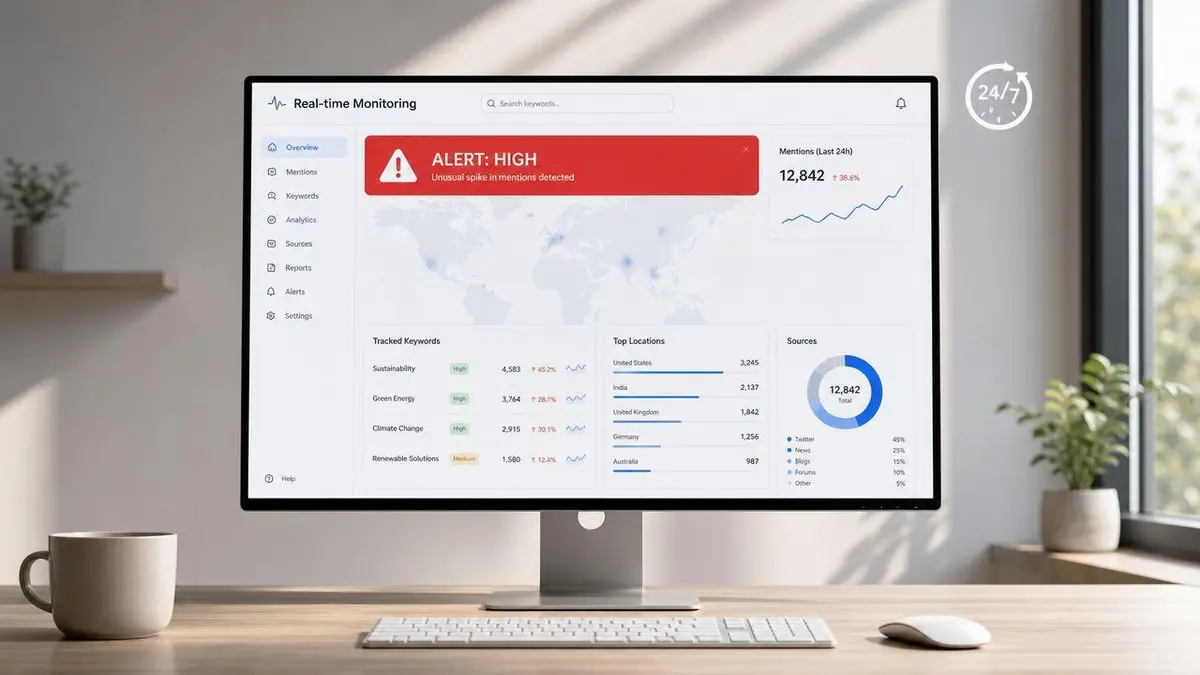
A proper alert stack monitors exact names, common misspellings, aliases, product terms, campaign tags, executive names, and known hostile phrases. It also separates profiles. A public company CEO, a founder’s private family name, and a consumer brand shouldn’t sit in one undifferentiated alert feed.
What continuous surveillance actually requires
Removal work fails when the team treats takedown as closure. It isn’t. Harmful content often reappears on mirror domains, forum threads, file hosts, messaging apps, and image boards shortly after the original source comes down. Post-removal monitoring needs its own watchlist, its own escalation queue, and its own evidence log.
Practical rule: Keep surveillance active after removal, because the first reupload often appears before the original complainant checks again.
Use reverse image search for visuals, fingerprint-based detection where available, and persistent searches around the same asset title, quoted language, and uploader identity. If the matter involves doxxing, defamation, leaked images, or non-consensual content, route alerts directly into counsel and platform reporting workflows. If you need source removal and post-removal surveillance under one process, review content removal support options.
2. Multi-Platform Monitoring Strategy
A false allegation breaks on an anonymous forum at 2:00 a.m. By sunrise, screenshots are circulating on Reddit, clipped into short-form video, quoted in comments under a news article, and indexed in search results under your executive’s name. If your monitoring stack covers only major social platforms, you discover the attack after distribution is already underway.
High-stakes reputation defense requires channel mapping, not a generic mention feed. Media monitoring has to cover online news, social platforms, podcasts, broadcast, and other public media sources, as outlined in Meltwater’s overview of media monitoring. For high-profile individuals and brands, that baseline is too narrow on its own. Add search results, forums, comment sections, review sites, creator platforms, marketplaces, and public messaging surfaces where hostile narratives, leaks, and impersonation attempts often appear first.
Build a platform priority matrix tied to actual exposure.
Rank each channel by five factors: audience impact, search visibility, repost velocity, removal path, and legal jurisdiction. A consumer brand facing counterfeit abuse needs persistent coverage of marketplaces, reseller listings, and review manipulation. A public figure needs closer surveillance of Reddit threads, gossip blogs, image boards, parody accounts, and platforms that permit fast account creation with weak identity checks.
Monitor according to spread mechanics
Treat platforms differently based on how harm moves across them:
- Primary visibility channels: Search engines, major social networks, news sites, video platforms, and review pages where content reaches mass audiences and influences perception fast.
- Amplification channels: Forums, subreddits, comment threads, repost blogs, newsletters, and aggregator pages that push a narrative into wider circulation.
- Origin channels: Anonymous boards, file hosts, fringe communities, paste sites, and leak-oriented spaces where coordinated attacks, doxxing material, or fabricated evidence may surface before mainstream pickup.
This structure matters for legal and technical reasons. A post on a small forum may create limited direct harm but still demand immediate attention if search engines can index it, journalists can cite it, or coordinated actors are using it as a staging point. Teams that monitor only by platform size miss the channels that create the first evidence trail.
Reddit deserves special attention because it often functions as both an origin and an amplifier. A single thread can show whether a claim is isolated criticism, adversarial seeding, or part of a coordinated campaign designed for later migration into search and press coverage. For teams assessing early narrative formation and hostile audience behavior, this guide to finding market signals on Reddit is a useful tactical reference.
Set ownership by platform before an incident. Legal should know which channels support defamation, privacy, copyright, trademark, or impersonation complaints. Security should cover impersonation clusters, account abuse, domain spoofing, and coordinated posting patterns. PR should track whether engagement will suppress the story or give it oxygen. Multi-platform monitoring works only when each surface has a defined watcher, a defined removal path, and a defined escalation rule.
3. Rapid Response Protocols and Incident Classification
The worst time to decide who handles a takedown, who preserves evidence, and who speaks publicly is after the incident is already live. High-risk organizations need a written classification system that converts raw alerts into action within minutes, not debate by committee.
Start with categories that match real legal and platform pathways. Defamation, impersonation, non-consensual intimate imagery, privacy exposure, copyright infringement, fake reviews, and coordinated harassment each require different evidence packages and different response sequencing. If you mix them together under “reputation issue,” your team will send the wrong notice to the wrong party and lose time.
Build a severity ladder
Not every alert deserves the same treatment. Some can wait for routine review. Others need immediate legal hold, executive notification, platform reporting, and external counsel. Your monitoring team should classify each event by harm level, source authority, virality risk, indexation risk, and jurisdiction.
A workable protocol answers five questions fast:
- What is the content type
- Where is it hosted
- Who has legal standing to complain
- Can it be removed by policy, law, or both
- Does public response reduce harm or amplify it
Escalation rules must be written before the incident. If they aren’t, staff will improvise under pressure and create avoidable exposure.
Pre-drafted demand letters, platform complaint templates, chain-of-custody procedures for screenshots, and a designated incident lead should already exist. So should your decision on silence versus response. Many executives worsen a manageable event by commenting too early, admitting facts not yet verified, or threatening legal action where a cleaner platform policy route would have worked faster.
4. Legal Jurisdiction Mapping and Compliance Monitoring
A takedown strategy that ignores jurisdiction is amateur work. The same content can be actionable in one country, protected speech in another, or removable under a platform policy even when a court claim would be weak. You need a jurisdiction map before you file demands, not after a rejection.
This matters more as monitoring programs expand across channels and territories. The global media monitoring market was estimated at USD 4.31 billion in 2023 and is projected to reach USD 8.42 billion by 2028, implying a 14.4% CAGR, according to the MarketsandMarkets media monitoring market report. That expansion is being driven by real-time alerts, sentiment analysis, and broader cross-channel coverage. In practice, broader coverage means more cross-border exposure, more platform-policy variation, and more legal complexity.
Map law, platform rules, and evidence requirements together
Don’t ask only where the content is visible. Ask where the publisher sits, where the platform entity operates, where the servers are located if relevant, where the claimant resides, and which jurisdiction gives you the strongest lawful basis. A post involving private personal data may support one route. A false accusation from an anonymous account may support another. Copyright, trademark, privacy, and defamation each travel differently.
Your case file should track:
- Applicable legal theory: Defamation, privacy, copyright, trademark, harassment, impersonation, or data protection.
- Platform-specific policy route: Terms of service, impersonation form, privacy complaint, copyright notice, or court order submission channel.
- Evidence standard: URLs, timestamps, screenshots, identity documents, registration records, rights ownership proof, and prior correspondence.
When counsel, investigators, and monitoring staff use one jurisdiction map, they stop wasting time on requests that were never viable. They also preserve stronger arguments for the forum that can compel action.
5. Source and Secondary Distribution Tracking
Efforts often attack the visible copy and miss the distribution chain. That’s how harmful material survives. The article disappears from one site, but the screenshots remain on social media. The video is removed from the obvious host, but clipped versions keep circulating through smaller platforms and mirror pages. In reputation defense, source tracing matters as much as removal.
Start by identifying the origin point, then map every derivative version. Reverse image search, quoted-text search, metadata review, cached search references, and uploader pattern analysis all help. If the same language, file name, or visual asset appears across multiple domains, preserve that relationship in your evidence log because it can support repeat-offender reporting and coordinated removal strategy.

Remove in sequence, not at random
Teams often debate whether to hit the source first or the copies first. The answer depends on the platform mix and reupload risk. If secondary copies are highly visible and easy to remove, clear them quickly to slow spread. If the primary source feeds the rest, attack it without delay and preserve evidence before notifying the uploader.
Use tooling that supports visual matching and known-asset recognition. Google reverse image search, TinEye, and Yandex can help with public visual discovery. Platform-native systems such as YouTube Content ID can help for certain rights holders and asset types. None of those tools replaces human review. They support it.
The question isn’t whether content was removed somewhere. The question is whether you’ve identified the source, the copies, the mirrors, and the accounts most likely to repost it.
Tracking secondary distribution also helps with attribution. If the same actor or network keeps reappearing, your legal strategy can shift from isolated takedowns to a repeat-abuse file with a cleaner evidentiary record.
6. Platform Relationship Management and Direct Liaison Programs
A generic support form is often the slowest path available. For ordinary consumer issues, that may be acceptable. For active impersonation, leaked material, coordinated defamation, or account compromise involving a public figure, it usually isn’t.
Organizations that handle high-stakes reputation work need direct, professional relationships with trust and safety teams, legal submission channels, escalation desks, and brand protection programs where available. That doesn’t mean informal favoritism. It means knowing the correct route, the correct evidence standard, and the correct format for a request that will be reviewed quickly and seriously.
Earn credibility with precision
Platforms respond better when your submissions are accurate, complete, and consistent. If your team floods abuse forms with weak claims, contradictory timelines, or unsupported legal threats, you’ll undermine future credibility. Every request should identify the exact URL or account, the precise policy or legal basis, the harmed party, the requested action, and the evidence attached.
Strong liaison management usually includes:
- A dedicated owner: One person or small team should manage platform communications so submission quality stays consistent.
- A repeatable archive: Keep prior ticket numbers, outcomes, rejection reasons, and successful wording patterns.
- A professionalism standard: Don’t overstate claims. Don’t send broad accusations. Submit what you can prove.
This isn’t administrative housekeeping. It’s a strategic advantage. When platform teams learn that your submissions are disciplined and factually reliable, your matters move faster and with less friction. That’s especially valuable when ordinary public reporting routes become congested or ineffective during a fast-moving incident.
7. Competitive and Adversarial Threat Monitoring
Not all negative coverage is organic. Some of it is coordinated by competitors, former employees, anonymous agitators, extortionists, or ideological groups. If you fail to distinguish criticism from orchestration, you’ll choose the wrong response and miss the actor behind the campaign.
Many “media monitoring best practices” guides stop too early. They tell you to track mentions, keywords, and platforms. They spend less time on the harder operational question of how to separate signal from noise without over-monitoring and when a spike is actionable. That gap is identified in Sprinklr’s discussion of media monitoring workflows and prioritization, which points toward a more disciplined model: better monitoring is often less broad but more operational, with clear rules for what gets ignored, routed, or escalated.
Look for coordination markers
A coordinated campaign leaves patterns. Posts appear in tight timing clusters. Newly created accounts repeat similar phrasing. Reviews arrive from profiles with thin histories. Screenshots and allegations migrate across platforms in a deliberate order designed to create the appearance of independent corroboration.
Your analysts should review:
- Timing patterns: Multiple posts landing within a narrow window.
- Account characteristics: Creation dates, profile completeness, posting history, follower anomalies, and cross-platform reuse.
- Language similarities: Repeated syntax, unusual turns of phrase, or matching accusation structures.
Don’t overreact to every cluster. Set decision thresholds in advance. Some bursts are routine chatter. Others justify evidence preservation, platform reports for coordinated inauthentic behavior, internal investigation, and legal preparation. The threshold should be explicit, not subjective. That’s the difference between noise and intelligence.
8. Brand Asset and Intellectual Property Monitoring
For many brands and creators, reputation harm isn’t limited to what people say. It’s what they sell, copy, counterfeit, or impersonate under your name. A stolen logo, cloned landing page, fake social account, pirated course, or unauthorized marketplace listing can drain revenue while training search engines and customers to associate your brand with fraud.
Intellectual property monitoring has to run in parallel with reputation monitoring. Trademark misuse, copyright infringement, and brand impersonation aren’t side issues. They’re often the infrastructure of a wider attack. A fake account can publish defamation. A counterfeit listing can trigger customer complaints. A cloned site can harvest credentials and create a security event that becomes a press issue.
Protect the assets people can weaponize
Monitor your brand name, logos, taglines, product photography, executive likeness, social handles, and suspicious domain registrations. Watch for marketplace listings that use your marks, affiliate pages that alter your branding, and social accounts that mimic your voice or identity. Search combinations of your brand with terms like “discount,” “sale,” “official,” and “support” because abuse often hides in commercial phrasing.
A disciplined IP workflow includes:
- Trademark and rights documentation: Keep registrations, ownership records, and specimen evidence accessible.
- Visual matching: Use reverse image search and marketplace reporting tools to locate unauthorized logo and product image use.
- Enforcement routing: Send matters into the correct trademark, copyright, domain, or impersonation process immediately.
If your issue involves counterfeiting, cloned content, impersonation, or unauthorized use of protected assets, review intellectual property protection services as part of a broader monitoring and takedown strategy.
9. Reputation Baseline Establishment and Sentiment Analysis
You can’t identify a meaningful deterioration in reputation if you’ve never defined normal. That’s why baseline work matters. Without it, every spike feels urgent, every complaint feels existential, and leadership has no disciplined way to distinguish routine criticism from a real narrative shift.
Continuous monitoring should be operational, not occasional. Industry guidance recommends weekly or monthly review cycles for most businesses, while social monitoring guidance calls for daily or weekly checks depending on volume, with alerting, refreshed keyword lists, mention categorization, and reporting shared across teams, as summarized in Agility PR’s best-practices guidance for modern media monitoring. For high-profile clients, that review cadence needs to support a live baseline and immediate exception handling.
Build a baseline that decision-makers can use
Your baseline should track source types, recurring themes, sentiment categories, search-result patterns, executive mention frequency, and the normal level of negative commentary that doesn’t require intervention. Sentiment analysis helps, but don’t outsource judgment to software. Automated sentiment frequently misses irony, quote context, legal nuance, and reputation significance.
Use sentiment as one layer in a larger model. A low-volume but highly credible allegation from a respected publication may matter more than a larger volume of low-quality chatter. A cluster of neutral mentions around a leak can still create legal exposure. What matters is deviation plus context.
A useful baseline doesn’t just describe coverage. It tells leadership when to ignore noise, when to prepare a response, and when to authorize removal, counsel, or escalation.
For organizations that need long-term tracking across brands, executives, and incidents, reputation monitoring support should feed directly into your incident and legal workflows rather than sit as a standalone reporting function.
10. Crisis Communication Coordination Between Monitoring, Legal, and PR Teams
Monitoring without coordinated response creates a dangerous illusion of control. Your dashboard lights up, but nobody knows who approves a statement, who preserves evidence, who contacts the platform, who briefs the principal, or who decides whether silence is safer than reply. In a real incident, that gap becomes the crisis.
The governance problem is bigger than is often acknowledged. Existing guidance on social and media monitoring often mentions archiving or compliance briefly, but leaves retention, access control, consent, employee monitoring boundaries, and auditability underexplained, especially when workflows cross jurisdictions and departments. That governance gap is outlined in Jatheon’s discussion of social media monitoring strategy and archive responsibilities. For high-risk reputational matters, governance isn’t administrative detail. It’s evidence control.
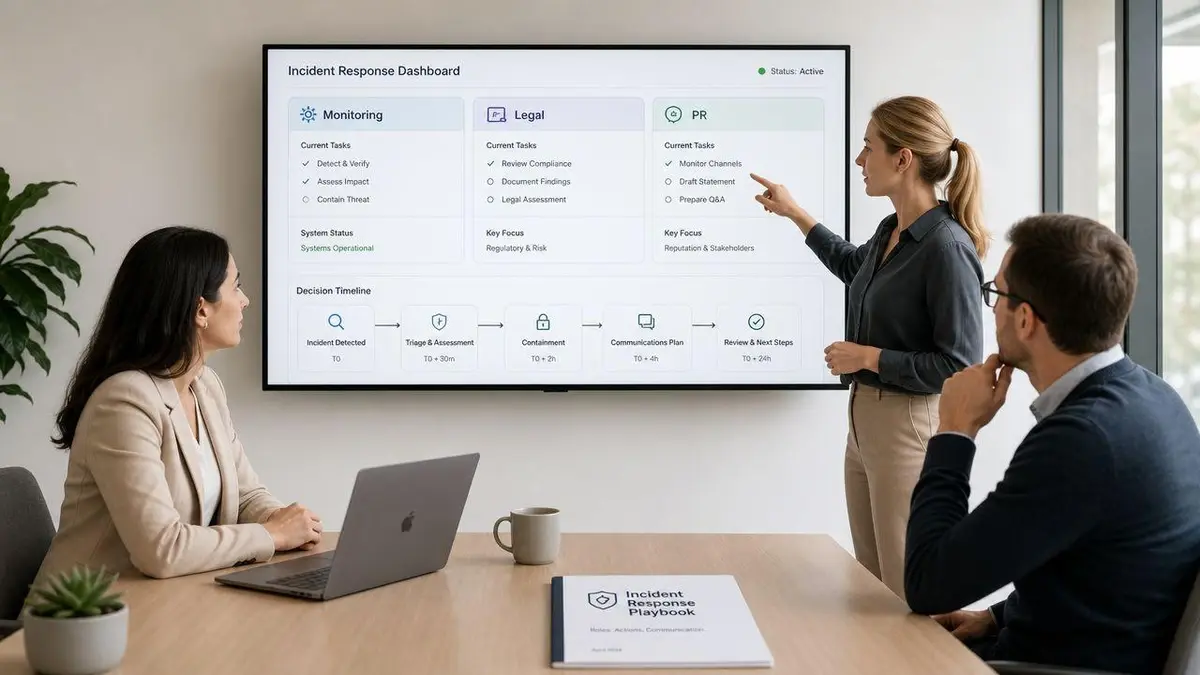
One incident, one command structure
Legal, communications, security, and executive staff need a single incident lead and a shared operating picture. Monitoring should push verified alerts into a secure channel. Legal should assess removal grounds, preservation duties, and litigation risk. PR should prepare holding language, internal guidance, and stakeholder messaging that doesn’t prejudice legal options.
The minimum coordination standard is simple:
- One decision tree: No parallel chains of command.
- One evidence record: One archive of URLs, screenshots, timestamps, notices, and outcomes.
- One approval path: Public statements, internal notifications, and platform submissions should follow predefined authority.
Run simulations. Test whether your team can classify a leak, preserve evidence, notify the right people, and issue or withhold comment without confusion. If it can’t, your monitoring system is generating alerts faster than your organization can safely use them.
10-Point Media Monitoring Best Practices Comparison
Use this comparison to decide where to spend budget, who owns each function, and which gaps create legal or reputational exposure first. In high-stakes matters, the right stack is the one that shortens detection time, supports defensible action, and keeps watch after a takedown.
| Strategy | Implementation complexity | Resource requirements | Expected outcomes | Ideal use cases | Key advantages |
|---|---|---|---|---|---|
| Real-Time Alerting and Continuous Post-Removal Monitoring | High. Requires automated alerts, fingerprinting, and constant tuning | Ongoing tool subscriptions, monitoring engineers, analyst review time | Faster detection of harmful content and repeat uploads, shorter time to action | High-risk reputation threats, NCII, repeat-posting abuse, persistent smear campaigns | Early warning, repeat-upload detection, continued surveillance after removal |
| Multi-Platform Monitoring Strategy | Very high. Requires API connections, source normalization, and coverage across closed and open channels | Significant tooling spend, platform specialists, integration support | Wide visibility across search, social, forums, video, marketplaces, and news. Better detection of content migration | Brands and individuals exposed across multiple channels, piracy, impersonation, coordinated attacks | Broad cross-platform coverage, fewer blind spots, better tracking of threat movement |
| Rapid Response Protocols and Incident Classification | Moderate. Requires playbooks, escalation rules, and decision trees | Trained on-call staff, legal review access, PR coordination | Faster, more consistent response and clearer prioritization of removal, preservation, or public statement | Organizations that need SLA-based handling, executive protection, crisis-prone clients | Fewer delays, consistent triage, faster takedown and escalation decisions |
| Legal Jurisdiction Mapping and Compliance Monitoring | High. Requires ongoing legal research, platform policy tracking, and jurisdiction-specific workflows | Multi-jurisdiction counsel, compliance tracking tools, case management support | Higher removal success by using the correct legal basis and filing route | Cross-border publication issues, privacy violations, defamation, platform disputes with jurisdiction limits | Specific legal strategies, fewer weak notices, lower risk of ineffective filings or counterclaims |
| Source and Secondary Distribution Tracking | High. Requires forensic review, fingerprint matching, and source attribution work | Specialized analysis tools, analyst time, evidence management processes | Identification of original sources and distribution paths, better suppression of reposting cycles | Leaks, piracy, deepfakes, coordinated distribution campaigns | Integrated removal strategy, source identification, stronger long-term suppression |
| Platform Relationship Management and Direct Liaison Programs | Moderate. Requires documented contacts, reporting standards, and governance | Dedicated liaison staff, consistent request volume, internal approval controls | Faster handling and better outcomes on urgent or borderline enforcement matters | High-volume reporters, emergency takedowns, executive protection teams | Shorter queue times, clearer escalation paths, better results in edge cases |
| Competitive and Adversarial Threat Monitoring | High. Requires behavioral analysis, linguistic review, and attribution support | Forensic analysts, advanced tooling, legal oversight, security input | Earlier detection of coordinated attacks and stronger evidentiary basis for legal or strategic action | Suspected competitor interference, coordinated defamation, activist targeting, influence operations | Identifies organized actors, supports attribution, improves legal and strategic response options |
| Brand Asset and Intellectual Property Monitoring | Moderate. Requires trademark, copyright, and impersonation watches across key platforms | Brand monitoring tools, enforcement budget, legal support | Earlier detection of counterfeits, impersonation, unauthorized use, and revenue loss | E-commerce brands, public figures, creators, IP owners | Protects revenue, supports trademark and copyright enforcement, reduces impersonation harm |
| Reputation Baseline Establishment and Sentiment Analysis | Low to moderate. Requires historical benchmarks and disciplined tuning | Analytics platforms, historical data, analyst review | Better anomaly detection and clearer measurement of reputational impact over time | Long-term reputation defense, executive visibility, trend monitoring, ROI review | Data-based thresholds, earlier escalation, clearer distinction between noise and true threat |
| Crisis Communication Coordination Between Monitoring, Legal, and PR Teams | Moderate. Requires workflow integration, approval controls, and tested playbooks | Shared incident dashboard, crisis coordinator, trained cross-functional teams | Faster aligned response, legally safer messaging, fewer internal conflicts | High-profile incidents that require synchronized legal, technical, and communications action | Prevents conflicting statements, protects legal position, keeps response teams aligned |
Implementing a Proactive Defense Strategy
These media monitoring best practices only work when they operate as one system. Real-time alerting without legal routing creates delay. Platform coverage without prioritization creates noise. Removal without post-removal surveillance creates false closure. Sentiment tracking without baseline context creates panic. A crisis channel without governance creates evidentiary and messaging risk.
That’s the central point high-profile clients usually learn the hard way. Reputation defense isn’t a software subscription. It’s an operational discipline that combines monitoring, evidence preservation, legal analysis, platform enforcement, and communications control. If any one part is missing, the others lose force. A harmful article may stay indexed because nobody assessed jurisdiction correctly. An impersonation account may survive because the evidence package was weak. A leak may be removed once and reappear because no one kept watch after the takedown.
The market direction reinforces the need for more disciplined systems, not looser ones. Monitoring has expanded because organizations want real-time alerts, sentiment analysis, and broad cross-channel visibility. But broader collection isn’t the same as stronger protection. In high-stakes matters, the winning framework is selective, operational, and accountable. It defines what you monitor, why you monitor it, what threshold triggers action, who owns the response, what evidence must be preserved, and how long surveillance continues after apparent resolution.
That’s also why privacy, compliance, and archive governance deserve much more attention than they usually get. If your team is monitoring public content across jurisdictions, storing incident records, and escalating matters involving individuals, you need clear retention rules, access controls, and audit discipline. Otherwise, the monitoring program itself becomes a liability.
If you’re responsible for an executive, public figure, family office, creator brand, or reputation-sensitive company, assess your framework now, before the next incident tests it. Review your keyword architecture. Audit your platform coverage. Examine your alert thresholds. Confirm your legal playbooks by jurisdiction. Test whether communications, legal, and monitoring staff can operate under one command structure. Then review the post-removal layer, because that’s where many complex attacks keep their momentum.
For organizations that need external support, ContentRemoval.com is one option that combines content removal work with ongoing monitoring and reputation protection workflows. The right next step is a confidential assessment that identifies your highest-risk surfaces, your current blind spots, and the legal and technical protocols required to close them.
If harmful content, impersonation, leaks, or coordinated attacks are already affecting your search results or public narrative, contact ContentRemoval.com for a confidential assessment and a customized action plan.
Frequently asked questions
Which platforms should executive media monitoring cover beyond news and social?
Add search results, forums, comment sections, review sites, creator platforms, marketplaces, and public messaging surfaces, because hostile narratives and impersonation often appear there first. Reddit deserves particular attention since it works as both an origin and an amplifier for claims that later migrate into search and press.
Why does harmful content come back after it has been removed?
Because takedown gets treated as closure. Screenshots stay on social media, clipped versions circulate on smaller platforms, and mirror pages republish the original. Post-removal monitoring needs its own watchlist, escalation queue, and evidence log, with reverse image search and persistent queries around the same asset and uploader.
How do I know if negative coverage is a coordinated attack?
Look for posts landing in tight timing clusters, newly created accounts repeating similar phrasing, reviews from thin profiles, and allegations migrating across platforms in a deliberate order. Set decision thresholds in advance so a burst triggers evidence preservation and platform reports only when the markers line up.