A content protection service built for creators and publishers
You sell what you make: and piracy sites, scrapers and re-uploaders give it away. Our content protection service finds every unauthorized copy of your work and files it down, continuously.
What we remove
- Pirated courses and paid digital products
- Leaked subscriber and membership content
- Scraper sites republishing your articles
- Re-uploaded videos on every major platform
- Torrents, file lockers and Telegram leak channels
- Google results pointing buyers at free copies
How it works
What clients say

Kayla Itsines
Founder, Sweat.com · Brand Protection
"Frankie & his team at Content Removal relentlessly protected our brand in the 7 years leading up to our first exit."

Alex Hormozi
Acquisition.com · Brand Protection
"These fake accounts not only diluted my brand presence but also risked misleading my vast follower base with counterfeit information... Content Removal removed these accounts in days."

William Brown
BuildGrowAndExit.com · Brand Protection
"I spent a lot of money on some complex problems we were trying to solve, and nobody could fix them. We'd almost given up."
Piracy is a revenue leak you can measure
Every pirated copy of a course, a subscription video or a paid download is a checkout you didn't get. Worse, leak sites rank: type your course name plus the word free into Google and there's a decent chance an infringing page sits on page one, intercepting buyers at the exact moment of purchase intent. Creators tend to discover this late, usually from a customer who mentions they almost downloaded it for free.
Fighting it yourself is a treadmill. You find a leak, file a DMCA notice, the file moves to a new locker, a new forum thread links it, and your evening disappears into whack-a-mole. The leak economy is industrialised; the response has to be too.
There's a second cost that doesn't show up in revenue reports: exclusivity. Members pay for content the public can't see, students pay for material outsiders don't have, and every public leak erodes the reason to subscribe at all. Pre-release leaks are worse still (a course circulating on forums before launch day, a video shared before the premiere) because they burn the marketing moment you built the entire release around. Protecting content, in other words, isn't only recovering lost checkouts; it's defending the scarcity your whole business model depends on.
What continuous content protection looks like
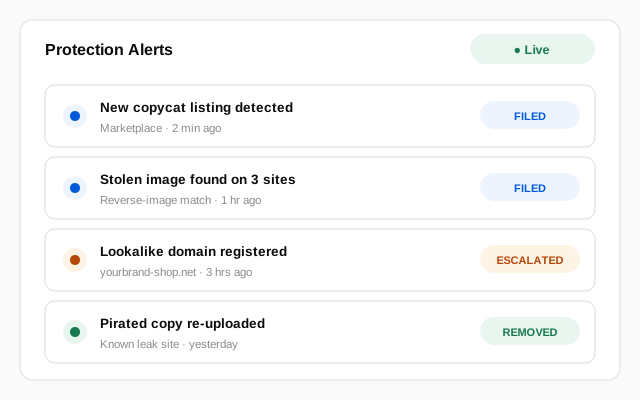
Our service runs as a cycle, not a favor. Detection sweeps scan the surfaces where your work actually leaks (piracy forums, file lockers, torrent indexes, Telegram channels, video re-upload platforms and scraper networks) keyed to your titles, watermarks and fingerprints. A human analyst verifies every hit, because a false takedown against a legitimate reviewer or affiliate damages you.
Then specialists file: DMCA notices to hosts and platforms, de-indexing requests to Google so leak pages stop ranking for your product names, and locker-level removals that kill the file rather than just one link to it. Repeat leak sites get escalated to their registrars, hosts and, where they run ads or sell access, the payment and ad infrastructure funding them. Each cycle ends with a report showing what was found, filed and removed.
Because it's continuous, the curve bends: fresh leaks get caught in days rather than months, before they're mirrored across a dozen hosts, and serial uploaders learn your content costs them more effort than it's worth. That deterrence effect is real, leak communities notice which creators fight back and which don't.
Built for how creators actually work
Course sellers, newsletter and media publishers, video creators, photographers, membership communities, the leak surfaces differ, so the sweep is tuned to each. You keep making things; the enforcement runs in the background under a Protection Plan, with a named specialist you can actually talk to.
Onboarding is deliberately light. You share your catalogue, storefront links and any watermarking or licensing arrangements already in place; we build the fingerprint set, tune the sweep to your actual leak surfaces, and agree the rules, which uses are licensed, which affiliates and reviewers are legitimate, what gets filed automatically and what gets flagged to you first. From there, the monthly report is your entire workload: what was found, what was filed, what came down, and where the persistent offenders are heading next.
Start with a free Exposure Scan: we'll show you where your work is currently leaking and what it would take to clean it up. If the scan comes back quiet, we'll tell you that too.
Frequently asked questions
Is this just automated DMCA filing? +
Can you get my course off piracy forums that ignore DMCA? +
How quickly do new leaks get caught? +
Start with a free, confidential Exposure Scan
We'll scan your digital footprint, show you exactly what's exposed, and recommend the fastest path to remove it, or tell you honestly if you don't need us.
Book Your Assessment