A private principal, a society wedding, and 40 links in five languages
The owner of a European family holding company married at a wedding attended by royalty. Within two weeks his name and face were across tabloids, society magazines and social media in five countries. He had never consented to any of it. His chief of staff called us.
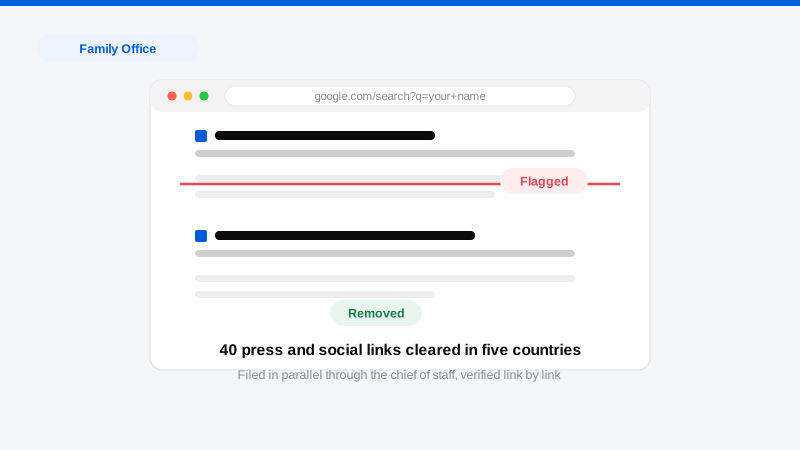
links removed within 3 days of the first instruction
countries and languages, worked entirely through the chief of staff
The situation
The principal is not a public figure. He runs a family holding company from Liechtenstein and had spent a career staying out of the press. His wedding changed that overnight, because one of the guests was royalty. Photographers were there for the guest. The coverage carried the groom.
Within a fortnight the family found wedding photography in German boulevard press, on a royal-watcher blog, across Instagram, on Tumblr image servers, in a YouTube Short and on Reddit. A second sweep, run with the family, found sixteen more: a UK tabloid, an Argentine national newspaper, a Greek celebrity site, a Swedish society magazine and further Instagram posts. Every contact came through the chief of staff. The principal never appeared in an email.
The distinction that mattered here is the one most families miss at the start. This was not a reputational attack. Nobody had written anything hostile. The problem was simply that a private man had become searchable, in five languages, off the back of an event he had hosted for family and friends. A search for his name returned a face he had spent decades keeping out of circulation, and the images were attached to a story about somebody else entirely.
Why wedding coverage spreads the way it does
Society and royal coverage moves faster than almost any other category, because it is cheap to produce and reliably read. One agency set of photographs is licensed or lifted, and within hours it is running in a dozen outlets across a dozen markets. Each outlet writes its own headline, crops its own image, and gives the story a fresh URL that search engines treat as a separate page. Nobody involved is thinking about the person at the edge of the frame.
From there it moves sideways into the places that have no editorial process at all. Royal-watcher blogs aggregate the coverage. Instagram accounts repost the pictures with captions naming the people in them. Reddit threads collect the whole set in one place, which is often the page that ranks best because it carries the most links. Image boards and Tumblr-style servers hold raw copies with no article attached, which means they survive long after the original story is forgotten.
How the engagement ran
The first batch was quoted at eleven links and executed as thirteen. Invoicing went to the holding company at its Liechtenstein address. Every instruction, every update and every question came through the chief of staff, and the family chose per-matter invoicing over a retainer throughout the engagement.
We established who held each copy of the material, worked every layer of the problem at the same time rather than one after another, and checked each address afterwards. Ten of the thirteen first-batch links were gone within three days. The second batch of sixteen was cleared through October and November, with a few items resisting into December. The family saw the evidence, not the paperwork.
Why the obvious routes were not enough on their own
The instinct in a wedding matter is to write to the publications and ask nicely. That works sometimes, and it was used here. It is not sufficient on its own for two reasons. The first is arithmetic: polite requests are slow, they are handled by editorial staff who are not obliged to answer, and there were more than forty destinations. The second is that the aggregators and social reposts, which are usually where the ranking actually lives, have no editorial contact to write to at all.
Working only at the search layer is not enough either. A listing can stop appearing for the principal's name while the photograph itself is still sitting somewhere it can be found, embedded and reused. A family that treats search as the whole job finds the same pictures resurfacing months later through a different host.
The magazine that argued back
A year later the principal's name and image appeared in a US fashion magazine's slideshow of the wedding. The editor pushed back hard: the subject was a face in a crowd, the images had been supplied and approved by the wedding family, and, awkwardly, the family's own brand-side PR had already told the magazine to disregard the request.
That last point is the one worth studying. An in-house adviser had, in good faith, conceded the position before anybody checked with the principal. Once a publisher has been told by somebody who appears to speak for the subject that a request can be ignored, the request is dead unless the position is formally separated and re-made by the right party.
We took an escalation call with the editor, separated the principal's position from the family's earlier approval, and the image and name came down two days later, about three weeks after instruction. The lesson for any family office is to hold a single channel. When press, legal, brand and family staff can all speak to a publisher independently, a publisher will act on whichever message suits it best.
The article that kept coming back
In 2026 the problem changed shape. A European trade site published an article alleging a business disagreement involving the group, then republished the same allegation twice more under new URLs, new wording and new images. Each version needed a fresh application. The first came down in four days, the second in two, the third the day after instruction, with its image copies following twelve days later. One Google image thumbnail remained open while we waited for the indexed source URL.
Republication under a new URL is a common tactic and an underrated one. To a search engine, a rewritten page at a new address is a new document. Nothing already won carries across, so the matter has to be built again from the beginning. Publishers who do this are relying on the complainant running out of patience before they run out of URLs.
Who makes first contact and what the 15-minute call covers
In matters like this the first message almost never comes from the principal. It comes from a chief of staff, a family office director, a private secretary, a lawyer or an agency acting for the family. That is normal and it is how the engagement is designed to run. The principal here never appeared in an email at any stage.
The 15-minute call is a working call, not a pitch. We ask what the links are, when they appeared, who else has already been contacted, whether anything has been said publicly, and who is authorised to sign. We say which items look straightforward, which look contested, and which we would not take on. If something is unlikely to move, that is said on the call rather than discovered later.
What follows is a free Exposure Scan: a link-by-link picture of what is actually visible for the principal's name, which is usually broader than the list the family arrived with. The scan is written down and it is the family's to keep, whether or not they instruct anyone. Confidentiality and an NDA are standard, and we work alongside existing counsel, PR and security teams rather than around them.
What this shows family offices
Content the family never posted and cannot control. Multi-jurisdiction, multi-language spread from a single event. A publisher that argues back and an in-house adviser who had conceded the point. Adversarial business coverage that reappears under new URLs. The whole engagement ran through the chief of staff, with invoices to the holding company and every removal evidenced link by link.
The general lesson is that privacy matters for private principals are logistics problems more than legal ones. The number of destinations, the number of languages, the separation of page from image file from search listing, and the discipline of a single authorised channel decide the outcome far more often than the strength of any one argument. A family that gets those four things right early recovers most of what it wants within weeks.
If you act for a principal in a similar position, start with the free Exposure Scan or read how we work with chiefs of staff.
"Our boss married two weeks ago and the online world is now full of pictures from the wedding and him. He did not give his consent for this."
Chief of Staff, family holding company
Facing something similar?
This case was handled through our Press and image removal service.
Start with a free, confidential Exposure Scan
We'll scan your digital footprint, show you exactly what's exposed, and recommend the fastest path to remove it, or tell you honestly if you don't need us.
Book Your Assessment