
To remove negative press about a company, spend the first 48 hours on containment: a communications freeze, full evidence capture and a map of every place the story appears. False, unlawful or policy-violating press may be removable through publisher outreach, legal notices or de-indexing; factual, legally protected journalism usually is not, and the realistic path is suppression backed by remediation.
Key facts
- Never contact the publisher before the evidence file of search, source, spread and ranking is complete.
- A publisher request names the URL, quotes the passage, attaches proof and asks for a specific remedy.
- The 2014 EU Right to be Forgotten ruling underpins de-indexing requests in qualifying jurisdictions.
- Suppression of factual coverage only holds when paired with published remediation and governance changes.
Where ContentRemoval.com comes in. ContentRemoval.com runs corporate press matters from the containment window onward: the evidence file, the removability read, publisher outreach and de-indexing where grounds exist, and search suppression with monitoring where the article will stay up. The call usually comes from the CEO’s chief of staff, general counsel or the company’s PR agency. A free 15-minute Exposure Scan maps what is removable, what is suppressible and what needs a rehabilitation plan, and the report is yours to keep. Get a Free, Confidential Exposure Scan or read how our news article removal work is done.
At 6:30 a.m., your phone lights up with the message every executive dreads. A board member has forwarded a search result. A journalist has published something damaging. A customer has started circulating it on LinkedIn. Your spouse has seen it. Your investors will see it next. By mid-morning, your company name returns a page of search results you no longer control.
Panic is the default response. It’s the response that does the most damage.
When negative press ranks for your company name, this stops being a communications problem and becomes an enterprise risk issue. A single negative article appearing on the first page of Google search results leads to a 22% loss in revenue, and 80% of consumers change their minds about a purchase after encountering a negative online review, according to Electro IQ’s reputation management statistics. If your buyers, partners, recruits, lenders, or counterparties search before acting, the damage moves fast.
Executives make the same mistake in the first hours. They treat this as a press problem, call a PR team, and start drafting statements. That’s backwards. The first job is control. The second is classification. Only then do you decide whether the target is actual removal or disciplined suppression.
This distinction matters more than most firms admit. Negative press that is false, unlawful, or policy-violating may be removable. Negative press that is factual, legally protected, or embedded in legitimate editorial coverage often isn’t. If you confuse those categories, you waste time, trigger wider attention, and harden the very search results you’re trying to dislodge.
If your issue stems from a broader operational event such as a breach, outage, vendor failure, or public incident, study the anatomy of crisis escalation before you speak. The breakdown in Cyber Threats Crowdstrike Incident is useful because it shows how fast a technical event becomes a reputation event once search, media, and public commentary converge.
The right mindset is simple. You are not trying to “clean up Google.” You are deciding which battlefield you’re on, what can be removed, and what must be strategically outranked, de-indexed, neutralized, or reframed. If you need a deeper executive-level framework for that decision, this strategic guide to online reputation management for executives is a sensible starting point.
An Executive’s Guide to a Digital Crisis
The first thing to understand is that your company isn’t in a debate. It’s in an exposure event.
A negative article doesn’t sit on a publisher’s site. It gets indexed, mirrored, discussed, screenshotted, and fed into every stakeholder decision that starts with a search query. By the time an executive sees the problem, employees may already be speculating internally, customers may be forwarding links, and reporters may be checking whether there’s a second story.
What the first shock gets wrong
Most leaders immediately ask, “How do we get this taken down?”
Sometimes that’s the right question. In many cases, it isn’t.
The more useful first question is this: what exactly is this content, and what legal or technical grounds for action attach to it? If the answer is unclear, don’t let anyone freelance a response. Not the CEO. Not the head of communications. Not outside PR. Not a well-meaning lawyer firing off a generic threat letter.
Your first public reaction can become the second article.
Treat the initial period as a controlled assessment window. You need the facts, the spread pattern, the publisher profile, the search footprint, and the risk of amplification. That’s how serious digital crisis firms operate. They don’t improvise.
What pressure does to judgment
Under pressure, smart executives overcorrect in one of two directions.
Some go aggressive. They threaten litigation before they’ve preserved evidence, understood the publication, or assessed whether the claims are factual. That can provoke editors, trigger follow-up coverage, and make you look defensive.
Others go passive. They hope the story burns out. That ignores how search works. If the article holds page-one real estate for your company name, time is not neutral. Time lets the result age, attract links, and become the default reference point for anyone researching your business.
A disciplined response starts by accepting one uncomfortable truth. The phrase remove negative press about company sounds like a single task. It isn’t. It covers several very different situations, each with different remedies, timelines, and odds of success.
The standard you should demand
You need a response built on evidence, not optimism.
That means a documented audit, a legal read on removability, a technical read on de-indexing options, and a search strategy for everything that can’t be deleted. Anything less is theatre dressed up as crisis management.
Immediate Triage The First 48 Hours

The first 48 hours are for containment. Not debate. Not spin. Not reputation repair. Containment.
A rigorous digital footprint analysis should identify 80-90% of harmful links within the first 24-48 hours, and that audit phase comes before any legal or SEO action, according to Pella Dynamics’ overview of negative press removal methodology. If your team starts posting, arguing, or threatening before that map exists, they’re operating blind.
Issue a communications freeze
One person controls outward communication. Everyone else stops talking.
That includes executives texting reporters, regional managers replying to comments, sales teams “clarifying” things for customers, and junior staff posting defensive takes on social media. Uncoordinated communication creates admissions, contradictions, and screenshots.
Use a short internal instruction:
- Freeze external commentary: No employee should comment publicly, on or off the record, without express approval.
- Centralize inbound requests: Route media, investor, customer, and partner inquiries to one named decision-maker.
- Preserve internal records: Don’t delete messages, drafts, recordings, or internal threads connected to the issue.
If your legal team is involved, this discipline also protects privilege and prevents accidental waiver.
Capture everything before it moves
Negative content changes. Headlines get updated. Posts get deleted and reposted. Search results shift. You need evidence before anyone touches the situation.
Your capture file should include:
- Search evidence: Screenshots of branded search results in standard search, news, image search, and relevant autocomplete suggestions.
- Source evidence: Full-page captures of the article, author page, publication details, comments, and any visible updates.
- Spread evidence: Copies of social shares, reposts, embeds, newsletter mentions, review site references, and forum threads.
- Ranking evidence: Notes showing which harmful results rank for the company name, product names, founder names, and executive names.
Use timestamped screenshots, PDF archives, and a clean URL log. If the matter escalates into platform reporting, legal correspondence, or de-indexing requests, this record becomes operationally critical.
Practical rule: Never contact the publisher before your evidence file is complete.
Map the complete exposure, not the obvious exposure
Executives fixate on the first article they saw. That’s rarely the full problem.
Search your company name, product names, founder names, and obvious variations. Check Google’s main results, news tab, images, and social platform search. Review whether the same allegation has been syndicated, republished, or paraphrased elsewhere. Many crises spread through duplicates, not originals.
A short triage table keeps the problem manageable:
| Asset or channel | What to check | Why it matters |
|---|---|---|
| Google branded search | Top results, snippets, news box | Customers and investors form first impressions here |
| News tab | Original article and pickups | Syndication expands reach and complicates removal |
| Review platforms | Related complaints and review spikes | Review volume often follows publicity |
| Social platforms | Shares, commentary, impersonation, hashtags | Social discussion can outrank weaker owned assets |
| Image search | Screenshots, logos, executive photos | Visual search can preserve damaging content |
Classify before you respond
By the end of the first 48 hours, you should know four things.
First, whether the core content appears false, defamatory, privacy-invasive, or otherwise violative. Second, whether it sits on a publisher site, social platform, review platform, or search result only. Third, whether it’s spreading through duplication. Fourth, whether any immediate response would reduce harm or multiply it.
If you don’t know those answers yet, you’re not ready to act publicly.
The Strategic Fork Removal Versus Suppression
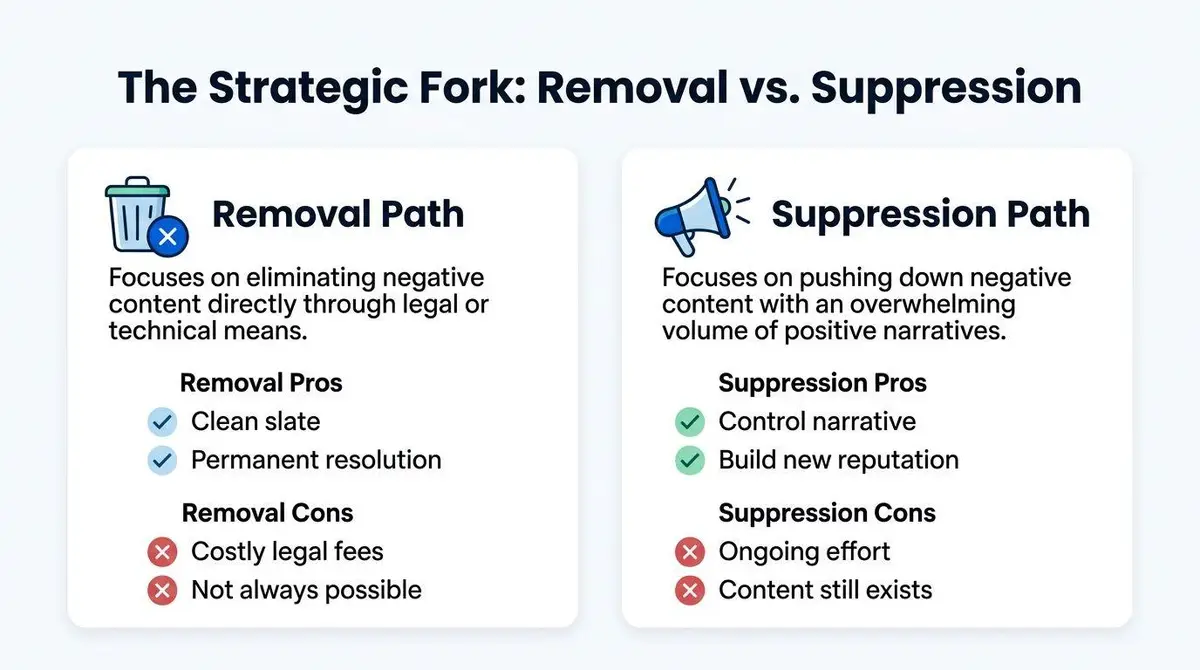
Most advice on how to remove negative press about company gets the core decision wrong. It treats removal and suppression as if they’re interchangeable. They are not.
Entrepreneur’s analysis of bad press removal identifies this clearly. The false binary appears when guides blur together takedowns and search suppression, then fail to confront the hard case: legally protected editorial content that cannot be removed. In those situations, suppression may be the only viable path, and it works on a very different timetable.
Door one is removal
Removal means the content is deleted, de-indexed, or otherwise taken out of practical visibility through a legal or technical mechanism.
That path is viable when the material is more than embarrassing. It needs some form of basis for action. Typical grounds for action include false statements, impersonation, privacy violations, copyright infringement, terms-of-service breaches, or legal rights tied to outdated or harmful content.
If the basis for action is strong, removal can be clean and efficient. If it’s weak, you can spend weeks sending letters that achieve nothing.
Door two is suppression
Suppression means the content remains online, but you push it down and reduce its visibility by making stronger, more relevant, more authoritative content outrank it.
That is not defeat. It is often the only rational move when the article is factual, published by a legitimate outlet, and unlikely to come down. Search engines rank relevance and authority, not fairness. If the negative result is lawful and newsworthy, outrage won’t move it.
Suppression is slower and less emotionally satisfying because the content still exists. But when executed properly, it shifts what stakeholders see first. For many companies, that’s the outcome that matters.
If the article is true enough to survive a legal challenge, your job shifts from erasing history to controlling current visibility.
The wrong path wastes money
A company facing factual reporting often insists on removal long after removal is off the table. That burns time, inflates legal cost, and can deepen the search footprint. Meanwhile, no one is building the assets needed to outrank the story.
The opposite mistake happens too. Teams default to suppression even when the content is plainly removable. That leaves unlawful material online longer than necessary and tells attackers that the company won’t fight on the merits.
Use a simple decision matrix:
| Question | If yes | If no |
|---|---|---|
| Is the content false or materially misleading? | Explore removal first | Move to next question |
| Does it violate platform rules or privacy rights? | Pursue reporting and takedown | Move to next question |
| Is it legitimate journalism or factual criticism? | Suppression is likely primary path | Check for narrow edits or de-indexing angles |
| Is the source authoritative and likely to resist pressure? | Expect suppression and selective outreach | Removal odds improve if the source is weak |
| Is public rebuttal likely to amplify the issue? | Stay controlled and technical | Consider a targeted response |
When factual content changes the strategy
This is the scenario most executives hate because it strips away the fantasy of a quick fix.
If the negative press concerns a real recall, a verified regulatory issue, a documented lawsuit, or a substantiated operational failure, you may not be able to remove it. In that case, your strategy cannot be “bury it with fluff.” Search suppression without operational credibility rarely holds.
You need two parallel tracks.
One track is search visibility. Build assets that rank. Push the harmful item down. Clean up review surfaces. Improve branded search dominance.
The other track is rehabilitation. Publish corrective facts, updated governance, leadership changes, remediation steps, customer protections, or post-incident progress. If the underlying event is real, stakeholders must see evidence that the company changed.
That is the difference between cosmetic suppression and durable suppression. One manipulates the page. The other changes what the page can say about you.
The executive rule
Choose the path that matches the legal and factual character of the content, not the path that feels more satisfying. Removal is cleaner. Suppression is frequently more realistic. Serious crisis management starts when you stop confusing the two.
Executing the Removal Strategy Legal and Technical Takedowns

If your analysis points to removal, move decisively. Weak, emotional outreach fails. Precise, evidence-backed requests have a chance.
The legal foundation for de-indexing is stronger than many executives realize. The 2014 EU Right to be Forgotten ruling established a framework that enabled over 1 million successful de-indexing requests from Google by 2023, according to Pure Reputation’s discussion of negative press removal. That matters because not every win requires a courtroom. Some of the strongest outcomes come from platform and search-engine processes used properly.
Start with publisher outreach, not theatrics
A direct request to the publisher is frequently the fastest clean route, provided the request is disciplined.
Write like counsel, not like an outraged founder. Identify the URL. Identify the statement or passage at issue. State the factual problem. Attach proof. Specify the remedy sought. That may be removal, correction, anonymization, or de-indexing.
A clean structure works better than argument:
- Identify the publication: Include article title, date, author, and exact URL.
- Pinpoint the problem: Quote the false or harmful statement precisely.
- Attach evidence: Supply court records, corporate documents, correspondence, or identity proof as relevant.
- Request a remedy: Ask for deletion, correction, noindex treatment, or name removal, depending on the facts.
- Set a response window: Give a firm but reasonable deadline.
Don’t accuse the editor of malice unless you can prove it. Don’t threaten suit in the opening line. You’re trying to give the publisher a defensible reason to fix the problem.
Know when legal pressure is justified
If the content crosses into false factual allegations, reputational attack, impersonation, privacy violation, or another actionable wrong, legal escalation is appropriate.
A proper cease-and-desist letter should do one of two things. It should either force correction by showing obvious exposure, or clarify that the publisher has no realistic obligation to remove because the content is likely protected. Both outcomes are useful. Ambiguity is not.
If your team needs a plain-language primer on how courts and attorneys frame defamation, review that before you let anyone throw the word around casually. False accusation is a legal category. It isn’t a synonym for “harmful article.”
Use search engine and platform procedures with precision
Search engines don’t exist to rescue reputations. They do, however, process defined categories of removal and de-indexing requests.
That means your filing should be narrow and specific. Broad moral arguments fail. Platform-rule and legal-policy arguments travel better.
A practical hierarchy looks like this:
| Target | Best route | Typical rationale |
|---|---|---|
| Publisher site | Direct editorial request | Inaccuracy, outdated context, privacy, settlement, naming issue |
| Search result | De-indexing request | Privacy right, outdated harmful content, legal basis |
| Review platform | Terms of service report | Fake review, extortion, impersonation, irrelevance |
| Social platform | Policy enforcement | Harassment, impersonation, doxxing, manipulated content |
If the issue involves a news result, you may need to pursue both the source and the search layer. Source removal is ideal. Search de-indexing can materially reduce exposure even when the page remains live.
For executives considering article-specific action, this guide on whether it’s possible to remove a news article gives a useful framework for what’s realistically removable and what isn’t.
A takedown request wins when it gives the recipient a policy reason to act, not when it tells them you’re upset.
Don’t over-litigate weak cases
Some companies should never file the first threat letter they draft.
If the article is substantially accurate, published by a serious outlet, and connected to a matter of public interest, overreaching can backfire. Editors compare notes. Reporters dislike intimidation. Search interest can increase when a company appears to be trying to censor truthful reporting.
That doesn’t mean you do nothing. It means you choose your mechanism carefully. Sometimes the smarter removal strategy is a narrow correction request, a name removal request, or de-indexing in a qualifying jurisdiction, rather than a maximalist attack that you can’t sustain.
Executing the Suppression Strategy Dominating the Narrative

When removal isn’t viable, you need search dominance. Not “positive vibes.” Not empty blog posts. Dominance.
Effective suppression relies on review management as well as content production. A technical process can identify and flag violative negative reviews with a 65-75% success rate for removal within 14 days. For reviews that don’t violate policy, a campaign of 10-15 positive review injections, combined with ORM tools, can push negative items to the third page or lower within 21 days, and that matters because 70% of search traffic is lost beyond page one, according to RepSpert’s explanation of review removal and suppression.
Build a digital fortress, not a content pile
Most suppression campaigns fail because they produce weak assets on weak sites.
The goal isn’t to “post more content.” The goal is to rank better assets for the same branded queries that trigger the negative result. That means every owned and influenced property needs to be optimized around the company name, executive names, product names, and key brand terms.
Start with assets you control:
- Corporate website pages: Strengthen the homepage, about page, leadership bios, newsroom, and investor-facing pages.
- Executive profiles: Tighten LinkedIn profiles, speaking bios, and leadership pages so they rank for named searches.
- Structured third-party profiles: Secure and improve company entries on credible business directories and databases.
- Owned media: Publish updates that reflect real milestones, governance steps, partnerships, product improvements, or community impact.
Weak branded assets leave room for hostile content. Strong branded assets occupy search real estate.
Use authority, not volume
A negative article on a serious publication won’t be displaced by filler on your own domain alone. You need external authority.
That means earned or arranged placements on relevant industry publications, executive interviews, contributed articles, press releases tied to actual developments, and credible mentions that search engines view as independent signals. Each asset should target a search phrase the negative content currently owns.
Many firms lose discipline here. They flood the internet with generic “good news” that no one searches for. That doesn’t solve the branded search problem. Build around the exact terms that matter.
A compact operating model helps:
| Asset type | Purpose in suppression | Notes |
|---|---|---|
| Leadership bio pages | Capture executive-name queries | Must be complete, current, and keyword-aligned |
| Press releases | Generate fresh branded search signals | Use only when tied to genuine developments |
| Guest articles | Add third-party authority | Target publications with strong indexing |
| Review management | Improve local and trust surfaces | Handle violative and non-violative reviews differently |
| Social profiles | Occupy page-one positions | Keep branding and naming consistent |
Don’t fake your way past a factual crisis
Suppression only works if the new narrative has enough truth and authority to hold position.
If the underlying event was real, address it. Publish what changed. Show remediation. Highlight oversight improvements, compliance updates, customer protections, or leadership decisions that put distance between the current company and the archived event.
That is why a proper suppression strategy is part SEO, part PR, part governance communication.
One factual mention is enough here: ContentRemoval.com uses AI-driven monitoring as part of its broader content-removal and suppression work to detect reuploads and recurring exposure patterns, which is the kind of system you need when a hostile item keeps resurfacing rather than disappearing on its own.
If you’re dealing specifically with search visibility rather than source-level deletion, this executive guide to suppressing negative search results is the more relevant framework.
Search suppression is not a trick. It’s a campaign to replace your worst first impression with your strongest current evidence.
Review management is part of search control
Executives often separate “negative press” from “negative reviews.” Search engines don’t.
If a news article triggers review spikes, forum posts, and low-trust sentiment across profile pages, you now have a blended search problem. That requires policy-based removal where available, response discipline where needed, and active cultivation of authentic positive feedback to dilute the negative footprint.
Handled well, suppression changes not just what ranks, but what stakeholders infer from the entire page.
The Long Game Monitoring and Professional Engagement
The crisis isn’t over when the article drops from page one. It’s stable, not over.
Damaging content reappears through reposts, cached references, copied headlines, image results, forum threads, and fresh commentary tied to the original event. If no one is watching, the same issue can rebuild its footprint while your team assumes it’s gone.
Monitoring has to be continuous
You need ongoing observation of branded search, executive-name search, news indexing, social mentions, and review surfaces. The goal is early interception.
That means spotting a repost before it gains traction, catching a duplicate article before it outranks stronger assets, and identifying whether a critic or anonymous poster is trying to revive a dormant story. Monitoring is not glamorous. It’s what stops a solved issue from becoming a recurring liability.
Reputation resilience is built before the next hit
Companies that maintain a healthy layer of current, credible, well-ranked content are harder to damage. That includes accurate executive biographies, active media pages, strong review profiles, current corporate information, and visible evidence of operational competence.
This isn’t “brand building” in the abstract. It’s defensive architecture. When the next issue lands, the search results are already crowded with assets you control or influence.
Know when to stop doing this yourself
Some matters don’t belong in-house.
Bring in specialist help when the case spans multiple jurisdictions, when the source is a news publisher with legal representation, when the attack includes impersonation or leaks, when harmful material is being copied across platforms, or when consequences are significant for experimentation. If your board, investors, or family office would view a failed response as unacceptable, you are past the point for ad hoc management.
The companies that handle these cases best don’t wait until every easy option has failed. They escalate when precision matters more than internal pride.
Frequently Asked Questions for Executives in Crisis
What if the negative press comes from an anonymous source
Treat anonymity as a factor, not the whole problem.
First, classify the content. If it’s on a major platform or publisher, your fastest path may be policy enforcement, editorial challenge, or search suppression rather than identity tracing. If the source is posting across fringe sites, forums, and social accounts, tracing may matter more because the same actor may keep republishing.
Don’t make public accusations about who you think is behind it unless you can prove it. Misidentification creates a second problem.
How do we avoid the Streisand Effect
By staying selective.
Don’t argue publicly with low-visibility content that hasn’t yet earned broad attention. Don’t threaten every small account. Don’t issue a dramatic statement just because the executive team feels exposed. Public response is justified only when it reduces uncertainty, protects a legal position, or corrects a material falsehood that stakeholders are already seeing.
If a statement won’t change the search picture or legal footing, silence is frequently the stronger move.
What if the article is in another country
Cross-border cases require jurisdictional discipline.
Publisher standards, privacy laws, intermediary liability rules, and court attitudes differ sharply between markets. A tactic that works in one country may fail completely in another. In international cases, the right sequence usually matters more than the loudest demand. Preserve evidence, identify where the entity is hosted and operated, assess whether local counsel is needed, then decide whether the better route is source attack, search de-indexing, or suppression in the markets that matter most to your business.
Can we just respond with positive PR and move on
Only if the issue is minor and the content is weak.
If the negative item is authoritative, page-one visible, or grounded in factual reporting, generic PR won’t solve it. You need a deliberate search strategy tied to the exact query set at issue. If the content is false or violative, failing to pursue removal first is a mistake. If the content is factual, pretending it can be erased is also a mistake.
How quickly should an executive act
Immediately, but not impulsively.
Containment starts at once. Evidence collection starts at once. Strategic classification starts at once. Public commentary should wait until those pieces are in place. Fast and sloppy is how companies create bigger crises than the one they started with.
If negative press is harming your company, the key question isn’t whether you’re upset. It’s whether the content is removable, suppressible, or neither without a deeper rehabilitation plan. ContentRemoval.com handles confidential assessments for executives, brands, and high-profile clients who need a precise strategy across publisher outreach, de-indexing, platform takedowns, suppression, and ongoing monitoring. When the impact is substantial, guessing is expensive.