
When nude photos are stolen, treat the incident as a forensic breach and run two tracks from the first hour: preserve evidence of every live URL, then remove access by securing accounts and filing precise reports. Diagnose whether the leak came from a partner, an account takeover, or AI manipulation, because that decides the reporting route and the legal lever.
Key facts
- Meta has a dedicated non-consensual intimate image form; a compromised account needs a separate security complaint
- The US TAKE IT DOWN Act requires covered platforms to remove validly noticed material within 48 hours
- Google’s explicit-imagery route removes search results, not the source, and allows 11 months to appeal
- An audit of X found copyright reports removed AI nudes within 25 hours while NCII reports sat for weeks
Where ContentRemoval.com comes in. ContentRemoval.com handles stolen and leaked intimate content as one case file: identifying the likely source, filing and escalating platform and host takedowns, pursuing search de-indexing, and monitoring for reuploads under changed filenames or new accounts. The person affected, a parent, or their solicitor usually makes contact, and the process stays confidential. A free 15-minute Exposure Scan maps what is removable, and the report is yours to keep. Get a Free, Confidential Exposure Scan or read how our intimate image removal work is done.
You discover the image through a message from someone you barely know, a search result, or a notification from an account you don’t recognize. The file is yours, but you didn’t authorize its publication. Before you confront anyone or start clicking report buttons, treat the incident as a forensic breach, not a private relationship dispute.
Your first decisions determine what evidence survives, which reporting route applies, and how quickly a platform can act. The response should run on two tracks from the outset: preserve proof and remove access. If the images came from a hacked account, a former partner, a criminal marketplace, or an AI manipulation, the correct legal and technical response won’t be identical.
The First Hour When Intimate Images Are Stolen
The first hour is for preserving options. Panic creates predictable mistakes, especially deleting messages, changing files, or confronting the person who posted the material. Those actions may feel decisive, but they can destroy evidence, alert an offender, or cause the content to move before you’ve recorded where it appeared.
Preserve the scene before changing it
Start by documenting every live location. Capture screenshots that show the full page, the account name, the post, visible timestamps, comments, and the browser address bar. Copy each URL into a separate incident log, then record the date and time you accessed it. If the same image appears on multiple pages, document each page separately rather than assuming one report will cover all copies.
Archive the source path where possible. Note whether the image appears on a social profile, a public website, a file-sharing page, a forum, or a search result. Save the surrounding messages, threats, usernames, email headers, and payment demands in their original form. Don’t edit screenshots or crop away context. Keep an untouched copy in secure storage and work from duplicates.
Practical rule: Preserve the evidence before you pursue the takedown. Removal is the objective, but proof of publication, ownership, consent, and source may be essential for escalation.
Next, secure the accounts that could contain the original files. Change passwords from a trusted device, enable two-factor authentication, review active sessions, revoke unfamiliar devices, and check recovery email addresses and phone numbers. Secure cloud storage, messaging accounts, and social profiles, not only the account where you found the image. An attacker with a valid session may remain inside even after a password change.
Don’t message the poster. A confrontation can trigger deletion of the account, relocation of the files, retaliation, or further distribution. If someone is demanding money or threatening publication, preserve the demand and avoid bargaining without legal advice. For targeted threats or sextortion, use a specialist sextortion response resource while maintaining the original communications.
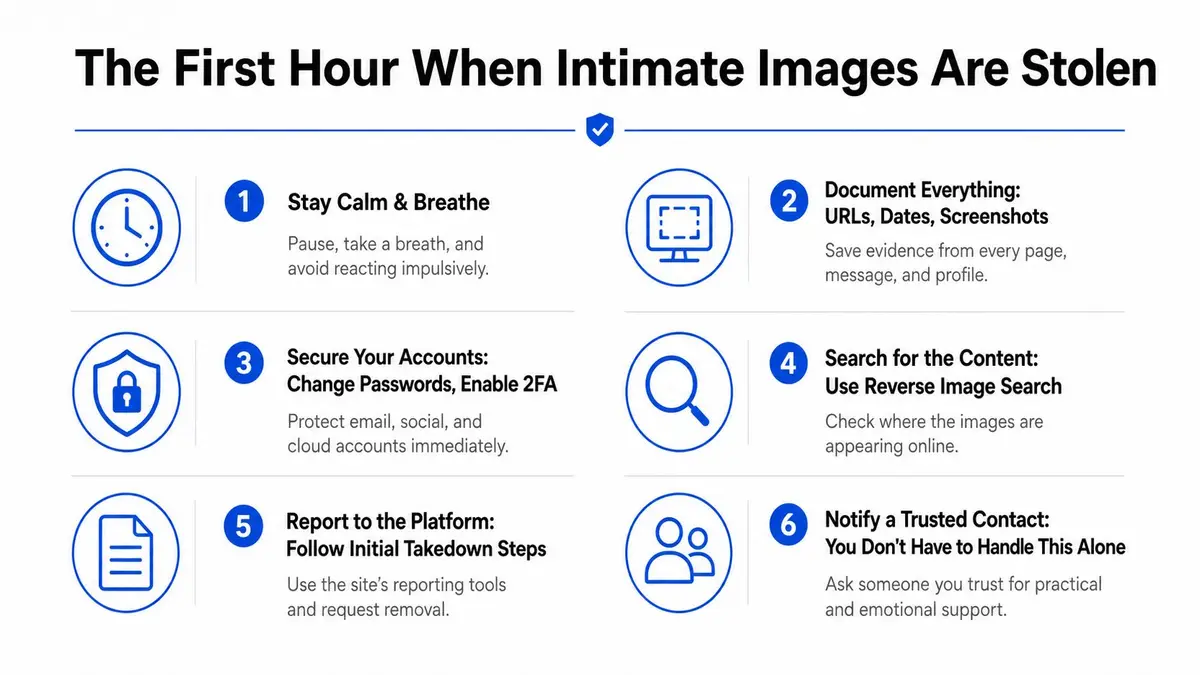
Search for additional copies only after you’ve recorded the first discovery. Reverse image search can identify reposts, but repeated viewing can increase distress and may expose you to more harmful pages. Ask a trusted person, solicitor, or specialist firm to help with the search if you’re struggling to do it safely.
Your first-hour record should answer four questions: what was posted, where it appeared, when you found it, and how the source may have obtained it. That record protects your choices during platform reporting, legal escalation, and any later investigation.
Diagnosing the Leak Before You Report Anything
A client once arrives with a simple description: “My nude photos were stolen.” That description identifies the harm, not the mechanism. Before filing a report, I want to know whether the original file was copied from a partner’s phone, extracted from a cloud account, taken through an account takeover, or fabricated from an existing photograph. The distinction affects evidence, reporting language, and potential defendants.
Start with the file itself. Preserve the original version and inspect available metadata, including creation details, device information, and location data. Metadata can be stripped or altered, so its absence doesn’t prove anything. Compare the dimensions, compression, crop, and filename of the published image with files on your devices or backups. A screenshot of an image may suggest that someone copied it from a private conversation rather than obtained the original file.
Account compromise leaves different clues. Look for unfamiliar login alerts, changed recovery details, new devices, password-reset notices, unexpected sent messages, or cloud-sharing activity. A session-token theft can allow access without an obvious password change. If the images disappeared from a private account and other account activity looks abnormal, treat the incident as an account-security case, not merely a leak by someone you know.
Use the source to choose the reporting route
A partner or former partner may have received the image lawfully but published it without consent. That often points toward civil remedies, preservation demands, platform NCII reporting, and a carefully documented criminal referral where local law applies. An account hijack requires immediate platform security escalation and may justify reporting to the FBI Internet Crime Complaint Center, particularly where organized theft or criminal marketplaces are involved.
Synthetic content requires different framing. In a manipulated image, there may be no original nude photograph at all. Look for inconsistent lighting, anatomy, hair, jewelry, reflections, edges around the face, or unnatural texture. Those clues aren’t conclusive by themselves. Preserve the earliest version, identify the account that circulated it, and describe the material as manipulated or AI-generated when reporting it, rather than claiming that an original file was stolen.
The FBI has warned that sexual exploitation actors are accessing adult and underage victims’ social media and personal accounts to steal and sell explicit content on criminal marketplaces. That changes the threat model from an interpersonal dispute to organized theft for profit. A 2024 scoping review also found evidence gaps around the prevalence of digitally altered intimate images and the non-consensual taking of intimate images, so don’t assume a platform investigator will classify the incident correctly without a clear factual record.
| Incident Type | Key Indicators | Primary Reporting Channel |
|---|---|---|
| Partner or former-partner publication | The recipient had lawful access, threats or messages identify the person, and the file matches a privately shared original | Platform NCII process, solicitor, local law enforcement, and civil remedies |
| Account takeover | Login alerts, unfamiliar devices, changed recovery details, missing cloud files, or unauthorized messages | Platform security team, law enforcement, and FBI IC3 where organized theft is suspected |
| Device or cloud compromise | Files appear from a backup, shared device, or storage account without a relationship-based explanation | Account provider, device-security specialist, platform reporting, and law enforcement |
| AI-generated or manipulated image | Facial or anatomical inconsistencies, synthetic artifacts, or no matching original file | Platform synthetic-content or explicit-content process, search removal, and legal counsel |
| Criminal marketplace distribution | Anonymous sellers, payment demands, bulk files, or references to private databases | Law enforcement, FBI IC3 where appropriate, marketplace and host escalation |
Classify first, then report with the most accurate description. A wrong category can send your complaint into the wrong workflow and force you to start again.
Platform Reporting Flows and Which Pathway to Use
A reporting button starts a process, not a legal strategy. Treat each upload as a forensic incident: preserve the evidence, identify the correct policy, then file a precise complaint. Include every post, profile, message, and search-result URL, the account identifier, a clear explanation of non-consent, and proof that you are the depicted person or an authorized representative. The first 48 hours often determine whether evidence and copies remain available.
On Facebook and Instagram, use Meta’s non-consensual intimate image form, not only a generic harassment report. List each post or profile URL and state that publication occurred without consent. Add the original account or message context when it establishes how the file was obtained or shared. A compromised account requires a separate security complaint. Keep the account-takeover facts out of a vague NCII paragraph, or the case may enter the wrong queue.
Google Search handles a different problem. Its dedicated explicit-imagery route can remove a result from search, but it does not necessarily remove the image from the source website. Identify the result URL and page URL, then explain whether the material is intimate, non-consensual, fake, or AI-generated. Google’s process covers explicit imagery, including fake or AI-generated content, and gives an affected person 11 months from the removal date to appeal if Google later removes content under that policy. Use the Google legal removal request to reach the relevant process.
X requires a deliberate choice between policy routes. An audit of 50 AI-generated nude images found that all 25 sent through X’s copyright process were removed within 25 hours, while all 25 sent through its non-consensual nudity policy remained available for more than three weeks. The test reported removal rates of 100% and 0% respectively (audit study of X reporting pathways). If you own the copyright, a truthful copyright notice may produce a faster result. Do not claim copyright merely because you appear in the image. For genuine NCII, use the relevant safety policy and save the confirmation.
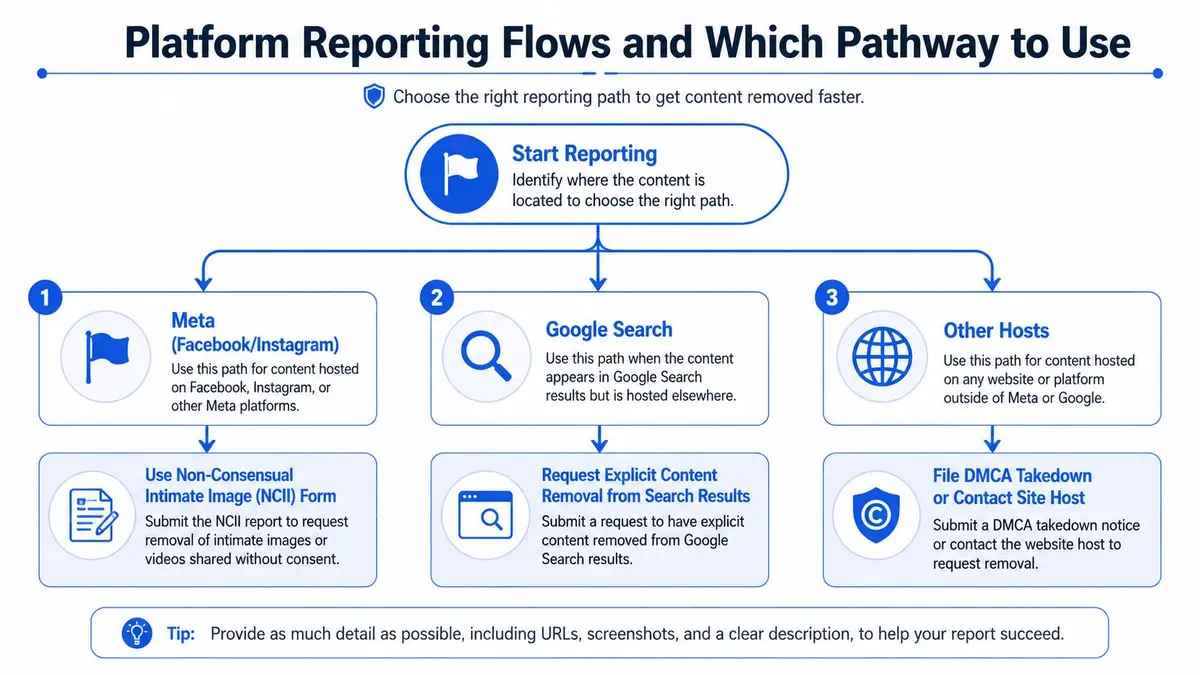
The U.S. TAKE IT DOWN Act provides a separate notice route for covered platforms. A valid written request must identify the depiction sufficiently for the platform to locate it, state in good faith that publication was unauthorized, and include a signature and contact information. After receiving a valid notice, the platform must remove the material as soon as possible and no later than 48 hours, according to this Congressional Research Service summary of the Act. Send the notice through the platform’s designated channel and retain delivery records.
India’s MeitY SOPs require platforms and other intermediaries to remove or disable access within 24 hours after a complaint. That window also applies to search-engine de-indexing and measures by content delivery networks and domain registrars to make the material inaccessible (Indian government takedown reporting). If a CDN or registrar obscures the host, contact the underlying service and intermediary separately.
For a practical overview of how a platform form works, watch this explainer before filing:
Choose the pathway as a technical decision. Policy wording, accurate copyright ownership, statutory notice requirements, and host location determine whether the complaint reaches a specialist queue or disappears into general support.
Legal Levers That Move Outcomes
Treat stolen intimate imagery as a forensic incident. The legal response should follow the publication route, the available evidence, and the jurisdiction. Start with removal, then use legal pressure to preserve evidence, identify the publisher, or stop further distribution.
If you created the photograph, you may own copyright even if another person possessed a copy. A DMCA notice can target the website host, platform, or search engine when it accurately identifies the copyrighted work, infringing material, ownership basis, contact details, and required good-faith statements. Copyright does not cover every image. If you did not create the photograph, do not claim ownership just because you appear in it.
The U.S. TAKE IT DOWN Act creates a notice-and-removal framework for covered platforms. A notice must be written, signed, and sufficiently specific. Validly noticed material must be removed within 48 hours after receipt. Send the notice through the designated route and retain proof of delivery. A complete, properly served notice gives you a stronger record if the platform fails to act (Congressional Research Service explanation of the TAKE IT DOWN Act).
Match the remedy to the offender
A partner leak may justify a lawyer’s preservation letter, cease-and-desist demand, restraining order, or civil claim. Use those tools when you can identify the publisher and need to stop direct contact, prevent distribution, or preserve devices and messages. A court order may assist with third-party hosts, but it will not automatically resolve an overseas hosting problem.
An account hijack calls for a different record. Preserve login alerts, recovery emails, access logs, and messages before changing account settings. AI-generated or altered material requires evidence showing manipulation, false attribution, and the services distributing it. Do not present a synthetic image as proof that an authentic photograph was stolen. The legal theory and evidence must match the incident.
The United Kingdom has adopted a 48-hour statutory takedown rule for abusive images. Companies may face fines of up to 10% of qualifying worldwide revenue or service blocking in the UK after a report (UK government announcement). India’s SOPs set a 24-hour response expectation for platforms, search engines, CDNs, and registrars (Indian SOP coverage). Counsel should verify which rule applies to the victim, platform, and host.
Refer the matter to police when evidence indicates hacking, extortion, trafficking, organized theft, or marketplace sales. A criminal referral does not replace takedown work. Investigations follow their own timetable, while source removal requires immediate handling.
Search De-Indexing and Reputation Containment
Source removal and search removal are separate jobs. A website may delete the image while Google continues showing a cached result, thumbnail, title, or URL. Conversely, Google may remove a result while the image remains live on the host. Treat the search surface as an independent incident map.
Begin with Google’s explicit-content removal process. Submit every affected result, not just the most visible one, and distinguish a source page from a search-result URL. Include the exact reason for removal, especially where the image is non-consensual, intimate, manipulated, or falsely associated with your name. If Google later removes material under its explicit-content policy, the affected person has 11 months from the removal date to appeal through the email-linked appeal form (Google’s explicit-content policy and appeal instructions).
Bing and other search engines require their own submissions. Keep a central register of submitted URLs, confirmation messages, decisions, and appeal deadlines. Don’t assume that a successful Google request propagates automatically to other engines. Search providers make independent decisions.
Build a cleaner search result set
Suppression is the second workstream. It doesn’t erase the source, but it can reduce the chance that an executive, client, employer, or journalist encounters a harmful result first. Build credible, identity-consistent pages that deserve to rank for your name:
- Control the foundation: Maintain a personal website, professional biography, and verified social profiles with consistent names, roles, and contact details.
- Publish durable material: Use dated bylines, accurate biographies, original commentary, and pages that remain useful rather than short-lived promotional posts.
- Strengthen authority selectively: Seek legitimate coverage, professional profiles, and speaking or publication pages from respected outlets. Don’t create a network of thin pages that search engines may ignore.
- Use clean page architecture: Choose canonical URLs deliberately, connect related biography and professional pages, and avoid publishing sensitive material on pages you later need to revise.
Do this while source takedowns are underway. Search containment takes time because it depends on crawling, indexing, relevance, and competing pages. It’s not a consolation prize after removal fails. It’s how you protect professional visibility while the underlying incident is being resolved.
Ongoing Monitoring and Preventing Reuploads
Removing the first copy doesn’t end the incident. Reuploads may use a changed filename, a cropped image, a new account, or a different host. Monitoring should therefore identify visual matches and language patterns, not just the original URL.
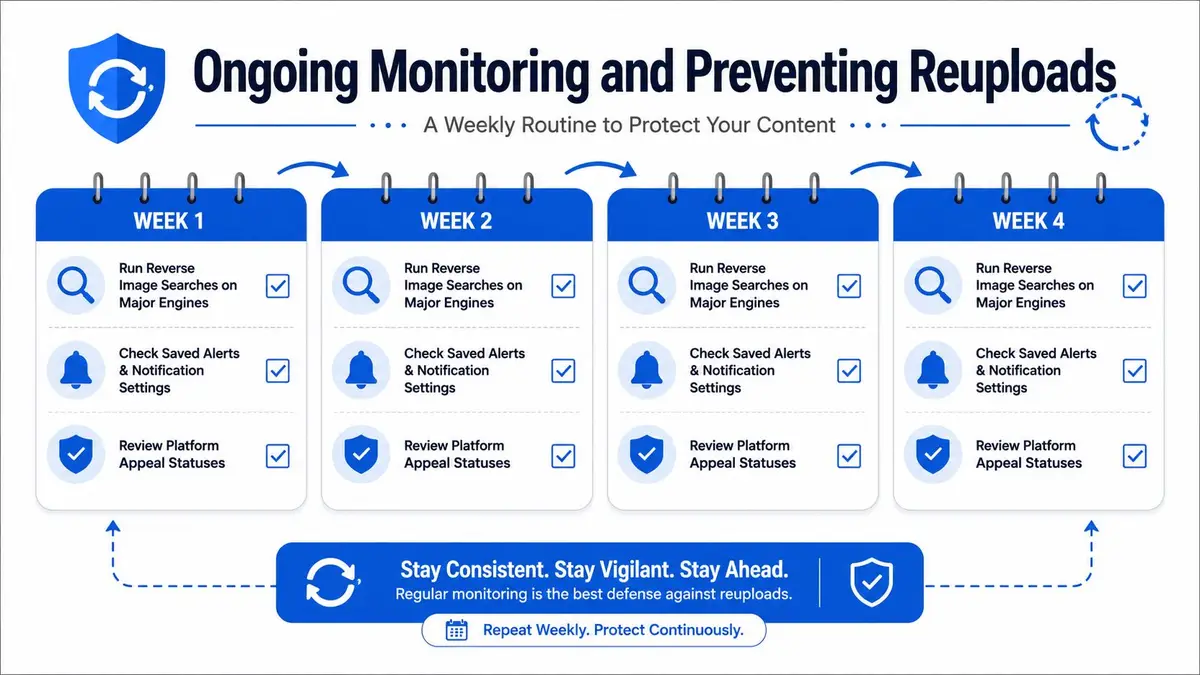
Run a repeatable weekly routine. Search the image through major reverse-image tools, check your name and username variations, review saved search alerts, and inspect platform notifications for impersonation or new-message activity. For high-profile clients, add dark-web monitoring and marketplace review through a qualified provider. Public search won’t reveal every criminal listing, but it can expose reposts, previews, or links that lead to a larger distribution network.
Use the same weekly checklist
In week one, confirm that every known URL has a recorded outcome, secure all accounts, and remove unnecessary third-party access. In week two, run reverse-image searches again and review whether search engines have processed the submitted results. In week three, check platform appeals, impersonation notices, and account-recovery alerts. In week four, repeat the search, update the incident register, and escalate any fresh copy immediately.
Prevention is mostly account hygiene. Rotate credentials, revoke active sessions on every device, enable strong two-factor authentication, protect cloud backup destinations, and remove applications that no longer need account access. Hardware-based second factors provide stronger protection against many phishing attacks than ordinary text-message codes, but they don’t repair an already compromised session by themselves.
For images you control, consider hashed-image tools such as StopNCII, which can help participating platforms detect matching material before it spreads further. Hashing isn’t universal coverage, and it won’t remove content from every website, so keep the monitoring process active. A concise privacy guide for everyday users can also help household members review device, account, and sharing practices that often create secondary exposure.
When Self-Help Ends and a Specialist Firm Becomes Worth It
Self-help works best when the source is visible, the platform has a clear form, and the publisher is not actively multiplying the files. It becomes inefficient when the material is hosted overseas, distributed through criminal marketplaces, altered with AI, tied to a professional identity, or appearing across several services at once.
A specialist firm can coordinate source takedowns, search de-indexing, platform escalation, evidence records, and reupload monitoring in one case file. Ask on the first call who will handle the matter, which jurisdictions they can address, how they protect confidentiality, what they can realistically remove, and how they distinguish source removal from search suppression. Do not accept guaranteed outcomes without a precise definition of what the guarantee covers.

ContentRemoval.com reviews leaked and stolen visual content, files and escalates removal requests, verifies search outcomes, and can provide ongoing monitoring. Review this guide on how to choose a content removal company before signing an engagement. If the incident is causing acute distress, practical emotional support matters too, and readers in the Okanagan can review Kelowna trauma recovery options alongside the legal and technical response.
ContentRemoval.com can assess stolen nude photos, identify the likely source, coordinate platform and host takedowns, pursue search de-indexing, and monitor for reuploads discreetly. Visit ContentRemoval.com to request a confidential assessment and receive a case-specific action plan.
Frequently asked questions
Should I confront the person who posted my private photos?
No. A confrontation can trigger deletion of the account, relocation of the files, retaliation, or further distribution before you have recorded where the images appeared. Preserve the messages or demands in their original form, and if money is being demanded, avoid bargaining without legal advice.
Can I use a DMCA notice to remove a leaked nude photo?
Only if you created the photograph, in which case you may own the copyright even though someone else held a copy. A DMCA notice must accurately identify the work, the infringing material, and your ownership basis. Do not claim copyright merely because you appear in the image; for genuine NCII use the platform’s safety policy instead.
How long does a platform have to remove intimate images posted without consent?
Under the US TAKE IT DOWN Act, covered platforms must remove validly noticed material as soon as possible and no later than 48 hours. The UK has adopted a 48-hour statutory rule for abusive images, and India’s SOPs set a 24-hour window for platforms, search engines, CDNs, and registrars. Counsel should confirm which rule applies to the victim, platform, and host.