
Choosing a content removal company is one of those decisions you only make when something has already gone wrong: a defamatory post, a mugshot, a leaked image, a hit-piece article that follows you into every job interview and first date. You are stressed, you want it gone yesterday, and an entire industry knows it. Some of that industry is made up of serious professionals. Some of it is built specifically to exploit people in exactly your position.
This guide is written by practitioners who do this work every day. It will show you what content removal firms actually do behind the curtain, the ten questions that separate real operators from sales floors, the red flags that should end a call immediately, and how the pricing models actually work, including our own, because a firm that won’t discuss its pricing philosophy in public is telling you something.
Read it before you sign anything. Even if you never hire us, the fifteen minutes you spend here will likely save you thousands of dollars and months of wasted effort.
What a content removal company actually does
Strip away the marketing language and a legitimate removal firm does four things:
1. Diagnosis. They identify every instance of the harmful content, not just the URL you found, but the syndicated copies, the scraper sites, the cached versions, and the image results. A single defamatory article often lives in six to twelve places. Removing one and leaving five accomplishes very little.
2. Legal and policy analysis. Every piece of content sits at the intersection of the host platform’s policies, the search engines’ policies, and applicable law (copyright, privacy statutes, defamation, revenge-porn laws, and more). The removal path depends entirely on which levers actually apply to your situation. A DMCA notice is useless against a truthful news article; a defamation argument is useless against content you posted yourself. Good firms map the content to the right mechanism before they act. (This analysis informs strategy. It is not legal advice, and a removal firm is not your law firm.)
3. Execution. Drafting and submitting takedown requests, platform policy reports, search engine removal requests, and de-indexing petitions, then following up, escalating, and re-submitting when the first attempt is denied, which it often is. Persistence and precision are most of the job. You can see how we structure this on our process page.
4. Verification and monitoring. Confirming content is actually gone (from the host and from search results, which are two different things), and watching for reappearance. Removed content resurfaces more often than most buyers expect, which is why ongoing protection retainers exist as a category.
Anything a firm promises beyond these four functions deserves scrutiny. There is no fifth secret function. There is no back door into Google.
Key takeaway: Legitimate removal work is diagnosis, legal/policy analysis, execution, and verification. Any firm hinting at “proprietary access” or “special relationships” with platforms is describing something that does not exist, or something you don’t want to be associated with.
The evaluation framework: 10 questions to ask on the first call
You do not need industry expertise to vet a removal firm. You need these ten questions and the discipline to walk away when the answers are bad.
1. “Will you assess my case before quoting me?”
The right answer is yes, and the assessment should be free or clearly scoped. Removal difficulty varies enormously by source, a scraper site and a major newspaper are different universes. A firm that quotes a price before understanding what and where the content is is quoting from a rate card, not a strategy.
2. “What exactly is removable in my case, and what isn’t?”
This is the single most revealing question. An honest firm will tell you, on the first call, that some content cannot be removed, accurate reporting by major outlets, court records, some government publications. If everything in your case is conveniently “removable,” you are being sold, not advised.
3. “Who will actually work on my case?”
Ask for names, roles, and backgrounds. Is the work done by in-house specialists, contract paralegals, offshore VAs, or “our team”? You are trusting these people with sensitive material about the worst moment of your life. Anonymous teams are a red flag we cover below.
4. “What happens if a removal attempt fails?”
Real practitioners fail sometimes and have a plan for it: escalation paths, alternative legal theories, de-indexing as a fallback, or a straight refund under their terms. Firms that have never considered failure have either never done the work or won’t admit how it goes.
5. “How do you charge, and what triggers payment?”
Get the pricing model in writing: per-link, retainer, or contingency (pay-on-removal). Each is legitimate in the right context, we break them down later in this guide, but you need to know which one you’re in, what counts as “success,” and what happens to your money if the content comes back.
6. “Can you show me evidence of past results?”
No firm can share client files without consent, but established firms have published case studies, reviews, and testimonials you can read and sanity-check. A firm with zero verifiable history and a very confident pitch is asking you to be their case study.
7. “What’s the realistic timeline?”
Honest answers are ranges tied to the removal path: platform policy takedowns often resolve in days to weeks; search engine removals and legal-route removals can take weeks to months; news content is the slowest and least certain. “48-hour guaranteed removal” of arbitrary content is a fantasy.
8. “Will I own and see everything submitted on my behalf?”
You should receive copies (or at least summaries) of what is sent in your name. This matters because some bad actors submit fraudulent DMCA notices or fake court orders “on behalf of” clients, and the client wears the consequences. If a firm’s methods are secret from you, the client, that secrecy is protecting them, not you.
9. “What happens if the content reappears?”
Get the re-removal policy in writing: free within a defined window, discounted, or full price again? Reappearance is common enough that this clause matters more than most buyers realize.
10. “Do you also sell suppression, and how do you keep the incentives clean?”
Suppression, pushing content down in search with new positive content, is a legitimate tool, but it is far more profitable to sell as an open-ended monthly service than a one-time removal is. A removal-first firm should be able to explain, clearly, when it recommends removal, when it recommends suppression or ongoing reputation management, and why. If the answer to every problem is a monthly retainer, the diagnosis is the sales model.
Red flags that should end the conversation
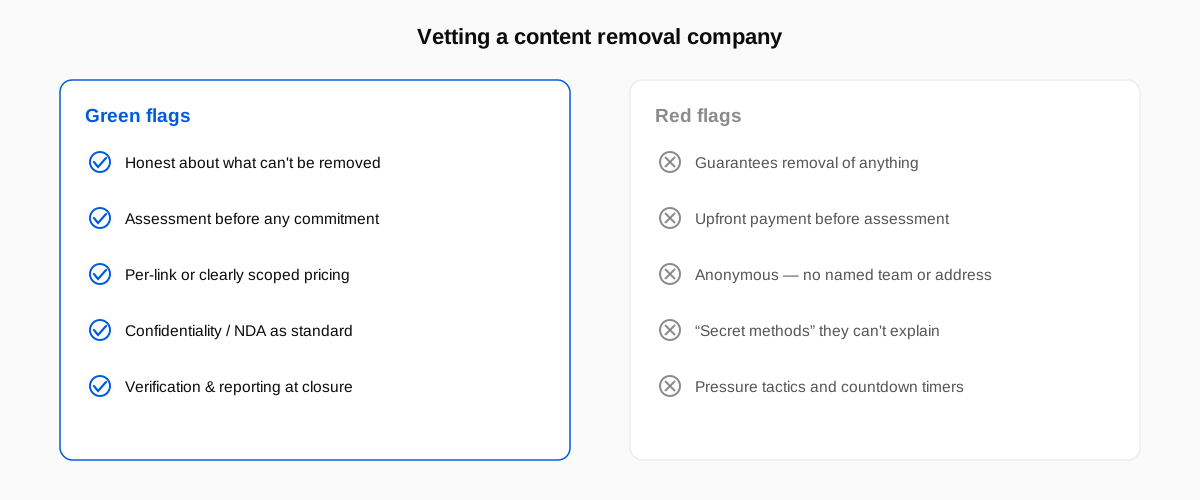
“Guaranteed removal” of anything and everything. No one controls Google, news publishers, or platform trust-and-safety teams. Removal outcomes can be highly likely, experienced firms know which cases they win, but a blanket guarantee across arbitrary content is either a lie or a set of terms and conditions doing very heavy lifting. Read what “guarantee” means in the contract; it usually means “guaranteed attempt.”
Full payment up front for uncertain outcomes. Deposits and staged payments are normal. Demanding the entire fee before any assessment, for content the firm hasn’t even analyzed, is how the scam side of this industry funds itself. The worst offenders take payment and simply stop answering.
Anonymous operators. No named principals, no physical address, no verifiable history, stock-photo “team” pages, domains registered behind privacy shields last year. In an industry where some operators have literally run the extortion sites they charged victims to escape (the mugshot-ransom model, where the same network posts the mugshot and sells its removal) anonymity is disqualifying. You should be able to find out who you are paying.
“Proprietary” or “secret” methods. Every legitimate removal lever is publicly documented: platform policies, DMCA, court orders, privacy statutes, search engine removal programs. Firms differ in skill, judgment, and persistence, not in access to hidden machinery. “We can’t tell you how we do it” frequently means gray-hat tactics (fraudulent notices, fake identities, hacked takedowns) that can rebound onto you.
Pressure and countdown clocks. “This price expires today.” “The content spreads every hour you wait.” The second sentence is actually true, but real firms tell you that and then let you decide. Manufactured urgency is a sales-floor tell.
A quote that never changes with the facts. If the price was the same before and after they learned what your content is, where it’s hosted, and how many copies exist, there was no analysis.
Key takeaway: The four fatal red flags: guaranteed-anything, pay-everything-first, anonymous teams, and secret methods. Any one of them alone is reason to walk.
Skip the guesswork.Free confidential Exposure Scan: we show you what's removable and quote it honestly, whether or not you hire us.
Book Your Free ScanGreen flags: what good looks like
The inverse of the red flags, plus a few markers buyers often miss:
- A free, substantive assessment that names specific URLs, hosts, and removal paths, not a generic “we can help.”
- Willingness to decline your case. Firms that turn down unwinnable work are protecting their results and your money. We tell a meaningful share of callers that their best move is to do nothing, or to handle it themselves for free.
- Written scope and success definitions. What counts as removed? Host-level deletion? De-indexed from search? Both? Ambiguity here is where disputes are born.
- Published pricing philosophy. Exact quotes require assessment, but a firm should be able to tell you its ranges in public, the way we do below and on our content removal page.
- Named humans with verifiable backgrounds, a real address, and a history longer than your problem.
- Clean incentive separation between removal (finite, project-based) and monitoring or suppression (ongoing), with removal recommended first when it’s viable.
Pricing models, explained honestly
There are three dominant models. None is inherently a scam; each has failure modes worth understanding.
Per-link / per-item project pricing
You pay a defined fee for each piece of content, quoted after assessment. This is our primary model: every removal is quoted per link, in writing, after a free confidential assessment, the exact price sits beside each URL before you commit, with complex cases (major news outlets, litigated defamation, multi-jurisdiction content) quoted individually.
Strengths: finite cost, clear success criteria, incentives aligned with actually finishing the job. Watch for: what “a link” means (does the syndicated copy count separately?), and the re-removal policy if content returns.
Monthly retainers
You pay a recurring fee for ongoing work, appropriate for continuous threats (serial harassers, recurring leaks, executives and public figures with standing exposure) and for monitoring after a removal. Our Protection Plans are scoped to your exposure and quoted at member rates after the free scan. The wider market spans from $99/month DIY monitoring tools to five-figure monthly enterprise retainers.
Strengths: right-sized for ongoing risk; someone is always watching. Watch for: retainers sold as the answer to a finite problem. If you have three bad links and no ongoing threat, a 12-month retainer is a financing plan for work that should have been a project. Ask what the deliverable is each month.
Contingency (“pay after removal”)
You pay only if the content comes down. Genuinely client-friendly when offered honestly. The firm carries the risk.
Strengths: obvious. You can’t pay for failure. Watch for: three things. First, cherry-picking: contingency firms only accept easy cases, so the model tells you your case was easy (and possibly overpriced for its difficulty). Second, definitions: “removed” for how long, and from where? Some contracts pay out on de-indexing while the content still sits on the host. Third, price: contingency fees are typically the highest per-item in the market, because you’re paying for the firm’s losses on other cases.
Key takeaway: Match the model to the problem. Finite problem → per-link project. Ongoing threat → retainer. Risk-averse and simple case → contingency, with the success definition in writing.
Why “cheapest per link” backfires
Price-shopping removals by the link is the most common expensive mistake buyers make, for four reasons:
1. Cheap quotes count links differently. A $500-per-link quote that treats every scraper copy, cached page, and image result as a separate billable link routinely totals more than a professional quote that scopes the whole cluster as one engagement.
2. Partial removal is often worth nothing. If the article comes down but the top-ranked syndicated copy stays up, your search results are unchanged. You paid for activity, not outcome.
3. Failed cheap attempts poison the well. Sloppy or template takedown requests get denied: and platforms and publishers keep records. A denied request can make the correct, well-argued follow-up harder. You can burn the best path for the price of the worst one.
4. Gray-hat shortcuts create new problems. The cheapest operators keep prices down with fraudulent DMCA notices, fake personas, and forged documents. When those unravel, the content often comes back, sometimes with a fresh article about the fraudulent takedown attempt attached to your name. Now you have more to remove than you started with.
The right comparison is never price per link. It’s total cost to reach your actual outcome, a clean search page, including the probability of getting there at all.
Get a real number before you commit to anyone.Our free Exposure Scan maps every copy of the content, tells you what's genuinely removable, and quotes the full job, no pressure, no countdown clocks.
Book Your Free ScanWhat a professional engagement timeline looks like
So you can benchmark any firm you talk to, here is the shape of a well-run engagement:
Days 1 to 3: Assessment and mapping. Full inventory of the content: original source, syndications, scrapers, caches, images, search visibility. You receive a written scope: what’s removable, by what path, at what price, and what isn’t.
Week 1: Strategy and authorization. You approve the scope. The firm confirms the legal/policy basis for each item and sequences the work (order matters: removing the original before the copies, or vice versa, depends on the case).
Weeks 1 to 4: First-wave execution. Platform reports, takedown notices, and search engine requests go out. Fast paths (clear policy violations, mugshot sites with established procedures, copyright matters) often resolve in this window.
Weeks 3 to 12: Escalation and slow paths. Denials get appealed and re-argued. Defamation-based removals, publisher negotiations, and legal-route de-indexing mature here. News content can take longer still, and an honest firm will have told you that in week zero.
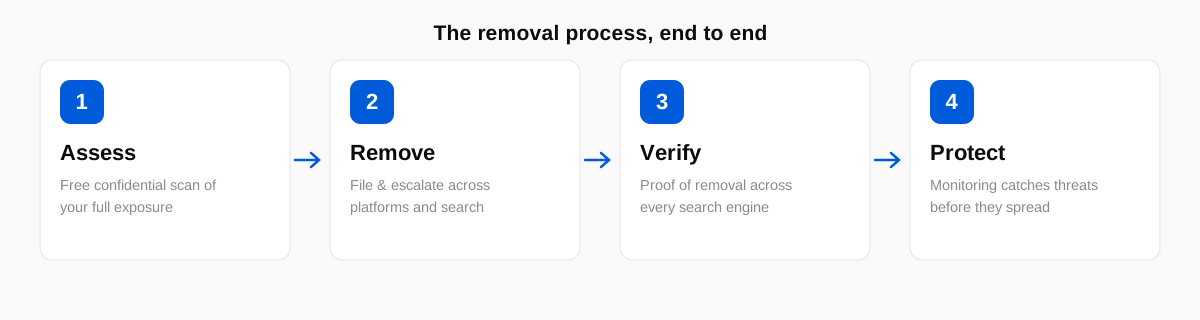
Ongoing: Verification and watch. Each removal is verified at the host and in search results (de-indexing can lag deletion by days or weeks). Then a monitoring window (or a Protection Plan, for clients with recurring exposure) watches for reappearance.
Throughout, you should be getting periodic written status updates without having to chase anyone. Silence after payment is the single most common complaint against bad operators in this industry.
Frequently asked questions
How much does a content removal company cost?
Across the market: DIY data-broker and monitoring tools start around $99/month; professional per-link removals commonly run from several hundred dollars (low-end operators) to several thousand; our removals are quoted per link, in writing, after a free assessment, with complex and news-related cases quoted individually; ongoing protection retainers range from four figures to five figures monthly. Anyone quoting you a precise price before assessing your specific content is guessing.
Can a removal company really guarantee results?
No firm can guarantee removal of arbitrary content, because no firm controls the platforms, publishers, and search engines that make the final call. What honest firms offer instead: accurate case selection (declining work they can’t win), specific likelihood assessments based on the removal path, and clear terms for what happens if an attempt fails. Treat blanket guarantees as a red flag, and read the fine print behind any guarantee that survives your first call.
How long does professional content removal take?
It depends entirely on the path. Clear platform-policy violations: often days to a few weeks. Search engine removal programs and copyright matters: typically weeks. Defamation-based and legal-route removals: weeks to months. Established news outlets: the longest and least certain, sometimes months, sometimes never. A trustworthy firm gives you a range per item, not one number for everything.
Should I try to remove content myself before hiring anyone?
Sometimes, yes, and a good firm will tell you when. Data-broker opt-outs, reporting clear policy violations on social platforms, and Google’s own removal request forms are free and effective for straightforward cases. Professionals earn their fee on the hard cases: denied requests, hostile hosts, syndicated clusters, news content, and anything where a botched first attempt could foreclose the good path. If you’re unsure which kind of case you have, that question is exactly what a free assessment answers. See our FAQ for more on where DIY works.
Get an honest read on your case first
The best protection against a bad removal firm is information, knowing what you’re dealing with, what’s actually removable, and what it should cost before anyone asks for your money. That’s what our free, confidential Exposure Scan provides: a complete map of the harmful content, an honest assessment of what can come down, and a real quote, whether or not you hire us. Book your free Exposure Scan and make this decision with the facts in front of you.