A wellness founder, three mastheads, and coverage that outlived the facts
An Australian wellness founder carried six-year-old coverage of a collapsed gym group across three national mastheads. The articles never reflected the court orders that later went his way. The publisher said no. The result was still won, at the search layer, on a second legal theory.
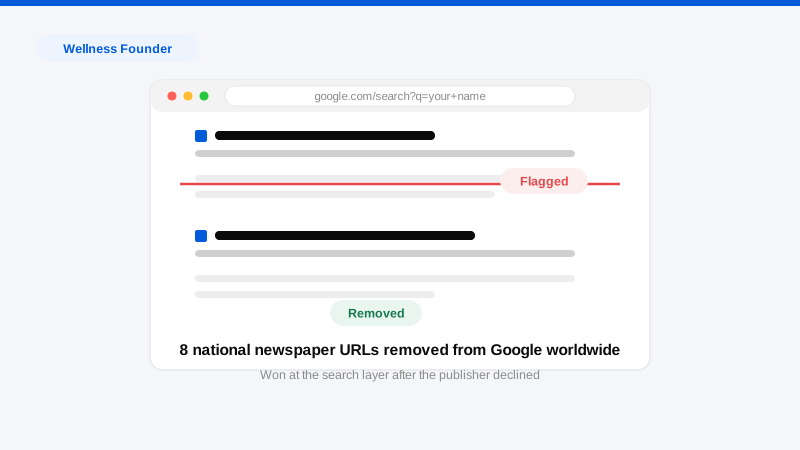
national newspaper URLs removed from Google search worldwide
from instruction to the search-level breakthrough
The situation
In 2019 a boutique gym group failed. A national metro daily ran six articles about the collapse, creditors, wages and alleged phoenix activity, then a follow-up about the founder backing a new studio. A second masthead in the same group syndicated three of them and kept a journalist archive page. A third carried a news video. Two trade-site pieces rounded it out.
By late 2025 the founder was running a wellness business. The coverage was six years old, contested on nine specific points of fact, and silent on Supreme Court orders from 2018 that had gone in his favour, including an order requiring a co-director to return a substantial sum to the company. It was still the first thing a prospective client, partner or investor saw.
Why old business-failure coverage keeps ranking
News archives are built to last and search engines are built to trust them. A national masthead has enormous domain authority, its pages are stable, well linked and cleanly structured, and nothing on a founder's own website competes with that on the founder's own name. Once a story about a collapse is published, it becomes the most authoritative document about that person that exists online, and it stays that way by default.
Syndication multiplies the problem rather than duplicating it. When a second masthead in the same group republishes three of the articles, those are three more URLs, each capable of ranking on its own, plus a journalist archive page that lists them together. A news video on a third title is a fourth surface, indexed separately and often shown with a thumbnail. Trade-site pieces sit alongside, ranking for the industry-specific searches that partners and suppliers run.
What none of it does is update. A story about creditors written in 2019 is a snapshot of 2019. Court orders made afterwards, findings that go the subject's way, and the ordinary passage of six years do not reach back into the archive. The reader searching in 2026 has no way of knowing that the most prominent result about a person is also the most out of date, which is precisely the harm this category of removal work exists to address.
What we told him before he instructed us
That the odds were about sixty-forty, in writing. He replied that he could live with that, and that his real fear was investing and finding nothing removed three months later. Applications went in within eleven days of the proposal.
Saying the odds out loud is not modesty. Press matters against national mastheads are genuinely contested, and a client who is told a case is a certainty makes bad decisions with the rest of their plan: they stop preparing counterparties, they stop building their own search presence, and they treat a probable outcome as a settled one. A number in writing, before anything begins, lets a founder decide whether the attempt is worth it on the real terms.
It also sets what reporting looks like afterwards. If the odds were stated at the start, then a refusal partway through is a known branch of the plan rather than a failure to be explained away, and the conversation moves straight to the next route.
The publisher said no
Approaches to the publisher ran from November into January. The legal office replied that it declined to remove any of the articles and would move only on a court order or genuinely new evidence. In February the strategy changed.
Publishers refuse for structural reasons rather than personal ones. A masthead that unpublishes on request creates a precedent it cannot control, and its own editorial code treats the archive as a record. The realistic outcomes from a publisher approach are a correction, an update note, an amendment to a specific factual error, or a de-listing of the page from the site's own search, and those are worth asking for. Full removal is rare and is usually reserved for material the publisher already believes is wrong. A founder who expects anything more from a masthead is planning on the wrong assumption.
Winning at the search layer
The first applications were refused, then met with a reply that pages were locked or inaccessible, and two rounds of reconsideration followed in March. In August, on a differently grounded application, Google confirmed it would remove eight URLs from search results globally: the creditors story, the liquidator investigation, the new-studio story, the wages piece and the rest of the metro coverage.
The trade-site pieces, the news video, one syndicated article and the journalist archive page were refused or remain live, and they were reported that way. Every result was verified, evidenced to the client and monitored afterwards, on the searches that actually mattered to him, which meant his own name rather than the business names.
Why the first argument was not the one that won
The first argument asked a search engine to weigh whether six-year-old allegations were still fair and whether the public interest in them had expired. Australia's serious harm element gives an argument like that a real foundation. It still asks a search engine to form a view on the merits of somebody else's journalism, and that is a decision it would rather leave to the publisher.
The second argument asked a narrower question, one that could be answered from documents rather than from opinion. That is what produced a global removal. The general point for founders is that a single piece of content usually offers more than one route, the routes have very different success rates, and nine months of approaches, refusals and reconsiderations is what it took to get to the one that worked. From outside that looks slow. From inside it was the ordinary length of the road.
Common mistakes that make it harder
Contacting the journalist informally, or through a mutual contact, is the most common one. It puts the request somewhere it cannot be recorded or escalated, and it tells a newsroom that the subject cares, which in this category is itself a reason to keep the story up.
Publishing a rebuttal or a statement while an approach is live is the second, because fresh comment gives the outlet a reason to write again. Waiting for a quieter moment is the third. Public interest in an old allegation does fade, and that only ever helps somebody who is actually making the argument.
The fourth is arriving with a general complaint that the coverage is unfair, rather than a specific record of what is wrong and the documents that support each point. This founder had nine contested points of fact and court orders behind them, and that document did work on every route that followed.
Who makes first contact and what the 15-minute call covers
Founders in this position usually make contact themselves, because the coverage is personal and they have often been carrying it silently for years. Sometimes the first message comes from a lawyer, an investor relations adviser or a chief of staff preparing for a raise or a partnership.
The 15-minute call establishes what the URLs are, how old they are, what is factually contested, what documents exist to support that, whether the publisher has been approached before and what images of you the pages use. We then say what we think the odds are, in a number, before anything is agreed. This client heard sixty-forty on that call and had it in writing before he instructed us.
The free Exposure Scan that follows is a written link-by-link map of what is visible for your name across search, video and syndication, including the copies most founders have not found. It is yours to keep whether or not you go ahead. Confidentiality and an NDA are standard, and the work runs alongside your lawyer, your PR team and your investors rather than cutting across them.
What this shows wellness and fitness founders
Old business-failure coverage in national papers is the exact shape of problem this market has: syndicated across mastheads, factually contested, never updated, and still ranking first. A publisher can say a flat no and the outcome can still be won at the search layer, on a second legal theory, through persistence. Updates went out at every stage, including when there was nothing to report.
The other thing this matter shows is what a realistic scope looks like. Eight URLs cleared globally. Several did not, and were named. The founder knew the odds before he started, knew the publisher had refused when it refused, and knew in August exactly which pages had gone and which had not. That is what a press matter looks like when it is run properly, and it is a very different experience from being promised a clean first page.
If press coverage is still defining you years after the facts changed, read our page for wellness founders or book the free Exposure Scan.
Facing something similar?
This case was handled through our Press article removal service.
Start with a free, confidential Exposure Scan
We'll scan your digital footprint, show you exactly what's exposed, and recommend the fastest path to remove it, or tell you honestly if you don't need us.
Book Your Assessment