
Bing search removal is a set of separate processes, not one form. De-indexing hides a result while the page stays live; source removal takes the content down at the host. Bing offers EU privacy delisting, a copyright route, legal submissions for defamation and an Outdated Cache tool, each needing different evidence, and removed results can return if the source remains.
Key facts
- EU residents can request name-based delisting through Bing’s EU privacy request form under Right to be Forgotten.
- Bing’s Outdated Cache tool frequently rejects submissions, especially for social media profiles, per Microsoft support threads.
- DMCA and defamation claims typically process within 24 to 48 hours; about 35 percent of weak filings are rejected.
- There is no public data on reappearance rates after removal, so monitoring has to follow every takedown.
Where ContentRemoval.com comes in. ContentRemoval.com handles Bing cases where a self-help submission has already failed, the source is anonymous or hostile, or the same material is spreading across other search engines and sites. Executives, family offices and their counsel typically get in touch after a rejected cache request or a first legal filing that went nowhere. A free 15-minute Exposure Scan maps what is removable, and the report is yours to keep. Get a Free, Confidential Exposure Scan or read how our search result removal work is done.
You’ve likely already had the same thought most clients have when they contact us: “If this is showing up on Bing, who else is seeing it?” That’s the right question. The problem usually isn’t just the link itself. It’s the combination of visibility, credibility, and loss of control.
When harmful material appears in Bing search, speed matters, but so does choosing the right path from the start. Often, time is wasted using the wrong tool for the wrong objective. They try to remove a result when they really need to remove the source. Or they chase the publisher when a fast de-indexing action would buy immediate breathing room. Bing search removal is not one process. It’s a set of different processes with different standards, consequences, and failure points.
The Reality of Unwanted Bing Search Results
A damaging Bing result can be false, invasive, outdated, stolen, defamatory, or private enough that it should never have become searchable. The first mistake is treating every one of those scenarios the same. They aren’t the same legally, technically, or strategically.
The first decision is simple. Are you trying to hide a result from Bing, or eliminate the content altogether? Those are different objectives. If you confuse them, you lose time and often create a paper trail that weakens your next move.
What Bing can remove and what it cannot
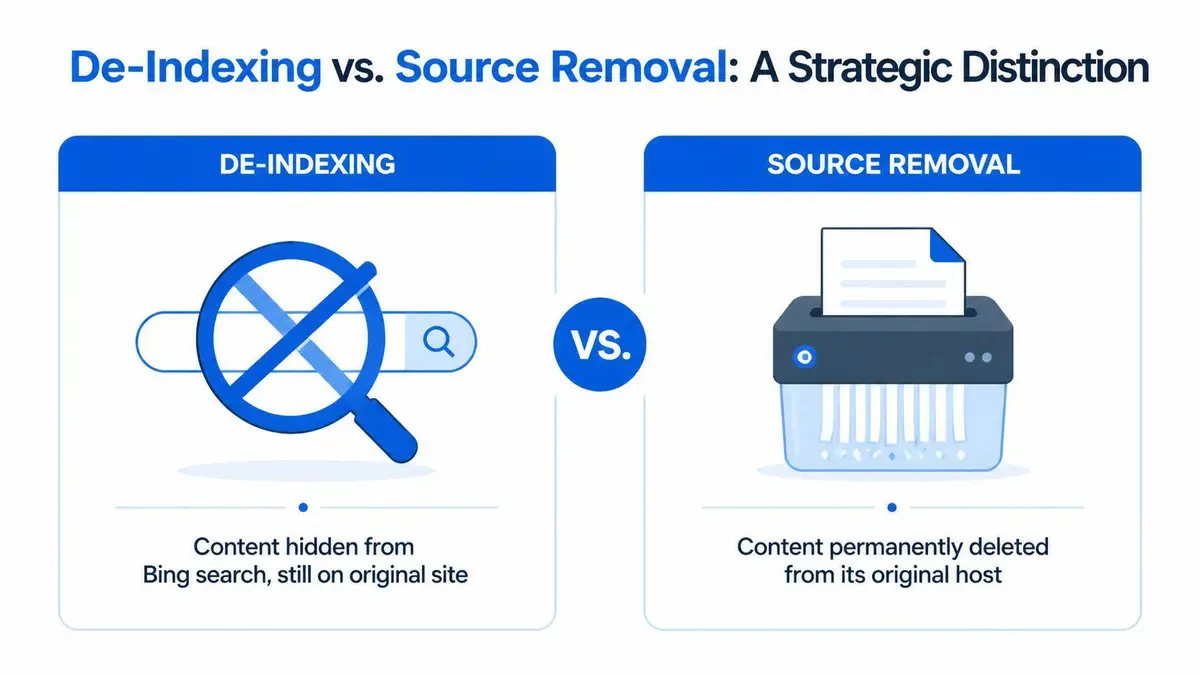
Bing can de-index content from search results in certain circumstances. That means the result may stop appearing on Bing, while the original page still exists online. Source removal is different. That requires the content to come down from the website, platform, or host that published it.
For many clients, de-indexing is the urgent first action because it reduces visibility. It does not solve the underlying problem if journalists, litigants, competitors, or bad actors can still access the page directly.
Practical rule: If the content creates legal, commercial, or family-office risk, treat de-indexing as containment, not closure.
The wrong method creates delay
People under pressure often submit a generic content complaint, then wait. That’s usually a mistake. Bing has different pathways for privacy requests, legal complaints, outdated cache issues, and broader content concerns. Each route expects different evidence.
Use this triage before you do anything:
- Name-based personal privacy issue: consider the privacy delisting route if the issue fits Bing’s standards.
- Stolen photos, copied articles, or scraped material: use a copyright-based approach.
- False statements or extortionate posts: prepare a legal submission with evidence, not a casual complaint.
- Old snippets or cached versions: test the cache route, but assume it may fail and plan the escalation immediately.
That last point matters because many clients arrive after a failed self-help attempt. By then, the publisher has been alerted, the content has changed, or the record is messier than it needed to be.
De-Indexing Versus Source Removal a Critical Distinction
The cleanest way to think about bing search removal is this. De-indexing controls discoverability. Source removal controls existence. If your reputation problem is active and escalating, you often need both.
When de-indexing is the right first move
De-indexing is often the faster tactic. Under the EU’s Right to be Forgotten ruling, European residents can ask Bing to delist name-based results when the information is inadequate, inaccurate, no longer relevant, or excessive through Bing’s EU privacy request form. That process affects search visibility. It does not remove the content from the original website.
That distinction matters more than most guides admit. If the page remains live, a recruiter, reporter, opposing counsel, or obsessed individual can still access it through direct links, other search engines, archives, reposts, or AI-generated summaries based on existing web material.
For a more detailed breakdown of how suppression works in practice, our view on strategic de-indexing decisions is straightforward. Use de-indexing when immediate visibility is the threat. Don’t confuse it with permanent cleanup.
When source removal is the only serious answer
If the content is defamatory, infringing, intimate, extortionate, or commercially sensitive, source removal is the stronger objective. Once the original page is gone, every search engine has less to index. That improves your position across Bing, not just inside Bing.
Here is the practical comparison:
| Criteria | De-indexing | Source removal |
|---|---|---|
| Speed | Often faster for search visibility | Usually slower because the host or publisher must act |
| Permanence | Limited if the source remains live | Stronger because the original content is eliminated |
| Scope | Bing-specific visibility control | Wider impact across search, sharing, and reposting |
| Difficulty | Can be straightforward in narrow privacy cases | Often requires legal, platform, or host-level leverage |
The decision framework clients actually need
Ask three questions.
First, is your problem visibility or existence? If the damage comes from people finding it by searching your name, de-indexing may be enough as an immediate containment step.
Second, is the source likely to cooperate? A legitimate publisher, social platform, or commercial site may respond to a properly framed legal notice. A malicious actor usually won’t.
Third, what happens if the content stays live? If the answer includes investor concern, board exposure, family privacy risk, media pickup, or copycat posting, you should pursue source removal from day one.
If a page can still be shared privately after it disappears from Bing, the crisis isn’t over. It’s only quieter.
Executing a Bing Content Removal Request
Users often start with Microsoft’s public tools. That’s reasonable, but only if you understand what each tool is designed to do and where it routinely breaks.
The main Bing pathways
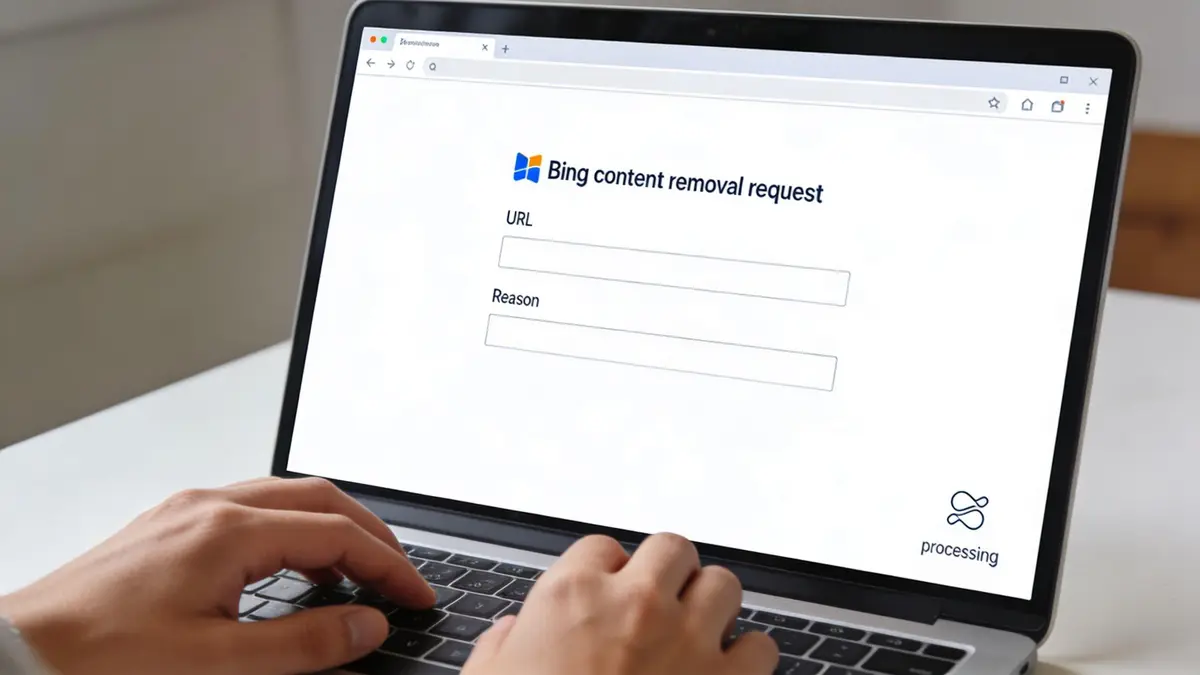
There are two practical routes most clients encounter first. One is Bing Webmaster Tools, which supports URL-focused removal activity. The other is Microsoft’s broader content concern process for personal information and related issues.
The process sounds simple. It rarely is. You need the exact URL, the correct complaint category, and evidence that matches the category you selected. If your submission mixes privacy language with copyright facts, or calls a live page “outdated,” you’ve already weakened it.
A measured self-help route looks like this:
- Capture the current evidence. Save the URL, search query, snippet, and page content before anything changes.
- Choose one theory first. Privacy, outdated cache, copyright, or legal violation. Don’t file a confused hybrid request.
- Submit the request with supporting material. If identity or ownership matters, prove it cleanly.
- Track the response and result. Acknowledgment isn’t the same as removal.
- Escalate quickly if the wrong tool was used. Delay benefits the publisher, not you.
If you want a plain-language overview of the broader process, removing search results strategically is a useful starting point.
Why the Outdated Cache route fails so often
The most frustrating part of bing search removal is often the so-called easy fix. A significant unresolved issue is the frequent failure of Bing’s Outdated Cache tool, particularly for social media profiles. Users report that submissions are rejected even when they follow the stated instructions, leaving outdated personal information visible and unresolved in Microsoft’s own support discussions about Bing content removal failures.
That failure pattern matters because executives often discover old bios, stale profile text, or outdated handles in search before they realize the underlying page is no longer accessible in a normal way. The cached result lingers. The public tool rejects the request. Time passes.
Three practical mistakes show up repeatedly:
- Using weak comparison text: the cache request often depends on proving the page changed materially.
- Targeting the wrong URL version: one mismatch can sink the request.
- Treating a rejected cache request as a final answer: it usually isn’t.
This walkthrough gives a visual sense of the process, but the main issue is still evidence quality and escalation judgment.
What a serious submission looks like
A serious request is concise, documented, and narrow. It states the harm, identifies the exact result, and ties the facts to a recognized removal basis. It does not ramble. It does not editorialize. It does not threaten randomly.
“I am requesting removal of the Bing result at [URL] because it displays personal information that is no longer accurate and creates a clear privacy risk. The current cached snippet reflects outdated data that no longer appears on the live source. Attached are screenshots of the search result, the live page, and identity documentation supporting this request.”
That style works better than anger. It also makes escalation easier if the first attempt fails.
Invoking Legal Frameworks for Removal
When public-facing tools stall, you stop filing complaints and start building a legal record. That shift changes the tone, the standard, and often the outcome.
DMCA, privacy, defamation, and intimate content
Different legal theories do different work.
A DMCA notice is the right instrument when someone copied your protected photos, videos, text, or other original work without permission. A privacy-based demand is stronger when the issue involves doxxing, exposed personal information, or highly sensitive material. Defamation submissions need precision because bare denial is weak. You need falsity, context, and evidence. For non-consensual intimate imagery, speed and specificity matter more than rhetoric.
Bing’s legal request workflow can move quickly, but weak filings fail. According to the verified data, requests involving legal claims such as DMCA or defamation are typically processed within 24 to 48 hours, but incomplete or poorly justified submissions face a rejection rate of approximately 35% in this summary of Bing’s de-indexing methodology. That’s why legally coherent drafting matters.
If you need a practical reference point, our guide on submitting a Bing legal request properly tracks the same principle. Match the claim to the evidence, and the evidence to the remedy.
What to include in the notice
A legal notice should do four things well:
- Identify the material exactly. Include the result URL, underlying source URL if known, and screenshots.
- State the legal basis cleanly. Copyright infringement, privacy violation, defamation, or another recognized ground.
- Show proof. Ownership records, identity documents, original publication dates, false-statement corrections, or court material where available.
- Demand a defined action. Removal, de-indexing, or both.
A sloppy notice creates two problems. It gives Bing an easy reason to reject the request, and it gives the publisher a preview of your case without enough pressure to comply.
Sample language that sounds like counsel, not a frustrated user
Use direct language. Don’t overstate.
Suggested phrasing: “This notice concerns content indexed by Bing that infringes my legal rights. The material identified below contains unauthorized use of copyrighted work and has caused ongoing reputational and commercial harm. I request prompt de-indexing of the identified result and review under Microsoft’s applicable legal complaint process.”
For defamation, use this style instead:
“The indexed content contains false statements presented as fact concerning the claimant. Those statements are inaccurate, harmful, and unsupported. The attached materials identify the false assertions and provide documentary contradiction. We request removal or de-indexing consistent with Bing’s legal review standards.”
The strategic mistake most people make
They argue morally instead of legally. Bing doesn’t remove material because it feels unfair. It responds when the request fits a recognized framework and the evidence is organized.
That’s also why timing matters. If the content is spreading, copied across domains, or attached to a brand attack, you should coordinate the Bing filing with host-level notices and platform enforcement. Filing only one side of the problem is slow and incomplete.
Managing Timelines and Preventing Re-Indexing
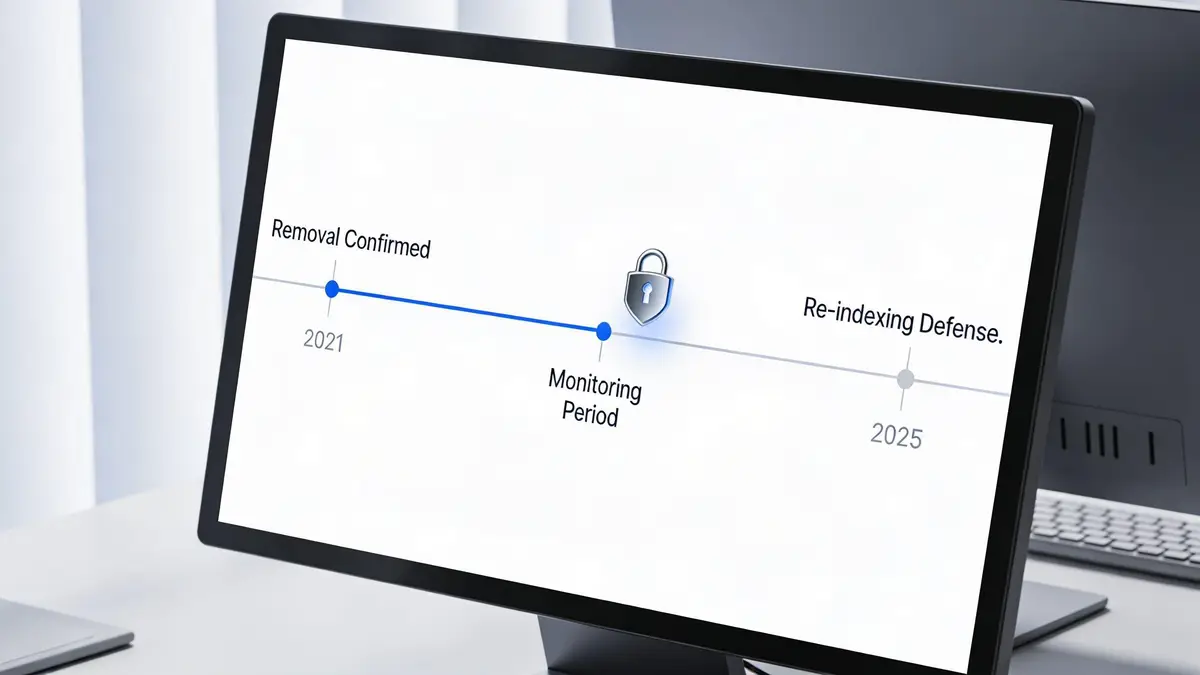
The most dangerous assumption in bing search removal is that one successful takedown ends the matter. It doesn’t. It starts the monitoring phase.
What happens after the first removal
There are several clocks running at once. Bing may review a legal request quickly, especially where the claim is clear. The source host may take longer. The result may disappear from one query and remain visible under another. Cached references can also lag behind the source state.
That’s why smart operators document every stage:
| Stage | What you need to confirm |
|---|---|
| Submission received | The request was accepted into the correct queue |
| Review outcome | Bing removed, refused, or requested more information |
| Search visibility | The result no longer appears for the relevant query |
| Source status | The original page is down, changed, or still live |
| Recrawl risk | The material may return if the source or a copy remains accessible |
Re-indexing is the real long-term threat
Guidance on preventing Bing re-indexing is scarce, especially around AI integration such as Copilot that could surface removed information in new ways. There is also no public data quantifying reappearance rates post-removal, which leaves high-profile individuals exposed if they rely on one-off action rather than continuous surveillance, as noted in this discussion of Bing re-indexing and AI-related resurfacing risk.
That uncertainty is exactly why experienced crisis teams treat removals as a campaign, not a ticket. If the content was commercially valuable to the attacker, emotionally satisfying to the harasser, or easy to repost, assume it will come back somewhere.
What sustained defense looks like
Your defense posture should include:
- Search monitoring: track name queries, branded terms, and known URL variants.
- Source monitoring: watch the original host and adjacent repost sites.
- Evidence preservation: keep screenshots and logs from every removal cycle.
- Escalation rules: know in advance when a reappearance triggers legal action versus platform action.
Removed isn’t the same as gone. It means you’ve won one round.
The AI issue adds another layer. Even if a result is suppressed, summaries and answer interfaces may continue to reflect stale material if the underlying web record remains messy. That’s one reason source cleanup still matters after a successful de-indexing event.
When Professional Intervention Is Non-Negotiable
Some cases can be handled with a disciplined self-help approach. Others shouldn’t be. If the stakes involve litigation risk, board exposure, family safety, blackmail, impersonation, or persistent republication, DIY isn’t efficient. It’s dangerous.
The trigger points for escalation
Bring in professional help immediately if any of the following are true:
- Multiple jurisdictions are involved. Defamation, privacy, and platform standards don’t align neatly across borders.
- The source is hostile or anonymous. Anonymous site operators, leak forums, and serial harassers don’t respond to polite requests.
- The material is spreading. Once copies begin appearing across blogs, forums, social platforms, or low-quality syndication sites, every delay multiplies the cleanup burden.
- Your first filing failed. A rejected request often means the next one must be tighter, not louder.
- Discretion matters. Executives, family offices, and public figures usually need containment without attracting new attention.
A useful analogy comes from outside reputation management. Businesses that outsource specialized work do so because missteps are expensive and internal teams aren’t built for edge cases. That’s the same logic behind Miles Marketing outsourced marketing. When the work is specialized and the cost of trial and error is high, you hand it to people who do it every day.
Why permanence is harder than people think
Microsoft’s retirement of Microsoft Search in Bing on March 31, 2025 showed that platform policy can permanently erase certain categories of data, including work or school search history, under Microsoft’s retirement notice for Microsoft Search in Bing. Public web content is different. It doesn’t disappear because a platform changed direction. It has to be pushed down, removed at the source, monitored, and defended against reappearance.
That difference is exactly why professional intervention becomes essential in serious cases. The problem is not just getting one URL out of Bing. The problem is making sure the issue doesn’t regenerate in another form a week later.
If you’re facing a live reputation threat, a privacy leak, or a failed Bing removal attempt, ContentRemoval.com can assess the facts confidentially and map the correct removal path, including de-indexing, source takedowns, and post-removal monitoring.
Frequently asked questions
How do I get a search result removed from Bing?
Capture the URL, query, snippet and page content first, then choose one theory: privacy, outdated cache, copyright or a legal violation. Submit through the matching Bing pathway with supporting evidence, track the outcome rather than the acknowledgment, and escalate quickly if the wrong tool was used.
Why does Bing’s Outdated Cache request keep getting rejected?
The request usually depends on showing the page changed materially, so weak comparison text or a mismatched URL version sinks it. The article notes this route fails often for social profiles and that a rejection should be treated as a prompt to escalate, not a final answer.
Does removing a result from Bing delete the content?
No. De-indexing controls discoverability on Bing only; the original page can still be reached by direct link, other search engines, archives, reposts and AI summaries. If the content creates legal, commercial or family risk, pursue source removal as well.