
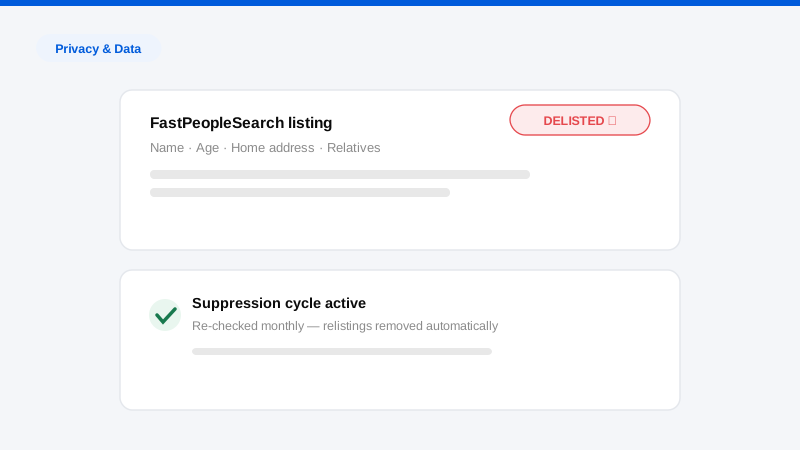
FastPeopleSearch is one of the most exposing sites in the people-search industry, and one of the most searched-against. Unlike brokers that tease details behind a paywall, it displays your current home address, full address history, phone numbers, email addresses, and household members free to anyone, no account required. If you want to remove your address from Fast People Search, the mechanics are genuinely simple, the site runs one of the easier opt-out flows in the industry, and we will walk through them precisely below.
But there is a catch that makes FastPeopleSearch a special case, and it is the reason this guide exists as more than a three-step checklist. FastPeopleSearch belongs to a family of interlinked free people-search sites built on shared data, and its listings are among the most heavily scraped and cloned on the open web. Filing one opt-out on one domain, while the same record stands on its siblings and copies, changes very little about what a stranger can find.
As practitioners who broker these opt-outs daily, here is the full procedure: the exact removal steps, the network you also need to hit, and the maintenance rhythm that keeps a removed address from resurfacing.
Step one: inventory your records before touching the opt-out form
FastPeopleSearch keys records to name-and-location combinations, and most adults have several. Before filing anything, build your target list:
- Run your full name on fastpeoplesearch.com and note every record matching you: current city, prior cities, and misspelled or variant names that are clearly you.
- Run the reverse phone lookup on your cell and home numbers; phone-keyed records sometimes exist independently of name-keyed ones.
- Run the reverse address lookup on your current home; it can surface records for household members you will want to handle in the same session.
Save the URL of each record page. The opt-out flow works per-record, and an inventory prevents the classic mistake of removing one profile while four survive.
How to remove your address from Fast People Search, step by step
The site’s removal flow is email-verified rather than phone-verified, which makes it faster than most:
- Go to the removal page at fastpeoplesearch.com/removal. It is linked from the site footer as well, typically under a “Remove My Info” or privacy label.
- Enter an email address and complete the CAPTCHA. The email is used to send your verification link. If you prefer not to hand the site your primary address, a dedicated or masked email works fine. You only need to receive one message.
- Search for your record from within the removal flow. The site prompts you to find the listing you want removed; locate each record from your inventory.
- Select the record and request removal. Confirm it is your listing and submit.
- Open the verification email and click the removal link. The link is time-limited. Check spam and promotions folders, these messages land there routinely, and an unclicked link means an unprocessed removal.
- Repeat for every record on your inventory list. Each record needs its own request-and-verify cycle.
- Confirm removal. FastPeopleSearch states removals process quickly: typically within about 72 hours. Re-run your name, phone, and address searches to verify each record is gone, and re-file anything that survived.
The entire process is free. No account, no ID upload, no phone call. If a removal fails repeatedly, the site publishes a contact route for manual requests; use it with the specific record URL rather than a general complaint.
A few field notes that save time. Do the whole batch in one sitting, the removal flow’s search step is the same interface you used for your inventory, so momentum matters. If the verification email never arrives, retry with a different email provider before assuming the flow is broken; certain mail hosts filter these messages aggressively, and resist the temptation to submit removals for records that are probably not you: opting out a stranger’s record does nothing for you, and if the record is a garbled merge of your data and someone else’s, removing it is still worthwhile, merged records are common, and they count as your exposure when they contain your address.
Step two: hit the sibling sites, or the removal is cosmetic
FastPeopleSearch operates within a cluster of free people-search sites that share data and design DNA: TruePeopleSearch, SearchPeopleFree, and FastBackgroundCheck are commonly grouped with it, each with its own domain and its own separate opt-out. Removing a record from one does not remove it from the others, and a searcher who does not find you on FastPeopleSearch will land on a sibling in the same results page.
Practical rule we apply on every engagement: treat a free people-search removal as a batch job across the cluster, done in one sitting while you have your record inventory in hand. Each sibling site runs a similar email- or form-verified flow; the marginal cost of doing four sites instead of one is perhaps twenty minutes, and the difference in outcome is dramatic.
Beyond the immediate cluster sits the broader broker economy (Whitepages, Spokeo, Radaris, BeenVerified, Intelius, and hundreds more) all drawing on the same public-record feeds. Full-ecosystem data broker removal is a larger undertaking than a Saturday morning, but the free-site cluster is the right first strike because it is where your address is visible with zero friction.
Why FastPeopleSearch records come back, and the scraping problem
Two distinct forces bring removed addresses back, and they need different countermeasures.
Re-population from data feeds. Like every broker, FastPeopleSearch rebuilds its database from refreshed public and commercial records. A new deed, a utility connection, a change-of-address, any of these can generate a fresh record after your opt-out, often at a new URL. There is no filing that prevents this; there is only detection and re-filing. This is the core reason serious practitioners describe the work as recurring suppression, and why ongoing protection plans are structured around scheduled re-scans rather than one-time purges.
Scraped copies. Because FastPeopleSearch publishes full records free, its data is a favorite target for scrapers who republish it on low-quality lookup sites, many hosted offshore with no functioning opt-out at all. Removing the FastPeopleSearch original does not touch these copies. Countermeasures here are different: finding the copies (search your address and phone number in quotes), filing removals where a process exists, and, where the site itself will not cooperate, working the search-engine layer so the page stops surfacing for your name. Google’s personal-information removal process accepts requests for pages exposing home addresses and phone numbers even when the hosting site is unresponsive; that suppression work is the heart of removing yourself from Google.
The scraped long tail is precisely where automated opt-out tools stop helping. They cover a fixed list of cooperative brokers; the offshore mirror of your FastPeopleSearch record is not on anyone’s list. Covering it is manual, investigative work, the kind that fills most of the hours in a professional digital footprint cleanup.
Why the free sites deserve first priority
It is worth being explicit about why our standing advice is to remove your address from Fast People Search and its siblings before tackling the bigger-name paid brokers. Risk is a function of friction. A stalker, an angry stranger from a comment thread, or an opportunistic scammer is rarely going to pay for a background report, but every one of them will click the first free result that hands over a street address. The paid brokers matter for determined, resourced adversaries; the free tier is what exposes you to the impulsive ones, and impulsive adversaries are far more numerous.
The free model also changes the data’s downstream behavior. Paywalled records leak slowly; free records get copied, quoted in forum posts, and pasted into harassment threads, because there is nothing to stop anyone from doing so. Every week a free listing stands, the probability grows that your address now lives somewhere with no opt-out at all. That is the compounding cost of delay, and it is why the 72-hour FastPeopleSearch removal is one of the highest-leverage fifteen minutes in personal privacy work.
A maintenance schedule that actually holds
Based on what we see across client re-scans, a workable DIY cadence looks like this:
- Week 1: Inventory, file FastPeopleSearch and sibling-site removals, verify at 72 hours.
- Week 2 to 3: Sweep the major paid brokers; file Google removal requests for any exposed-address pages that remain.
- Day 90, then quarterly: Re-run every search from your original inventory: name, phone, address in quotes. Re-file anything that returned. New listings caught early are quick kills; listings left standing get scraped and multiply.
- After any record event: Moving, refinancing, or a new phone number should trigger an off-cycle re-check about a month later, because those events push fresh records into broker pipelines.
Two household notes. First, records are cross-linked: your spouse’s un-removed listing will display your shared address and undo your work, so process the household together, reverse-address search from step one gives you the list. Second, for executives, board members, and other visible people, the re-check cadence should be tighter and the scope wider, because the people searching are more motivated; that operational reality is what our executive privacy program and our work with family offices are built to absorb.
When to do it yourself and when to hand it off
We are a removal firm, so discount our bias accordingly, but here is the honest split we give people who ask.
Do it yourself if your exposure is ordinary, your risk profile is low, and you will genuinely keep the quarterly appointments. The FastPeopleSearch flow in this guide is free and takes minutes per record; the sibling cluster adds under an hour.
Consider professional personal data removal when any of these are true: your address exposure is a safety issue (harassment, stalking, hostile litigation); your role makes you a target worth researching; your household is large enough that the batch-and-maintain workload will realistically not happen; or your searches keep surfacing scraped copies on sites with no opt-out, which require the manual search-suppression route. What a managed service adds is not secret access. It is completeness across hundreds of sites, verification that removals actually happened, and the recurring re-scan discipline that DIY efforts almost always drop after the first quarter.
One boundary worth stating plainly: if your record is being weaponized (posted with threats, used for doxxing) that can cross into legal territory. A removal firm is not a law firm; involve law enforcement and counsel for the threat itself while the exposure cleanup runs in parallel.
Frequently asked questions
Is the FastPeopleSearch opt-out really free?
Yes: free, no account required, verified by a single email link. Any site or service charging you specifically to process a FastPeopleSearch removal is reselling a free form. Paying for broad, managed suppression across the whole broker ecosystem is a different and legitimate service; paying per-site for free opt-outs is not.
How long does it take to remove your address from Fast People Search?
The site generally processes verified requests within about 72 hours. Add days to a couple of weeks for search engines to drop the dead page from results, accelerable with Google’s outdated-content tool once the record itself is gone.
I removed my record. Why does my address still show in Google results?
Three usual suspects: Google is still serving the cached FastPeopleSearch page (fix with the outdated-content tool); a sibling site like TruePeopleSearch still publishes the record (file that site’s own opt-out); or a scraped copy lives on a third-party site (find it by searching your address in quotes, then remove or suppress it). The address is only “down” when all three layers are clear.
Does FastPeopleSearch have my data because I signed up for something?
No: you never had an account to delete. The site compiles public records and commercially available data the same way the rest of the people-search industry does. That is also why removal is never permanent by default: the pipeline keeps flowing, and suppression has to be maintained against it.
See every site publishing your address right now
FastPeopleSearch is one domain in an ecosystem of hundreds. Before you spend a weekend on opt-outs, run our free exposure scan. You will get a concrete inventory of the broker sites, clone networks, and scraped copies currently publishing your home address, so you can clear all of it, not just the site you happened to find first.