
Somewhere right now, a competitor is using your product photography, a “free download” site is distributing your paid course, or a content farm has republished your entire blog under someone else’s byline. For executives and founders, copyright infringement removal tends to arrive as an operational surprise: you built the asset, someone else is monetizing it, and the tool everyone mentions, “send a DMCA”, turns out to be less a button and more a discipline. Filed properly, takedown notices are among the most reliable enforcement mechanisms on the internet, because they engage the legal self-interest of hosts and platforms rather than their goodwill. Filed sloppily, they get rejected on technicalities while the infringement compounds.
The gap between those outcomes is strategy, and that’s what this guide covers. Not the legal theory (we’re practitioners who file takedowns daily, not a law firm, and nothing here is legal advice) but the operational playbook: how the notice mechanism actually works, why serious enforcement targets hosts, platforms, and search engines in parallel rather than one at a time, how to escalate against sites engineered to ignore you, and what changes when you’re facing systematic piracy of a course or product rather than a single stolen image.
One framing note before the tactics: infringement is a revenue and brand problem, not an ego problem. Stolen product images divert buyers to counterfeit listings. Scraped articles cannibalize your search rankings, sometimes outranking the original. Pirated courses convert your most price-sensitive prospective customers into non-customers. The business case for enforcement is usually straightforward; the question is doing it at the right cost and scale.
How the takedown mechanism actually works
The DMCA’s notice-and-takedown system rests on a trade: online service providers get a safe harbor from liability for their users’ infringement, in exchange for removing infringing material expeditiously when a copyright owner sends a valid notice. That structure explains almost everything about how takedowns behave in practice:
- Compliance is in the provider’s interest. A host that ignores valid notices risks its safe harbor. This is why hosts routinely remove content even when their customer, the infringing site, objects. You’re not asking a favor; you’re triggering a liability calculation.
- Validity is technical. A notice must contain specific statutory elements: identification of the copyrighted work, identification and location of the infringing material, your contact information, a good-faith statement, an accuracy statement made under penalty of perjury, and a signature. Miss an element and providers can, and do, reject the notice outright, buying the infringer weeks.
- The perjury language is load-bearing. You are swearing to ownership and to a good-faith belief the use is unauthorized. False claims create real exposure and, at platform scale, get repeat abusers’ notices deprioritized. Never claim what you don’t own, and think before filing against uses that might qualify as fair use: commentary, criticism, and parody notices can boomerang badly.
- Counter-notices exist. The alleged infringer can file a counter-notice, after which the material may be restored unless you pursue the matter legally. Most commercial pirates never counter-notice, doing so requires identifying themselves and consenting to jurisdiction, but a contested case is your signal to involve an actual attorney.
Before any notice goes out, assemble the ownership file once and reuse it: the original files with creation dates and metadata, publication records showing your content live before the infringer’s, registration details if you have them, and for work-for-hire or agency-created assets, the contracts showing rights actually transferred to you. The single most common self-inflicted wound we see from founders is discovering mid-dispute that their photographer or agency never assigned the copyright. Audit that now, not during a takedown; our intellectual property protection practice starts every engagement there.
The parallel-track principle: hosts, platforms, and search at once
Most DIY enforcement fails not on validity but on sequencing: people send one notice, to one party, and wait. Professional enforcement runs three tracks simultaneously, because each track has a different failure mode and the tracks cover for each other.
Track 1: The host
For infringing content on an independent website, the site’s hosting provider is usually the decisive target. Identify the host through the site’s DNS and network records, find its designated copyright agent or abuse channel, and send the notice there. The host’s safe-harbor incentive does the rest in the typical case: they forward the notice to their customer with a comply-or-else deadline. When the entire site is substantially infringing, a piracy site rather than a site with one stolen page, hosts can and sometimes do suspend the whole account.
Track 2: The platform
Content on YouTube, Instagram, Facebook, TikTok, Amazon, Etsy, or a forum is governed by that platform’s own copyright process, generally a web form implementing the DMCA framework, sometimes with additional tools layered on top (content-matching systems, repeat-infringer policies, seller enforcement programs for marketplaces). Platform processes are faster than host processes when your submission fits their format exactly, and platform strikes carry consequences for the infringer’s whole account, which changes their incentives in a way a single removed post doesn’t.
Track 3: Search engines
A notice to Google removes the infringing URLs from search results, and this track matters even though it doesn’t touch the content itself. Piracy and scraper sites live on search traffic; de-indexing cuts their oxygen while the slower host track proceeds. Search takedowns for clean notices are typically processed in days, they cover Google Images for stolen visual assets, and accumulated valid notices against a domain feed Google’s demotion signals for that whole site. Full detail on the search-side mechanics is in our guide to Google’s removal processes.
Run all three at once and the failure modes stop being fatal: a slow host is offset by fast de-indexing; a rejected platform form is offset by the host notice; an offshore host is offset by both other tracks. The content comes down at the source and loses its distribution while that happens, which is the actual goal, since removing search results alone leaves the infringement alive for anyone with a link.
Escalation: when the site is built to ignore you
A meaningful minority of infringing sites (dedicated piracy operations, counterfeit storefronts, scraper networks) are engineered for non-compliance: hidden ownership, bulletproof-friendly hosting in non-responsive jurisdictions, no functioning abuse contact. Against these, the standard notice is an opening move, not a strategy. The escalation ladder runs down the infrastructure stack:
- CDN and reverse-proxy providers. Many rogue sites hide their true host behind a CDN. The CDN’s abuse process can reveal the actual hosting provider or, for substantially infringing sites, result in service termination, either outcome advances your case.
- The true host, once unmasked. Even “unfriendly” jurisdictions contain hosts that respond to well-documented complaints, particularly when framed against their own published acceptable-use policies.
- Domain registrars. Registrars are more conservative than hosts, but wholesale-piracy domains with documented notice histories do get suspended, particularly when the registrar’s terms prohibit illegal activity.
- Payment and advertising rails. A pirate site that can’t be delisted can often be defunded. Payment processors and ad networks have intellectual-property policies and enforce them; cutting the revenue changes the operator’s math even when the content stays up.
- Search de-indexing at scale. Persistent per-URL notices against a rogue domain make its business model steadily less viable. This is attrition, and against sites that ignore everything else, attrition works.
Every rung requires documentation: the notice history, the non-responses, the evidence package. Infrastructure companies act on well-built escalation files and shrug at angry emails. This is the least DIY-able part of enforcement: knowing which providers respond, to what, at what evidentiary standard, is accumulated professional knowledge, and it’s where our removal process does its heaviest lifting.
Course and product piracy: enforcement at scale
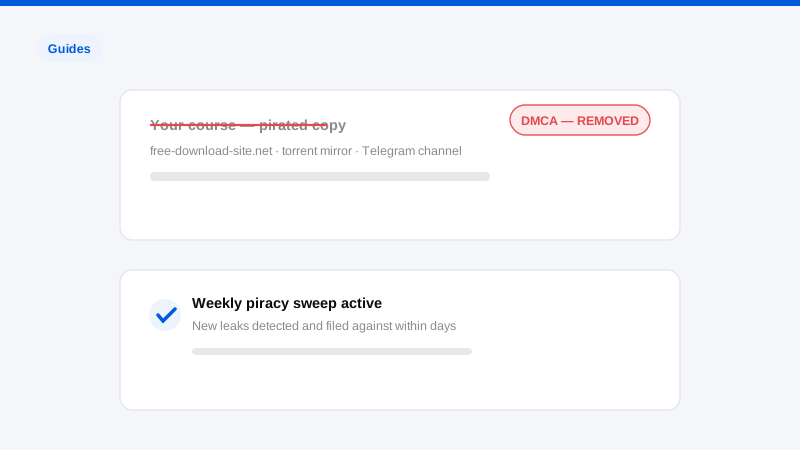
For founders selling digital products (courses, templates, software, paid communities) infringement isn’t an incident, it’s a flow. Your launch gets ripped to “free download” aggregators, Telegram channels, and torrent indexes within days, and every takedown is answered by a re-upload. The single-notice mindset loses this fight arithmetically. What works is treating enforcement as an ongoing operation:
- Monitor systematically. Scheduled searches for your product name plus “free,” “download,” and “torrent”; reverse-image searches on your covers and slides; monitoring of known aggregator sites. Speed matters, a leak taken down in its first week never accumulates the search rankings that make it self-sustaining.
- Batch and template the notices. Same work, same ownership evidence, dozens of URLs: takedowns at scale are a production process. Track every URL, every notice, every provider response.
- Prioritize by traffic, not by count. Ten obscure mirrors matter less than the one leak ranking for “[your course] free.” Enforce where buyers actually find the piracy.
- Hit the discovery layer. De-index leak pages from search and report pirated-course listings on the platforms where your buyers search. Most piracy consumption starts with a search, not a bookmark.
- Harden the product. Watermarking, licensed-user personalization, and gated delivery raise the cost of leaking and identify sources. Prevention doesn’t replace enforcement, but it slows the flow you have to enforce against.
The realistic goal is suppression, not eradication: keeping piracy off the first pages of search and off the platforms your customers use, permanently, at a sustainable cost. That’s a monitoring-plus-response operation, which is exactly what our protection plans are structured to run.
A practical step-by-step for your first serious takedown campaign
- Inventory the infringement. Reverse-image search your key visual assets; search distinctive sentences from your written content in quotes; search your product names with piracy modifiers. Log every infringing URL with screenshots and capture dates.
- Verify ownership for each asset. Confirm you hold the rights: created in-house, properly assigned by contract, or licensed with enforcement rights. Set aside anything uncertain.
- Map each URL to its tracks. For each infringement, identify the host, the platform (if any), and confirm search-engine indexing. This becomes your notice matrix.
- Draft complete, accurate notices. Every statutory element, exact URLs, precise identification of your original work. One notice per provider, covering all their URLs.
- File all tracks in parallel. Host, platform, and search on the same day. Calendar follow-ups at one and two weeks.
- Log responses and escalate the silent. Compliance gets verified and archived; silence gets moved to the infrastructure ladder with the notice history attached.
- Re-check in 30 days. Confirm removed content stayed removed, catch re-uploads, and decide, based on the observed re-infringement rate, whether this is a one-time cleanup or an ongoing operation.
Frequently asked questions
Do I need to register my copyright before sending takedown notices?
For sending notices, no, copyright protection exists from the moment of creation, and hosts and platforms process notices without registration. Registration primarily matters if a dispute escalates to litigation, where (for US works) it’s a prerequisite to filing suit and affects available remedies. Practically: send the takedowns now, and talk to an attorney about registering your commercially significant assets as a portfolio matter.
What if the infringer files a counter-notice?
Then the provider will typically restore the content after a statutory window unless you initiate legal action, and the dispute has moved beyond the notice system. Counter-notices are rare from commercial pirates, filing one requires disclosing identity and accepting jurisdiction, and more common from parties who genuinely believe they have a defense. Either way, a counter-notice is your cue to get an actual attorney’s advice before the clock runs; it is not something to handle by form-filing.
The infringing site is hosted overseas and ignores DMCA notices. Is it hopeless?
No: it just means the host track alone won’t win. The site still depends on layers that do respond: CDN providers, registrars, payment processors, ad networks, and the search engines that deliver its traffic. De-indexing its URLs and defunding its revenue are achievable regardless of where the server sits, and the infrastructure ladder above unmasks and pressures more “untouchable” sites than their operators would like you to believe. Slower, yes; hopeless, no.
Someone copied my whole website design and text. Is that copyright infringement removal territory?
The copied text and images: yes, typically, and those takedowns proceed like any other. The look-and-feel, layout, and branding raise trademark and other questions beyond the copyright mechanism, and wholesale clones (often built for phishing or lead theft) frequently justify escalation to the host on fraud grounds as well as infringement, which can take down the entire clone at once. Clone sites are a case where combining claims in one escalation package is markedly more effective than any single claim alone.
Enforcement is a system, not a form: ownership evidence, parallel notices, disciplined escalation, and monitoring calibrated to how fast your particular infringement regenerates. If you want a map of where your content is being used without permission and what it would take to shut that down, start with our free exposure scan: we’ll show you the infringement footprint and give you an honest read on the enforcement path.