Ecommerce brand protection for stores under attack
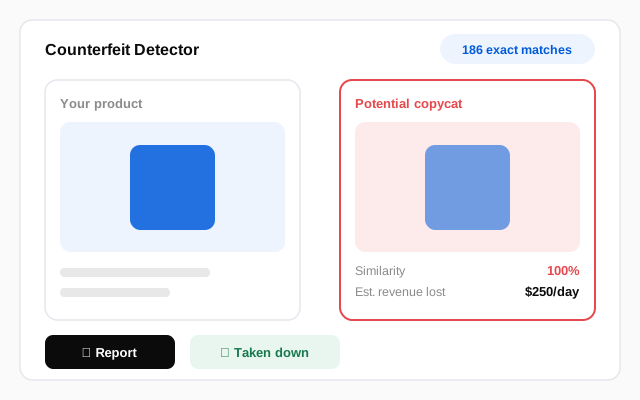
Copycat stores running your product photos. Hijackers undercutting your listings. Fake ads spending against your own creative. Ecommerce brand protection means finding all of it and taking it down before it takes your revenue.
What we remove
- Copycat stores cloning your site and products
- Marketplace hijackers on your listings
- Fake ads built from your stolen creative
- Scam stores taking payment and shipping nothing
- Review abuse and competitor sabotage
- Lookalike domains and checkout clones
How it works
What clients say

Kayla Itsines
Founder, Sweat.com · Brand Protection
"Frankie & his team at Content Removal relentlessly protected our brand in the 7 years leading up to our first exit."

Alex Hormozi
Acquisition.com · Brand Protection
"These fake accounts not only diluted my brand presence but also risked misleading my vast follower base with counterfeit information... Content Removal removed these accounts in days."

William Brown
BuildGrowAndExit.com · Brand Protection
"I spent a lot of money on some complex problems we were trying to solve, and nobody could fix them. We'd almost given up."
The four attacks every successful store faces
Copycat stores are the bluntest: an entire shop built from your product photography, descriptions and sometimes your brand name, selling counterfeits or simply taking payments and shipping nothing. Your customers can't tell the difference, but they'll blame you when the parcel never comes, and the chargebacks and one-star reviews land on your reputation.
Marketplace hijackers attach themselves to the listings you built, undercutting on price with counterfeit or diverted stock and bleeding your buy-box share. Fake ad campaigns take your best-performing creative and run it on Facebook, Instagram, TikTok and Google to funnel your customers toward the fakes. You effectively fund your competitor's media testing, and review abuse rounds it out: bought one-star campaigns, competitor sabotage, and fake reviews propping up the copycats. Each attack feeds the others, which is why fixing one in isolation doesn't hold.
The damage arrives through channels you can measure and channels you can't: chargebacks and payment-provider risk reviews when scam clones borrow your name, rising acquisition costs when fake advertisers bid against your own creative, softening conversion when shoppers hesitate because something in the search results felt off. Store owners usually notice the symptoms (ad costs creeping, buy-box share slipping, strange support tickets) well before they find the cause, because none of it shows up labeled as brand abuse in your analytics.
How we clear it: surface by surface
Detection sweeps run across the surfaces that matter to a store: marketplaces, ad libraries, social commerce, domain registrations and search results, keyed to your product imagery, titles and brand marks. Every hit is verified by a human analyst, distinguishing a genuine reseller from a hijacker matters, and getting it wrong hurts you.
Then specialists file where each target lives: copyright complaints on stolen photography and copy, trademark complaints against brand misuse, ad-policy reports that kill fraudulent campaigns and the ad accounts behind them, and platform filings against hijacked listings. Scam and copycat stores get the infrastructure treatment: hosting takedowns, registrar action on lookalike domains, and reports to the payment processors whose rails the scam runs on. A fake store that can't advertise, can't rank and can't take payment is finished, whatever its operator does next.
Review abuse is handled as an evidence exercise: documenting the patterns (timing clusters, non-customer reviewers, competitor fingerprints) that turn a platform's automated no into a manual yes.
Protection that runs while you sell
Attackers watch your launch calendar: new product drops, seasonal peaks and viral moments all draw fresh waves. Our Protection Plans keep the sweep-verify-file cycle running continuously with priority response during your peak periods, and monthly reporting that shows exactly what was found and removed. The free Exposure Scan is the place to start. We'll map the copycats, hijackers and fake ads targeting your store right now, with no obligation attached.
Two things make the ecommerce version of this work distinctive. The first is tempo: unlike a defamation case that unfolds over weeks, a fraudulent ad campaign does its damage in days, so the detection-to-filing cycle has to run on a matching clock. The second is customer contact: when a scam wave is actively taking your customers' money, we prepare customer-advisory copy and, where warranted, press statements so your team can warn buyers immediately, protecting the relationship while the takedowns land. Monthly reporting closes the loop: targets found, filings made, outcomes verified, and the trend line that tells you whether the pressure is working.
Frequently asked questions
A fake store is using our photos and brand name. How fast can it come down? +
Can you stop the fake ads using our creative? +
Do you work with stores not on Amazon? +
Start with a free, confidential Exposure Scan
We'll scan your digital footprint, show you exactly what's exposed, and recommend the fastest path to remove it, or tell you honestly if you don't need us.
Book Your Assessment