
Fake positive reviews are a form of market manipulation that can harm the business they appear to praise. Whether bought by a rogue agency or planted by a competitor to make a listing look manipulated, they can trigger platform penalties, regulatory scrutiny and customer backlash. Detection relies on network, timing and behavioral signals, and removal needs a platform-specific evidentiary submission.
Key facts
- Roughly 30% of online reviews are estimated to be fake, and 82% of consumers encounter them within a year.
- About 93% of AI-generated fake Amazon reviews reportedly carry Verified Purchase badges, so badges prove little.
- Liability can attach whether the company ordered the reviews or merely benefited and left them unaddressed.
- Ensemble detection methods combining behavioral and linguistic signals can exceed 75% precision.
Where ContentRemoval.com comes in. ContentRemoval.com runs the forensic side of a suspicious praise event: preserving the review record, mapping reviewer overlap and posting bursts, classifying whether the pattern is self-inflicted, affiliate-driven or planted by a competitor, and filing platform-specific removals with legal escalation where the operator can be identified. General counsel, a brand protection lead or the founder usually makes contact. A free 15-minute Exposure Scan maps what is removable and the report is yours to keep. Get a Free, Confidential Exposure Scan or read how our review removal work is done.
You notice it in the weekly report before anyone else says it out loud. A sudden wave of five-star praise appears across a product page, a local listing, or a founder profile. The language feels polished but strangely empty. The timing is off. The reviewers don’t look like your customers. Legal is worried about exposure. Sales is worried about trust. The board is asking whether this is helping you, hurting you, or setting you up for a platform penalty.
That concern is justified.
Fake positive reviews aren’t a harmless vanity tactic. They’re a form of market manipulation. They can inflate a business that doesn’t deserve the rating, distort buyer behavior, and create a record that regulators, journalists, opposing counsel, or platform investigators may later treat as evidence of deception. If the reviews were planted by a competitor or third party, the danger changes shape but not severity. Your reputation still absorbs the blast.
The Anatomy of a Fabricated Reputation
The scale of the problem is already too large to dismiss as fringe behavior. Roughly 30% of online reviews are estimated to be fake or inauthentic across major markets and platforms, and 82% of consumers encounter fake reviews at least once in a 12-month period. Exposure is even higher among younger buyers, with 92% of people aged 18 to 34 reporting they have seen fake reviews, compared with 59% of consumers aged 55 and older, according to Shapo’s fake review statistics roundup.
That matters because review systems aren’t side channels anymore. For many businesses, they are part of the sales funnel, the diligence file, and the public credibility record all at once. A fabricated reputation can alter conversion behavior, channel partner confidence, recruiting, investor perception, and media scrutiny.
Two distinct forms of risk
The first risk is obvious. A company, agency, reseller, or rogue employee buys praise to inflate ratings. That can produce short-term lift in appearance, but it creates long-term liability. If customers rely on those reviews and discover the underlying experience doesn’t match the praise, you inherit complaints, refund pressure, and scrutiny over whether the reviews were deceptive.
The second risk is less discussed and often more dangerous. A competitor or hostile actor can flood a listing with fake positive reviews to make your operation look manipulated. That can trigger platform enforcement, attract investigative attention, or create a paper trail suggesting your business participated in misconduct when it didn’t.
Practical rule: If a burst of praise looks operationally convenient, assume it could still be adversarial.
Why executives should treat this as governance, not marketing
Most leaders still frame fake positive reviews as a consumer trust issue. That’s too narrow. This is a governance problem. Reviews influence how the market prices your credibility. Once false praise spreads across Google, Amazon, Yelp, niche directories, app marketplaces, and reseller ecosystems, the correction process becomes slower and messier than the original attack.
A short distinction helps:
| Scenario | Immediate effect | Real risk |
|---|---|---|
| Bought praise for your own business | Higher rating signal | Deceptive marketing exposure and customer backlash |
| Fake praise planted by a third party | Artificially inflated profile | Platform penalties and reputational contamination |
| Fake praise boosting a competitor | Distorted market comparison | Revenue diversion and unfair competitive pressure |
When clients call us about fake positive reviews, they usually start with a narrow question. Can this be removed. The better question is broader. Who benefits, who created the pattern, and what legal and platform risk now attaches to your name?
Weaponized Praise and AI-Generated Deception
The old assumption was simple. Fake reviews were crude, easy to spot, and usually self-inflicted by desperate merchants. That assumption is obsolete.
Modern fake positive reviews are often weaponized praise. A hostile actor doesn’t need to post a fake negative review about you. They can post suspiciously glowing reviews to your listing instead. If the pattern looks purchased, the platform may suppress, investigate, or flag the account. The false praise becomes the attack.

Verified badges no longer settle the question
The most dangerous misunderstanding in this area is the belief that a verified badge resolves authenticity. It doesn’t. According to reporting on AI-generated fake Amazon reviews, approximately 93% of AI-generated fake Amazon reviews carry “Verified Purchase” badges. That changes the risk analysis completely.
Executives who still rely on visible legitimacy markers are making the same mistake companies made when they treated verified social accounts as proof of trustworthy speech. The badge may confirm a transaction occurred. It does not prove the review reflects an authentic, unincentivized customer opinion.
AI has changed the shape of fraud
AI has made fake positive reviews easier to produce, easier to vary, and harder to dispute at a glance. Operators now generate large volumes of text that avoid the obvious duplication problems that older spam campaigns created. They paraphrase, localize phrasing, vary sentiment intensity, and simulate customer storytelling.
If you want a benign example of how easily AI can mimic human style, Flaex.ai’s guide to ghost writing AI is useful because it shows how machine-written content can be shaped to sound personal, coherent, and plausible. That same capability, applied maliciously, creates review text that looks less robotic than many real customer comments.
Liability doesn’t depend on who ordered the fraud
Senior leadership often gets caught flat-footed by this dynamic. They assume legal exposure turns only on whether the company directly bought the reviews. That’s too comfortable. If fake positive reviews appear on your properties and remain unaddressed, several problems can follow:
- Regulatory exposure if the pattern suggests deceptive endorsement practices.
- Platform sanctions if a marketplace concludes your listing benefits from manipulated trust signals.
- Civil disputes if customers, partners, or competitors argue the inflated reputation caused measurable harm.
- Internal governance failures if an agency, distributor, affiliate, or growth consultant acted without authorization.
A review can be fake, favorable, and still highly damaging to the subject it appears to praise.
High-profile clients face another layer of risk. Journalists and litigators don’t usually distinguish cleanly between “the company orchestrated this” and “the company benefited from this.” If the public record shows fabricated acclaim around a founder, clinic, fund, restaurant group, law practice, or luxury brand, the nuance often disappears before the cleanup begins.
Advanced Signals for Forensic Review Analysis
You cannot solve a complex review attack with intuition alone. Generic advice about “watch for repetitive wording” is too shallow for modern campaigns. Proper forensic review analysis uses structural, behavioral, linguistic, and metadata signals together.
Network patterns expose review rings
That matters because language is easy to manipulate. Structure is harder to fake.
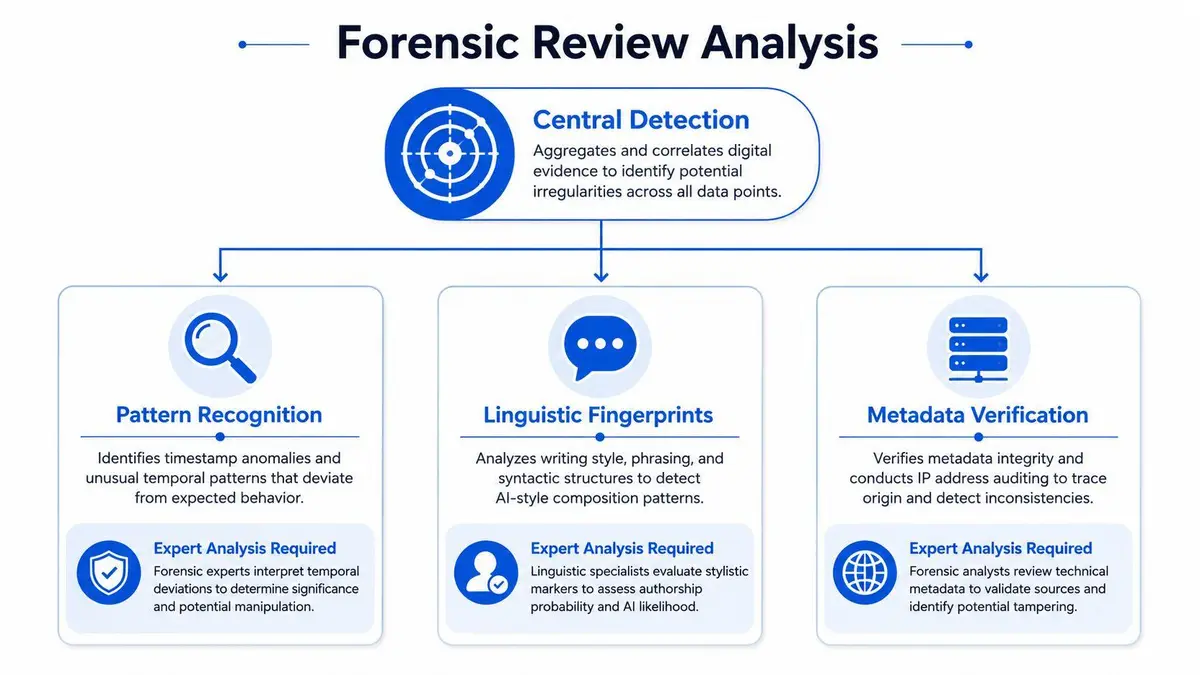
A professional review audit usually asks questions such as:
- Who overlaps with whom: Are the same reviewer accounts appearing across unrelated products, listings, or geographies?
- How tightly do they cluster: Organic customer activity tends to disperse. Purchased activity often bunches.
- What marketplace logic is missing: Do the reviewer relationships make commercial sense, or do they look manufactured?
This is the same reason investigators in other domains study patterns, not just statements. A behavioral guide like CheatScanX’s signs of cheating guide for partners is useful as an analogy. Complex deception usually reveals itself in recurring patterns across actions, timing, and associations, not in one obvious confession.
Behavioral and linguistic fingerprints matter
The strongest investigations combine network analysis with a second layer of review-level forensics. The Cambridge review of fake review detection methods reports that ensemble methods can exceed 75% precision, and it describes a pattern set that serious counsel should understand.
Key markers include the following:
- Batch timing: Fake positive reviews often appear in clustered posting windows rather than natural customer rhythms.
- Purchase signal weakness: The same review populations often lack the normal profile depth and purchase history of genuine customers.
- Narrative inflation: Instead of discussing product specifics, the text leans on scenes, gifting stories, or generalized excitement.
- Odd language choices: Some campaigns overuse first-person phrasing and action-heavy descriptions while avoiding concrete nouns and product detail.
Why internal teams miss this
Most internal marketing teams don’t have the tooling or time to do this properly. They look at screenshots and samples. They need a reproducible evidentiary record. That means preserving review text, timestamps, account characteristics, overlap patterns, and platform behavior before the operator edits, deletes, or reposts.
For organizations that need early warning rather than one-off cleanup, a dedicated reputation monitoring program is the sensible baseline. Not because software solves the case by itself, but because delayed detection usually means weaker evidence and a longer removal fight.
Navigating Platform Policies and Legal Recourse
Clients often assume the removal path is straightforward. Flag the review, explain it’s fake, wait for the platform to act. That model fails in coordinated attacks because platform reporting tools were designed for volume moderation, not adversarial evidence disputes.
Platform systems are inconsistent by design
The public-facing rules usually prohibit deceptive or incentivized reviews. The operational problem is enforcement. Reporting channels are thin, appeals are uneven, and decisions often arrive without meaningful explanation. That’s one reason this area remains so frustrating for legitimate businesses under attack.
The commercial impact is not trivial. Reporting summarized by ClickOrlando on fake reviews and platform enforcement gaps notes that fake reviews influenced approximately $152 billion in global spending in 2022, while practical guidance for victims remains thin and platform enforcement is often opaque.
Self-help usually stalls at the wrong moment
A standard complaint form can remove an obvious fake. It rarely dismantles a coordinated ring. Once you’re dealing with repeat uploads, related accounts, reseller listings, mirrored profiles, or review bursts across multiple platforms, the issue stops being a moderation dispute and becomes a remediation campaign.
That’s where platform policy and legal strategy have to work together. A strong escalation package typically combines:
- Technical evidence showing pattern-based fraud rather than isolated suspicion.
- Narrative framing that explains how the activity violates platform rules in the platform’s own language.
- Legal positioning that preserves claims against the operator, broker, affiliate, or competitor behind the activity.
- Executive documentation for boards, counsel, or investors if the issue creates disclosure or diligence concerns.
If a platform lacks transparent enforcement, your evidence package has to do the heavy lifting.
Legal recourse is often the real pressure point
Where the operator can be identified, counsel may consider cease and desist demands, unfair competition claims, defamation theories in the right fact pattern, or complaints under consumer protection frameworks. The exact route depends on jurisdiction, platform, and whether the reviews are merely false, commercially deceptive, or tied to a broader interference campaign.
For Google-specific incidents, a strategic removal process matters more than repeated generic reporting. This is why executives dealing with business listing abuse often review a focused framework such as this guide on how to remove bad reviews from Google strategically. The same principle applies to fake positive reviews. Precision beats volume.
Executing a Takedown and Fortification Strategy
A serious response has two jobs. Remove the false praise that already exists, and make it harder for the same actors to reappear under new accounts or adjacent platforms.

The first phase is evidence, not outrage
Most companies waste time in the first week. They argue internally about whether the reviews feel fake. That’s not useful. The opening move should be disciplined evidence assembly.
A defensible file usually includes archived screenshots, review text preservation, posting chronology, account overlap analysis, and a written explanation of why the pattern is inauthentic. If the attack spans more than one platform, the evidence should be normalized so each platform receives a specific submission supported by the same factual core.
A workable sequence looks like this:
- Preserve the record early. Reviews disappear, mutate, and get reposted. Capture first, argue second.
- Classify the attack type. Self-promotional fraud, hostile planting, affiliate misconduct, and competitor manipulation require different escalation paths.
- Map the spread. The visible listing is rarely the whole problem. Check search results, reseller pages, local listings, and industry directories.
Multi-platform takedowns require coordination
Submitting the same complaint everywhere is a rookie move. Each platform uses different policy language, different evidentiary thresholds, and different review structures. The report has to match the venue.
Some matters can be handled by in-house counsel and brand protection teams. Others justify outside specialists. Firms that work in this niche, including ContentRemoval.com’s strategic review removal approach, typically combine platform reporting, documentation, escalation workflow, and follow-on monitoring. That’s not PR. It’s operational remediation.
Here’s the practical point. If you send weak complaints, you train the platform to ignore you. If you send a tightly argued evidentiary submission, you improve the odds of action and preserve your advantage for the next step.
A short explainer can help frame how these campaigns are addressed in practice:
Fortification is what prevents repeat damage
Removal alone is not enough. Once a business becomes a target, attackers often test the perimeter again.
A sound fortification plan usually includes:
- Authentic review governance: Tight internal rules for agencies, affiliates, franchisees, and customer success teams so no one “helps” by creating a new liability.
- Ongoing monitoring: Alerting for unusual review bursts, rating swings, reviewer overlap, and profile impersonation.
- Response playbooks: Pre-approved steps for legal, communications, and operations when new suspicious praise appears.
- Reputational ballast: A lawful system for earning real feedback from verified customers so isolated attacks carry less weight.
This is the difference between cleanup and control. High-profile clients need control.
Your Next Steps for Reputation Integrity
If fake positive reviews have appeared around your business, product, executive profile, practice, or portfolio company, don’t treat it as a cosmetic issue. Treat it as a credibility event. The central question isn’t whether a few flattering comments are technically inaccurate. The question is whether someone has started manipulating the trust architecture around your name.
That architecture affects buyers, journalists, counterparties, regulators, and litigation opponents. Once false praise contaminates it, every later dispute becomes harder. Honest customer reviews are forced to compete with synthetic signals. Internal teams start making defensive decisions from incomplete information. Leadership wastes time debating optics instead of asserting control.
What a responsible executive should do now
Start with a confidential audit. You need to know whether the suspicious reviews are isolated, coordinated, synthetic, cross-platform, or connected to a competitor, affiliate, or prior agency. If you skip that analysis and jump straight to complaint filing, you risk deleting symptoms while leaving the attack infrastructure in place.
Then tighten governance. Marketing, franchise, affiliate, and customer service teams need bright-line instructions about endorsements, incentives, and review handling. Many reputation problems start with a consultant or channel partner who thought they were “supporting the brand.”
For search visibility concerns beyond review platforms, a practical resource like Netco Design LLC’s guide to fixing negative search engine brand results can help frame how reputation issues spread from a single review problem into a broader search problem. That’s useful context, but it’s not a substitute for forensic review analysis or a takedown plan.
The right question isn’t “Can we live with these reviews?” It’s “What do these reviews allow others to say about us if we leave them in place?”
For executives, founders, family offices, and public figures, reputation integrity now belongs under the same discipline as legal risk and cyber risk. It needs ownership. It needs monitoring. It needs escalation paths, and when the pattern points to coordinated manipulation, it needs specialist intervention.
If you’re facing suspicious praise, review spikes, or a listing that suddenly looks too polished to be real, seek a confidential assessment from ContentRemoval.com. A proper review attack response starts with evidence, not guesswork, and it should produce a clear plan for takedown, escalation, and long-term protection.
Frequently asked questions
Can fake five-star reviews hurt my business?
Yes. A burst of purchased-looking praise can lead a platform to suppress or investigate the listing, attract journalists or opposing counsel who will not distinguish between orchestrating and benefiting, and create refund pressure when the real experience does not match. Competitors sometimes plant glowing reviews for exactly that reason.
How can you tell if positive reviews are fake?
Look at structure rather than wording. Fake campaigns cluster in tight posting windows, come from accounts with thin histories that overlap across unrelated listings, and lean on generalized excitement or gifting stories instead of product detail. Verified badges do not settle the question.
What should a company do if it finds fake positive reviews on its own listing?
Preserve the record first, then classify the attack as self-promotional fraud, affiliate misconduct or hostile planting, and map how far it has spread across search, resellers and directories. Submit platform-specific reports built on the same factual core, tighten governance for agencies and affiliates, and consider legal action where the operator can be identified.