
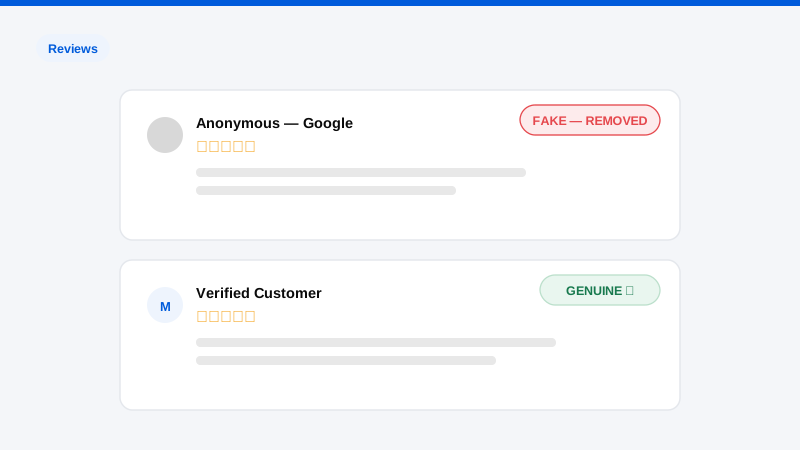
Layoffs generate two shockwaves. The first hits the people who lose their jobs. The second hits your employer profiles, a wave of one-star reviews on Glassdoor and Indeed, angry Google reviews from people who were never customers, and sometimes coordinated review-bombing organized in laid-off employees’ group chats. Executives searching for how to remove negative employee reviews after a layoff are usually staring at a rating that dropped a full star in three weeks, right as the company most needs to convince remaining employees to stay and future candidates that the ship is steady.
Here’s the honest framing we give every post-layoff client, because it determines the entire strategy: a layoff wave is a mixed wave. Some of it is genuine grievance from real former employees, protected content that no platform will remove and no credible firm should promise to remove. Some of it violates platform guidelines, reviews from people who never worked for you, duplicate reviews from the same authors, confidentiality breaches, attacks naming individual non-executive employees, and rating-bombing from sympathizers who read about your layoff on LinkedIn. The violating portion can be removed, often in meaningful volume. The genuine portion cannot, and pretending otherwise wastes the narrow window when removal work is most effective.
This guide covers both halves of the job: identifying and removing the guideline-violating share of a layoff wave, and running the employer-brand repair that has to happen alongside removal, because even a perfectly executed takedown campaign leaves you with the reviews that deserve to stay, and those are answered with response and rebuilding, not flags.
Anatomy of a layoff review wave
Post-layoff waves have a recognizable composition. Sorting yours into these categories is the first working session of any removal effort, because each category has a different disposition.
Genuine reviews from laid-off employees. Real people, real employment, real anger. “Leadership botched this,” “no warning, insulting severance,” “avoid this place.” However painful, these are exactly what employer-review platforms exist to host. Disposition: respond, don’t flag.
Sympathy bombing from non-employees. People with no employment history at your company (friends and family of the laid-off, industry onlookers, strangers reacting to a news story) posting one-star reviews in solidarity. Every employer-review platform requires actual employment; Google requires actual customer experience. Disposition: flag. This category is often the largest removable share of a wave, and platforms have practice with it, review-bombing tied to news events is a known moderation pattern, and platforms have been willing to sweep clearly event-driven brigading rather than adjudicate it review by review.
Duplicates and multi-platform multiples. One angry ex-employee posting three reviews on the same platform from variations of their account, or recycling identical text everywhere. Most platforms allow one review per employer per person (with updates replacing, not stacking). Disposition: flag the duplicates; the pattern itself is the evidence.
Guideline-violating content from genuine employees. Real former employees whose reviews cross written lines: naming and attacking non-executive employees (“ask HR manager [name] why she smiled while reading the list”), disclosing confidential information (severance terms under NDA, non-public financials, unannounced plans) threats, harassment, or specific unverifiable criminal accusations against identifiable people. Disposition: flag the violation. The review’s negativity is protected; the violating elements are not, and platforms remove reviews containing them.
Fabricated “employee” reviews riding the wave. Layoff chaos is cover for opportunists: competitors and bad actors know a bombing window when they see one, and a fake review posted during a wave looks plausible. Disposition: flag with employment-record evidence, same as any fake-reviewer case.
What platforms will and won’t remove: the honest line
Before flagging anything, internalize the line, because post-layoff executives are emotionally primed to overestimate what’s removable.
Not removable: truthful anger from real employees. Harsh characterizations of leadership decisions. Accurate descriptions of how the layoff was communicated, even if embarrassing. Opinions about severance fairness. One-star ratings from genuinely affected employees. Reviews you’re certain are “unfair” but that break no written rule. Flagging this content fails, and mass-flagging it can degrade your credibility with moderators for the flags that matter.
Removable with evidence: reviews from people who never worked for you; duplicate reviews; reviews identifying non-executive employees; confidentiality and NDA-relevant disclosures; threats, harassment, discriminatory content; specific criminal accusations against named individuals; demonstrably fabricated content; and, on customer-review platforms like Google, “reviews” of your business from people who were never customers, which describes nearly all layoff-sympathy reviews on a Business Profile, since employment grievances are also off-topic there.
That second list is usually substantial. In heavy waves, a disciplined flagging effort can materially move a rating, not by suppressing criticism, but because bombing waves genuinely are stuffed with ineligible content. The work is separating it, review by review, with evidence. That evidence-driven separation is the heart of our review removal practice, and it’s the difference between a cleanup and a doomed suppression attempt.
Step-by-step: how to remove negative employee reviews after a layoff
Timing matters: fresh violations are the easiest to remove, platforms respond better to bombing reports while the spike is visible in the data, and every week of delay is another cohort of candidates reading the wave. Run this sequence starting now, ideally within days of the wave breaking:
Step 1: Snapshot everything before you touch anything
Capture the full review landscape with dated screenshots: every new review across Glassdoor, Indeed, Google, and anywhere else hit, plus your pre-wave rating baselines. The snapshot preserves evidence (reviews get edited), establishes the bombing timeline, and gives you the before/after record that boards and general counsel will ask for.
Step 2: Build the wave spreadsheet
Log every review: platform, date, rating, reviewer handle, claimed role and tenure, and full text. Then classify each into the five categories above. Involve HR for the next step’s cross-checks and involve counsel early if reviews touch NDA’d severance terms or make legal accusations. We’re not a law firm, and layoff-adjacent review issues (separation agreements, protected concerted activity, NLRA considerations around employee speech) genuinely need one.
Step 3: Run employment verification on every suspicious review
For each review in the sympathy-bombing and fabrication categories, have HR document the records search: no matching employee for the claimed role, dates, and department. For duplicates, document the matching language and timing. This file is what converts “we’re being review-bombed” from a complaint into a case.
Step 4: Flag the ineligible reviews first, as a documented wave
Lead with the strongest, largest category, non-employee reviews, and report the bombing as an event where escalation paths allow it: the timeline, the trigger (your layoff announcement date), the spike pattern, and the per-review eligibility evidence. On Google, report layoff-driven reviews as lacking customer experience and off-topic; Business Profile brigading tied to news events is a recognized pattern with established removal outcomes. File individual guideline flags (naming violations, confidentiality, duplicates) in parallel, each citing its single strongest violation with quoted language.
Step 5: Escalate rejections with new substance only
First-pass moderation misses things, especially mid-wave. Rejected flags with genuinely strong evidence go to escalation channels with the fuller file. Identical resubmissions go nowhere. Track every flag, decision, and date. The campaign lives and dies on this bookkeeping.
Step 6: Respond publicly to the genuine reviews, once, well
While flags process, draft the employer response for the legitimate grievance reviews. After a layoff, one steady, honest response template (adapted per review, never pasted verbatim) outperforms both silence and defensiveness. The elements: acknowledge the layoff plainly, don’t litigate the reviewer’s experience, state concretely what the company did (severance, extended benefits, placement support, whatever is true), and offer a direct channel. Candidates reading a layoff wave expect anger in the reviews; what they’re actually evaluating is the company’s voice underneath it. Never hint at any reviewer’s identity, and have counsel sanity-check the template, public statements about a layoff carry their own exposure.
Step 7: Stabilize the rating with authentic current-employee voice
The fastest legitimate counterweight to a wave is the honest experience of people still there. Invite (never require, script, or incentivize, all of which violate guidelines and collapse credibility if exposed) current employees to share genuine reviews. Expect and accept mixed ratings; a post-layoff profile with realistic 3-and-4-star current-employee reviews reads as credible in a way a sudden flood of five-star praise never does, and platforms treat suspicious positive surges as manipulation.
Employer brand repair: the work removal can’t do
Even a successful campaign leaves the genuine reviews standing, and the layoff story doesn’t live only on review platforms. It lives in search results, news coverage, and LinkedIn commentary. Removal is one lane of a wider recovery:
Search layer. Check what actually ranks for “[company] layoffs” and “[company] reviews.” Sometimes the durable damage is a news article or forum thread outranking everything you control, a problem for search result strategy, not review flags.
Narrative layer. The companies that recover fastest give the story a second chapter: public follow-through on severance commitments, visible support for laid-off alumni, and later, concrete news of stabilization. Employer-brand recovery is a subset of reputation management. You can’t delete the layoff, but you can determine whether it reads as the end of the story or the middle.
Internal layer. Remaining employees read the reviews too, and they’re the authors of the next wave or the next recovery. Post-layoff transparency with survivors is review-page strategy, whether or not anyone frames it that way.
Monitoring layer. Waves have aftershocks: anniversary posts, reposts of removed reviews (themselves flaggable as duplicates), and second rounds if further cuts come. Standing reputation monitoring turns each aftershock into a same-week response instead of a next-quarter discovery, and if layoffs recur, the playbook and evidence infrastructure are already built.
Frequently asked questions
Can we remove negative employee reviews just because they came in a coordinated wave?
Coordination alone, no, real former employees deciding together to post honest reviews is still eligible content, review by review. What the wave pattern does do is justify platform-level bombing review and strengthen every individual eligibility challenge: waves reliably carry a high proportion of non-employee sympathy reviews, duplicates, and fabrications, and the documented spike is what gets platforms to look at the event rather than fifty isolated flags. Practically: the wave is your evidence frame; each removal still stands on a specific violation.
Laid-off employees signed severance agreements with non-disparagement clauses. Doesn’t that mean the reviews come down?
Not automatically, and tread carefully. This is squarely attorney territory. A non-disparagement clause is a contract between you and the employee; platforms aren’t parties to it and generally won’t remove reviews just because a contract exists. Separately, the enforceability of non-disparagement provisions in layoff severance has real legal limits, regulators and the NLRB have constrained how far such clauses can restrict employee speech. Where a review discloses genuinely confidential information, the platform’s own confidentiality rules are often the stronger removal hook. Before invoking any agreement against a reviewer, get employment counsel’s read; a misfired enforcement threat can create legal and PR problems worse than the review.
Should we respond to layoff reviews or wait for removal decisions first?
Split by category. For reviews you’re flagging as ineligible or violating, hold responses, replying legitimizes content you’re arguing shouldn’t exist, and your response vanishes if removal succeeds. For clearly genuine grievance reviews, don’t wait long: a wave of unanswered anger is its own message to candidates. In practice that means responses to the real reviews begin within a couple of weeks while the flagging campaign runs in parallel, sequenced per review, not one blanket decision.
How long does post-layoff review recovery actually take?
Removal outcomes on the ineligible share typically land over weeks, days for clean flags, longer for escalations. The rating math recovers as removals process and authentic current-employee reviews accumulate, usually over a few months. The search footprint (news coverage, the wave’s residue in brand queries) moves on a slower clock, quarters rather than weeks. Set expectations internally on all three clocks at once, because boards tend to watch the star rating while candidates are actually reading the search results.
If a layoff has put your employer profiles underwater, start with an accurate damage map. Our free exposure scan breaks down your review wave across platforms (what’s genuinely removable, what needs a response, and what the search results are telling candidates right now) before you commit to a strategy.