
Reputation management for ecommerce brands is the discipline of controlling what shoppers find in the thirty seconds between wanting your product and paying for it: the reviews, the “is [brand] legit” results, the lookalike stores, and the marketplace listings that decide whether the sale happens. An ecommerce brand has no showroom, no salesperson, and no second chance: its reputation is the storefront. Every element of trust a physical retailer builds with a lease and a handshake, an online brand has to build with search results and review scores, and every one of those surfaces can be attacked.
The attacks are not hypothetical for anyone operating at scale. Review platforms can be flooded by competitors, disgruntled parties, or extortionists. Copycat stores clone product pages and run ads against your own audience. Marketplace hijackers attach counterfeit inventory to your listings and harvest your reviews’ credibility, and the modern shopper’s reflex, typing “is [your brand] legit” before entering a card number, means a handful of hostile results can quietly tax every transaction you attempt.
This guide defines the ecommerce threat landscape as practitioners actually see it, explains the mechanisms by which it destroys revenue, and lays out what professional, removal-first protection looks like, and why serious ecommerce operators retain a specialist firm rather than treating trust erosion as a customer-service problem.
Why ecommerce brands are targeted
Ecommerce brands are targeted because their entire trust infrastructure is public, third-party, and manipulable. A shopper’s confidence in an online brand rests on surfaces the brand does not control (review platforms, search results, marketplace listings, social ads) and every one of those surfaces can be exploited by someone with an incentive to divert, extort, or damage.
Review attacks are the most common weapon because they are cheap and deniable. Competitors seed one-star reviews before your peak season. Extortionists post fabricated complaints and offer to remove them for payment. Aggrieved individuals (an ex-employee, a banned affiliate, a customer dispute gone feral) flood every platform that will take a submission. Review scores are the single most-consulted trust signal in ecommerce, which is precisely why they are the single most-attacked.
Copycat stores convert your marketing spend into their revenue. Operators clone your product pages, lift your photography and copy, register a near-miss domain, and run paid social ads to the audience your brand built. Buyers receive counterfeits or nothing. The chargebacks, complaints, and “this company is a scam” posts land on your name, because the victims believe they bought from you.
Marketplace hijackers attack from inside the platforms. On major marketplaces, hijackers attach themselves to your listings with counterfeit or diverted inventory, win the sale at a lower price, and ship inferior product, generating authentic negative reviews on your listing for units you never sold. Others copy your listings wholesale, or file bad-faith complaints against you to knock your products offline during peak periods.
“Is X legit” doubt is the ambient threat that all the others feed. Modern shoppers verify before they buy, and search engines dutifully surface whatever exists: scam-report threads seeded by fake-store victims, complaint-site pages, review-attack residue, forum speculation. Increasingly, AI shopping assistants synthesize these sources into a one-paragraph verdict on your trustworthiness, which makes what AI systems say about your brand a direct conversion factor.
Key takeaway: An ecommerce brand’s trust signals are public and third-party by design, which means they are attackable by design. Anyone with a motive can write on the surfaces your revenue depends on.
What’s at stake
What’s at stake for an ecommerce brand under reputational attack is conversion itself, the arithmetic that determines whether the business model works. Ecommerce economics are a chain of rates: click-through, conversion, repeat purchase, chargeback. Reputational contamination degrades every link simultaneously, and the damage hides inside metrics that look like marketing problems.
The conversion tax is invisible and continuous. When a shopper’s pre-purchase search surfaces scam allegations or a damaged review score, the sale doesn’t end with a complaint. It ends with a closed tab. The brand sees softening conversion and rising acquisition costs, and typically responds by spending more on the top of the funnel, which pours more traffic across the same contaminated trust surfaces. Paid acquisition against a damaged reputation is buying water for a leaking bucket.
Review damage compounds through platform mechanics. Ratings feed algorithms: marketplace rankings, ad quality scores, buy-box eligibility. A review attack that drops your score doesn’t just deter the shoppers who read the reviews. It suppresses your visibility to shoppers who never would have read them.
Copycat victims become your accusers. Every customer scammed by a lookalike store becomes a genuine, motivated complainant against your brand: posting warnings, filing chargebacks, and seeding the “is it legit” results with sincere testimony about a fraud you didn’t commit. Left running, a copycat operation manufactures an authentic-looking scam record for your brand, complete with real victims. This is how defamatory and misleading content accumulates around fundamentally honest businesses.
Marketplace standing is existential for many operators. Complaint rates and policy flags, including those manufactured by hijackers and bad-faith competitors, can suspend listings or entire accounts during the weeks that decide the year. For brands doing meaningful marketplace volume, reputation is not adjacent to operations; it is operations.
See what buyers find when they search your brand.Free confidential Exposure Scan: live results on a 15-minute call, yours to keep either way.
Book Your Free ScanWhat professional reputation management for ecommerce brands looks like
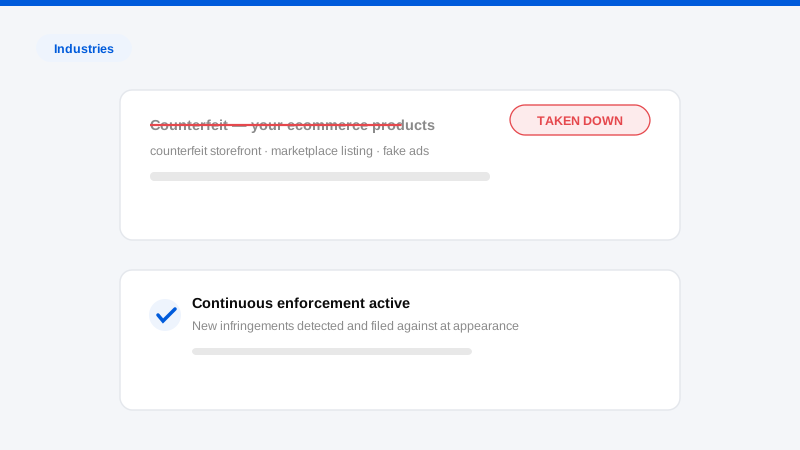
Professional reputation management for ecommerce brands is removal-first: the objective is to make hostile content (fake reviews, copycat stores, hijacked listings, defamatory scam allegations) cease to exist at the source, rather than to bury it under new content or argue with it in public. Response and suppression leave the threat standing; removal ends it. The professional sequence has four layers.
Remove at the source. Policy-violating reviews are challenged through each platform’s integrity process with the specific evidence that platform requires, the core craft of professional review removal. Copycat stores are dismantled at the infrastructure level: host, registrar, ad network, payment processor, a clone that cannot advertise or take payment is dead regardless of whether its domain still resolves. Hijacked and counterfeit marketplace listings are removed through intellectual property enforcement, and stolen product imagery and copy, the raw material of every clone, through copyright infringement removal. False and defamatory scam allegations are pursued through platform policy and defamation pathways.
De-index what resists removal. Some hostile content sits on complaint sites and forums that are slow or structurally resistant to removal. While source removal is pursued, de-indexing from search engines severs that content from the “is it legit” queries where it does its damage. A scam thread nobody finds converts no doubt.
Build authoritative press assets. Removal clears the negative; authority must occupy the space, or the next attack refills it. Earned press placements in credible publications give the brand ranked, third-party-validated assets across its search landscape, so the verification journey ends in vetted coverage, not a vacuum.
Monitor continuously. Review attacks recur, clones relaunch, hijackers return for every peak season. Mature ecommerce brands run continuous monitoring across review platforms, search results, ad libraries, domain registrations, and marketplace listings, with removal capacity standing by. This is the rationale for an ongoing Protection Plan: in a business where trust is re-verified on every transaction, protection has to be infrastructure, not an annual project.
Key takeaway: Removal-first is a sequence, not a slogan: remove at the source, de-index what resists, hold the ground with authoritative press, and monitor so the next attack dies in days instead of compounding for months.
Why DIY reputation management for ecommerce brands falls short
Most ecommerce teams fight reputational attacks with whatever function is nearest: customer service answers the reviews, the marketing agency “pushes positive content,” someone files a report form and hopes. These responses fail for structural reasons worth understanding before choosing a partner.
Responding to fake reviews validates them. A polished public reply to a fabricated review leaves the review standing, ranked, and now engaged-with. The platform’s removal process, not the reply box, is the correct venue, and it is an evidentiary process: each platform has narrow criteria and specific documentation standards, and generic complaints bounce. Specialists win these disputes because they know, from volume, what each platform’s integrity team actually actions.
SEO suppression treats the symptom. Generic reputation agencies sell content that “pushes down” negatives. Suppression is fragile: rankings shift, attacks refresh, and the hostile content still exists for anyone who scrolls, for complaint-site aggregators, and for AI systems that read the whole web rather than the first page. Removal-first work eliminates the source; suppression only decorates around it.
One-at-a-time takedowns lose to networks. Copycat operators and hijackers run portfolios, not single sites. Whacking one clone while its operator holds forty domains is not a strategy. Effective enforcement maps the network (shared infrastructure, payment rails, ad accounts) and dismantles it at the choke points, which requires investigative capability and platform relationships no in-house generalist accumulates.
Every "is your brand legit" search is a sale in the balance.Book a free confidential Exposure Scan: a specialist reviews the live findings with you on a 15-minute call, and they're yours to keep either way.
Book Your Free ScanWhy ecommerce brands choose Content Removal
Ecommerce brands choose Content Removal because the firm’s core discipline is exactly the work this landscape demands: removing hostile content at the source, at volume, across every platform that matters, and its track record includes the specific fraud mechanics ecommerce brands face.
For Sweat, the fitness platform, Content Removal stopped a fraud operation on track to divert an estimated $10 million from the brand’s customers: the copycat-and-impersonation playbook, run at scale, dismantled (see the Sweat case study). For Saski Collection, the firm dismantled the counterfeit operations trading on the brand: replica listings, cloned storefronts, stolen imagery. Client work spans consumer and enterprise brands including Danone; the record is documented in our case studies.
Three characteristics define the engagement for ecommerce operators. Outcomes are counted, not narrated: reviews removed, clones dead, listings restored, search results clean, reported transparently, including what is still pending. Speed is treated as the core variable: in ecommerce, hostile content compounds daily through platform algorithms, so response time is designed into the engagement rather than promised in the pitch. Scope is honest: Content Removal is not a law firm, does not provide legal advice, and does not guarantee outcomes on any specific item, platforms decide their own cases. What it commits to is a rigorous, evidence-driven process, executed by practitioners who do this every day, with a standing monitoring perimeter so the next attack is caught at hour one.
Frequently asked questions
Can fake reviews really be removed, or do we just have to outweigh them?
Reviews that violate platform policy (fabricated experiences, competitor and extortion campaigns, reviews from people who never transacted, content breaching the platform’s own guidelines) can be challenged and are frequently removed when the violation is documented to that platform’s standard. Genuine reviews from real customers generally cannot be removed, and any firm promising otherwise should be avoided. The professional craft is the separation: identifying which reviews are actionable, assembling the evidence each platform requires, and pursuing removal systematically rather than hoping volume of new reviews dilutes the attack.
A lookalike store is running ads with our product photos. What actually kills it?
Choke points, in parallel: the ad accounts (through ad-network IP and impersonation reports), the payment processing (fraud and infringement reports to the processor), the hosting and domain (abuse complaints to host and registrar), and the stolen creative itself (copyright enforcement). A clone that cannot advertise or take payment is commercially dead even while its domain resolves. Equally important is mapping the operator’s wider network first. Most clones belong to portfolios, and dismantling the portfolio prevents the immediate relaunch that defeats one-off takedowns.
Our brand name plus “scam” is in autocomplete and AI answers. Is that fixable?
It is addressable, without guarantees on timing or specific outcomes. The underlying inputs are usually identifiable: complaint threads, review-attack residue, copycat-victim posts. The removal-first approach takes down what violates policy or law, de-indexes what resists, and builds authoritative press assets that give search engines and AI systems better material to synthesize. As the source content disappears, the surfaces built on it (autocomplete, AI summaries, “is it legit” results) tend to follow, because they are reflections of the underlying web, not independent records.
When is the right time to engage, during an attack, or before one?
The economics favor before. Hostile content compounds through platform mechanics: reviews feed rankings, scam threads feed AI answers, clones accumulate victims. An attack caught at hour one through continuous monitoring costs a fraction, in revenue and in cleanup, of one discovered at month three through falling conversion. That is why operators at scale treat a Protection Plan as standing infrastructure, like fraud screening or uptime monitoring. If you are already under attack, the same logic compresses: every day of delay is compounding damage.
Right now, shoppers are searching your brand name with the word “legit” attached, and buying or bouncing based on what they find. See it before they do. Book a free, confidential Exposure Scan: a specialist walks you through live results (review integrity, copycat activity, marketplace hijacking, search and AI answers) on a 15-minute call, and the findings are yours to keep either way.