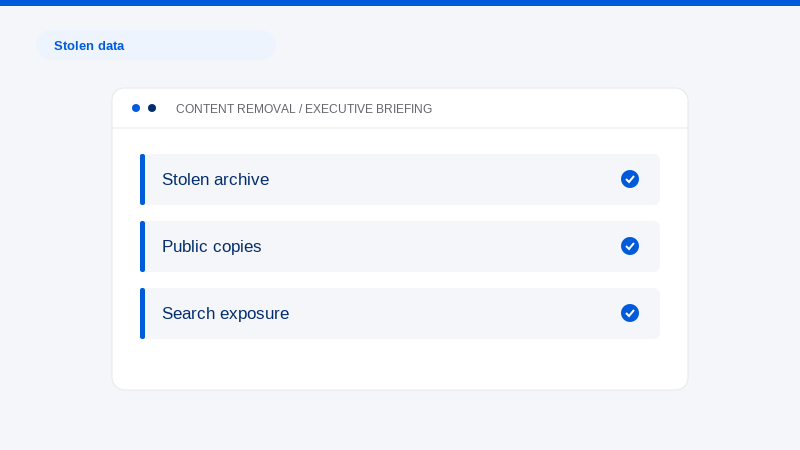
Stolen data can be held privately, offered for sale, published in samples, copied into other collections, or redistributed publicly after a data breach. Its journey is not a single sequence, and removing one published copy does not establish what happened to the others.
For a business leader, this distinction changes the recovery question. Restoring systems addresses the operation of the company. Understanding where stolen information has traveled addresses the continuing exposure of its customers, employees, leadership, and confidential business material.
If company files or sensitive records are already circulating, request a confidential assessment. Content Removal handles leaked content exposure alongside your incident response firm, breach counsel, and insurer. We do not provide incident response, forensics, malware removal, decryption, ransom negotiation, breach notification, or legal advice.
This guide explains the afterlife of stolen data, from the first claim of possession to the copies that can appear long after the original incident.
Where does stolen data go after a breach?
There is no universal destination. Someone who obtains a database, mailbox archive, or folder of internal documents can retain it, share it selectively, advertise it, or publish it. Several of those things can happen at once.
A useful business model separates four states:
| State | What leadership may see | What remains uncertain |
|---|---|---|
| Private possession | A claim, demand, or limited evidence | Who holds the material and whether others received it |
| Advertising or sampling | A listing, screenshots, or selected records | Whether the advertised collection matches the claim |
| Distribution | Public downloads, forwarded files, or shared extracts | How many recipients retained their own copies |
| Republication | New posts, collections, mirrors, or screenshots | Whether the posting reflects new theft or older material |
These states describe information exposure, not technical access. A public file can remain online after the affected systems are secured. Equally, the absence of a public file does not settle what happened inside the environment. That is for the incident response team to investigate.
Leadership should therefore avoid a simple assumption that data moves from theft to sale to deletion. A collection can branch into several distributions, each with a different audience and lifespan.
Why do advertisements and samples matter before full publication?
An advertisement is a claim about possession. A sample is a limited disclosure. Neither should automatically be treated as a complete inventory of stolen material.
A listing may name a company, describe a collection, and display a few records or document images. Those visible items can themselves expose sensitive information, regardless of whether the larger claim is accurate. A screenshot containing a signature, private number, or customer record deserves attention independently of any advertised download.
At the same time, the claim can exceed what the visible material supports. An old document can be presented as current. A folder title can imply more than its contents. A collection can contain information from multiple origins.
The executive consequence is a need for precise language. “A post claims possession of company files” is different from “the entire database has been published.” Counsel and the incident response firm should guide conclusions about authenticity and scope.
Removal work can focus on the visible exposure without presenting the attacker’s description as verified fact. Preserving relevant evidence and reducing publication are compatible objectives when coordinated with the incident team.
How does one stolen collection become many different copies?
Copying does not preserve the original package. A mailbox archive can become selected attachments. A spreadsheet can become images of individual rows. A presentation can appear as cropped slides with identifying context removed.
This matters because a removal inventory organized only around the original filename can understate the problem. The same confidential information may survive in a different format, under a different title, or inside another person’s post.
Three forms of redistribution deserve separate attention:
Direct copies reproduce the original file or collection. They may appear at another download location or as a mirror of an earlier publication.
Extracts reproduce selected material. Examples include screenshots of records, copied email text, or a page from a longer document. An extract can be more accessible than the original archive because readers do not need to download or interpret a large file.
Combined collections mix exposed information with other records. The resulting package may acquire a new name and posting date even though some of its contents are older.
These are possible distribution patterns, not a prediction that every breached organization experiences each one. The practical point is that the unit of harm is not always the original file. It may be the sensitive content reproduced inside a new item.
Why can stolen data appear outside the dark web?
The dark web is not a required first stop, and it is not a boundary around the exposure. Stolen data can appear directly on an ordinary website or move between hidden services, forums, file hosts, social platforms, and messaging channels.
The distinction between these environments matters. Telegram and Discord are not synonymous with the dark web. Neither is every page missing from Google. A private group, an unindexed page, and a hidden service can present different visibility and removal questions.
For leadership, the important change is often audience. A privately circulated archive may require specialist knowledge to find. A screenshot on a public platform can put the same information in front of customers, employees, or someone searching an executive’s name.
Public posts can also point to files hosted elsewhere. Removing the post does not necessarily remove the download, and removing the download does not necessarily remove screenshots already attached to other posts.
Our information on Telegram content removal and Discord content removal covers those platforms as separate exposure locations. Treating them individually helps keep the scope concrete rather than hiding everything under a broad “dark web” label.
Does a new posting mean the company was breached again?
Not necessarily. A newly discovered copy can contain previously stolen data. A new date on a page establishes when that page appeared or changed, not when the underlying information was obtained.
There are several different dates to distinguish: when a record was created, when the incident occurred, when material was first published, and when a particular copy was observed. Collapsing those dates can create a false picture of continuing intrusion.
The opposite mistake is to dismiss everything as old. A mixed collection may contain both familiar and unfamiliar records. A small newly exposed extract can matter even when most of the archive was already known.
Technical conclusions belong with the incident response firm. The removal workstream should describe what is visible, identify its relationship to known material where supported, and keep uncertainty explicit.
This distinction also improves reporting to the board. “Another copy of known material was found” and “newly exposed material requires investigation” call for different decisions.
Which stolen information keeps its value after access is secured?
Some information loses part of its usefulness when access changes. An exposed password should be reset through the security response. But resetting a password does not retract the other contents of a stolen mailbox or database.
Different assets have different persistence:
- Confidential business documents can reveal strategy, negotiations, pricing decisions, or product plans after the relevant account has been secured.
- Customer and employee records can expose personal details independently of whether any company system remains accessible.
- Private correspondence can disclose relationships, decision history, and sensitive context.
- Identity and family information can support unwanted targeting beyond the workplace.
- Source code and technical documents can disclose intellectual property even after exposed access credentials are changed.
The age of a file is not a complete measure of its sensitivity. A draft agreement may no longer describe a live transaction but still contain signatures and personal contact details. An old employee record may still identify someone’s home.
This is why the stolen-data journey is not simply a cybersecurity story. Content can continue causing harm without granting access to a single system. Where personal information becomes a targeting tool, doxxing removal addresses that distinct publication problem.
What changes when a published copy is removed?
Source removal changes the availability of a specific hosted item. It can remove an accessible file, post, or page at the location assessed. That is a meaningful outcome, but it should be described at that level.
Search removal addresses a different layer. A result can stop appearing in an assessed search context while the underlying page remains reachable. Conversely, a source page may disappear while an outdated reference remains visible for a time. Search visibility and hosting status should not be reported as though they are the same thing.
Neither observation establishes that every recipient deleted a downloaded copy. An attacker deleting a listing also does not prove deletion of private holdings. A page becoming unavailable might reflect removal, a temporary outage, or a change in access.
The appropriate question is not whether a single action erased the incident. It is what exposure changed, what evidence supports that conclusion, and what remains unresolved.
A verified reduction in accessible copies can still be valuable. It narrows the material readily available to new audiences without requiring an unsupported claim about every private copy.
What should a useful executive exposure report show?
A useful report separates claims, observations, and confirmed outcomes. It should help a decision maker understand the distribution picture without unnecessarily circulating the stolen material.
The report should make the following distinctions clear:
- Content family: Whether an item is an original file, a direct copy, an extract, or material whose relationship is uncertain.
- Exposure location: Where the relevant page, post, or file was observed, with sensitive details restricted to the appropriate recipients.
- Observed status: Whether the item was accessible when checked, rather than assumed to be permanently available or permanently gone.
- Business consequence: Which people or confidential assets the publication exposes.
- Outcome: Source removal, reduced search visibility, continued exposure, or an assessment still in progress.
- Remaining uncertainty: Unseen recipients, inaccessible locations, incomplete context, or unverified claims.
Raw totals need context. Multiple search references can point to one hosted file. One page can expose many distinct documents. A reduction in the number of visible links does not automatically measure the sensitivity of what remains.
The most useful board question is, “Which meaningful exposures remain accessible, and what has changed since the previous report?” That keeps attention on the content and affected people rather than a reassuring but incomplete count.
How does Content Removal help with the stolen-data afterlife?
Content Removal addresses the published content layer through data breach removal. We assess exposed copies, pursue removal of leaked material, address relevant search visibility, and monitor for republication within the agreed scope.
For confidential files, leaked documents removal focuses on the documents and reproduced extracts. Hidden sources require individual assessment through our dark web takedown service. We do not promise outcomes for a source before assessing it.
Our role runs alongside your incident response firm, breach counsel, and insurer. Ongoing Protection Plans can support monitoring and removal work after the initial exposure has been addressed.
Frequently asked questions
Is all stolen data sold?
No. Material may be retained privately, shared selectively, published without payment, or advertised without a verified sale. A public listing does not establish that anyone purchased the collection or that every advertised file exists.
Can a small sample cause harm without a full data dump?
Yes. A few records or document screenshots can expose private information, confidential negotiations, or identifiable individuals. The visible sample should be assessed for its own consequences rather than treated only as evidence of a larger claim.
Does disappearance from a leak page mean the data was destroyed?
No. It establishes only the observed change at that location. It does not establish what happened to private holdings, downloaded files, or other publications. Any outcome report should preserve that distinction.
Can the same stolen file return under a different name?
Yes. A copy can have a new filename, appear inside a different collection, or survive as an extract. Monitoring scope should account for relevant content variations rather than treating the first filename as the entire exposure.
Does removing stolen data resolve notification obligations?
No removal outcome should be treated as deciding that question. Breach counsel should guide notification duties and related decisions. Content Removal addresses published exposure, not breach notification or legal advice.
Need a confidential assessment of your exposure?
The practical goal is a clearer picture of the copies that matter and a documented reduction in accessible exposure. If stolen business information is circulating, contact Content Removal for an assessment coordinated with the specialists already handling your incident.